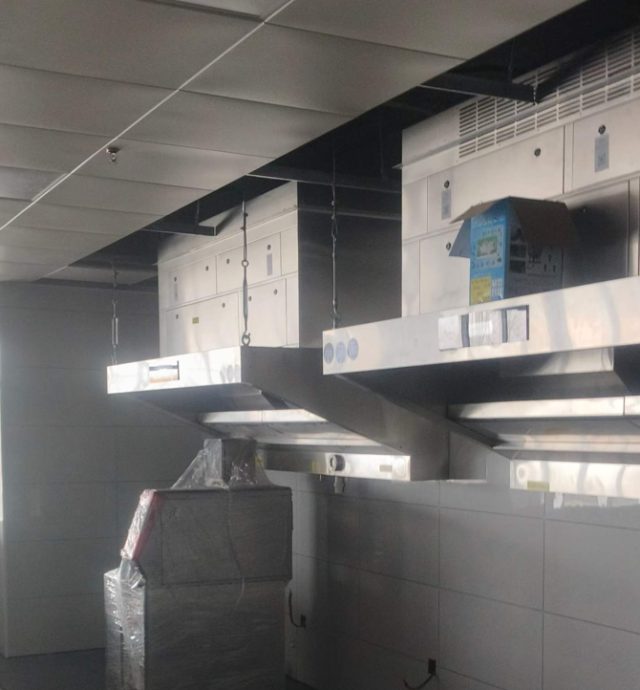
A gostilna is Slovenia’s traditional inn-restaurant, and it is where the country’s food culture actually lives: charcoal-grilled skewers, Carniolan sausage, game stews and wood-fired bread, usually served in a stone building that predates modern building services. Ventilating one is a two-sided engineering problem. On one side sits the SIST EN 16282 commercial-kitchen standard series that Slovenia adopts as national standards; on the other sits the ZVO-2 Environmental Protection Act (Uradni list RS, No. 44/2022, in force since 13 April 2022), under which a neighbor’s odor complaint is not a courtesy issue but a potential excessive-environmental-burden liability. This guide maps both sides, sizes the extraction for charcoal and frying loads, and shows how a ductless route handles the old-town buildings that cannot take a new duct.
What a Gostilna Kitchen Actually Puts Into the Air
The menu physics matter before any regulation does. A typical gostilna line runs an open charcoal grill for raznjiči skewers and grilled meats, a flattop or cast-iron plate for sides, a fryer for croquettes and potatoes, and a bread or dessert oven. Kranjska klobasa, the PGI-protected Carniolan sausage, and game dishes are often finished over open flame or in a wood-fired hearth, and many rural and old-town locations keep the fireplace visible in the dining room because it is part of the brand.
That produces a two-phase pollutant stream. The particulate phase carries grease-laden vapor, sub-micron particulate and carbon soot from the charcoal bed. The gas phase carries the odor compounds, including polycyclic aromatic hydrocarbons (PAHs) that solid-fuel combustion produces in far higher concentration than a gas burner of the same rating. The engineering consequence is fixed: capture and remove the particulate phase first, then polish the gas phase on adsorption media. A unit that only moves air, or only filters grease, leaves the second phase intact, and the second phase is what the neighbors smell.
The Rule Map: Which Documents Actually Bind the Project
Slovenia has no bespoke restaurant-ventilation decree; the binding frame is a stack of adopted European standards, national environmental law, and building fire rules.
SIST EN 16282: the design baseline, with one large hole
The Slovenian Institute for Standardization (SIST) adopts the EN 16282 series as national standards, covering eight parts from air inlets and outlets through ducts, aerosol separators and fixed fire suppression. SIST EN 16282-8:2017 (effective 1 October 2017) is the part that governs installations for the treatment of cooking fumes: it sets technical safety, hygiene and verification requirements for aerosol-treatment hardware, with technology-specific annexes for UV devices, ozone generators, water spray, microbiological treatment and photocatalytic oxidation. The newly revised SIST EN 16282-1:2026 (published 17 August 2026, effective 1 September 2026, replacing the 2017 edition) supplies the airflow calculation method for the rest of the kitchen.
But Part 1 carries an exclusion that decides most gostilna projects: the standard explicitly does not apply to solid fuel appliances, naming charcoal grills as the example. In other words, the European calculation recipe covers everything except the single appliance that defines the menu. A charcoal grill section therefore has to be engineered beyond the standard baseline, on first principles and manufacturer test data, while the treatment hardware attached to it still follows SIST EN 16282-8:2017.
ZVO-2: the odor liability framework
The Environmental Protection Act (Zakon o varstvu okolja, ZVO-2) entered into force on 13 April 2022 in the Official Gazette of the Republic of Slovenia No. 44/2022, replacing the long-amended ZVO-1, and is supported by more than one hundred implementing regulations. The Act embeds the polluter-pays principle and states that the originator of excessive environmental burden is criminally and damages liable, and must eliminate both the source and its consequences. It also anchors a constitutional-level right to a healthy living environment, which is the legal lever behind most restaurant odor complaints. Oversight of air and emissions sits with the Environmental Agency of the Republic of Slovenia (ARSO), while municipal inspectors handle nuisance in practice. For a kitchen operator, the practical reading is simple: odor control is a continuing duty, not a one-off permit box.
Fire rules: assessment, not guesswork
The fire side runs through the Building Act (Gradbeni zakon, Official Gazette No. 102/2004), the technical guideline TSG-1-001:2005 on fire safety of buildings, and the Rules on fire safety of buildings (Pravilnik o požarni varnosti objektov). Buildings are classified through a fire risk assessment (ocena požarne ogroženosti) on a six-level scale, and the result drives organizational measures: fire plans, evacuation plans and the operating fire order (požarni red). A charcoal grill raises the fire load classification of the kitchen, which in turn raises what the extraction system must demonstrate: grease-tight ductwork where ducts exist, protected routes, and treatment stages that do not become fuel.
Why Solid Fuel Changes the Engineering
Gas-fired cooking produces a predictable aerosol plume. Charcoal does not. A charcoal bed emits soot particles that are smaller, stickier and more thermally buoyant than frying aerosol, and it emits them with spark carryover that no gas appliance produces. Three consequences follow for a gostilna extract design.
First, capture. The plume over a charcoal grill rises faster and spreads wider than the EN 16282-1 calculation assumes for standard appliances, so the canopy must either overhang further or run a higher face velocity. Undersized capture shows up immediately as a smoke layer at the pass, not as a slow annual drift.
Second, filtration sequence. Spark and large soot must be stripped before they reach an electrostatic stage, which is why the treatment train starts with a baffle or mesh pre-filter, then the ESP cell, then adsorption. An electrostatic precipitator sized only for frying aerosol will load up on soot within weeks if it receives raw charcoal smoke.
Third, maintenance cadence. Soot-loaded collector plates and ceramic insulators change the electrical profile of an ESP cell long before purification visibly fails. A gostilna that grills daily should treat cell washing as a weekly-scale task, not the monthly-scale routine of a lighter kitchen. Hardware certified under SIST EN 16282-8:2017 supports this with verifiable inspection and measurement procedures, and its operating constraints are concrete: airstream components are designed for sustained temperatures of at least 60 °C, ozone systems must interlock with fan operation and shut down when differential pressure falls below 20 Pa, and oxygen-fed ozone generation is required for total extract flows above 2,500 m³/h to avoid NOx and acid buildup in the airstream.
Sizing the Extraction
The industry sizing arithmetic that sits on top of the EN 16282-1 method translates to gostilna geometry cleanly. Around 4,000 m³/h per burner is the working figure for heavy open-flame appliances, which is exactly how a charcoal grill bed behaves. Hood-length arithmetic gives a cross-check: roughly 2,000 m³/h per metre of canopy, rising to about 2,500 m³/h per metre for open display cooking where the customer can see the fire.
A practical example: a gostilna running a two-burner charcoal grill plus a flat griddle and a single fryer under one canopy maps to a 2.0-2.4 m heavy-duty hood, with a duty in the region of 8,000-10,000 m³/h once the griddle and fryer shares are added. If the kitchen cannot achieve that with a ducted canopy, an all-in-one recirculating unit must be rated at or above the same calculated duty, because recirculation does not reduce the capture load, it only relocates the treatment.
Correction factors matter at the edges. Winter operation in a mountain village pushes kitchens slightly negative, and a negative-pressure kitchen spills odors through doorways into the dining room; make-up air, even a passive transfer grille, is part of the extraction design rather than an accessory.
Old-Town Constraints: The Part No Sizing Table Covers
Most of the demand for gostilna upgrades comes from buildings, not menus. Ljubljana’s old town, the lakeside row at Bled, Piran’s compact coastal core and the older quarters of Maribor share the same fabric: thick stone party walls, protected facades, low ceiling voids and no practical route for a new vertical duct to roof level. Facade protection typically blocks external duct runs, and interior voids are either occupied or historically protected in their own right.
On top of the fabric sit seasonal and neighbor constraints. Tourist-season service peaks in summer exactly when adjacent residential windows are open; courtyards and garden terraces multiply the seating that smells the kitchen; and municipal noise rules limit how hard a discharge fan can run at night. Every one of these pushes toward the same conclusion: the less the solution depends on new ductwork and roof penetrations, the fewer consents the project needs and the faster it lands.
Choosing the Architecture: Ducted, Ductless, or Mobile
The decision fork is the building, not the menu. Where a sound duct run already exists, or the building can take one, the classic route applies: a capture canopy connected to an inline ducted ESP filter range and a centrifugal fan sized to the calculated duty. This is the architecture SIST EN 16282 was written around, and it suits larger gostilnas and hotel restaurants with plant rooms.
Where the building cannot take a duct, a ductless range hood family treats the air at source: capture, electrostatic removal of grease and soot in an ESP cell, then an activated carbon stage for the gas-phase odor compounds, with clean air returned to the kitchen. It is worth being precise about what this does and does not do. Recirculating purification is not a legal exemption from ZVO-2; it is a way of meeting the same technical duty without touching protected fabric. The operator’s liability for excessive burden remains, which is why discharge behavior, maintenance records and a documented commissioning test belong in the project file.
Garden terraces, courtyard service and the summer event circuit need none of the above: a ventless catering cart carries its own capture and purification, moves with the pitch, and keeps the grill at the table without extending the kitchen’s fixed extract at all.
What a Compliant Gostilna Solution Looks Like
Bringing the engineering together: a heavy-fume gostilna kitchen wants a ductless all-in-one hood rated for charcoal-class loads, such as the ND-series, whose ESP cell handles the soot-heavy particulate phase while its carbon stage carries the PAH-rich gas phase. Where odor complaints have already been raised, pairing it with an Odor Removal Tower adds a dedicated adsorption stage sized for the dining-area adjacency problem. Larger properties that retain ductwork step up to the ESP Purifiers line with a matching fan. The selection logic, not the catalogue, is the point: match the calculated duty, sequence the filtration stages, and keep the treatment hardware verifiable under SIST EN 16282-8:2017 so the fire assessment file closes without argument.
Operating Routine That Keeps the File Clean
Compliance in Slovenia is ongoing behavior. A defensible routine keeps four records: ESP cell washing and insulator inspection on a fixed calendar, collector plate condition notes, filter change dates for the pre-filter and carbon stage, and the commissioning measurements taken at handover. The ESP cell, aluminum collector plates, sealing strips and ceramic insulators are consumable wear items under any warranty terms, so a replacement stock is an operating cost, not a defect. When a municipal inspector or a neighbor’s complaint arrives, the difference between a nuisance claim and a documented defense is usually exactly this paper trail.
Slovenia’s gostilna sector is small, proud and conservative, and its buildings are harder than its menus. Treat the charcoal exclusion in EN 16282-1 as the starting point of the design rather than a gap in it, and the same solution set serves the next country on the route.
The Compliance File: What to Have Ready Before Work Starts
Slovenian projects move faster when the paperwork is assembled first. A gostilna ventilation retrofit should open with four documents. The first is the airflow calculation itself, presented with the charcoal line treated as a measured solid-fuel load rather than folded into the EN 16282-1 appliance tables, so the reviewer can see the exclusion was recognized rather than missed. The second is the treatment specification, naming each stage from pre-filter through ESP cell to carbon, with the aerosol-treatment hardware referenced against SIST EN 16282-8:2017 verification procedures. The third is the fire paper: the building’s existing ocena požarne ogroženosti classification, a note on how the grill changes the kitchen’s fire load, and the proposed grease-tight route or recirculating boundary. The fourth is the environmental side: a short ZVO-2 position paper recording the discharge behavior, the odor-control stages, and the maintenance calendar that keeps the operator’s continuing duty defensible.
Suppliers used to Central European heritage work supply most of this as standard deliverables; what a buyer should check is whether the figures are measured for solid-fuel cooking or copied from a gas-fired template. A commissioning test that records face velocity at the canopy edge, cell voltage stability after a full service shift, and carbon-stage dwell time gives the file its closing evidence. Once those three measurements exist on paper, the same document answers the municipal inspector, the fire assessor and the neighbor’s lawyer, which is the cheapest way to keep a small kitchen’s compliance burden small.