Two tenders reach the same desk with the same duty point written on them: 8,000 m³/h at 700 Pa, centrifugal fan, weatherproof housing. One prices a single belt-driven unit. The other prices two smaller fans on a changeover panel. On paper the difference is one line of the bill. In service the difference is what happens at 19:40 on a Friday when a bearing starts to whine, and whether the kitchen trades through the weekend or closes its doors. This is a buyer’s guide to that decision: the arithmetic behind it, the clauses that make it enforceable, and the seven questions that turn two incomparable quotations into one comparable number.
The fan is the only moving part, so it inherits every error upstream
Everything ahead of the fan is passive: hood, aerosol separator, electrostatic cell, carbon bed, duct, cowl, damper. A fault in any of them does not announce itself as a component failure. It surfaces as a fan that cannot hold its duty point, running further out along its curve than the schedule assumed, and an extract that quietly loses containment at the busiest hour of the day. That is why the first step in choosing an arrangement is not choosing a fan. It is writing down the resistance the fan has to beat, component by component, in both the clean state and the loaded state.
For a 2.8 m heavy-duty cookline moving 8,000 m³/h, a realistic loaded-state budget reads: hood and grease filters 40 Pa, electrostatic cell 120 to 180 Pa, activated carbon bed 180 to 250 Pa, twelve metres of straight duct at 1.5 Pa/m gives 18 Pa, three elbows at 20 Pa each give 60 Pa, discharge cowl 40 Pa, balancing damper 30 Pa. That totals roughly 490 to 620 Pa before system effect, and system effect at the inlet and discharge of a real installation adds another 10 to 15 percent. A fan selected at 700 Pa is therefore not an oversized fan. It is a fan selected on the dirty state with a modest margin, which is exactly what the schedule should specify.
Selection rule worth writing into the tender: state the duty point at the loaded-state resistance and require the fan to deliver design flow within plus or minus 10 percent at commissioning. A fan selected on clean-state resistance will be 10 to 20 percent short by the second month, and the installer will blame the ducting.
Where the building can carry a full duct run and the volume is genuinely high, that resistance budget is what the ducted ESP purifier range is engineered around: a cell stage for the particulate, a centrifugal fan sized on the loaded curve, and a discharge that satisfies the fire separation rules. Where the volume is smaller, or the route is impossible, the same arithmetic is what makes a self-contained unit the cheaper answer, because the resistance disappears when the duct does.
Four arrangements, and what each one is really selling
Almost every kitchen extract quotation resolves to one of four arrangements. They differ in first cost by less than most buyers expect, and in failure behaviour by more than almost anyone models.
Single fan, direct drive. Motor shaft coupled straight to the impeller, one starter, one isolator, one penetration. Fewest parts, highest mechanical efficiency, no belts to tension or replace. Its weakness is that every failure mode is a full stop: bearing, winding, capacitor or starter.
Single fan, belt drive. The motor sits outside the hot airstream, which extends motor life in grease-laden duty, and the pulley ratio can be trimmed on site if the measured flow falls short. Belts slip two to five percent, need retensioning, and are the single most common cause of a Sunday call-out. Belt drive is also the arrangement that most often gets quoted with a motor that is oversized to allow for slip, which then runs part-loaded and at poor power factor.
Duty and standby. Two full-duty fans, two curbs, two penetrations, motorised dampers, and a changeover panel that starts the standby machine within seconds of a proven failure. This is the only arrangement that delivers 100 percent of design flow after a failure.
Two fans in parallel. Each machine sized at roughly half the design flow, both running in normal service. Failure leaves a survivor that delivers more than half but less than all of the design flow, which is often enough to keep a hood capturing while a replacement is sourced.
Single fan with variable speed. A frequency inverter on one fan does not add redundancy at all, but it changes the energy and the noise profile of every hour the kitchen is not at full load, and it is the arrangement most often quoted without anyone asking whether the duct velocity can survive the turndown.
The fan laws, and where the part-load claim breaks
Fan behaviour scales predictably: flow varies with speed, pressure with the square of speed, and shaft power with the cube. Take the 8,000 m³/h duty at 700 Pa, which needs about 2.5 kW at the shaft once a greasy fan efficiency of roughly 0.62 is allowed for, and a 3 kW motor. At 60 percent speed the fan delivers 4,800 m³/h at 252 Pa and draws 0.54 kW. At 40 percent speed it delivers 3,200 m³/h at 112 Pa and draws 0.16 kW. Those figures are why variable speed looks so attractive on a spreadsheet: the same duty costs a fifth of the energy at part load.
The claim breaks in two places. The first is containment. Hood capture depends on face velocity across the aperture, and the working band for a heavy frying or chargrill hood is roughly 0.4 to 0.6 m/s, falling to 0.25 to 0.5 m/s for light-duty equipment. A 2.8 m hood by 0.9 m presents about 2.5 m² of aperture, so 8,000 m³/h gives 0.88 m/s, comfortable margin at design. At 60 percent the figure is 0.53 m/s, still inside the band. At 40 percent it is 0.35 m/s, below it: the hood starts spilling at the front edge exactly when the kitchen gets busy again, the cook turns the speed up, and the part-load saving evaporates. For heavy equipment the honest turndown floor is therefore around 55 to 60 percent, not the 30 percent the inverter can physically deliver.
The second place is grease transport. Ducts carrying grease-laden vapour must keep the airstream above roughly 2.5 m/s, the 500 feet per minute floor that fire codes and ductwork standards converge on, or deposits begin to settle on the duct floor. At 8,000 m³/h in a 500 mm duct the velocity is 11.3 m/s; in 560 mm it is 9.0 m/s. Both are generous. Drop to 40 percent flow in the 500 mm duct and velocity falls to 4.5 m/s. Still clearing, but the margin that was protecting a long horizontal run is gone, and the cleaning interval just shortened. A specification that names the duty point but not the minimum velocity at minimum turndown leaves this to chance.
There is a third, quieter trap. A standard totally enclosed motor cooled by its own shaft-mounted fan loses cooling capacity below about 30 percent speed, and grease build-up on a slow-turning impeller is faster per operating hour than on a fast one. Inverter duty motors and a stated cleaning interval are part of the variable-speed package, not optional extras.
What a failure costs, counted in trading hours
Redundancy is usually argued as an insurance premium, which makes it sound optional. It is more useful to argue it as trading hours. A kitchen extract failure is not a comfort problem: without extract there is no capture, and without capture there is smoke in the dining room within minutes, a possible fire alarm activation, and in many jurisdictions a straightforward closure event until the system is proven working again.
The repair clock is what decides the case. A belt can be changed in one to two hours, but only if the correct belt is in the building and somebody can get onto the roof with the right tools. A bearing replacement is a four to eight hour job with a spare on the shelf, and a motor swap is one to three days if the frame size and speed have to be sourced. Add the time to find a contractor willing to attend at night, and a single-fan installation without spares is realistically exposed to one to three lost trading days per failure event.
Standby is cheap when it is designed in and expensive when it is retrofitted. The second curb, the second roof penetration, the changeover panel, the motorised backdraft damper and the interlocked control sequence all cost a fraction of their retrofit price, because a retrofit reopens the roof, re-certifies the penetration and rewires a live plant room. The buyer’s test is simple: multiply your own contribution margin per trading evening by the number of evenings a failure would cost you, and compare that with the incremental price of the second fan. Most operators who run the sum on a Friday-to-Sunday business discover that one lost weekend costs more than the redundancy.
Two fans in parallel are not half each
The parallel arrangement is the one most often mis-sold, because the arithmetic is not the arithmetic people assume. Two identical fans on a common plenum each deliver half the design flow at the design pressure. When one stops, the survivor does not deliver 50 percent of design flow. It runs at the intersection of a single-fan curve with the system curve, which for a typical kitchen extract system lands at 55 to 65 percent. That is a genuinely useful degraded mode: a hood at 60 percent may still capture light and medium loads, and the kitchen can trade in a reduced form while a replacement is organised.
Three details decide whether that degraded mode actually works. First, back-driving: a stopped fan’s impeller will freewheel backwards in the airstream, and without a motorised or non-return damper the running fan simply recirculates through the dead machine. Second, stability: two fans on a shared plenum can hunt or surge as system resistance rises with filter loading, which is why the plenum should be generously sized, each fan should have its own damper, and the control should stage on measured differential pressure rather than on a fixed sequence. Third, noise: two equal sources produce three decibels more than one, and when they sit side by side the low-frequency outputs can add more coherently than the arithmetic suggests, which is how parallel installations acquire a low-frequency complaint at the boundary that neither fan would have caused alone.
What the arrangement does to the rest of the package
A fan arrangement is not a single line item; it is a cascade of consequences that a quote comparison will hide unless the buyer asks. On structure, two fans mean two curbs and two sets of flashing, which distributes weight but doubles the number of waterproofed penetrations and the number of warranty conversations with the roofing contractor. On space, impeller withdrawal needs clearance of at least the impeller diameter plus 300 mm, plus drive-side access on a belt unit; a plant room designed around one machine rarely accommodates two without a layout change.
On electrics, the changeover panel is the item that separates a real standby installation from a decorative one: two starters, lockable local isolators at each fan, a proven-failure signal from each machine, a remote alarm to the building management system, and a weekly automatic test. An untested standby fan is a liability, because belts flat-spot and bearings seize when a machine never runs. On fire strategy, the standby logic must not defeat the shutdown sequence: extract must stop on alarm or on a duct fire, and the changeover must not restart a fan into a fire. That interlock is a commissioning item with a written test record, not a wiring detail left to the panel builder.
Noise is a planning condition before it is a design choice
In most cities the permissible noise at the nearest residential facade is a condition of the planning consent, not a matter of neighbourly tolerance, and typical municipal limits sit in the region of 45 to 55 dB(A) by day and 40 to 45 dB(A) at night. A second fan adds three decibels before any of the geometry is considered, which is precisely the margin many sites do not have. Distance helps at about six decibels per doubling of separation in free field, so moving the plant ten metres further away buys more than upgrading the attenuator, and a parapet or acoustic screen usually beats a larger silencer at low frequency.
The specification error here is universal and easy to avoid: quotations are commonly written as sound pressure at one metre, which cannot be checked against a boundary condition without directivity and distance data. Require sound power level at the duty point, in dB(A) and in octave bands, and require it for the fan alone and for the fan with its attenuator. Two further clauses matter in practice: a tonal penalty, because some authorities add up to five decibels for tonal or impulsive noise and belt whine is exactly that; and a night-time limit that applies when the kitchen is at part load, since a fan slowed to 60 percent is quieter but the kitchen extract rarely shuts down entirely in a city-centre site.
The fan lives in the grease stream
Downstream of a well-maintained filtration train the fan still sees fine aerosol, and downstream of a neglected one it sees far more. Uneven deposit on an impeller is an imbalance, and an imbalance is a bearing failure with a predictable delay. The cleaning thresholds that ductwork standards have converged on are a useful discipline for fan internals as well as ducts: a surface grease film of up to about 200 micrometres is acceptable, above that the component is due for cleaning, and above 500 micrometres it is a stop-and-clean item because the deposit is a fuel load as well as a balance problem.
Access decides whether that discipline survives contact with a real maintenance budget. The fan needs an inspection hatch, a drain at the low point for condensate, and enough room to withdraw the impeller without dismantling the duct. Belt guards must come off without removing the casing. Where the kitchen runs a heavy frying programme, quarterly impeller inspection is realistic; light-duty operations can stretch to annual, with a monthly vibration reading if the extract is business-critical. This is where redundancy pays a second time, in a way that never appears in a quote comparison: with two fans, one can be taken offline for cleaning during trading hours, so cleaning happens on schedule instead of being postponed until the next quiet Monday.
Eleven clauses that make the arrangement enforceable
- Duty point with reference conditions. Flow, static pressure, gas temperature, density and altitude. A duty point quoted without density is not a duty point.
- Commissioning tolerance. Design flow within plus or minus 10 percent, pressure within plus or minus 5 percent, measured by pitot traverse and reported as a written record.
- Standby requirement in words, not symbols. “100 percent standby, automatic changeover within 15 seconds of proven failure, with remote alarm” is enforceable; a note reading “standby” is not.
- Minimum duct velocity at minimum turndown. State the figure, typically 2.5 m/s, and state the minimum speed the control is permitted to command.
- Control philosophy and sensor ownership. Pressure-based or temperature-based, who supplies the sensor, where it is tapped, and how the setpoint is adjusted.
- Sound power level at the duty point in dB(A) and octave bands for fan and attenuator, plus the boundary limit the design must meet.
- Motor specification. Efficiency class IE3 or better, IP55, insulation class F, inverter duty where a drive is fitted, and a winding suitable for the humidity of the location.
- Impeller specification. Backward-curved centrifugal, grease-resistant finish, dynamically balanced to a stated grade, and a stated maximum imbalance for site rebalancing.
- Casing and drainage. Sheet thickness, inspection door size, drain position, and condensate handling.
- Accessories as separate line items. Flexible connectors, vibration isolators, backdraft dampers, weatherproof cowl, curb and flashing, attenuator, drive, starter panel, spare impeller, spare belts.
- Proof of performance. Either a witnessed factory test or a certified curve to a recognised fan test standard, with the test standard named in the submittal.
Turning two quotes into one comparable number
The reason a single-fan quote and a standby quote cannot be compared as they arrive is that they are priced at different boundaries. Seven questions close most of the gap. Is the fan priced as a bare machine or as a mounted assembly on its curb? Are starters, isolators and any drive inside the price? Is the attenuator included, and at what insertion loss? Is the weatherproof cowl and the roof flashing inside or excluded? Are vibration isolators and flexible connectors included? Is commissioning, with a written record, part of the scope? And is a spare impeller or belt set supplied, because that item alone decides whether a failure costs two hours or two days?
Once those answers are in, convert both quotations to one figure: price per complete installed duty point, including everything the fan needs to work and to be maintained. The comparison usually moves by 20 to 35 percent in one direction or the other, and more often than not the cheaper headline number stops being the cheaper installation.
The decision matrix
| Arrangement | First cost | After a failure | Part-load energy | Best fit |
|---|---|---|---|---|
| Single, direct drive | Lowest | Full stop | Poor unless driven | Short trading week, light load, spare motor held |
| Single, belt drive | Low | Full stop, belt most likely | Poor | Hot airstream, flow trimmed on site |
| Duty and standby | Highest | 100 percent flow restored | Good if staged | Long hours, high revenue per cover, closure risk |
| Two in parallel | Mid to high | 55 to 65 percent flow | Good, stages naturally | Load varies across the day, phased budget |
| Single with variable speed | Low to mid | Full stop | Best within turndown floor | Predictable part-load profile, light to medium fume |
Read the matrix by asking which row describes the cost of a lost evening in your business, not which row has the smallest number in the first column. A kitchen turning covers for four hours a day can defend a single fan with a spare motor on the shelf. A kitchen trading fourteen hours a day, seven days a week, in a building with no plant space to spare, cannot.
When the fan question disappears entirely
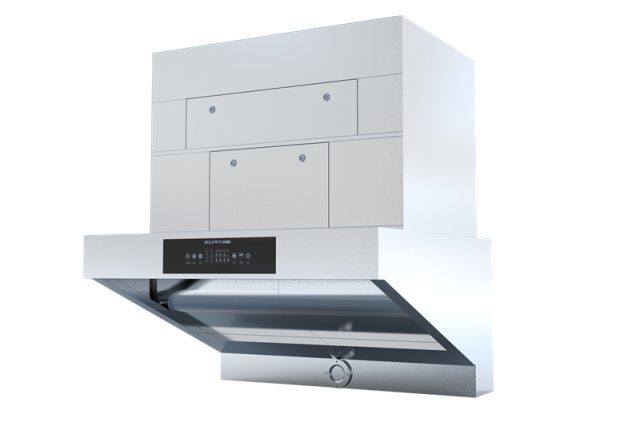
There is a fifth answer that the matrix does not contain, and it is the right one more often than buyers expect. If the constraint is a roof that cannot be penetrated, a landlord who will not grant a second penetration, a heritage facade, or simply no plant space, then the decision is not which fan to buy but whether the system needs a roof-mounted fan at all. A ductless range hood with a multi-stage electrostatic cell and a carbon odour stage carries its fan inside the unit, at the hood. The roof penetration, the curb, the flashing, the changeover panel and the standby argument all disappear with the ductwork, and the resilience question becomes a question about how many units and how much cookline each one covers rather than which machine backs up which.
That trade has a boundary worth stating honestly. A self-contained unit is a capture-and-treat device at the hood, so its capacity is finite and its carbon stage is a consumable with a replacement interval you should calculate before you buy, not after. Above a certain cookline load, or where a long duct run already exists and the building can take it, a ducted system with a properly sized centrifugal fan and a genuine standby remains the better engineering. And for operations with no fixed cookline at all, mobile catering carts put the fan, the cell and the carbon in the same footprint as the cooking, which is a different answer to the same question about what happens when the machine stops.
For the heavy-fume end of the ductless route the ND-series pairs a high-capacity cell with the Odor Removal Tower as a separate odour stage; the lighter end of the menu is served by the N-series, where the same cabinet does less work at lower volume. Souniny builds both around the same three-stage logic, which is why the sizing conversation starts with the cookline and the menu rather than with the model code.
The engineering conclusion is unglamorous. Write the loaded-state duty point, the minimum velocity at minimum turndown, the changeover time, the sound power level and the spares list into the specification before the first quote is requested. Then compare quotations on the installed duty point and on the cost of the evening the fan stops, not on the price of the machine. The buyer who does that usually ends up with a smaller fan than the first quote proposed, a larger spare-parts box than the second, and no argument at all about who is responsible when the extract falls short in month three.