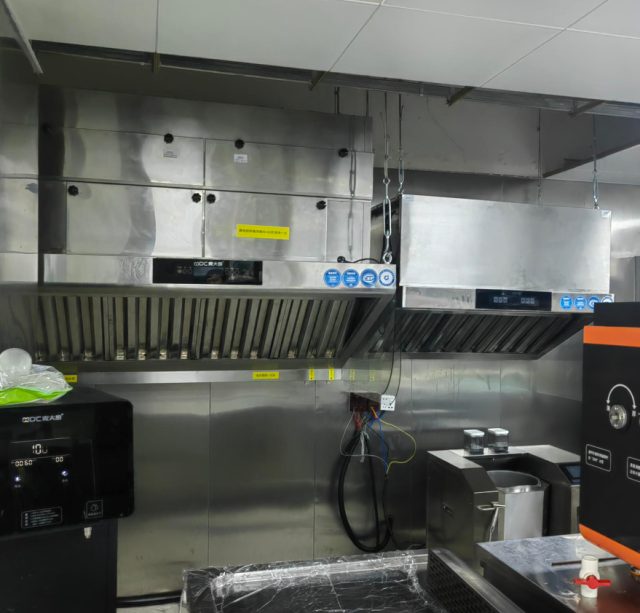
Almost every ventless hood explainer quietly assumes an electric cookline, and most real kitchens are not that. Gas burners, LPG rings and charcoal grills still carry the menu in a large share of the sites we see, especially across Southeast Asia and in the grill-heavy markets of Southern Europe. Putting combustion under a hood that returns its air to the room is not impossible; it is a different engineering problem, with three named hazards: carbon monoxide, water vapour and the loss of safety interlocks. This article sets out what changes, what numbers govern it, and which configurations should simply not be sold as recirculating at all.
What Combustion Adds to the Room Air
An electric hob puts heat into the kitchen and nothing else. A gas burner puts heat into the kitchen, combustion products into the room, and water vapour into the air stream, every minute it runs. The products are carbon dioxide in volume, carbon monoxide in trace amounts when the flame is properly adjusted and in larger amounts when it is not, oxides of nitrogen at the flame front, and water. Natural gas releases roughly 1.6 kilograms of water vapour for every cubic metre burned, and an open ring at typical commercial output consumes in the region of 0.25 cubic metres per hour per burner, so a six-burner line puts around two and a half kilograms of water into the kitchen air every hour before a single pot steams.
A ducted hood sends that load outside. A recirculating hood returns it, which means the room ventilation, not the hood, becomes the machine that keeps the kitchen breathable. Workplace exposure limits frame the design: carbon monoxide is commonly regulated around a time-weighted average in the low tens of parts per million across an eight-hour shift, with short-term ceilings well below a hundred. Those numbers are comfortably achievable in a kitchen that ventilates deliberately, and comfortably breached in a sealed room where nobody measured. The honest engineering position is that gas under a recirculating hood is acceptable only where the room air change path is designed and proven, not assumed.
The Moisture Problem Is Underrated
Carbon monoxide gets the headlines, but condensation is what actually fails installations. Two and a half kilograms of water per hour from the burners, plus cooking steam on top, has to leave the room or land on something cold. In a ducted kitchen the extract carries it away; in a recirculating kitchen the water either leaves through general ventilation or condenses on the first cold surface, which in an air-conditioned building is usually the diffuser above the cookline or the duct of the air-conditioning itself. Condensation dripping onto a griddle is a hygiene failure; condensation inside a ceiling void is a building defect. The design answer is a stated air change path: capture at the hood, dilution through the room, removal through the building’s general exhaust or a dedicated relief route, with the humidity load calculated rather than waved at. Kitchens that run gas under recirculation successfully are the ones with an open facade, a mechanical fresh-air route, or a steam-dominant hood stage sized for the moisture, not the smoke.
Sizing the Room Ventilation Path: A Worked Example
Take a six-burner natural-gas line at roughly 0.25 cubic metres of gas per burner per hour, so about 1.5 cubic metres per hour of fuel. Combustion itself needs in the order of ten cubic metres of air per cubic metre of gas, which is around fifteen cubic metres per hour of combustion air, a trivial figure that any open kitchen door exceeds. That number is not the problem, and buyers who size the ventilation on it undershoot by an order of magnitude. The real loads are dilution and heat. The burners put roughly 1.5 cubic metres per hour of combustion products, several kilograms of water vapour and the majority of their input rating as heat into the room, so the ventilation path has to move enough air to hold carbon monoxide far below the workplace limit, hold the dew-point below the coldest surface, and remove the heat the hood recirculates back.
In practice that lands at six to ten air changes per hour for the kitchen volume on gas duty, provided through a real path: mechanical supply or a designed open route in, capture at the hood, and a relief or extraction route out of the room. Two rules keep the design honest. First, general ventilation is not make-up air: an open path that nobody has measured is a hope, so the path is drawn, its openings sized and its direction checked with a smoke pencil during commissioning. Second, the path is verified with instruments, not noses: a hygrometer at the coldest surface and a carbon monoxide meter at working height across an hour of service tell the truth about whether two and a half kilograms of water per hour and the combustion products are actually leaving the room. Where the building is sealed and air-conditioned, the honest engineering answer is often that this kitchen should not run gas under recirculation at all, and the cookline should be electric, because no hood specification can substitute for a ventilation route the building does not have.
Airflow Proving: The Interlock That Cannot Be Optional
Under a ducted hood, a failed fan degrades comfort. Under a recirculating hood over combustion, a failed fan poisons the room slowly. That difference is why airflow proving is not an accessory in this configuration. The hood must verify that air is actually moving, by a pressure switch across the fan or by sensing the motor, and the cooking circuit must depend on that proof: no proven airflow, no enabled burner circuit, and an alarm that staff can hear. The same logic extends to the electrostatic power supply, which should interlock with access doors and discharge its high voltage when the cell drawer opens.
The fire-suppression link belongs in the same chain. Where a wet-chemical system protects the line, its detection and the gas solenoid must be wired so that a discharge closes the fuel and stops the electrical cooking circuit, including a shunt trip where the local code expects one. Under a ducted hood a suppressed fire vents through the duct; under a recirculating hood the suppression system is the only thing standing between the plenum fire and the room, so the interlock test belongs in the commissioning record and in the annual service, witnessed, not assumed.
Charcoal Is a Different Conversation From Gas
LPG and natural gas burn clean enough that the combustion question is about CO, water and interlocks. Charcoal adds three things a recirculating system handles badly unless it is designed for them. First, embers: a hood drawing air across a charcoal bed will occasionally lift sparks into the filter stages, and a cellulose or thin metallic pre-filter is not a spark arrestor; a proper inertial or wet first stage is. Second, pyrolysis gases: charcoal smokes before it glows and after it is doused, and that smoke carries heavier tars and finer aerosol than fryer oil mist, which loads an electrostatic cell much faster and can blind a carbon bed in days rather than months. Third, carbon monoxide from the fuel itself, which continues while the bed is banked and covered even with no cooking underway.
This is why the configuration table has a hard line in it. Electric duty under a recirculating hood is a mature, well-documented application. Gas duty is acceptable with designed room ventilation and full interlocks. Charcoal indoors under a recirculating hood is only credible with a wet or inertial spark-arresting first stage, an electrostatic stage sized for heavy loading, an oversized and monitored carbon bed, and room ventilation that addresses the banked-bed CO. Anything less is not a product; it is a liability with a stainless finish.
A Configuration Table That Survives an Engineer’s Review
Electric fryers, griddles and hotplates. Baffle first stage, electrostatic cell, carbon last. No combustion load. This is the standard ductless range hood application and the one all the sizing literature assumes. Carbon contact time in the 0.2 to 0.6 second band according to the menu, cell cleaning on a documented cycle.
Gas burners under recirculation. The same filtration train, plus three non-filtration items: designed room ventilation with a stated air-change path, combustion-air route for the burners, and the full interlock chain of airflow proving, suppression linkage and gas solenoid. The hood treats the cooking aerosol; the room treats the combustion.
Gas with a real duct available. If a duct exists, combustion products belong in it. The recirculating conversation should end there, because a hybrid arrangement, where the hood extracts combustion air to the outside while the electrostatic and carbon stages handle a separate recirculating stream, adds cost and failure modes for little gain. The exception is the retrofit where the duct exists but the discharge point is illegal or impossible, which is a design question with its own arithmetic; in that case a purpose-built ducted ESP filter ahead of the extract fan keeps the combustion load outside while the cleaning stages stay inside the plant room.
Charcoal or wood outdoors. Where the charcoal duty is genuinely outdoors or semi-outdoors, street grills and night-market positions among them, the mobile catering carts with water-cycle first-stage filtration were designed for exactly that combination of embers, tar-laden smoke and no duct, and they sidestep the indoor combustion question altogether.
Charcoal or wood indoors. Wet or inertial spark arrest first, electrostatic second sized for heavy loading, carbon sized generously and monitored, banked-bed CO addressed by ventilation, and a commissioning record that measures carbon monoxide at grid points across an actual service. Where any of these cannot be provided, the answer is a ducted route or an outdoor position, not a smaller hood.
Commissioning and the Numbers to Record
A gas-under-recirculation installation is commissioned, not just installed, and the record should contain four measurements. Airflow at the hood, verified against the rated figure within the usual tolerance of ten per cent, with the fan proved and the interlock sequence demonstrated live. Carbon monoxide at working height across the cookline after an hour of service, against the workplace limit the local rules apply. Relative humidity or dew-point observation at the coldest surface, to confirm the moisture path is working. And the suppression discharge test, witnessed, with the gas valve and shunt trip shown to close. Four numbers on a commissioning sheet are what separate an engineered installation from a hope, and they are the same four an inspector or an underwriter will ask for a year later.
The commissioning sheet is also the cheapest warranty document a buyer can own. When a dispute arrives about smell, heat or headaches, the baseline recorded on day one is the only reference that distinguishes a design problem from an operating one.
Four Failure Patterns We Keep Seeing
The sealed room: a gas cookline under a recirculating hood in a windowless box with no mechanical ventilation, where the CO readings climb across a shift and the staff complaints are treated as fatigue. The invisible interlock: a hood sold with an airflow switch that was never wired, discovered only when the fan tripped and the burners kept running. The charcoal shortcut: a fryer-spec hood over a charcoal grill, with the carbon bed saturated in a fortnight and the cell washed on a monthly schedule written for light duty. And the condensation drip: a sealed building where the moisture path was never designed, so the first cold surface above the line drips into the fryer station every morning. All four are specification failures, not product failures, and all four are catchable on paper before the order.
How This Changes What You Buy
The fuel decision belongs at the front of the equipment conversation, because it decides the architecture. On an electric line, a ductless hood with a multi-stage train is the clean answer: the N-series carries the light fry-and-griddle duty and the ND-series the heavier wok-and-fryer loads, with an Odor Removal Tower extending the gas-phase stage where the kitchen shares air with a dining room or a neighbour. Where the line burns gas, the same appliances work, but the order should include the ventilation design and the interlock chain as deliverables, not assumptions, and the buyer should ask to see the airflow-proving and suppression tests in the commissioning record before the balance payment. Where charcoal is the duty, insist on the spark-arresting first stage and the monitored carbon bed, or take the ducted route with a purpose-built electrostatic unit ahead of the extract fan. Every one of those conditions is checkable from a datasheet and a drawing, which is exactly how a fuel-driven regret becomes a specification footnote instead of a rebuild.