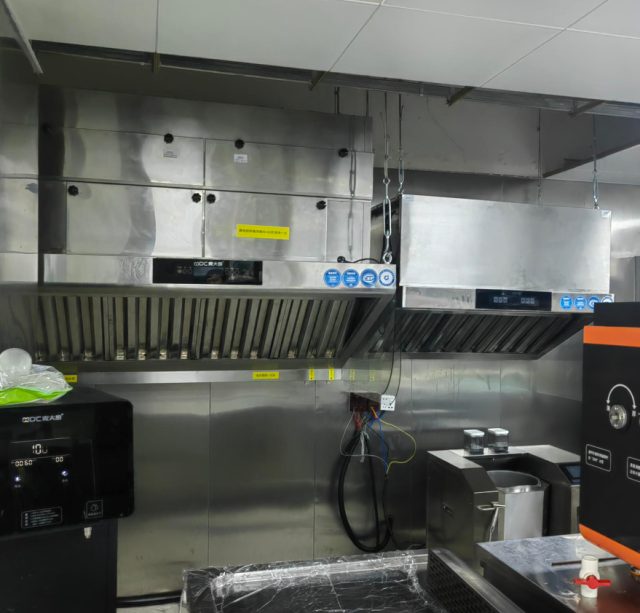
The acceptance meeting has been running for forty minutes. The pitot reading is 18 percent under design, the installer blames the make-up air, the client blames the duct run, and nobody at the table has a calibration certificate for the instrument being used. The dispute cannot be settled, because no independent party was ever appointed to settle it. Kitchen exhaust arguments rarely start as technical problems. They start as a gap in the appointment: no named person was given the instruments, the method and the authority to decide. That gap can be closed in four pages of contract text, and it is one of the highest-return purchases in a kitchen project.
The Clause That Leaves the Question Open
Most ventilation subcontracts contain a phrase close to “commission and demonstrate to the satisfaction of the employer”. The word that matters is satisfaction. It is undefined, it is subjective, and in practice it is exercised by whoever is standing nearest at handover, usually the installer’s own commissioning engineer. That engineer is not dishonest. He is simply answering a different question: did the system he built perform as he expected it to? The buyer needs a different answer: does the system meet the numbers that were specified, on the day it was tested, with instruments that can be traced?
The distinction has a commercial consequence. An airflow shortfall of 15 to 20 percent is common on first start-up and rarely the result of one mistake. It is usually three small things compounding: a duct run with two more elbows than drawn, a fan selected on clean filters rather than loaded ones, and a make-up air path that was value-engineered out in month four. None of those is visible from a summary sheet, and all of them are visible in raw traverse data. Only a witness with standing can insist on the raw data.
Three Appointment Models and What Each Can Actually Decide
There are only three realistic ways to put a signature on a kitchen exhaust acceptance test, and they carry very different authority. Choosing the wrong one is how projects end up with a signed sheet that nobody will rely on later.
Model one: the client’s own representative
A project manager, facilities engineer or consulting M&E engineer attends and signs. This costs almost nothing and works well where the person genuinely understands airflow measurement. It fails in two predictable ways. First, if the same consultant specified the system, he is reviewing his own design assumptions, and few people fail their own pressure budget in public. Second, the instruments are usually borrowed. A handheld vane anemometer held at the grille face is not a traverse and cannot be defended later in a defects discussion.
Model two: a specialist independent commissioning agent
An agent is appointed directly by the employer, has no design, installation or supply role on the project, brings own calibrated instruments, and issues a report that the contract makes binding on payment. This is the only model that produces a defensible number when the parties disagree. The cost is a small fraction of the ventilation package and is usually recovered the first time a retest is avoided, or the first time a retest is correctly charged to the party that caused it.
Model three: the authority or insurer witness
Fire authority officers, underwriters’ engineers and landlords’ surveyors all attend kitchen handovers, and their signature matters enormously, but it certifies compliance rather than performance. They confirm that the duct is welded and accessible, that clearances are kept, that the suppression system is certified and that the cleaning regime is documented. They will not normally measure a traverse, and they will not tell you whether the hood captures at 0.35 m/s instead of 0.45 m/s. Treat them as a separate gate, not a substitute.
The practical answer for most projects is a hybrid: a specialist agent appointed for the measured performance test, and the authority or insurer witness handled as its own compliance gate with its own document set. Budget both. They answer different questions and neither one covers the other.
What the Witness Must Be Given Authority Over
Appointing an agent without authority produces a report that gets filed. Four powers are worth writing into the appointment, because each converts an opinion into a consequence.
The payment gate. State that the relevant milestone is not payable until the agent’s report is issued and the exceptions list is closed or formally accepted. A witnessed test that does not touch money is a courtesy visit.
The exceptions list. The agent must be able to record an item as an exception with a measured value attached, and the contractor must respond within a stated window, typically five working days, with either a remedy or a reasoned technical objection. Silence should mean the exception stands.
The retest cost shift. If a witnessed test fails a tolerance, the retest is at the contractor’s cost, including the agent’s fee and any out-of-hours attendance. If it fails because the client changed the menu, the cookline or the building, the client pays. Written in advance, this clause removes most arguments about who caused a shortfall.
The deemed-acceptance warning. Any witness point covered without the agreed notice is recorded as unverified and cannot be claimed as accepted. This single sentence is what makes contractors respect the notice period instead of testing on a Friday afternoon when nobody is available.
Scope of Appointment: Ten Items to Put in Writing
The appointment document does not need to be long, but it needs to be specific. These ten items are the difference between a witness and a spectator.
1. Design and pressure-budget review before first fix. Two to three days of desk review while the duct is still being installed, checking the pressure budget line by line, the fan curve against the loaded resistance, and the make-up air path. Findings at this stage are cheap; findings at handover are variations.
2. A witness point schedule agreed against the programme. Fixed dates for pre-functional checks, first start, traverse and post-occupancy review, issued at least ten working days ahead.
3. Pre-functional sign-off before energisation. Duct sealing class achieved, access panels fitted at the specified spacing, fire stopping complete, flexible connections and isolators in place, suppression interface wired and proven, high-voltage sections earthed and interlocked. Measuring airflow through a leaking duct is measuring the wrong thing.
4. An instrument schedule with certificates. Model, serial number and calibration date for every instrument, certificates traceable and dated within the previous twelve months. Serial numbers should appear on the test sheets, so a later reader can tell which device produced which number.
5. A stated method and a stated edition of the standard. Which traverse standard, how many points, where the measurement plane sits, how readings are corrected for temperature and duct pressure. Ambiguity here is where disputes are manufactured.
6. Pass and fail definitions written before the test. Typically plus or minus 10 percent on airflow and plus or minus 5 percent on fan static pressure, plus separate criteria for capture velocity, room pressure and noise. Agree the tolerances while everyone is still friendly.
7. A sampling rule. One hundred percent of fans, every hood on a heavy-fume cookline, and a defined minimum on long duct runs. Sampling by exception is how a failed branch disappears from a report.
8. An exceptions log with response times. Each item carries a measured value, a required value, a proposed remedy and a due date.
9. A report within ten working days. Raw sheets, not only a summary; instrument data; a photographic log; and a plain statement of which criteria passed and which did not.
10. A post-occupancy review. Four to eight weeks after opening, and again after the first deep clean of the duct and cells. Loaded-condition performance is the number that governs the next five years, and it is routinely 10 to 20 percent below the clean-filter figure recorded on handover day.
The Numbers a Witness Should Refuse to Sign Without
Specificity is what separates a witnessed test from a walk-through. The following values are the working core of a defensible kitchen exhaust acceptance, and each one has a reason behind it.
Start with the design case, because the witness is testing against it. A 3.0 m heavy-fume hood at 2,500 m3/h per metre needs 7,500 m3/h, which is 2.08 m3/s. Through a 560 mm duct that is about 8.5 m/s, comfortably above the grease transport threshold. The pressure budget might read 40 Pa entry, 30 Pa filter, 60 Pa hood plenum, 120 Pa duct friction, 180 Pa fittings, 40 Pa terminal and 60 Pa fan discharge allowance: 530 Pa, plus 15 percent for system effect, so 610 Pa, and the fan is selected at 700 Pa. Shaft power at 2.08 m3/s and 700 Pa with a wire-to-air factor of 0.62 is about 2.35 kW, so the motor is 3 kW. Those are the numbers the witness carries onto site.
Now the measurement plane. A pitot traverse needs a straight length, ideally six diameters upstream and three downstream, with four and two as an absolute minimum before the result is qualified as indicative rather than definitive. Twelve to twenty points on a log-linear grid, not five points on a whim. Airflow should be corrected to standard density, because a hot summer afternoon in a plant room can shift a raw reading by several percent.
Capture velocity is the second core number. Light-fume cooklines are usually specified at 0.25 to 0.5 m/s at the hood face; heavy-fume lines at 0.4 to 0.6 m/s. Measure on a nine-point grid across the face, with the appliances running at production load, not at idle. A hood that reads 0.45 m/s over an empty pan will read 0.3 m/s over three burners at full gas, and the second number is the one that decides whether the dining room smells of frying.
Room pressure is the third. A kitchen should sit slightly negative to the dining area, commonly 5 to 10 Pa, and this is measured with doors in their normal operating position. A kitchen at minus 25 Pa is pulling its own grease through every gap in the building, and no amount of hood performance will fix the resulting smell complaints.
Then the equipment-specific readings. For electrostatic stages, cell current against the factory reference, per cell, recorded at the same operating point; a 10 to 15 percent drift on one cell points to arcing, a wet insulator or a failing power pack long before it becomes a visible smoke problem. For carbon stages, contact time between 0.2 and 0.6 seconds, verified by measuring face velocity through the bed and the bed depth rather than by reading the label. For filter stages, the differential pressure at clean condition, because that is the number all future maintenance decisions will be measured against.
Finally duct leakage and noise. Leakage should be tested to the class named in the specification before the ceiling closes, since afterwards the only available test is a smoke pencil and an argument. Noise should be measured with a background reading and corrected properly; where the measured level is within 3 dB of background, the measurement is invalid and needs a different time or a different method, and tonal content may attract a penalty in the assessment framework used locally.
Buying the Service: Fee Structures and Who Pays for Failure
Independent commissioning is bought in one of three ways, and the structure matters more than the headline number.
A day rate plus expenses is the most transparent and the easiest to scope: a defined number of attendance days, a defined number of report days, travel and out-of-hours at cost. It suits single-site projects and it keeps the agent indifferent to the outcome, which is the whole point.
A lump sum per witnessed system is easier to budget and is common on multi-site rollouts, but check what “per system” means. One hood and one fan is not the same scope as four hoods, two fans and a carbon stage, and lump sums tend to be written for the cheapest case.
A percentage of the ventilation package value is offered by some agents and is worth resisting. It scales the fee with the equipment value rather than with the work, and on a small high-specification kitchen it can exceed a day-rate appointment several times over.
Whatever the structure, three commercial terms belong in the appointment. The retest is chargeable to the party that caused the failure, with the fee stated in advance rather than negotiated afterwards. The agent’s fee must not depend on a pass, because an agent whose next appointment depends on a clean report is not independent. And professional indemnity cover should be evidenced, not assumed, since a report that is later shown to be wrong is exactly the document that gets relied upon in a defects claim.
Six Conflict-of-Interest Tests
Independence is a structural property, not a personality trait. Six questions will expose most problems before appointment.
Does the agent also design kitchen ventilation? A designer reviewing a system he designed is performing a review, useful but not independent. Does the agent install or maintain ductwork? Then a failed airflow reading is a sales opportunity. Does the agent sell or specify equipment, or hold a retainer from a distributor? In a supplier-dense market, the commissioning engineer who arrives with a preferred brand on his laptop is not neutral. Has the agent commissioned other packages for the same main contractor on the same site? That relationship is worth disclosing. Is the fee linked to the outcome, to the programme, or to a bonus for timely handover? Any of those dilute the report. And finally, will the named engineer actually attend, or will a pool engineer be sent on the day? The name on the appointment should be the name on the sheet.
Eight Clauses That Make the Appointment Enforceable
Each clause below exists to close one specific loophole. They are short enough to negotiate in a single sitting.
Appointment and authority – names the agent, states the scope, and confirms the report is binding for the payment milestone. Access and notice – five working days for a witness point, immediate access on the day, and a named site contact. Deemed unverified – witness points covered without notice are not accepted. Retest cost shift – failed tolerance, contractor pays the retest and the fee. Instrument calibration – certificates produced before the test, serial numbers recorded. Reporting – ten working days, raw data included, distribution list fixed. Data ownership and confidentiality – the client owns the report and the raw data. Liability cap and termination – a sensible cap tied to the fee, and termination for cause including loss of independence.
When There Is No Independent Agent: A Fallback That Still Works
Some projects cannot justify a specialist appointment. A takeaway counter, a single-hood kitchen or a mobile operation still needs evidence, and four measures produce most of the value of a formal witness.
Buy or hire one calibrated instrument and keep the certificate. A pitot-static set with a certified manometer costs less than a day of dispute. Record the serial number on every sheet. Second, demand raw readings rather than a summary: the individual traverse points, not the average. Averages hide distribution problems, and distribution problems are what smell. Third, have the factory test witnessed remotely before shipment. A live video call with the pitot read aloud, calibration certificates photographed in advance and the recording retained gives a credible pre-shipment baseline, though it cannot verify installation quality on site. Fourth, retain the commissioned values in an equipment register and re-measure at the first deep clean. The comparison between day-one and month-six is the only honest statement about how the system is actually performing.
How the Architecture Changes the Witness Scope
The appointment should match the system being tested, and the three common architectures need quite different attention.
A fully ducted installation is the widest scope: traverse planes, duct leakage, transport velocity, fan curve verification, terminal discharge, and the suppression interface. It also carries the most value at stake, which is why ducted projects justify a specialist agent most clearly. Where the building can support a full duct run and the volumes are high, the ducted ESP purifier range is the technology that line of testing is written around.
A recirculating or ductless installation removes the traverse entirely, and with it the easiest measurement in the job. The witness scope shifts to capture velocity at the hood face, differential pressure across each filtration stage, cell current, room pressure balance and odour at the discharge. That is more subjective than a duct traverse and therefore needs stricter record-keeping, not looser. A hood family designed with accessible instrumentation points makes this practical rather than theoretical, which is why the ductless range hood line is specified with service access to the pressure taps and the high-voltage section.
A split cabinet arrangement sits between the two: a short duct, a floor-standing cabinet, and a canopy with no vertical component above it. The interesting failure here is not airflow but recirculation, so the witness should verify the separation between extract and return, the short-circuit path around the canopy, and the pressure drop across each stage in the cabinet. For street food, market stalls and front-of-house live cooking, where there is no fixed cookline at all, the mobile food cart range moves the question again: the test becomes capture at the unit, electrical protection and a documented cleaning routine, because there is no building system to commission.
Designing for Measurability
The cheapest witness is a system that was designed to be measured. Three decisions in the specification do most of that work, and they cost nothing at tender stage.
First, write the acceptance criteria into the tender rather than the handover meeting. Airflow tolerance, pressure tolerance, capture velocity, the measurement plane, the standard edition and the instrument calibration requirement all belong in the documents that bidders price. A contractor who knows on bid day that a traverse will be taken at a named plane will draw the duct with that plane in it.
Second, prefer equipment that reports its own condition. A ductless hood with pressure taps on each stage and telemetry on the cell supply turns a dispute about a spot reading into a trend line that both parties can read. For heavy-fume lines the combination of an ND-series recirculating hood with a carbon odour stage, or the lighter N-series where the menu allows, gives the witness four numbers to trend instead of one number to argue about, and the odour stage is where most recirculating disputes end up. Ducted projects get the same benefit from a purifier that logs cell current per cell rather than a single alarm contact.
Third, keep the geometry standard. Standard duct diameters, standard hood widths and a straight length reserved for measurement cost nothing to draw and everything to retrofit. Where the layout genuinely cannot provide a plane, say so in the specification and agree an indicative method with a stated uncertainty, rather than discovering it on the day with a van outside.
None of this replaces the witness. It makes the witness cheap, quick and hard to argue with. The point of the appointment is not to add a signature to a handover pack; it is to convert a shouting match into a number that both parties had already agreed to accept.
Related solutions: if you are working through a similar decision, the Solutions index collects every note by venue, cuisine, market regulation and project stage.