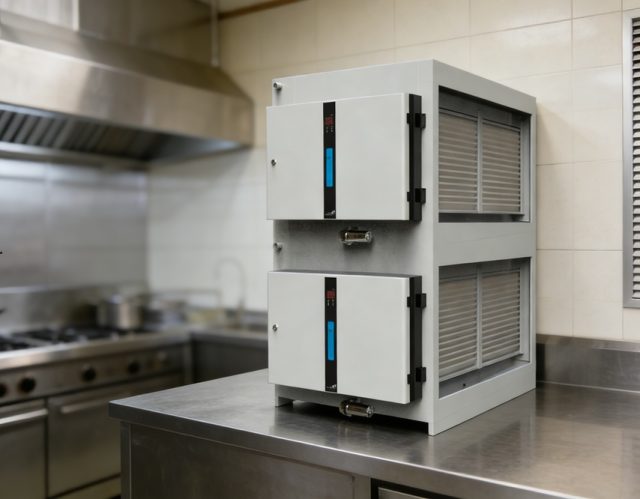
Wok cooking — the foundation of Chinese, Thai, Malaysian, Singaporean, and many other Asian cuisines — generates cooking emissions fundamentally different from Western cooking methods. Understanding the physics of wok smoke is essential to designing effective purification systems.
Why Wok Smoke Is Different
Particle size: High-temperature oil aerosol (180-300°C wok surface) produces particles predominantly in the 0.05-0.5 μm range — much finer than the 1-10 μm particles typical of grilling or frying. These sub-micron particles behave almost like gas: they remain suspended for hours, travel long distances, and penetrate deep into the respiratory system.
Concentration: A single wok station can generate 50-150 mg/m³ of particulate matter — 5-15× higher than a Western grill station. During peak cooking, concentrations can briefly exceed 300 mg/m³.
Composition: Wok emissions contain not just oil aerosol but also products of thermal decomposition (aldehydes, PAHs) when oil is heated above its smoke point — adding odor and potential health concerns beyond particulate.
| Parameter | Specification |
|---|---|
| Particle Size Range (Wok) | 0.05-0.5 μm (sub-micron) |
| Particle Size Range (Western Grill) | 1-10 μm |
| Peak PM2.5 at Wok Station | 50-300 mg/m³ |
| ESP Collection Efficiency at 0.1μm | 90-95% (vs <5% for baffle) |
| Recommended ESP Model | ND Series with high-density cell option (6mm plate spacing) |
| Multi-Cell Configuration | 2-4 parallel cells for continuous high-load operation |
Application Scenarios
- Chinese restaurant in London Chinatown: A Cantonese restaurant with 6 wok stations operating simultaneously during peak service was experiencing PM2.5 levels of 400+ μg/m³ in the kitchen breathing zone. Installing Heavy-duty Series with the high-density 6mm plate cell option reduced kitchen PM2.5 to 45 μg/m³ — an 89% reduction. The chef reported noticeable improvement in respiratory comfort during 12-hour shifts.
- Thai restaurant mall unit (Singapore): A Thai restaurant in a shopping mall where the wok station faces the mall corridor uses Heavy-duty Series ductless ESP with carbon+UV. The mall management required demonstrated air quality performance because luxury retail is adjacent. Quarterly PM2.5 monitoring in the corridor shows levels indistinguishable from mall baseline — the ESP system has been cited as a condition of lease renewal approval.
- Wok cooking research collaboration: A university food science department collaborated with Souniny to characterize wok cooking emissions using a scanning mobility particle sizer (SMPS) and aerodynamic particle sizer (APS). The study confirmed that 85% of wok-generated particles by mass are in the 0.1-0.5 μm range — precisely the range where ESP collection efficiency is highest and mechanical filtration is essentially zero. The research was published in a peer-reviewed journal and is used by Souniny for system optimization.
- Malaysian “tai chow” restaurant outdoor kitchen: A street-side Chinese restaurant in Penang that cooks in a semi-open kitchen was fined by the municipal council for visible smoke drifting onto the public footpath. The Heavy-duty Series installed between the wok stations and the open front eliminated visible emissions. Post-installation, the council withdrew all enforcement notices. The restaurant’s business actually improved — passersby can now see the cooking without being deterred by smoke.