Mexican restaurants generate one of the most recognizable — and most challenging — emission profiles in commercial dining. The menu is built around dry-heat cooking on the comal, fresh tortilla production, chile and tomato roasting, slow-braised meats, and live-fire finishing on planchas and charcoal grills. Each station produces a different aerosol: fine corn flour dust from the tortilla press, capsaicin-laden oil mist from chile roasting, heavy grease from carnitas and al pastor spits, and dense visible smoke from molcajete service and charred salsas. Because the cuisine is increasingly prepared in open kitchens, food halls, and compact urban storefronts, the air that the cook breathes is often the same air that reaches the guest within seconds. This article explains why Mexican restaurant kitchens need a purpose-built ventilation strategy, how electrostatic precipitation (ESP) matches each station on the line, and which Souniny configurations solve the most common field problems without inventing model numbers or quoting performance data that does not come from the product page.
Why Mexican Kitchens Are a Ventilation Category of Their Own
Three factors separate a Mexican restaurant cookline from a generic casual-dining kitchen. First, the cooking is dry and hot rather than wet and braised. Tortillas, quesadillas, and gorditas spend most of their cook time on a seasoned comal or plancha at temperatures that volatilize corn oils and char fine flour particles. Chile pods, tomatillos, and tomatoes are blistered directly over open flame or under salamanders, releasing capsaicin aerosols and pyrolyzed organic compounds that are pungent at extremely low concentrations. Second, the menu load is front-loaded: the bulk of the work happens during the mise-en-place shift — roasting chiles, frying chips, pressing tortillas, rendering pork fat — which means the exhaust system must handle a concentrated morning and mid-afternoon surge rather than a flat lunch-to-dinner curve. Third, the dining format is often intimate and visually open. Tacos are assembled on counters in front of the guest, molcajete is presented tableside in volcanic stone, and guacamole is frequently prepared on a cart beside the table. The boundary between kitchen and dining room is thin, so any breakthrough of smoke or odor is immediately visible and immediately complained about.
The traditional response — a large Type I canopy hood with a high-cfm exhaust fan and a packaged make-up-air unit — collides with the real estate and architecture of most Mexican restaurant formats. Taquerias lease narrow retail bays with no roof access. Cantinas in historic downtown buildings cannot accept vertical duct risers through decorated ceilings. Food-hall stalls share a common plenum and are prohibited from dumping unfiltered grease into the landlord’s exhaust manifold. And mobile taco carts, by definition, have no fixed duct infrastructure at all. A ventilation strategy that relies only on canopy capture and dilution forces the operator to choose between code compliance, guest comfort, and the authentic open-kitchen presentation that defines the concept. ESP-based purification changes that equation by treating the exhaust airstream at the source, allowing smaller ducts, lower airflow, recirculation where code permits, and tableside cooking where the brand demands it.
Pollutant Profile of a Mexican Restaurant Cookline
Each station on a Mexican cookline produces a characteristic aerosol, and the ventilation design must account for all of them rather than optimizing for the average. The tortilla station releases fine corn-flour dust during pressing and sheeting, followed by a light oil mist as the dough touches the hot comal. The particle size is small enough to remain suspended and travel with thermal currents, but the load is intermittent and tied to production batches. The chile-roasting station is more aggressive. Guajillo, ancho, chipotle, habanero, and pasilla pods are blistered over direct flame or under a broiler, releasing capsaicin-containing oil droplets, pyrolyzed cellulose particulate, and volatile organic compounds that create the distinctive roasted-chile aroma. In an enclosed kitchen, that aroma is a workplace exposure issue; in an open dining room, it becomes a guest-comfort problem.
The protein station adds the heaviest grease load. Carnitas are finished in their own rendered fat, al pastor is sliced from a vertical spit with a dripping fat cap, and grilled proteins on the plancha produce a steady stream of aerosolized oil. The fryer station for chips, churros, and flautas contributes sub-micron oil droplets that mechanical filters struggle to capture without high pressure drop. Live-fire finishing for fajitas, molcajete, and tableside guacamole adds visible smoke and localized heat plumes that rise faster than the average hood capture velocity. Finally, the salsa and sauce station, often powered by small butane burners or induction hobs, produces light thermal plumes that are low in grease but high in odor, especially when garlic, onion, and cumin are toasted. An ESP-based system is well suited to this mixed profile because electrostatic precipitation captures both sub-micron oil droplets and fine solid particulate across a wide range of loading conditions, while downstream carbon or water-spray stages address the odor fraction that ESP alone does not remove.
Standards and Code Compliance for Mexican Restaurant Ventilation
Mexican restaurants fall under the same commercial-kitchen ventilation codes as any other concept, but the cooking style creates specific compliance touchpoints. In the United States, NFPA 96 governs hood, duct, and fire-suppression design, while the International Mechanical Code sets make-up-air and discharge requirements. Solid-fuel and charbroiler cooking often triggers UL 710B testing requirements for the hood and grease-rated ductwork. In the European Union, the EN 16282 series provides the framework, with member-state regulations such as the German VDI 2052, French and Italian implementations of EN 16282, and the UK documents that succeeded DW172 adding local detail. Australia references AS 1668.2 and the National Construction Code, while markets across Latin America increasingly align with NFPA 96 or adopt local adaptations of ASHRAE 154.
Two compliance themes recur in Mexican restaurant projects. The first is discharge quality. Jurisdictions generally require kitchen exhaust to discharge above the roofline, or to pass through a verified cleaning device before any recirculation or side-wall discharge is permitted. A duct-mounted ESP applied to the relevant cooking aerosol is generally accepted by authorities in the United States, the European Union, Australia, and the Middle East when the unit is correctly selected, installed, and maintained. The second theme is fire protection. Chile roasting, molcajete service, and charcoal finishing produce high-temperature sparks and heavy grease condensate, so the duct and ESP plenum must be grease-rated, properly cleared of combustibles, and tied into the kitchen fire-suppression system where required. Configurations that integrate these fire-safety requirements — such as the Self-cleaning ESP and the ESP Auto-cleaner — can shorten the approval path on retrofit projects.
Souniny Equipment Mapping for Mexican Restaurant Kitchens
Souniny supplies a family of duct-mounted and cabinet-format ESP products that map directly to the stations found in a Mexican restaurant kitchen. Every product name below corresponds to a real page on the Souniny site; no alphanumeric model codes are used.
Heavy-Duty Cookline: Comal, Plancha, Charbroiler, Fryer
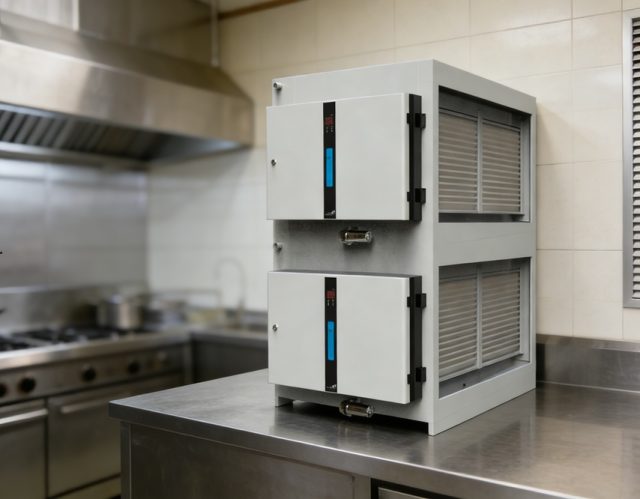
The core Mexican cookline — a bank of comals and planchas, a charbroiler for carne asada, a vertical spit for al pastor, and one or more fryers for chips and churros — produces the heaviest grease and particulate load. The standard Souniny recommendation is the Heavy-duty Series, a ducted two-stage electrostatic precipitator. The first stage is a corrosion-resistant stainless pre-filter that removes high-mass grease droplets by impaction, protecting the ionizing section from rapid fouling. The second stage is a high-voltage ionizing collector that targets the sub-micron aerosols typical of chile roasting, tortilla dust, and fryer oil mist. The unit installs inline in the Type I hood exhaust riser, downstream of the firestat and fire-suppression nozzles and upstream of the discharge stack or recirculation blower.
The Heavy-duty Series is the right choice when the hood serves more than four linear feet of high-load cooking, when the menu includes sustained charbroil or fryer duty, or when the operator is planning to expand the line with additional planchas or spits.
Light-Duty Cookline: Salsa, Sauce, and Hot Holding
The salsa and finishing section of a Mexican kitchen — toasting dried chiles, simmering mole, holding beans and rice, and finishing sauces under heat lamps — produces a lighter thermal plume with moderate odor but limited grease. The Light-duty Series addresses this profile with a lower-velocity cabinet-format ESP that mounts directly under the hood section or as a stand-alone wall unit beside the sauce station. It is the right selection when the goal is to capture and clean the air around the salsa prep and hot-holding area without paying for the heavier cell stack and higher static pressure of a full ducted installation.
Centrifugal Fan Sizing for Mexican Restaurant Applications
ESP cells do not generate their own draft. The Centrifugal Fan range supplied by Souniny pairs with the duct-mounted ESP and is selected to deliver the hood’s specified capture face velocity at the static pressure the ESP cell demands. Because ESP allows the designer to size the hood for capture-and-contain rather than for dilution, the centrifugal fan that follows the ESP cell can be selected at a lower brake-horsepower rating than the equivalent dilution-only installation, reducing operating cost on a kitchen that runs long hours every day.
Front Counter and Tortilla Station
The tortilla press and front counter are often the visual center of the restaurant. Guests watch tortillas being pressed, cooked, and plated within arm’s reach. The Cabinet Purifier addresses this profile as a recirculating cabinet-format air cleaner that mounts under the counter or beside the comal bank, capturing and returning cleaned air to the immediate workspace. The same cabinet format is the right selection for the Snack Cart Purifier configuration used at tasting events, festivals, and pop-ups where each station receives a small individual cooking unit. Both units are quiet enough to operate next to guest seating without intruding on conversation.
Tableside Molcajete, Guacamole, and Live-Finishing Service
Mexican concepts increasingly build the guest experience around tableside preparation: guacamole mashed in a volcanic molcajete, fajitas sizzling on a hot stone, or chile relleno finished with a handheld torch. These stations have no fixed duct infrastructure and must not disturb the dining room. The Ventless Catering Carts family solves this with ductless recirculating carts that integrate ESP with an internal washdown tank. The Countertop Cart and the Tempered Glass Cart are the typical choices for front-of-house service, with the Tempered Glass Cart preferred when the cart is visible to guests and the Countertop Cart chosen when space is limited. The Water-cycle BBQ Cart is the recommended option when the tableside profile includes live-fire searing or smoking, because the integrated water-spray stage handles the visible smoke and condensable organics that ESP alone addresses less efficiently.
Chile Smoke and Neighborhood Odor Control
Roasted chile, toasted cumin, and fried garlic produce aromatic compounds that are desirable inside the restaurant but can trigger complaints at the property line. The Odor Removal Tower mounts at the duct discharge and uses a layered activated-carbon stage to polish the airstream before it leaves the building. It is the right addition for downtown locations, mixed-use buildings, and any installation where the discharge point is close to neighboring windows or outdoor dining areas.
Water-Spray Polishing for Heavy Smoke Streams
When the menu includes a dedicated chile-roasting station, a charcoal-finish line, or a mole program that involves toasting large quantities of dried chiles and seeds, the exhaust stream carries a higher fraction of condensable organic smoke. The Water Spray Purifier is the recommended add-on stage, positioned after the ESP cell and before the discharge point, to capture the condensable VOC fraction and reduce the sticky residue that can accumulate in long duct runs.
Automated Cleaning for High-Volume Operations
Mexican restaurants that operate lunch and dinner seven days a week, or that run central commissary kitchens supplying multiple locations, generate enough grease loading that manual cell washing becomes a operational burden. The Self-cleaning ESP and the ESP Auto-cleaner configurations reduce that burden by automating the wash cycle. The Smart Water Tank supplies the wash water on a timer or pressure-differential basis, so the cell stays clean without removing it from the duct. These configurations are especially valuable in commissary kitchens, airport locations, and restaurant chains where downtime is expensive.
Recommended Souniny Solution Stack for a Standard Mexican Restaurant
For a typical full-service Mexican restaurant with a comal and plancha bank, charbroiler, fryer, salsa station, front tortilla counter, and occasional tableside molcajete service, the recommended Souniny equipment stack is as follows. The main cookline Type I hood runs the Heavy-duty Series ducted ESP, paired with the appropriately sized Centrifugal Fan downstream. The salsa and hot-holding stations operate behind a small canopy hood handled by a Light-duty Series cabinet-format ESP. The front tortilla counter is served by a Cabinet Purifier in recirculating mode. Tableside guacamole and molcajete service use one or two Ventless Catering Carts, typically the Tempered Glass Cart for visual appeal. If the menu includes a dedicated chile-roasting or charcoal-finish station, a Water Spray Purifier is added after the ESP cell. Finally, an Odor Removal Tower polishes the combined discharge before it leaves the building. The combined architecture allows the restaurant to maintain an open kitchen and tableside service while keeping exhaust airflow, energy cost, and neighbor complaints under control.
Choosing the Right Configuration
A comal-and-roaster line is a strong fit for the ductless N-series (light oil-fume) on tortilla and comal work, with the ND-series (heavy oil-fume) covering chile roasting, both paired with the Odor Removal Tower. The ESP Purifiers line with a Centrifugal Fan is the alternative where ductwork already exists.
Installation Notes for Urban, Heritage, and Food-Hall Locations
Many Mexican restaurant projects are retrofit installations into buildings that were never designed as commercial kitchens. Common field realities include: narrow retail bays with no roof access for a vertical stack; historic plaster or tin ceilings that cannot be penetrated; shared-lease food halls that prohibit individual rooftop equipment; and outdoor patios where the only available space is a temporary tent or cart enclosure. The ducted ESP configuration answers these constraints by allowing horizontal discharge through an exterior wall where local code permits, or by returning treated air into the building envelope as cleaned recirculation. The Self-cleaning ESP and ESP Auto-cleaner configurations further reduce maintenance burden in installations where ducts are concealed above finished ceilings. For true mobile operations, the Ventless Catering Carts and Water-cycle BBQ Cart provide a fully self-contained solution with no fixed ductwork at all.
Maintenance and Service Intervals
Correctly applied ESP does not eliminate the need for preventive service; it simply makes the service predictable. For a Mexican restaurant operating twelve to sixteen hours a day, seven days a week, the field-proven schedule is a weekly visual check of the cell, a two-week pre-filter rinse, a four-week cell wash cycle that the Smart Water Tank can automate, and a quarterly inspection of the high-voltage power supply, ionizing wires, and grounding. Souniny products ship with a 12-month whole-unit warranty under standard terms, with the ESP cell, aluminum collector plates, sealing strips, and ceramic insulators treated as consumable wear items that are replaced on a service schedule rather than under warranty. Souniny provides remote technical support and ships replacement components directly from Dongguan, so operators are not dependent on a local service agent for routine maintenance.
Operational Economics: Why ESP Pays Back in a Mexican Restaurant
The economic argument for ESP in a Mexican restaurant is strong for three reasons. First, the exhaust-volume reduction drops the brake horsepower of the operating fan, which directly cuts electricity cost. A meaningful reduction in airflow on a cookline operating fourteen to sixteen hours a day recovers a substantial share of the fan’s annual energy cost. Second, the make-up-air unit drops in proportion, recovering both winter heating and summer cooling load. In hot climates where Mexican restaurants are especially common, the air-conditioning savings alone can be significant. Third, the ability to recirculate treated air rather than dumping it above the roofline allows the building envelope to retain conditioned air, which is valuable in poorly insulated historic buildings and open-front taquerias. Most operators recover the equipment capital cost within the first few years, with energy savings continuing for the service life of the unit.
Application Scenarios
The configurations above map to a defined set of real-world Mexican restaurant formats. A downtown cantina in a historic building uses the Heavy-duty Series ESP on the main cookline and a Cabinet Purifier at the front tortilla counter. A food-hall taqueria stall uses a Light-duty Series unit sized for the landlord’s exhaust cap, paired with a Water Spray Purifier to handle the chile-roasting station. A fast-casual taco chain with a central commissary uses Self-cleaning ESP units in the commissary and Countertop Carts in the front-of-house assembly lines. A resort restaurant with tableside molcajete service places Tempered Glass Carts at each server station and an Odor Removal Tower at the building discharge. A festival or mobile taco operation runs entirely on Water-cycle BBQ Carts and Snack Cart Purifiers with no fixed duct infrastructure.
Conclusion
Mexican restaurant kitchens present a ventilation challenge that the conventional commercial-kitchen playbook is poorly suited to address. The combination of dry-heat comal cooking, chile roasting, live-fire finishing, and open-kitchen presentation requires a strategy that treats each aerosol at the source, controls odor at the property line, and preserves the guest-facing theater that defines the concept. Souniny supplies every layer of that stack — ducted ESP and cabinet-format ESP, centrifugal fans, water-spray polishing, automated cell cleaning, carbon polishing towers, ductless carts for tableside service, and matching cabinet-format cleaners for the smallest stations — with CE-marked manufacturing and a 12-month warranty backed by remote technical support. For operators opening a new taqueria, retrofitting a heritage cantina, or standardizing a multi-unit chain, an ESP-first ventilation strategy is the most reliable path to clean discharge air, lower energy cost, and an inspection-ready installation.