Brazilian steakhouses—known locally as churrascarias—operate some of the most visually dramatic and thermally intense kitchens in the global restaurant industry. Servers circulate dining rooms bearing skewers of picanha, linguiça, and lamb carved tableside, while behind the scenes pitmasters manage open charcoal pits, vertical rotisseries, and high-temperature grills that burn for ten to fourteen hours a day. The resulting exhaust stream is extraordinarily rich in grease-laden vapors, fine carbon particulates, and smoky aromatics. Without proper capture and purification, these emissions deposit thick layers of flammable residue inside ductwork, degrade indoor air quality for both guests and staff, and create persistent odor problems that can drift into adjacent retail or hotel spaces. This article examines why electrostatic precipitator (ESP) technology is uniquely suited to the ventilation demands of Brazilian steakhouse kitchens, how ESP Purifiers and complementary Ductless Range Hoods address each stage of the exhaust challenge, and what operators should consider when designing, installing, and maintaining these systems for long-term performance and safety.
1. The Churrasco Cooking Environment: Fire, Smoke, and Fat
Traditional churrasco cooking originated in the southern grasslands of Brazil, where gaúchos roasted large cuts of beef over open pits of hardwood charcoal. The modern churrascaria preserves this heritage at scale. Kitchens typically feature one or more of the following cooking stations:
- Open charcoal pits or fogões de chão — Large masonry or steel pits loaded with hardwood charcoal that burns at 600–900 °C, producing significant radiant heat and luminous carbon particles.
- Vertical rotisserie spits (espetos) — Long skewers of beef, pork, poultry, and game rotate slowly over embers, allowing fat to drip continuously onto hot coals. Each drip generates a puff of smoke rich in polycyclic aromatic hydrocarbons (PAHs) and ultrafine particles.
- Gas-assisted salamanders and plancha griddles — Used for finishing, searing, and preparing accompaniments, these surfaces add grease aerosol and NOx to the overall exhaust load.
- Charcoal starters and rekindling stations — Where fresh charcoal is ignited, producing dense smoke plumes during the preheat phase.
The combined exhaust profile from these stations is qualitatively different from typical fryer-and-range kitchens. Fat rendering from marbled beef creates a high concentration of sub-micron grease droplets that remain airborne long enough to travel deep into duct systems before cooling and condensing. Charcoal combustion introduces large quantities of black carbon, tarry compounds, and acrid phenolics. The social nature of the churrascaria—open grilling often visible to diners through glass or open kitchen designs—means that any visible smoke or odor breakthrough is immediately apparent to guests, undermining the premium experience that justifies the restaurant’s price point.
2. Why Conventional Filtration Fails in Churrascarias
Many Brazilian steakhouse operators initially install standard baffle or mesh filters above each grill station. These devices provide rudimentary flame protection by interrupting the path of grease droplets, but they are fundamentally inadequate for the churrasco environment for several reasons:
Grease loading exceeds design capacity. Baffle filters are engineered for typical restaurant grease loads—usually measured in grams per hour from shallow frying and sauté. Churrasco grilling, where entire primals of beef render fat continuously for hours, can produce ten to twenty times that grease volume. Baffles quickly become saturated, allowing carryover that coats ducts and fans in a flammable film.
Charcoal smoke particles are too fine for mechanical interception. The carbon particulates from hardwood charcoal combustion are predominantly in the 0.1–1.0 µm range. Baffle filters, which rely on inertial impaction, are essentially transparent to particles below 2 µm. These fines pass straight through and deposit on rooftop fan blades, neighbor buildings, and nearby HVAC intakes.
Odor breakthrough is rapid. Charcoal smoke contains volatile organic compounds (VOCs) with strong olfactory impact at parts-per-billion concentrations. Baffle filters do not adsorb or oxidize these molecules. In venues with open-kitchen designs or dining rooms adjacent to the grill line, guest complaints about smoky clothing and hair are common within weeks of opening.
Maintenance labor is unsustainable. In a high-volume churrascaria, baffle filters require daily removal, soaking, and scrubbing. The sticky, carbonized residue from charcoal smoke is far more tenacious than standard cooking grease, extending cleaning time and accelerating filter corrosion. Over time, operators either clean less frequently—raising fire risk—or abandon the filters entirely.
3. How ESP Technology Captures Churrasco Emissions
Electrostatic precipitation addresses each of the failures above through a fundamentally different mechanism. Rather than physically blocking particles, an ESP charges them electrically and then collects them on grounded metal plates. This process is uniquely effective for the sub-micron grease droplets and carbon fines that dominate churrasco exhaust.
3.1 Ionization and Collection of Grease Droplets
As exhaust enters the ESP cell, it passes a corona discharge zone created by high-voltage ionizing wires. The intense electric field (typically 8–15 kV/cm) strips electrons from air molecules, creating a plasma region. Grease droplets and carbon particles passing through this zone collide with ions and acquire a strong electrostatic charge. The charged particles are then drawn to grounded collection plates of opposite polarity, where electrostatic adhesion holds them firmly—even at airflow velocities well above those typical in kitchen exhaust ducts.
For Brazilian steakhouse operators, this means that the dense fog of sub-micron grease produced by continuous fat rendering is captured before it can cool and condense inside ductwork. The ESP cell removes particles across the full size spectrum, from 10 µm grease splashes down to 0.01 µm carbon nuclei, with collection efficiency typically exceeding 95 percent for particles above 0.1 µm.
3.2 Reduction of Duct Deposits and Fire Risk
Because the ESP removes grease while it is still in aerosol form, the volume of material reaching downstream ducts, fans, and discharge points is reduced by an order of magnitude or more. This has profound implications for fire safety. In conventional churrascaria ventilation, ducts near the hood outlet can accumulate several millimeters of grease within weeks. This layer is highly flammable and acts as fuel for duct fires ignited by stray embers or fan sparking. With ESP pre-purification, duct deposits are minimal, and the risk of a duct fire propagating through the building is dramatically reduced.
NFPA 96, the standard governing commercial kitchen ventilation in North America, recognizes ESP systems as acceptable grease-removal devices when installed and maintained according to manufacturer instructions. In jurisdictions governed by EN 16282 or AS 1668.2, ESP performance data can be submitted as part of the fire-risk assessment to justify extended duct-cleaning intervals and reduced suppression-system trigger rates.
3.3 Odor and VOC Reduction
While the primary function of an ESP is particulate removal, the high-voltage corona also produces low concentrations of ozone (O₃) as a byproduct. At the levels generated in well-designed kitchen ESP cells, this ozone reacts with odor-causing VOCs—phenols, cresols, and pyrolysis products from charcoal smoke—oxidizing them to less odorous compounds or condensable organics that are subsequently collected on the ESP plates.
The result is a meaningful reduction in the smoky, fatty odor that would otherwise characterize churrascaria discharge air. In venues located in mixed-use developments, shopping malls, or above ground-floor retail, this odor control can be the difference between harmonious neighbor relations and repeated environmental complaints or lease violations.
4. Souniny ESP Purifiers for the Churrascaria Line
The ESP Purifiers product line from Souniny is engineered for the sustained high-temperature, high-grease conditions found in live-fire cooking environments. For Brazilian steakhouse applications, the following configurations are particularly relevant:
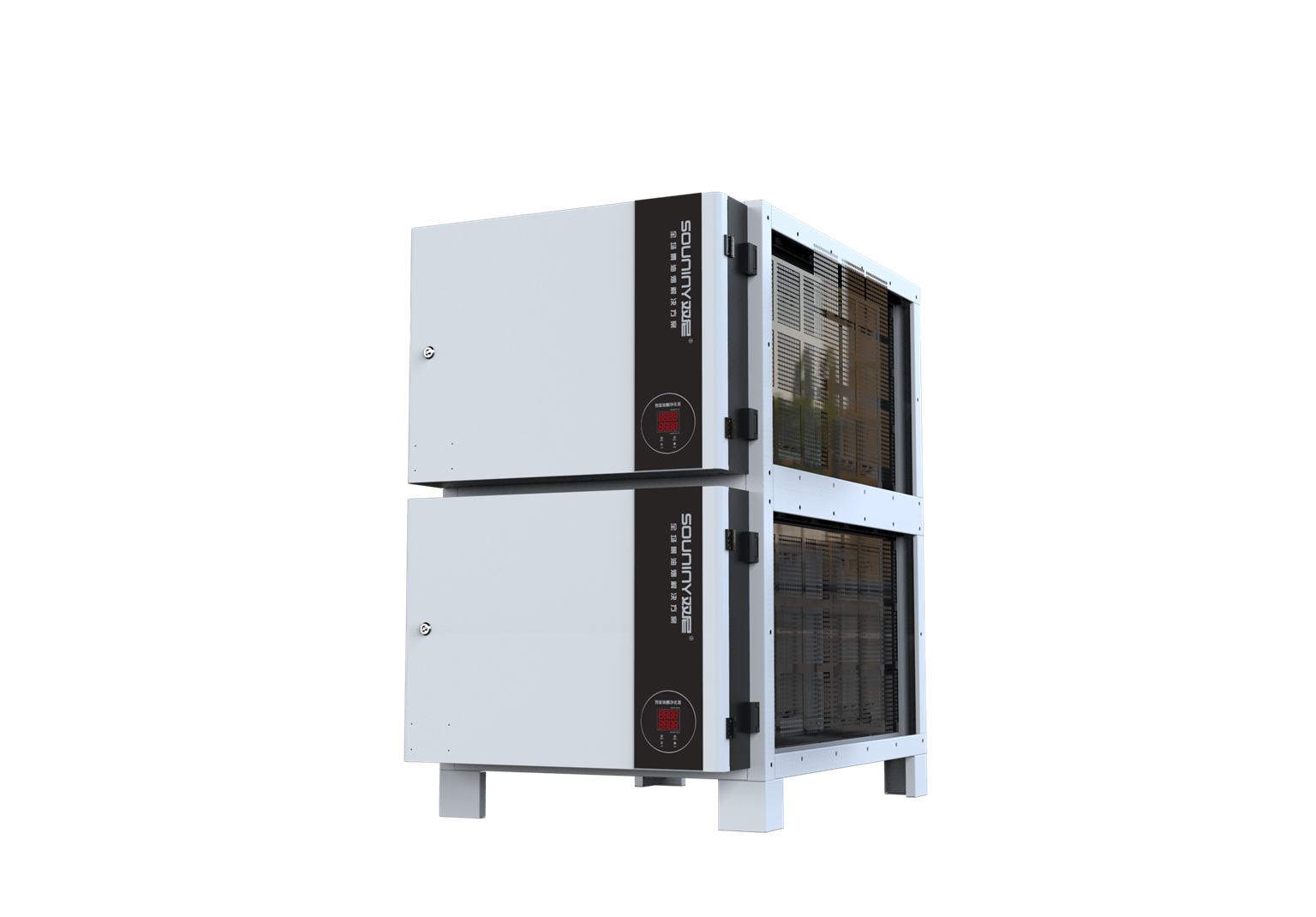
Standard ESP Purifiers provide the core two-stage electrostatic collection system in modular stainless-steel housings rated for continuous duty at exhaust temperatures up to 120 °C. Units are sized to match the airflow of each grill station or rotisserie bank, with multiple cells arranged in parallel for large open-pit lines. The all-stainless construction resists the corrosive acids produced when grease condenses on cooler surfaces, and the modular cell design allows individual stages to be removed for cleaning without shutting down the entire exhaust line.
Self-cleaning ESP models add an automated wash cycle that sprays detergent solution across the collection plates on a programmable schedule—typically after each service period or during the overnight closure window. For churrascarias operating lunch and dinner seven days a week, this automation eliminates the daily labor of cell removal and hand-washing, ensuring that collection efficiency does not degrade due to plate fouling. The wash effluent, containing captured grease and carbon particles, is drained to the kitchen grease interceptor or wastewater system.
ESP Auto-cleaner units integrate the self-cleaning function with a dedicated detergent dosing and water-softening module, ensuring that wash water chemistry is optimized for the specific grease profile of beef tallow and hardwood smoke. This is particularly valuable in churrascarias, where the combination of saturated animal fats and wood tar creates a sticky residue that can be difficult to remove with plain water rinsing.
Water Spray Purifier units offer a hybrid approach for installations where the exhaust stream includes both heavy particulate and high concentrations of soluble gases. In this configuration, a fine water mist pre-scrubs the exhaust, cooling it and capturing coarse ash and grease splashes, before the remaining fine aerosol passes into the ESP cell for electrostatic collection. The water curtain also provides a thermal buffer that protects the ESP electronics from temperature spikes when charcoal pits are stoked or cleaned.
Centrifugal Fan packages matched to the ESP pressure drop ensure that the additional resistance of the collection cells—typically 100–250 Pa depending on loading—does not compromise hood capture velocity. Souniny fan selections are based on the total system resistance including ESP, pre-filter, ductwork, and discharge louvers, with margins for filter loading over the cleaning cycle.
5. Ductless and Ventless Solutions for Satellite and Display Kitchens
Not every churrascaria cooking station requires a full ducted exhaust run. Modern Brazilian steakhouse concepts increasingly include:
- Display or exhibition grills in dining rooms where guests watch the passador carve meat tableside;
- Small-format satellite kitchens in hotel food courts, airport terminals, or food-hall stalls where building ductwork is unavailable;
- Outdoor terrace grills for seasonal or al fresco service;
- Catering and event stations for off-site churrasco experiences.
For these applications, Souniny offers ductless and ventless alternatives that recirculate purified air within the space rather than discharging it externally.
Heavy-duty Series and Light-duty Series ductless range hoods combine multi-stage filtration—typically mesh pre-filters, ESP cells, and activated-carbon final stages—in ceiling-suspended or wall-mounted enclosures that require no external duct. The ESP stage captures grease and smoke particles, while the carbon stage adsorbs odor molecules. Clean air is returned to the dining space at or below ambient temperature. These units are ideal for exhibition grills in high-end churrascarias where architectural constraints prohibit duct routing or where the visual impact of a suspended hood is preferred over a concealed bulkhead.
Cabinet Purifier units provide a floor-standing or countertop option for small satellite operations. The enclosed cabinet draws cooking fumes through a side or top intake, passes them through ESP and carbon filtration, and discharges clean air through a front grille. In food-hall or hotel-breakfast contexts where a full churrascaria grill is impractical, a Cabinet Purifier enables a scaled-down churrasco station without infrastructure modifications.
Ventless Catering Carts and the Water-cycle BBQ Cart extend this philosophy to mobile applications. The Water-cycle BBQ Cart incorporates an integrated water-curtain pre-filter that captures coarse grease and cools the exhaust from charcoal grilling, followed by ESP and carbon polishing. This configuration allows authentic charcoal churrasco to be served at events, weddings, and outdoor festivals without the permitting, setup, and teardown complexity of temporary ductwork.
6. System Design Considerations for Churrascaria Operators
6.1 Hood Capture and Airflow
ESP performance depends on the exhaust being delivered to the cell at the design flow rate and temperature. In churrascarias, the large radiant heat output from charcoal pits creates strong thermal updrafts that can compete with hood suction if capture velocities are inadequate. Souniny recommends perimeter-supply or displacement-supply hood designs that introduce tempered makeup air at the hood edge, improving capture while reducing the total exhaust volume required. This approach lowers both ESP sizing and HVAC energy costs.
6.2 Pre-Filtration and Spark Protection
Charcoal grilling introduces a small but real risk of ember carryover—glowing fragments of charcoal lifted by updrafts into the exhaust plenum. A stainless-steel mesh pre-filter or spark-arrestor baffle upstream of the ESP cell is essential to prevent hot particles from contacting the high-voltage ionizing wires. Souniny ESP Purifiers can be specified with integrated spark arrestors rated for charcoal and wood-fire applications.
6.3 Duct Material and Slope
Even with high-efficiency ESP protection, a small fraction of grease will reach downstream ductwork. In churrascarias, where exhaust temperatures are high and grease is predominantly saturated beef tallow with a melting point near 40 °C, ductwork should be constructed of stainless steel with all seams welded and smooth. Ducts must slope back toward the hood or to accessible grease drains; flat runs or negative slopes will allow molten fat to pool and create both fire hazards and odor sources.
6.4 Fire Suppression Integration
Churrascaria hoods should be protected by a UL 300 or equivalent wet-chemical fire suppression system. The ESP unit must be positioned so that suppression nozzles can access both the cooking surface and the plenum entrance, and the ESP housing must include access panels that do not obstruct the suppression pattern. Souniny provides dimensional drawings and cut-sheet data for fire-protection engineers to integrate ESP modules into the overall suppression design.
7. Maintenance Protocols for Peak Performance
ESP efficiency in churrascarias depends on disciplined maintenance. The following schedule is recommended:
Daily: Visually inspect pre-filters and spark arrestors for carbon buildup or damage. Empty and clean grease cups beneath the hood. Check that the ESP power-supply indicator shows normal operating voltage.
Weekly: Remove and soak ESP collection cells in a heated alkaline degreasing solution. In churrascarias, where wood-tar deposits can be tenacious, a brief soak in a sodium-hydroxide-based cleaner followed by pressure rinsing is usually required. Allow cells to dry completely before reinstallation.
Monthly: Inspect ionizing wires for corrosion or breakage. Clean the power-supply cabinet and verify that all electrical connections are tight. Check duct access ports for any evidence of grease breakthrough, which would indicate reduced ESP performance.
Quarterly: Engage a certified kitchen exhaust contractor to inspect the full duct run, fan, and discharge point. Perform a quantitative airflow test to confirm that hood face velocity and ESP face velocity remain within design parameters. Grease accumulation in downstream ducts should be negligible if the ESP is performing correctly; any significant buildup warrants immediate ESP servicing.
Operators using Self-cleaning ESP or ESP Auto-cleaner systems should verify detergent reservoir levels weekly and confirm that the wash cycle completes without alarms. The wash schedule should be adjusted based on operating hours; a churrascaria running two shifts daily will typically require more frequent washing than a single-shift operation.
8. Regulatory and Certification Context
Churrascarias operating in multiple jurisdictions must navigate a complex landscape of local and national standards. Key references include:
- NFPA 96 (United States, Canada, Middle East) — governs hood construction, duct clearances, grease-removal device acceptance, and suppression system design. ESP systems are recognized as grease-removal devices when listed and maintained.
- EN 16282-6 (European Union) — specifies requirements for grease filtration systems, including ESP performance testing under laboratory conditions. Souniny ESP Purifiers are CE certified to applicable EN standards.
- AS 1668.2 (Australia, New Zealand) — addresses kitchen exhaust discharge heights, neighbor protection, and minimum separation from air intakes. ESP-treated exhaust, with its reduced particulate and odor burden, may qualify for reduced discharge-height requirements in some jurisdictions.
- IMC / UMC (United States local jurisdictions) — the International Mechanical Code and Uniform Mechanical Code adopt NFPA 96 by reference but may impose additional requirements for emissions testing or neighbor-impact assessments in dense urban environments.
Souniny provides test reports, CAD drawings, and submittal packages for all ESP Purifiers and Ductless Range Hoods to support permitting and inspection in these jurisdictions. For projects in Brazil itself, where local fire departments (Corpo de Bombeiros) enforce IT 22/2011 and related state regulations, Souniny technical documentation can be submitted as part of the laudo técnico required for occupancy permits.
9. Conclusion
Brazilian steakhouse kitchens present one of the most demanding ventilation challenges in the restaurant industry: continuous high-temperature charcoal combustion, massive grease rendering from premium beef cuts, and the expectation of a pristine dining-room environment where guests remain for two hours or more. Conventional filtration is overwhelmed by the particle loading, odor intensity, and fire risk inherent in churrasco cooking.
Electrostatic precipitation, delivered through the ESP Purifiers product line and complemented by Self-cleaning ESP, ESP Auto-cleaner, and Water Spray Purifier options, provides the capture efficiency, fire-safety improvement, and odor control that churrascaria operators need. For satellite, display, and mobile applications, Heavy-duty Series and Light-duty Series ductless hoods, Cabinet Purifiers, and Water-cycle BBQ Carts extend these benefits to spaces where ducted exhaust is impractical.
With correct system sizing, integrated pre-filtration, and a rigorous maintenance schedule, Souniny ESP technology enables Brazilian steakhouse operators to deliver the authentic fire-cooked experience their guests expect—without the smoke, grease, and odor that would otherwise define the kitchen.
Self-cleaning ESP
ESP Auto-cleaner
Water Spray Purifier
Centrifugal Fan
Heavy-duty Series
Light-duty Series
Cabinet Purifier
Water-cycle BBQ Cart