Peruvian cuisine has become one of the most celebrated culinary traditions in the world — a layered fusion of Indigenous Andean cooking, Spanish colonial technique, African influence, Japanese and Chinese immigration, and Italian touches. That fusion is precisely what makes the Peruvian kitchen one of the most demanding ventilation environments in food service. A single restaurant may run a parrilla charcoal grill for anticuchos, a screaming-hot wok for lomo saltado (a legacy of Peru’s chifa Chinese community), a banana-leaf-lined earth oven for pachamanca, and deep fryers for yuca and plantanos — all at once. The result is a mixed emission stream of grease-laden vapor, sub-micron carbon from charcoal, polycyclic aromatic hydrocarbons (PAHs), and pungent volatile organic compounds (VOCs) that no single conventional filter can manage. This article explains why electrostatic precipitation is the right architecture for the Peruvian kitchen, how ESP Purifiers and complementary Ductless Range Hoods map onto each cooking method, and what operators should specify for safe, odor-free, code-compliant service.
1. The Peruvian Kitchen: Four Cooking Methods, One Exhaust Problem
Unlike a steakhouse that lives on one heat source or a bakery defined by ovens, the Peruvian restaurant is genuinely multi-modal. Understanding each station’s emission signature is the key to designing ventilation that actually works.
1.1 Anticuchos and the Parrilla (Charcoal Grilling)
Anticuchos — marinated beef-heart skewers — and broader parrilla grilling are cooked over hardwood charcoal at 500–800 °C. This produces luminous carbon particles in the 0.1–1.0 µm range, tarry wood-smoke compounds, and strong-smelling PAHs. Because skewers drip fat onto the coals continuously, each flip generates a puff of greasy smoke that carries both fine particulates and odor molecules deep into the room.
1.2 Lomo Saltado and the Chifa Wok Station
Lomo saltado — stir-fried beef, onion, tomato, and fried potato — is cooked in a Chinese-style wok over intense flame. The chifa tradition (Peruvian-Chinese cuisine) is central to the national diet, and wok cooking throws a hot, buoyant plume of grease aerosol and moisture. High-temperature stir-frying also generates acrolein and other aldehydes that are sharply irritating to eyes and airways.
1.3 Pachamanca (Earth-Oven Roasting)
Traditionally cooked in a pit lined with huacal leaves and heated stones, pachamanca is increasingly reproduced in indoor stone or ceramic ovens for restaurant service. These low-and-slow roasts render large volumes of animal fat and produce a dense, savory smoke that lingers — a signature aroma that guests love in the dining room but that wreaks havoc on ductwork and相邻 tenants if not captured.
1.4 Fryers, Empanada Ovens, and the Ceviche Prep Zone
Deep fryers for yuca, plátanos, and empanadas add a steady load of condensed grease aerosol, while even the “cold” ceviche prep zone generates citrus-aerosol and knife-station moisture that contribute to overall hood loading. The net effect is a kitchen where every major station emits a different pollutant at a different temperature — exactly the condition that defeats one-size-fits-all filtration.
Key takeaway: a Peruvian kitchen is not a “grill kitchen” or a “wok kitchen” — it is both, plus a roast oven and fryers. Ventilation must be specified for the combined load, not the largest single station.
2. The Mixed Emission Profile: Why It’s Hard
The Peruvian exhaust stream is unusually complex because its pollutants span the full particle-size spectrum and include both solids and gases:
- Sub-micron charcoal carbon from anticuchos and pachamanca — too fine for inertial baffle filters, deposits on fan blades and neighboring façades.
- Grease aerosol from the wok and fryers — condenses into flammable films inside ducts when not removed in vapor phase.
- PAHs and VOCs from charcoal and roasting — odorous at parts-per-billion levels; the source of guest complaints about smoky clothing and “smells like a grill” lobbies.
- Water vapor and citrus aerosol — raises relative humidity in the plenum, accelerating corrosion if stainless construction is not specified.
When these load sources operate simultaneously during a dinner rush, total emission mass can exceed a single-method kitchen by a wide margin. Capture velocity at the commercial kitchen exhaust canopy must be designed for the peak combined plume, and the purification stage must remove both particulates and odor-bearing gases.
3. Why Baffle Filters Alone Fail the Peruvian Kitchen
Many operators install standard baffle or mesh filters above each station and assume the job is done. In a multi-method Peruvian kitchen this assumption fails fast:
Grease loading exceeds capacity. Baffles are rated for typical shallow-fry grease loads. Continuous wok tossing plus pachamanca rendering produces many times that volume; baffles saturate within days and allow carryover into ducts.
Charcoal fines pass straight through. The carbon particles from anticuchos are predominantly below 1 µm. Baffle filters rely on inertial impaction and are essentially transparent to anything under ~2 µm — so the black smoke simply continues to the fan and discharge point.
Odor is untouched. Baffles do not adsorb or oxidize VOCs. In mixed-use buildings or open-kitchen concepts, charcoal and roasting odor breakthrough is immediate and persistent.
Cleaning labor is unsustainable. The carbonized, fatty residue from Peruvian grilling is far more tenacious than standard grease. Daily removal-and-soak quickly becomes skipped, raising fire risk.
4. How Electrostatic Precipitation Captures the Peruvian Mix
An Electrostatic Precipitator (ESP) removes particles by electrical charge rather than mechanical blocking, which makes it ideal for the full-size-spectrum Peruvian stream. As exhaust enters the cell, a high-voltage corona ionizes grease droplets, carbon fines, and even condensed VOC droplets; grounded collector plates then capture them. Removal efficiency for particles above 0.1 µm typically exceeds 95 percent.
4.1 Sub-Micron Charcoal and Wok Grease
The same corona that charges 10 µm wok grease splashes also charges the 0.1 µm charcoal nuclei from anticuchos. Both are collected before they cool and condense, so ducts stay clean and fans stay balanced. This single-stage capture across the entire size range is the core reason ESP suits mixed-method kitchens.
4.2 PAH and Odor Reduction
The corona generates low-level ozone that reacts with odor-causing VOCs and PAHs, oxidizing them to less offensive compounds or condensable organics that are subsequently collected on the plates. For a cuisine defined by charcoal and earth-oven aroma, this odor control is what keeps the dining room pleasant rather than smoke-laden.
4.3 Fire Risk Reduction
By removing grease in vapor phase, ESP cuts downstream duct deposits by an order of magnitude. Less fuel in the duct means a far lower probability of a duct fire igniting from stray embers or fan sparking — a material benefit under NFPA 96, which recognizes ESP as an accepted grease-removal device when listed and maintained.
5. Souniny ESP Purifiers for the Ducted Peruvian Line
For Peruvian kitchens with available ductwork, the ESP Purifiers product line provides continuous-duty collection sized to the combined station load:
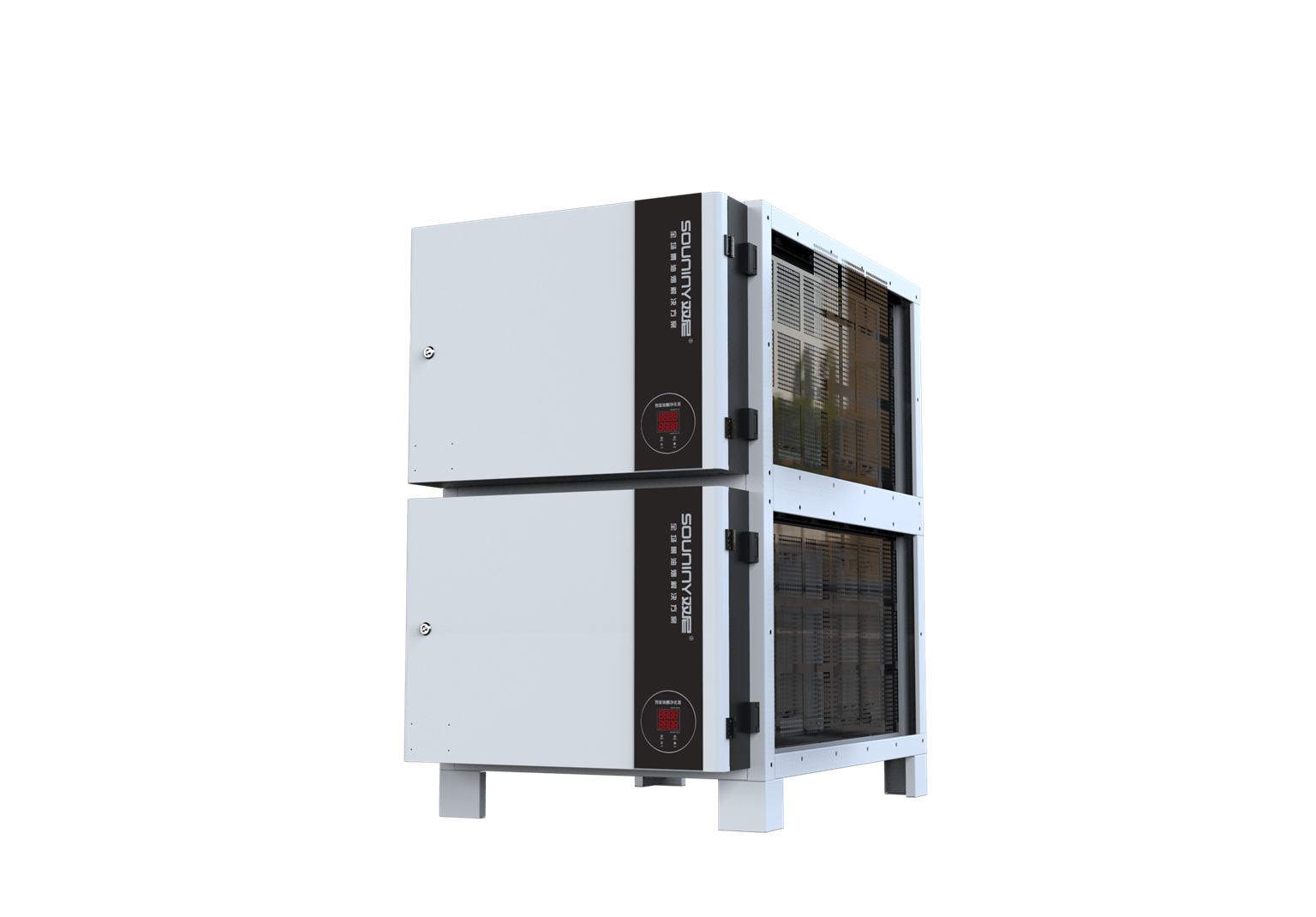
ESP Purifiers (DUCTED, inline in duct) ship in modular stainless-steel housings rated for continuous exhaust up to 120 °C. Units are sized to the total canopy face velocity across all stations — grill, wok, and roast oven — with parallel cells for large combined lines. Stainless construction resists the acidic condensate formed when grease meets citrus and char vapor.
Self-cleaning ESP adds an automated wash cycle, ideal for seven-day service: cells are sprayed on a programmable schedule (e.g., after the dinner close), eliminating the daily hand-cleaning that Peruvian loads otherwise demand. Wash effluent drains to the grease interceptor.
ESP Auto-cleaner integrates detergent dosing and water softening, optimizing wash chemistry for the saturated-animal-fat-plus-wood-tar residue unique to anticuchos and pachamanca — a sticky combination plain-water rinsing cannot fully remove.
Water Spray Purifier offers a hybrid front stage: a fine mist pre-scrubs coarse ash and grease splashes and cools the stream before it reaches the ESP cell, protecting electronics from temperature spikes when the parrilla is stoked. It is especially useful where charcoal and wok run side by side.
Centrifugal Fan (also called Exhauster in the KW sheet) packages are selected on total system resistance including ESP, pre-filter, duct, and discharge louvers — with margin for loading across the cleaning cycle so capture velocity never sags during a rush.
6. Ductless and Ventless for Chifa Woks and Ceviche Bars
Not every Peruvian station needs full ducted exhaust. Open chifa wok counters, ceviche bars, and food-hall stalls often sit where ductwork is impractical. Here, ductless and ventless options recirculate purified air:
Heavy-duty Series and Light-duty Series ductless range hoods combine mesh pre-filters, ESP cells, and activated-carbon final stages in ceiling-suspended or wall-mounted ventless hood enclosures. The ESP captures wok grease and charcoal fines; the carbon stage adsorbs lomo saltado and roast odor; clean air returns to the space. These suit exhibition chifa stations where guests watch the wok fire.
Cabinet Purifier provides a floor-standing option for compact ceviche prep and small fry stations, drawing fumes through side intake, purifying, and discharging clean air through a front grille — no infrastructure changes.
Ventless Catering Carts and the Water-cycle BBQ Cart extend purification to off-site Peruvian events and festivals, with an integrated water curtain pre-filtering coarse grease from charcoal grilling before ESP and carbon polishing — authentic anticuchos catering without temporary ducting permits.
7. System Design Notes for Peruvian Operators
7.1 Capture and Make-Up Air
Charcoal and wok plumes are strongly buoyant and can out-compete hood suction if capture velocity is low. Specify perimeter or displacement make-up air at the canopy edge to improve capture and cut total exhaust volume — lowering both ESP size and HVAC cost. Balance supply and exhaust per ASHRAE 154 and the relevant mechanical code.
7.2 Spark Protection for Charcoal
Anticuchos and pachamanca introduce ember carryover risk. A stainless spark-arrestor baffle upstream of the ESP cell is essential to keep glowing fragments off the high-voltage ionizing wires. Souniny ESP Purifiers can be specified with integrated spark arrestors rated for wood- and charcoal-fire applications.
7.3 Duct Material and Slope
Even with ESP protection, some grease reaches downstream duct. Use welded stainless steel with smooth seams, sloped back toward the hood or to grease drains. Flat or negative-slope runs let molten beef tallow pool and create fire and odor sources.
7.4 Suppression Integration
Protect charcoal and wok hoods with a UL 300 (or equivalent) wet-chemical system. Position the ESP so nozzles reach both cooking surface and plenum entrance; include access panels that do not block the suppression pattern. Souniny provides cut sheets for fire-protection engineers.
8. Maintenance for Sustained Performance
Daily: Inspect pre-filters and spark arrestors; empty grease cups; confirm ESP power-supply voltage is nominal.
Weekly: Soak ESP cells in heated alkaline degreaser. Peruvian wood-tar residue is tenacious — a sodium-hydroxide soak followed by pressure rinse is usually required; let cells dry fully before reinstalling.
Monthly: Inspect ionizing wires; clean the power-supply cabinet; verify duct access ports show no grease breakthrough (a sign of declining ESP performance).
Quarterly: Engage a certified exhaust contractor to inspect the full duct, fan, and discharge; run a quantitative airflow test confirming hood and ESP face velocities remain in design range. Downstream buildup should be negligible if the ESP performs correctly.
Operators using Self-cleaning ESP or ESP Auto-cleaner verify detergent levels weekly and confirm the wash cycle completes without alarm, adjusting frequency to operating hours.
9. Regulatory and Certification Context
Peruvian restaurants in multiple markets navigate overlapping standards:
- NFPA 96 (US, Canada, Middle East) — hood construction, duct clearances, grease-removal acceptance, suppression design. ESP recognized as a grease-removal device when listed and maintained.
- EN 16282-6 (EU) — grease filtration performance testing; Souniny ESP Purifiers are CE certified to applicable EN standards.
- AS 1668.2 (Australia, NZ) — discharge height and neighbor protection; ESP-treated exhaust may qualify for reduced discharge height in some jurisdictions.
- IMC / UMC (US local) — adopt NFPA 96 by reference; dense-urban sites may require neighbor-impact assessment. UL 710B covers recirculating (ventless) systems.
Souniny supplies test reports, CAD drawings, and submittal packages for all ESP Purifiers and Ductless Range Hoods to support permitting across these jurisdictions.
10. Conclusion
The Peruvian kitchen is a masterclass in culinary fusion — and a genuine test of ventilation engineering. Charcoal anticuchos, chifa wok flames, pachamanca roasting, and fryers together produce a mixed stream of sub-micron carbon, grease aerosol, PAHs, and VOCs that conventional baffle filtration cannot control.
Electrostatic precipitation — delivered through the ESP Purifiers line with Self-cleaning ESP, ESP Auto-cleaner, and Water Spray Purifier options — provides the cross-size-spectrum capture, odor control, and fire-risk reduction the Peruvian kitchen needs. For chifa wok counters, ceviche bars, and mobile service, Heavy-duty Series and Light-duty Series ductless hoods, Cabinet Purifiers, and Water-cycle BBQ Carts extend the same benefits where ducted exhaust is impractical.
With correct combined-load sizing, integrated spark protection, and a disciplined maintenance schedule, Souniny ESP technology lets Peruvian operators serve the fire, smoke, and soul of their cuisine — without the grease, odor, and risk that would otherwise define the kitchen.
Self-cleaning ESP
ESP Auto-cleaner
Water Spray Purifier
Centrifugal Fan
Heavy-duty Series
Light-duty Series
Cabinet Purifier
Water-cycle BBQ Cart