West African cuisine has moved decisively from community kitchens and street corners into the mainstream restaurant landscape of Europe and North America. Dishes once found only in diaspora neighborhoods — smoky suya skewers, fragrant one-pot jollof rice, golden fried plantains, and rich pepper stews — now anchor full-service menus in major cities. Yet for operators, this culinary rise carries a ventilation problem that generic exhaust design rarely anticipates: a single kitchen can simultaneously produce charcoal smoke, steam-laden stockpot vapor, deep-fryer grease, and capsaicin-heavy pepper aerosols, often in a compact, fast-paced room. This article examines the emission profile of the West African kitchen and explains how electrostatic precipitator (ESP) purification, paired with a correctly matched Centrifugal Fan and a properly configured exhaust hood, delivers clean air, code compliance, and long-term equipment protection.
Why West African Cooking Is Emission-Intensive
Most commercial kitchens generate a mix of grease-laden vapor and sub-micron particulate, but few produce such a concentrated combination of fuel smoke and food aerosol. The West African menu stacks three distinct emission sources in a single pass line. The suya grill burns lump charcoal at high temperature, releasing polycyclic aromatic hydrocarbons (PAHs) and a visible, tarry smoke that clings to surfaces. The jollof rice pot and its accompanying stews simmer in large stockpots, throwing off continuous steam and grease-laden vapor that condenses on duct interiors. The deep fryer used for plantains, akara, and puff-puff releases sub-micron oil droplets that stay suspended for hours. Together these three sources create an aerosol spectrum — coarse charcoal particles, fine oil mist, and gas-phase odor — that a single-stage baffle filter cannot capture.
The consequence is predictable for any operator who has run such a kitchen without the right air management. Grease accumulates on walls, ceiling tiles stain, odor bleeds into the dining room, and fire risk climbs as flammable residue builds inside the duct run. Air quality complaints from staff and neighbors follow, and in many jurisdictions a poorly controlled kitchen is a compliance citation waiting to happen. The fix is not more airflow alone; it is a purification-first approach that removes contaminants at the source rather than simply pushing them outdoors.
The Suya Grill: Charcoal Smoke and PAHs
Suya is the signature skewer of the West African kitchen — thin strips of beef, chicken, or ram rubbed with a fiery peanut-and-spice blend and grilled over open charcoal. The method is deliberately high-heat and smoky; the char is part of the flavor. From a ventilation standpoint, suya is essentially live-fire cooking, closer to a charcoal barbecue than to a saute line. Charcoal combustion produces carbon monoxide, nitrogen oxides, and a dense particulate plume, much of it in the sub-micron range that passes straight through a conventional baffle or mesh pre-filter. Worse, the spiced rub includes ground peanut and oil, which vaporize and condense as a sticky, odorous grease film on any downstream surface.
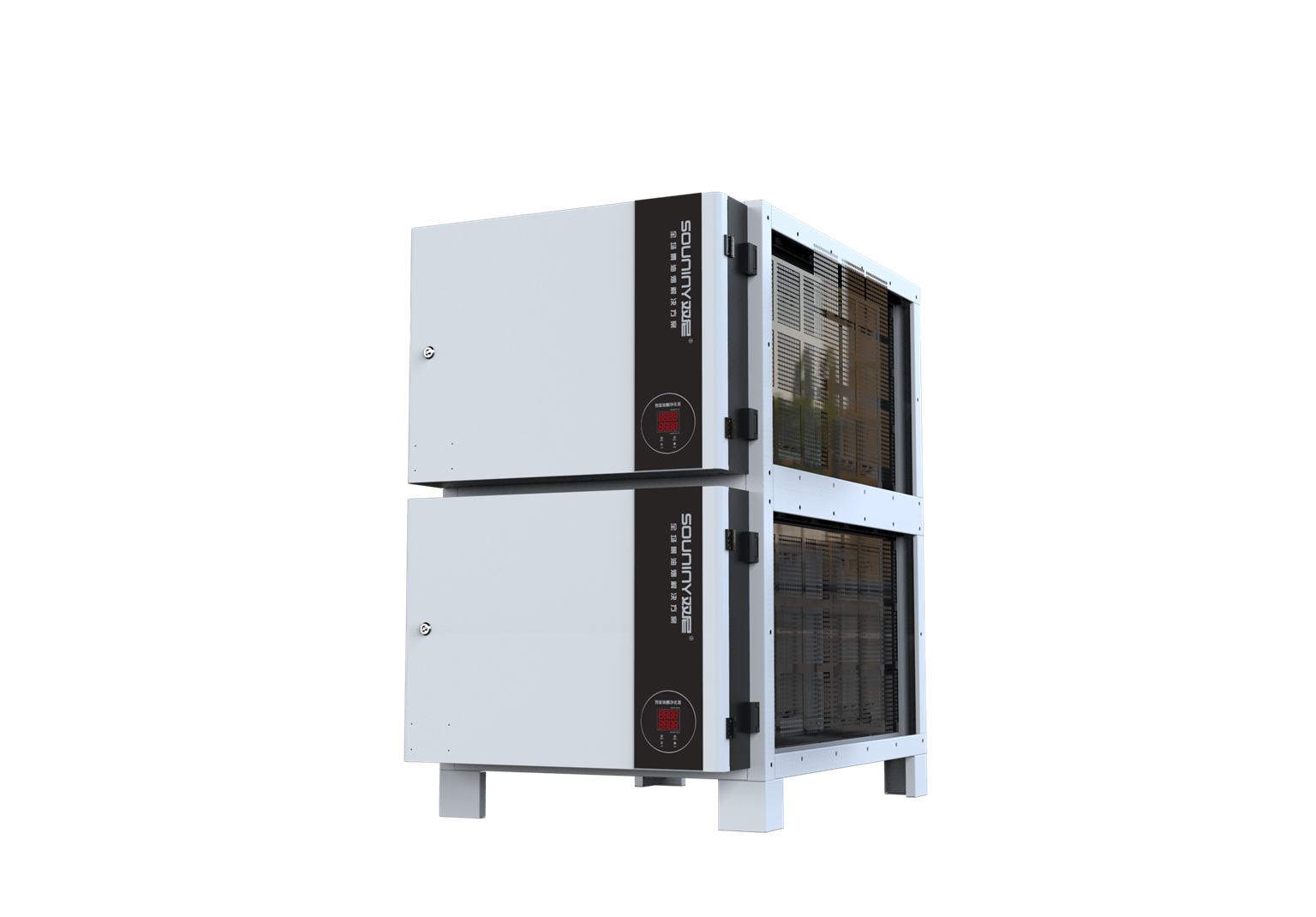
Because the smoke is produced at the cooking plane and rises quickly, capture efficiency depends on the hood geometry as much as the purifier. A well-fitted Commercial Range Hood or exhaust canopy positioned over the grill, with sufficient edge overhang and an adequate capture velocity, is the first stage. But capture is only half the equation; what enters the duct must then be cleaned. Here a Ducted ESP Purifier fitted inline downstream of the hood removes the charcoal particulate and the greasy condensate before the air reaches the Centrifugal Fan and the rooftop discharge. The result is dramatically less duct residue, lower fire load, and a discharge that does not foul neighboring premises — a frequent point of friction for restaurants in dense urban and mixed-use buildings.
Jollof Rice and Stockpot Steam: Grease-Laden Vapor
Jollof rice is a single-pot dish built on a long-simmered tomato, pepper, and onion base, with the rice cooked in the resulting stock. It is produced in volume — a single service may draw from multiple large pots — and it cooks for extended periods with lids partially off to control moisture. The result is a near-continuous release of steam carrying tomato oils, onion volatiles, and fine rice starch. Operators often underestimate this source because it lacks the visual drama of a grill flame, but its contribution to grease loading is substantial and, over a full shift, exceeds the fryer in many kitchens.
This steam-laden, grease-laden vapor is precisely the aerosol class that electrostatic precipitation handles most efficiently. When vapor is drawn through an Electrostatic Precipitator, the suspended droplets and particles are charged in a high-voltage ionizer and then collected on oppositely charged collector plates. The water content of stockpot steam actually assists collection by keeping the collected material fluid enough to drain, rather than baking onto the plates. For a jollof-heavy line, an ESP Purifier sized for the full hood airflow keeps the duct interior substantially cleaner and prevents the greasy condensation that otherwise drips from ceiling penetrations.
Fried Plantains and the Deep Fryer: Sub-Micron Particulate
Fried plantains, along with akara (bean fritters) and puff-puff (sweet dough balls), keep the deep fryer in near-constant use. Deep-frying generates a dense, invisible oil mist of sub-micron droplets that are among the hardest pollutants to capture mechanically. These droplets are too small for baffle filters to intercept, remain airborne for hours, and carry odor deep into the building. They are also a primary cause of the slippery film that coats floors, walls, and equipment around a fry station.
Electrostatic precipitation is specifically effective at these fine particles because collection force is electrical rather than inertial; the smallest droplets are the easiest to charge and the most reliably drawn to the collector plates. For a West African kitchen, placing a dedicated ESP unit on the fryer hood branch — or sizing a single unit to the combined hood — removes the oil mist before it can condense on ductwork. The practical benefits are immediate: a safer floor, a cleaner front-of-house odor profile, and a fryer station that staff can work without a sheen of oil on every surface.
Pepper Stews, Egusi, and the Capsaicin Problem
West African cooking is built on pepper. Scotch bonnet and habanero-class chiles are blended into the base of nearly every stew, and when those stews simmer, capsaicin and other irritant volatiles are released into the exhaust stream. This is a real occupational health concern: kitchen staff working over bubbling pepper stew can experience eye, throat, and respiratory irritation that lowers productivity and increases turnover. From the customer side, a whiff of pepper aerosol drifting from the kitchen into the dining room is uncomfortable and, for some guests, genuinely unpleasant.
ESP technology addresses the particulate and condensed-oil fraction of this aerosol, while the gas-phase odor is best handled by a second-stage treatment. In many installations the ESP Purifier is followed by an activated-carbon or deodorizing stage, or a water-wash unit such as the Water Spray Purifier that strips water-soluble compounds from the air stream. The combination of electrostatic collection for particles and a downstream odor-control stage is what transforms a pepper-heavy kitchen from an eye-watering workspace into a comfortable, code-compliant environment. For front-of-house live cooking, the ductless Ventless Catering Carts and the Water-cycle BBQ Cart offer self-contained purification that keeps smoke and capsaicin out of the dining air entirely.
Why Baffle Filters Fall Short
Traditional baffle or mesh filters work by inertia — forcing the air to change direction so that heavier grease droplets impinge on the metal blades. They are inexpensive and required in many codes as a first stage, but they were never designed to handle the fine particulate and dense smoke of charcoal grilling or the sub-micron mist of deep frying. Their capture efficiency drops off sharply below roughly five to ten microns, which is exactly the size range that dominates suya smoke and fryer oil mist. A kitchen that relies on baffles alone is effectively exhausting untreated air into its ductwork, where the residual grease condenses and accumulates.
The cost of that accumulation is not trivial. Grease-loaded ducts are the single biggest fire hazard in a commercial kitchen, and many insurance carriers and local fire authorities now require documented duct cleaning on a fixed schedule or engineered fire suppression. By moving to a Ducted ESP Purifier downstream of the baffle stage, operators cut the grease reaching the duct by the overwhelming majority, extending cleaning intervals, reducing fire load, and protecting the Centrifugal Fan and any downstream heat-recovery equipment from fouling.
Designing the ESP Solution for a West African Line
The right architecture depends on whether the kitchen can run ductwork to the exterior. Most full-service West African restaurants can, and should, use a ducted configuration: a Commercial Range Hood over each major cooking station, a pre-filter (baffle or mesh) at the hood, an inline ESP Purifier in the duct, and a Centrifugal Fan sized to move the required airflow against the system’s static pressure. The fan matters as much as the purifier; a centrifugal fan maintains rated airflow even as filters load, which is essential in a kitchen where the suya grill and fryer run concurrently at peak service.
For the suya grill specifically, consider a water-wash or auto-clean configuration. Charcoal smoke carries a high soot load that can coat ESP plates more quickly than ordinary cooking fume. An ESP Auto-cleaner or Self-cleaning ESP automates the washing cycle, and a Smart Water Tank supplies and recycles the wash water, keeping collector plates at peak efficiency with minimal manual labor. This is a meaningful operational decision in a small restaurant where the owner is often also the cook and has no time for daily filter pulls.
Where ductwork is impossible — a stall in a food hall, a basement unit, a historic building, or a front-of-house suya station — the ductless product line applies. Ductless Range Hoods, including the Heavy-duty Series for the grill and the Light-duty Series for a lower-emission station, recirculate cleaned air back into the room, eliminating the need for rooftop penetrations. For portable, self-contained live cooking, the Ventless Catering Carts and Water-cycle BBQ Cart bring purification directly to the point of cooking. These are especially useful for the growing number of West African operators launching with a cart or stall before committing to a full build-out.
Fire Safety and Code Compliance
Charcoal grilling and deep frying put a West African kitchen squarely in the “grease-laden vapor” category that most fire codes treat with special care. In North America, NFPA 96 governs the design of ventilation for commercial cooking operations and requires grease removal devices, protected ductwork, and regular inspection. In Europe, EN 16282 sets comparable requirements for kitchen ventilation systems, including the need for effective grease separation and fire safety provisions. Australian operators face AS 1668.2, while international projects commonly reference IMC and ASHRAE 154 as the baseline.
A correctly installed ESP purification train supports compliance on two fronts. First, it dramatically reduces the grease that reaches the duct and fan, lowering the fire load that the codes are designed to control. Second, it keeps the discharge clean enough to satisfy increasingly strict urban emission rules, which matter when the rooftop outlet is close to residences or office intake louvers. Operators should document the cleaning cycle — whether manual or automatic — because inspectors increasingly ask to see maintenance records, not just the equipment on the wall. The ESP Auto-cleaner and Self-cleaning ESP are valuable here because they generate a consistent, provable wash schedule without depending on staff memory.
Sizing, Placement, and Operational Notes
Sizing an ESP system is a function of the hood airflow, not the floor area of the restaurant. The purifier must be matched to the cubic-metres-per-hour (or CFM) rating of the exhaust system so that residence time through the ionizer and collector is sufficient for high single-pass efficiency. Undersizing the purifier relative to the fan defeats the purpose; oversizing wastes energy and budget. A competent supplier will start from the hood capture velocity and total airflow, then select the ESP unit and the Centrifugal Fan as a matched pair.
Placement matters as well. The purifier should sit downstream of the pre-filter and upstream of the fan, in a section of duct that is accessible for service and inspection. In retrofit situations where a kitchen is converting from baffle-only ventilation, an inline ESP unit can often be inserted without major structural change — one reason the technology is popular for existing West African restaurants that have outgrown their original ventilation. High-heat stations such as the suya grill may benefit from a water-wash first stage, which the Water Spray Purifier provides, to knock down temperature and coarse particulate before the ESP plates are asked to do the fine work.
Finally, think about growth. A West African menu tends to expand — a catering operation, a weekend grill special, an outdoor suya event. Ductless and mobile solutions such as the Ventless Catering Carts and Water-cycle BBQ Cart let an operator scale into events and pop-ups without re-engineering the main kitchen, and they keep the same purification standard across every serving point.
Centrifugal Fan
ESP Auto-cleaner
Self-cleaning ESP
Smart Water Tank
Water Spray Purifier
Ductless Range Hoods
Heavy-duty Series
Light-duty Series
Ventless Catering Carts
Water-cycle BBQ Cart