Rooftop bars and sky kitchens are the crown jewels of urban hospitality. They deliver panoramic views, premium menus, and an atmosphere that draws crowds from sunset to late night. But their ventilation problem is just as elevated as their location. Many rooftop kitchens are retrofitted into spaces where external ductwork is either architecturally prohibited, structurally impractical, or visually unacceptable. The answer is not a smaller duct; it is a ductless commercial kitchen exhaust system that recirculates cleaned air back into the cooking zone while removing grease, smoke, and odor at the source. Souniny’s N-series light oil-fume all-in-one units, ND-series heavy oil-fume all-in-one units, and Odor Removal Tower give rooftop operators a clean-air solution without punching through the roof.
Why Rooftop Kitchen Ventilation Is Different
Unlike ground-level restaurants, rooftop food service works under three built-in constraints. First, the structure often cannot support long galvanized duct runs, heavy exhaust fans, or seismic bracing for a full mechanical shaft. Second, the visual impact of exposed ducting conflicts with the design language of a premium terrace, lounge, or sky bar. Third, neighbors, hotel guests, and event venues on lower floors are highly sensitive to any smoke or odor drift, even when exhaust is technically vented above roof level.
These constraints make a conventional ducted hood-to-roof discharge system expensive and risky. Routing ducts through occupied floors requires fire-rated enclosures, NFPA 96 clearance, make-up air compensation, and landlord approvals. In many cases, the project becomes too slow or too costly, and the kitchen concept is abandoned. Ductless range hood technology removes that barrier by treating the exhaust stream internally and returning conditioned air to the kitchen, eliminating the need for external ductwork altogether.
The Ductless Principle for Open-Air and Semi-Open Kitchens
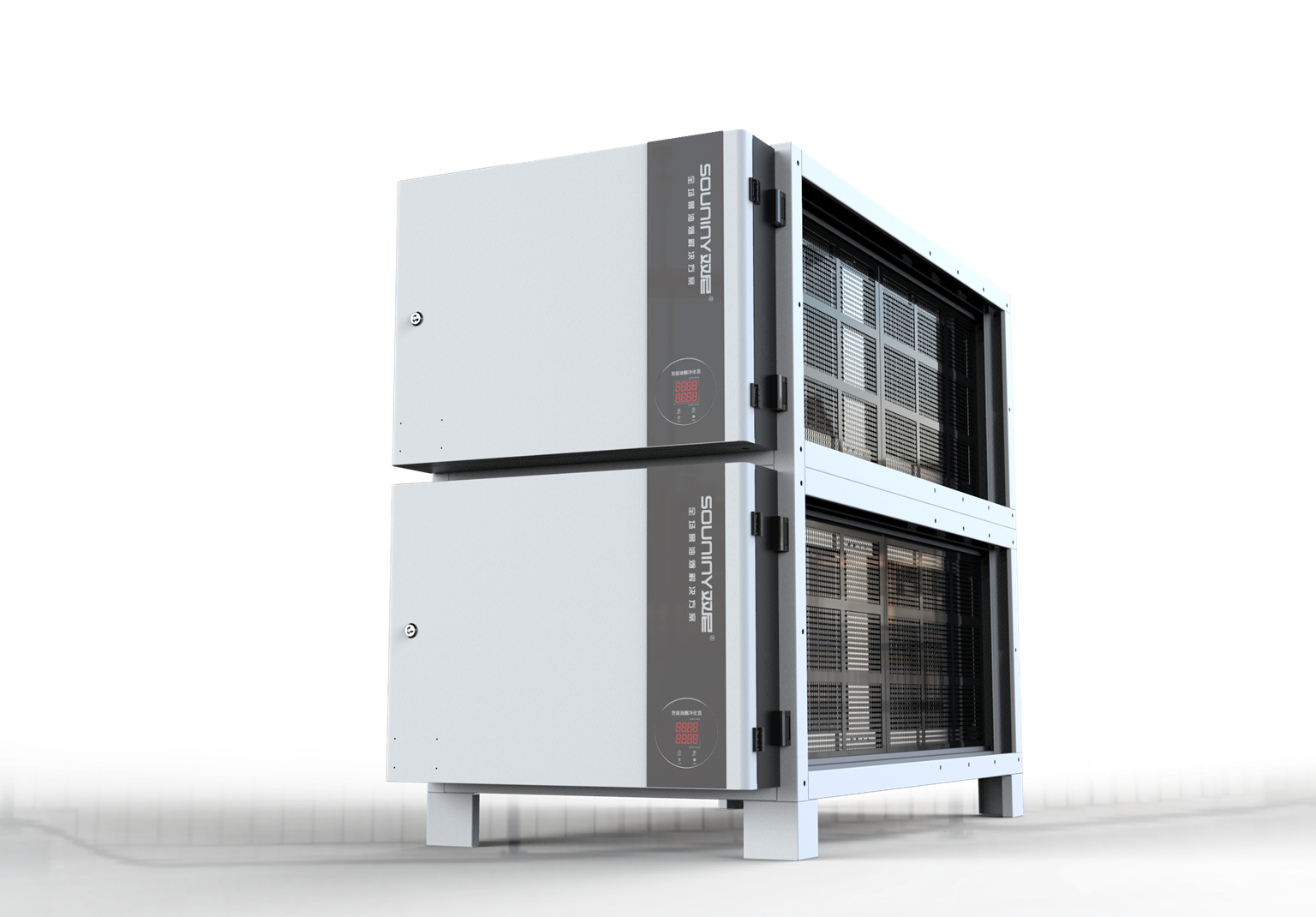
A ductless commercial range hood captures grease-laden vapor at the hood face, passes it through multi-stage filtration, and releases purified air back into the room. The typical Souniny path begins with a stainless-steel baffle or mesh pre-filter that stops large grease droplets and food particles. The air then enters an electrostatic section where high-voltage ionizer wires charge sub-micron particulate, including the fine oil aerosols produced by searing, grilling, and wok cooking. Collector plates attract the charged particles, and a final activated-carbon or deodorizing module addresses volatile organic compounds (VOCs) and odor-bearing molecules before recirculation.
This closed-loop approach is ideal for rooftop kitchens that operate under canopies, pergolas, or retractable roofs. Even when one wall is open, the cooking plume still needs to be captured before it drifts toward customer seating or condenses on glass railings and HVAC equipment. A ductless exhaust hood placed directly over the cooking line solves the problem at the source, without relying on wind direction or cross-ventilation.
Matching the Load: N-series for Light-Fume Rooftop Bars
Rooftop bars that focus on small plates, seafood towers, salads, flatbreads, and cocktail garnishes generate relatively light oil-fume loads. The particles are finer, the volumes are lower, and the peak loads come in short bursts during service. For these kitchens, the N-series light oil-fume all-in-one range hood is the appropriate match. It provides the capture velocity and electrostatic efficiency needed for continuous cooking without the oversized footprint and higher power draw of a heavy-duty system.
The N-series installs directly above standard cooking equipment, such as flattop griddles, panini presses, pasta boilers, and induction ranges. Because it is a ductless range hood, the unit can be rolled into place or suspended from the ceiling without modifying the building envelope. This is especially valuable on leased rooftop terraces where the operator may not be allowed to cut into the roof or where the lease term makes permanent ductwork uneconomical. Operators also benefit from lower HVAC loads because treated air remains in the conditioned space instead of being expelled and replaced by outside air.
When the Menu Gets Heavy: ND-series for Grills and Live Stations
Not every rooftop kitchen is limited to cold canapés. Many high-end sky bars now feature live grilling, yakitori skewers, smash burgers, and open-flame seafood stations that produce dense grease-laden vapor and high thermal loads. These applications require a heavy oil-fume solution. The ND-series heavy oil-fume all-in-one range hood is built for exactly this duty cycle.
The ND-series combines a larger electrostatic field, higher-capacity pre-filtration, and reinforced drainage to handle the heavier particle loading that comes from char-broiling and searing. It still operates on the same ductless principle, so operators can place a live-cooking station near the bar edge or under a partial canopy without running ducts through the terrace. For mixed-menu concepts that shift from light daytime service to heavier nighttime grilling, pairing N-series stations with ND-series stations lets the designer right-size each hood rather than oversizing the entire line.
Odor Control at Altitude: Why the Odor Removal Tower Matters
Grease and smoke are visible problems; odor is the invisible problem that closes rooftop venues. At higher elevations, wind currents can carry cooking smells across the building or down to neighboring balconies. Charcoal, garlic, spices, and seared proteins all release odor-active VOCs that bypass coarse filters. Souniny’s Odor Removal Tower adds a dedicated deodorizing stage to the exhaust stream, targeting the molecular components that cause complaints.
The tower integrates with both the N-series and ND-series ductless lines. It is not a simple carbon pad; it is a standalone deodorizing module engineered to maintain contact time and low pressure drop under commercial duty. For rooftop operators, this means the recirculated air smells neutral, the terrace atmosphere stays premium, and the venue can operate a charcoal or spice-forward menu without triggering neighbor complaints. In jurisdictions that enforce ASHRAE 154, IMC, or local odor ordinances, this dedicated odor stage also demonstrates a best-practice approach beyond minimum code.
Mobile Rooftop Pop-Ups: CV-A, CV-B, and CV-C Ventless Carts
Some rooftop programs are not permanent kitchens. They are seasonal pop-ups, tasting events, or private-party cooking stations that change layout from night to night. For these formats, a fixed hood makes no sense. Souniny’s CV-A, CV-B, and CV-C ventless catering carts bring the ductless purification system onto a mobile cart that can be wheeled to the service point and stored afterward.
Each cart variant is designed for front-of-house cooking where there is no existing ductwork. The built-in hood captures emissions at the source, passes them through filtration stages similar to the N-series architecture, and returns cleaned air to the terrace. For rooftop operators, this opens up formats such as live teppanyaki, made-to-order pasta, or grilling demonstrations without committing to a permanent kitchen build-out. When the event ends, the cart is simply disconnected and moved to storage.
Code, Safety, and Neighbor Considerations
Even ductless rooftop kitchens must meet applicable codes. In the United States, NFPA 96 governs commercial cooking ventilation and requires listed grease removal devices and adequate clearance to combustibles. The International Mechanical Code (IMC) and ASHRAE Standard 154 provide additional guidance on hood overhang, airflow, and capture efficiency. In Europe, EN 16282 sets the performance framework for kitchen ventilation systems, while local building codes may restrict rooftop equipment visually or acoustically.
Because Souniny ductless range hoods avoid roof penetrations, they also reduce the fire-path risk associated with vertical grease ducts. There is no long duct run where condensate and residue can accumulate, and no roof fan to maintain in high winds or salt-air environments. Operators still need a regular cleaning schedule for the electrostatic cells and pre-filters, but the maintenance burden is concentrated at the hood itself rather than distributed across a roof-level network.
Integration with Rooftop MEP Design
Ductless systems simplify the mechanical, electrical, and plumbing coordination that usually delays rooftop projects. Without exhaust shafts, designers can preserve ceiling heights, avoid conflicts with structural beams, and reduce the size of make-up air units. The N-series and ND-series units plug into standard power supplies and drain to local grease traps or wastewater connections. The Odor Removal Tower connects inline with the hood module, requiring only the same footprint as a small auxiliary cabinet.
This compact footprint is a major advantage on rooftop terraces where every square meter generates revenue. A ducted hood might require a dedicated mechanical chase consuming tens of square meters across multiple floors. A ductless exhaust hood sits above the cooking line and returns air to the same space, freeing square footage for seating, bars, or planters. For operators paying premium rooftop rent, that recovered area can be worth more than the entire ventilation budget.
Air Quality and Customer Experience
The business case for rooftop ventilation is ultimately about customer experience. Guests do not return to a terrace that smells like grease or stings their eyes with smoke. Staff cannot work efficiently if they are constantly waving smoke away from the pass. Ductless range hoods create a physical barrier between the cooking plume and the guest area, keeping both zones comfortable even during peak output.
Because the air is recirculated rather than dumped outdoors, the system also helps stabilize rooftop temperature and humidity. In hot climates, this means less cooled air is lost; in cold climates, less heated air escapes. The result is a more stable indoor climate and lower energy bills, which is increasingly important for venues that operate year-round under retractable enclosures.
Specifying the Right Product Mix
No single product fits every rooftop concept. A champagne-and-oyster sky bar may need only N-series units above induction stations, while a mixed grill and cocktail lounge needs ND-series hoods for the live-fire line plus an Odor Removal Tower to protect the terrace atmosphere. A hotel rooftop that hosts rotating culinary events can add CV-A or CV-C carts for flexibility. Souniny’s product strategy treats rooftop kitchens as a scenario, not a SKU, and matches the solution to the menu, layout, and regulatory environment.
Souniny has supplied ductless commercial kitchen exhaust systems to hotels, resorts, and entertainment venues since 2015. All ductless units are CE certified, and the company operates an in-house R&D center focused on electrostatic precipitation, odor removal, and compact recirculating hood design. For rooftop project support, contact info@souniny.com or reach the team on WhatsApp/WeChat at +86 189 2910 1713.