Wineries are no longer just about the cellar. Modern estates host tasting rooms, harvest dinners, wood-fired pizza nights, chef collaborations, and festival-scale cooking that turns a vineyard into a hospitality destination. But most winery buildings were never designed for commercial kitchens. Stone walls, timber ceilings, heritage approvals, and remote locations make conventional ducted exhaust almost impossible to install. Souniny’s N-series light oil-fume all-in-one range hoods, ND-series heavy oil-fume all-in-one range hoods, and Odor Removal Tower give winery operators a ductless way to cook professionally while protecting the building, the wine, and the guest experience.
Why Winery Kitchens Need a Different Ventilation Approach
A winery kitchen is a unique hospitality environment for three reasons. First, the building stock is often historic, with listed facades, thick masonry, and decorative ceilings that cannot be cut for exhaust ducts. Second, the cooking program is seasonal and variable: a quiet tasting menu in winter becomes a five-station harvest feast in autumn. Third, the guest experience is built on atmosphere, and grease-laden vapor, smoke, or lingering cooking odor can quickly ruin the impression of a premium estate.
Conventional ventilation design assumes a dedicated mechanical shaft running from the hood to a roof discharge point. In a winery, that shaft may have to pass through protected structures, up through timber rafters, or across a barrel cellar where temperature and humidity control are critical. The cost and disruption of such a project often outweighs the value of the kitchen itself. Ductless range hoods change the equation by capturing and purifying the exhaust stream inside the unit and returning cleaned air to the room, eliminating the roof penetration entirely.
The Ductless Principle Applied to Estate Cooking
A ductless commercial range hood captures grease-laden vapor at the cooking surface, then passes it through a multi-stage filtration process. Large grease droplets are stopped by a stainless-steel baffle or mesh pre-filter. The remaining sub-micron particulate, including the fine oil aerosols produced by searing and grilling, is charged by an ionization section and collected on electrostatic plates. Finally, a deodorizing module treats volatile organic compounds (VOCs) and odor-bearing molecules before the air is recirculated into the kitchen.
This closed-loop architecture is ideal for winery buildings. It needs no exhaust fan on the roof, no fire-rated duct chase, and no make-up air system sized to replace expelled air. The unit sits directly above the cooking equipment, works within the existing room volume, and preserves the conditioned air that keeps a cellar or tasting room stable. For estate kitchens located inside buildings that were originally barrel halls, stables, or farmhouses, this is often the only viable path to a legal and professional cooking setup.
N-series for Tasting Room Kitchens and Light Fare
Tasting room kitchens typically focus on composed plates, cheese boards, charcuterie, flatbreads, and small-batch pastries. The cooking loads are moderate, the equipment list is compact, and the service is spread across the day. For these programs, the N-series light oil-fume all-in-one range hood is the right match. It delivers the capture and electrostatic efficiency needed for continuous cooking without the footprint, airflow, or energy profile of a heavy-duty system.
The N-series installs above induction ranges, panini presses, pasta boilers, and small combi ovens. Because it is a ductless range hood, it can be suspended from the ceiling or mounted against a wall without cutting through the roof. This is especially valuable in tasting rooms with exposed timber or stone finishes, where visible ductwork would destroy the design language. The unit recirculates cleaned air, so the room stays warm in winter and cool in summer, and the aromatics of the wine remain the dominant smell in the space.
ND-series for Estate Restaurants and Wood-Fired Cooking
Many wineries now operate a full estate restaurant or host chef residencies built around wood-fired ovens, charcoal grills, and whole-animal roasting. These programs produce dense grease-laden vapor, high heat, and heavy particulate loading. They need a heavy oil-fume solution. The ND-series heavy oil-fume all-in-one range hood is engineered for exactly this duty cycle.
The ND-series pairs a larger electrostatic field with higher-capacity pre-filtration and reinforced condensate drainage, so it can hold up to the punishing output of a wood-fired oven or a char-grill station. It still operates on the same ductless principle, which matters when the kitchen is housed in a heritage building where a conventional exhaust stack is not an option. For estates that combine light daytime service with heavier evening cooking, mixing N-series stations with ND-series stations lets designers right-size each hood instead of oversizing the whole line for the busiest hour.
Odor Removal Tower: Protecting the Wine and the Guest
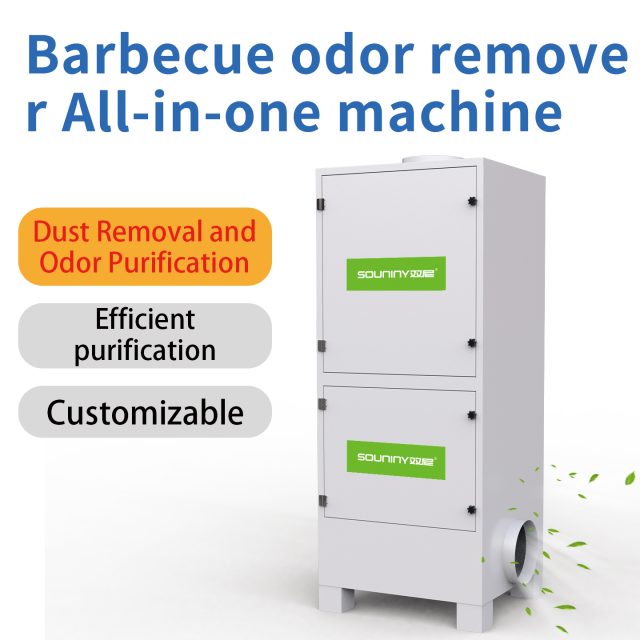
Wineries face a special odor problem. Cooking aromas that might be acceptable in a city restaurant can interfere with wine tasting, where the guest’s palate and nose are the product. Garlic, smoke, charred meat, and spice all release VOCs that cling to the air and to surfaces. Souniny’s Odor Removal Tower adds a dedicated deodorizing stage that targets these molecular components before recirculation.
The tower is designed to work alongside both the N-series and ND-series ductless lines. It maintains contact time with the airstream at a low pressure drop, so it does not starve the hood of capture velocity. For wineries, this means the estate kitchen can run a wood-fired menu without tainting the tasting experience two rooms away. It also demonstrates a best-practice approach that goes beyond minimum code in jurisdictions applying IMC, ASHRAE 154, or EN 16282 frameworks.
CV-A, CV-B, and CV-C Carts for Harvest Festivals and Outdoor Events
Harvest season turns many wineries into outdoor event venues. Grape stomping festivals, food and wine pairings, long-table dinners, and market days all need cooking capacity at temporary locations far from the main kitchen. Fixed hoods cannot follow the crowd. Souniny’s CV-A, CV-B, and CV-C ventless catering carts bring the ductless purification system directly to the service point.
Each cart variant suits a different front-of-house format, from a compact ventless hood station to countertop and tempered-glass display cooking. Because the carts are ventless, they can be positioned on a patio, under a pergola, or inside a barrel hall without any connection to a roof exhaust. The built-in range hood captures emissions at the source, purifies the airstream, and returns clean air to the event space. When the festival ends, the cart is wheeled back to storage and the venue returns to its original state.
Code, Fire Safety, and Heritage Compliance
Every winery kitchen, ductless or not, must meet applicable codes. In the United States, NFPA 96 sets the benchmark for commercial cooking ventilation, requiring listed grease removal devices, appropriate clearances, and fire protection for cooking operations. The International Mechanical Code (IMC) and ASHRAE Standard 154 cover hood performance, capture efficiency, and airflow requirements. In Europe, EN 16282 defines the performance classes for kitchen ventilation components, while local heritage rules may prohibit any visible alteration to protected buildings.
Ductless systems reduce fire-path risk because there is no long vertical grease duct where residue can accumulate. The fire risk concentrates at the hood itself, where it can be inspected and cleaned on a defined schedule. This is a major advantage for wineries with timber ceilings and historic structures, where a traditional duct could introduce a new fire-propagation route through the building. The shorter the exhaust path, the fewer the hidden hazards.
Integration with Winery MEP and Architecture
Because ductless range hoods need no roof penetration, they integrate cleanly with winery mechanical, electrical, and plumbing systems. Designers keep ceiling heights, avoid structural conflicts, and skip the large make-up air units that a ducted kitchen would demand. The N-series and ND-series units connect to standard power supplies and drain to local grease traps or wastewater lines. The Odor Removal Tower installs inline with the hood module and needs only a compact footprint.
This simplicity is transformative in heritage conversions. An old stone barn can become a commercial kitchen without drilling through the roof. A listed estate can add a cooking program without touching the building envelope. Architects can preserve the exposed beams, the original plaster, and the historic character that gives the winery its identity, while the kitchen operates to modern commercial standards.
Maintenance, Wine Quality, and Long-Term Operation
A winery kitchen ventilation system must be reliable because harvest season does not pause for equipment failures. The maintenance routine for a ductless system is concentrated and predictable: clean the baffle or mesh pre-filter, wash the electrostatic cells, and service the deodorizing modules on a set schedule. There is no roof fan to service, no duct cleaning contract for a long vertical run, and no access platform required at height.
Keeping the kitchen air clean also protects the wine itself. Airborne grease can settle on barrel surfaces, tasting glasses, and exposed bottles, and strong odors can migrate into the cellar where they compromise stored product. A well-designed ductless exhaust hood confines the cooking plume to the kitchen and prevents cross-contamination of the tasting and storage areas. For a winery whose reputation rests on the integrity of its product, that protection is part of the business case.
The Business Case for Ductless Winery Kitchens
Adding a cooking program converts a winery from a tasting destination into a full hospitality venue. Revenue flows from food pairings, cooking classes, private dinners, and festival tickets. The ventilation system is the enabling investment that makes those programs possible, and a ductless solution dramatically lowers the capital cost compared with cutting a duct through a historic building. Installation is faster, disruption is minimal, and the system can be relocated if the food program moves.
Energy is another advantage. Because treated air stays inside the building, the winery does not lose conditioned air to the outside. Heating and cooling loads stay stable, which matters in buildings with large thermal mass and strict humidity control for barrel storage. Over the life of the system, the energy savings offset the operating cost of the purification stages.
Souniny has supplied ductless commercial kitchen exhaust systems to hospitality venues since 2015, with CE-certified equipment and an in-house R&D center focused on electrostatic precipitation, odor removal, and compact recirculating hood design. For winery project support, contact info@souniny.com or reach the team on WhatsApp/WeChat at +86 189 2910 1713.