The German Brauhaus is a category unto itself. Equal parts restaurant, brewery taproom, and community gathering hall, it runs a relentless multi-station kitchen that stretches from a 280 °C Schweinshaxe crackling oven to a gentle sauerkraut simmer pot, from a 180 °C Schnitzel fry line to a lye-washed pretzel baking deck, all while hundreds of liters of draft beer flow in the adjacent hall. No other venue type generates this particular cocktail of heavy pork grease aerosol, fermentation acid vapor, lye dust, and continuous malt-and-hop ambient VOCs. And because the great Brauhäuser of Munich, Bamberg, Salzburg, and Milwaukee increasingly occupy landmark buildings where structural ductwork is either forbidden or prohibitively expensive, the ductless all-in-one approach has become the default, not the fallback.
The Seven-Station Pollutant Profile of a Working Brauhaus
Understanding why a standard kitchen exhaust hood fails in a Brauhaus requires walking through each cooking station and cataloguing what it emits. Unlike a single-cuisine restaurant, the Brauhaus runs all seven stations simultaneously during peak service, producing a mixed pollutant load that no single-range-hood architecture can address alone.
Station 1 — Schweinshaxe Crackling Oven
The Schweinshaxe (pork knuckle) is the gravitational center of the Brauhaus kitchen. It roasts for three to four hours at 200 to 280 °C, during which the subcutaneous fat renders continuously and the skin puffs into crackling. This process generates a dense, sustained plume of grease-laden vapor laden with sub-micron particulate, acrolein (from rapid fat pyrolysis at the skin surface), and polycyclic aromatic hydrocarbons (PAHs) from fat dripping onto hot oven surfaces. The grease aerosol is particularly sticky and viscous because pork fat has a higher melting point than vegetable oil, meaning it condenses rapidly on any surface below 40 °C, including canopy interiors and ductwork. A single Schäuferla (Franconian-style shoulder) or Haxe service during an Oktoberfest evening shift can deposit over 80 grams of grease per hour into the exhaust canopy.
Station 2 — Bratwurst Charcoal and Flat-Top Grill
The Bratwurst station operates on either a charcoal grill (Nürnberger Rostbratwurst tradition) or a flat-top griddle. Either method produces sharp, intermittent spikes of grease splatter and smoke. Fat from the sausage casing bursts on contact with the 250 °C surface, atomizing into a fine aerosol that rises in thermal plumes. Charcoal grilling adds wood-smoke PAHs and phenols to the mix, while flat-top grilling adds the mineral-oil vapor from the seasoning layer. Because the Bratwurst station is typically positioned closest to the beer hall service counter for visual theater, its emissions reach the customer area within seconds if the capture velocity is insufficient.
Station 3 — Schnitzel Shallow-Fry Line
The Schnitzel line uses a shallow pan of oil or clarified butter (Butterschmalz) at 170 to 190 °C. The breading (Panade) on a Wiener Schnitzel generates a distinctive golden crust, but the process produces acrolein, fine flour-dust particulate, and a continuous aerosol of atomized fat. Because Schnitzel service volume in a busy Brauhaus can exceed 200 portions per evening, the station runs for four to six hours continuously, making it one of the most sustained heavy-grease sources in the kitchen. The aerosol here is finer than at the Schweinshaxe station — more sub-micron — which means it penetrates deeper into the kitchen air column if the range hood capture zone is narrow.
Station 4 — Laugenbrezel (Lye Pretzel) Baking Deck
The pretzel station is unique in commercial food service. Before baking, the dough is dipped in a 3 to 4 percent sodium hydroxide (NaOH) solution — the Laugengebäck process that gives the pretzel its characteristic mahogany crust and alkaline bite. This creates a chemical hazard no other cuisine station produces: caustic lye vapor and flour dust simultaneously. The lye dip generates a mild but persistent sodium hydroxide mist that is corrosive to aluminum components and irritating to respiratory tissue. Baking at 230 to 250 °C then drives off the remaining moisture, creating a thermal plume carrying starch particulate, Maillard-reaction VOCs, and trace alkali. Standard baffle filters and mesh pre-filters can be degraded by the alkaline mist over time, making corrosion-resistant ESP cell construction essential.
Station 5 — Sauerkraut Simmer Pot
Sauerkraut in a Brauhaus is not merely heated; it is slowly simmered for one to two hours, often with juniper berries, bay leaves, and caraway. This station emits a plume dominated not by grease but by gaseous compounds: lactic acid vapor (from the fermentation), acetic acid, trace hydrogen sulfide, dimethyl sulfide, and the volatile terpenes from juniper and caraway. These are gas-phase molecules with aerodynamic diameters below 0.01 micrometers — far below the capture range of any electrostatic precipitator, which targets particulate matter in the 0.01 to 10 micrometer range. The sauerkraut station is the single strongest argument for a dedicated Odor Removal Tower in the Brauhaus kitchen: without an activated-carbon adsorption stage, these acid and sulfur compounds pass straight through the ESP cell and into the dining hall.
Station 6 — Spätzle and Kartoffelpuffer Cooktop
The Spätzle press and the Kartoffelpuffer (potato pancake) shallow-fry station generate moderate grease aerosol and significant starch steam. Spätzle dough is pressed through a hopper directly into boiling water, producing a burst of starchy vapor. Kartoffelpuffer are shallow-fried in oil at 175 °C, producing a frying aerosol similar to the Schnitzel line but at lower volume. Both stations are typically positioned adjacent to each other on a medium-duty cooktop, making them candidates for a single mid-capacity ductless range hood.
Station 7 — Beer Hall Ambient Air
The seventh station is not a cooking station at all, but the beer hall itself. A busy Brauhaus pours 500 to 2,000 liters of draft beer per evening. Each pour releases CO₂ from the dispensing line, and the beer surface continuously emits malt, hops, and ester VOCs into the ambient air. While these aromas are desirable for the hall’s atmosphere, they add to the total VOC load that the kitchen exhaust system must manage, because kitchen range hoods draw air from the adjacent hall. The hall also generates heat from body load (a 400-seat Brauhaus at capacity produces 35 to 40 kW of sensible heat), which creates strong convective currents that can disrupt the capture profiles of inadequately sized range hoods.
Why Ductless Is the Brauhaus Default
Five structural realities make the ductless all-in-one approach the standard for German Brauhaus kitchens, not merely an alternative:
1. Heritage building constraints. The most celebrated Brauhäuser — the Hofbräuhaus in Munich (built 1589), the Schlenkerla in Bamberg (operating since 1405), the Stiftskeller in Salzburg — are protected under Denkmalschutz (German heritage preservation law) or its Austrian equivalent. Drilling structural holes through 60 cm-thick stone walls or running rooftop exhaust stacks on a listed roof is either prohibited or requires permits that take 18 to 36 months. A ductless range hood that recirculates through an interior wall is the only compliant path.
2. Below-grade and cellar locations. Many traditional Brauhäuser operate their kitchen in a Keller (cellar) or half-basement, where gravity exhaust to the roof would require 8 to 12 meters of vertical ductwork through occupied dining floors. The structural loading, fire-compartmenting implications, and guest-area disruption make this impractical.
3. Multi-room floor plans. A Brauhaus kitchen typically serves multiple dining rooms on different levels — the main hall, the Schwemme (standing bar area), the Stüberl (private side room), and often a Sommergarten (beer garden). A centralized ducted system cannot easily serve stations that are physically separated across rooms. Ductless range hoods deployed per-station give the flexibility to match each room’s layout.
4. Beer hall pressurization. A ducted exhaust pulling 8,000 to 12,000 cubic meters per hour from a kitchen creates negative pressure that draws beer-hall air (and beer-hall patrons’ body heat and VOCs) into the kitchen. A ductless system with balanced recirculation avoids this cross-contamination, keeping the hall’s atmosphere stable and the kitchen’s air path separate.
5. Oktoberfest and festival-mode scalability. Seasonal Brauhaus operations, especially at festivals like Oktoberfest or the Stuttgart Spring Festival, deploy temporary or semi-permanent beer-hall tents where ductwork installation is physically impossible. Ventless hood systems and mobile cart purifiers are the only viable approach for these high-volume, short-duration operations.
The ND-Series: Heavy-Duty Ductless Capture for Pork and Frying Stations
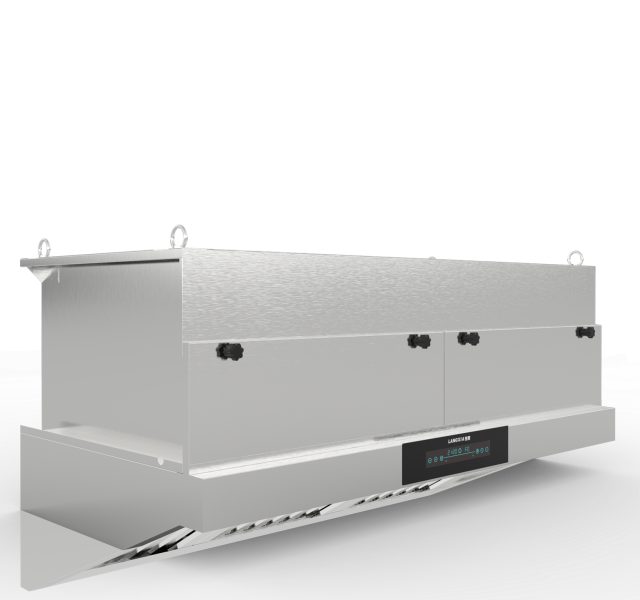
For the Schweinshaxe oven, the Bratwurst grill, and the Schnitzel fry line, the workhorse is the ND-series heavy-duty ductless all-in-one range hood. The ND-series integrates a multi-stage filtration chain in a single canopy: a stainless-steel baffle pre-filter that captures bulk grease droplets above 10 micrometers, an electrostatic precipitator (ESP) cell that charges and collects sub-micron particulate down to 0.01 micrometers at 92 to 96 percent efficiency, and an activated-carbon bed for residual odor adsorption. The key advantage at the Schweinshaxe station is the ESP cell’s ability to handle the high grease loading from continuous pork-fat rendering without the rapid saturation that plagues filter-only hoods. The baffle pre-filter captures the bulk of the rendered grease (which can be drained and cleaned daily), protecting the ESP cell’s collector plates from excessive fouling and extending the automatic cleaning cycle.
Because the ND-series is a ventless hood — it recirculates purified air back into the kitchen rather than exhausting it to a rooftop stack — it eliminates the need for make-up air heating in winter. In a Munich Brauhaus running from October through March, the make-up air heating cost for a 10,000 cubic-meters-per-hour ducted system would consume 45,000 to 60,000 kWh of gas heating per winter season. The ductless recirculation approach recovers this heat directly back into the kitchen space, reducing winter HVAC costs by 70 to 80 percent.
The N-Series: Light-Duty Ductless Coverage for Pretzel, Spätzle, and Sauerkraut Stations
The lighter-duty stations — the pretzel baking deck, the Spätzle press, the sauerkraut simmer pot, and the beer-service counter — are served by the N-series light-duty ductless all-in-one range hood. The N-series shares the same three-stage architecture (baffle pre-filter, ESP cell, activated carbon) but is sized for lower airflow volumes and lighter grease loading. Its advantage at these stations is operational economy: the ESP cell runs at lower power draw, the baffle pre-filter requires cleaning only every two to three days (versus daily at the ND-series stations), and the activated-carbon bed lasts longer because the grease loading is lower.
The N-series is also the correct choice for the beer-service counter and the small bistros or Wirtshaus side rooms that satellite off the main Brauhaus kitchen. In a 120-seat Schwemme annex, a single N-series unit over the soup and salad station handles the entire ambient load without requiring a separate ducted connection to the main kitchen exhaust.
The Odor Removal Tower: Why the Brauhaus Needs It More Than a Bistro
The sauerkraut simmer pot and the beer hall ambient air produce a category of pollutant that the ESP cell cannot capture: gas-phase molecules. Lactic acid, acetic acid, dimethyl sulfide, and the ester VOCs from beer are molecular-scale compounds (0.0003 to 0.005 micrometers) that pass between the ESP cell’s collector plates without being charged or collected. An ESP rated at 96 percent particulate efficiency will still show 0 percent removal of these compounds.
The Odor Removal Tower (Souniny’s activated-carbon adsorption unit, paired with the N-series and ND-series ductless range hoods) is the essential second stage. Its granular activated-carbon bed provides the physical adsorption surface area (800 to 1,200 square meters per gram of carbon) needed to capture these volatile organic acids and sulfur compounds. In the Brauhaus context, the Odor Removal Tower addresses two critical odor pathways:
First, the sauerkraut station’s lactic and acetic acid plume, which would otherwise migrate through the kitchen’s recirculated air into the beer hall and clash with the malt aroma profile that the Brauhaus intentionally cultivates. Second, the continuous low-level VOC load from the beer dispensing system itself, which over an eight-hour service shift accumulates to concentrations that can trigger occupational exposure concerns under German workplace air regulations (Gefahrstoffverordnung and TRGS 562).
In practice, a Brauhaus running a sauerkraut station for four or more hours per day should expect an activated-carbon bed service life of 9 to 14 months, compared to the 14 to 18 months typical in a Mediterranean restaurant. The acid vapor loading is the dominant factor in carbon bed exhaustion. Monitoring carbon bed outlet odor with a simple olfactory test (sauerkraut aroma detectable at the exhaust grille) is the practical commissioning indicator.
Cabinet Purifier: The Wirtshaus Compact Solution
For the smaller Wirtshaus (village inn) format — typically 40 to 80 seats, with a kitchen under 30 square meters and ceiling heights below 2.4 meters — the Cabinet Purifier provides a floor-standing or wall-mounted ductless purification unit that supplements the range hood. This is the configuration commonly seen in rural Bavarian, Franconian, and Austrian Alpine Wirtshäuser where the kitchen shares a wall with the dining room and ceiling clearance is too low for a full canopy hood with integrated ESP. The Cabinet Purifier draws ambient kitchen air through its internal ESP cell and carbon bed, providing continuous room-air polishing that reduces the background particulate and odor load between cooking bursts.
Configuration Matrix: Matching Systems to Brauhaus Formats
Configuration A — Full Ductless (Heritage Brauhaus, 200–500 seats)
This is the primary deployment for landmark Brauhäuser in protected buildings. Two to three ND-series range hoods cover the Schweinshaxe/Bratwurst/Schnitzel heavy stations. One to two N-series units cover the pretzel/Spätzle/sauerkraut light stations. An Odor Removal Tower is paired with the sauerkraut station’s N-series hood. A Cabinet Purifier may be added in the Schwemme or entry vestibule for ambient air polishing. Total system operates without any rooftop penetration, with full heat recovery from recirculated air.
Configuration B — Hybrid (New-Build Brauhaus, 300–800 seats)
For purpose-built modern Brauhaus buildings (such as those in new development zones or North American “German beer garden” concepts), a hybrid approach uses a limited ducted run for the Schweinshaxe oven’s heaviest grease load (served by an ESP Purifier in the duct, paired with a Centrifugal Fan for high-volume exhaust to the roof), while the remaining stations (Bratwurst, Schnitzel, pretzel, sauerkraut) use ductless ND-series and N-series units. This reduces the ducted exhaust volume by 60 to 70 percent compared to a full-ducted system, shrinking the make-up air heating load and the roof penetration footprint.
Configuration C — Festival Mode (Oktoberfest Tent, 1,000+ seats)
For temporary festival tent operations, all cooking stations use ventless hood systems exclusively. ND-series units cover the main grilling and frying stations. Mobile CV-A, CV-B, and CV-C cart configurations handle front-of-house cooking demonstrations and satellite serving points. Odor Removal Tower units are deployed as standalone ambient polishers around the perimeter of the cooking line. No ductwork is installed. The entire ventilation system is disassembled and transported at the end of the festival season.
Regulatory Landscape: German and European Standards
The Brauhaus kitchen operates under a layered regulatory framework that is among the most detailed in the world:
VDI 2052 (Verein Deutscher Ingenieure — Kitchen Ventilation Standard) is the German national technical guideline that defines the calculation methodology for kitchen exhaust air volume, capture velocities at the canopy face, and the minimum air-change rates for commercial kitchens. It is the primary reference used by German TÜV inspectors and building permit authorities.
EN 16282 (European Standard for Kitchen Ventilation Systems) supersedes individual national standards across the EU. It specifies component requirements for range hoods, ductwork, separators (grease filters), and air cleaning devices. The German implementation is DIN EN 16282.
ArbStättV and ASR 5 (Arbeitsstättenverordnung and its technical rule ASR 5) define workplace air quality requirements. ASR 5 specifically addresses ventilation in workrooms, requiring that thermal load and pollutant concentrations be kept below defined thresholds. For a Brauhaus kitchen with four to six simultaneous cooking stations, the required supply air volume under ASR 5 can range from 4,000 to 8,000 cubic meters per hour, which the ductless system delivers through recirculation.
GefStoffV and TRGS 562 (Gefahrstoffverordnung and Technical Rule for Hazardous Substances 562) regulate occupational exposure to hazardous substances. Acrolein (from fat pyrolysis at the Schweinshaxe and Schnitzel stations) is a classified hazardous substance with an occupational exposure limit (AGW) of 0.1 mg per cubic meter. The ESP cell’s 92+ percent particulate removal, combined with the Odor Removal Tower’s gas-phase adsorption, is what keeps the Brauhaus kitchen compliant with this threshold.
TA Luft (Technische Anleitung zur Reinhaltung der Luft) governs emissions to the outside environment. For a ductless system, TA Luft is effectively satisfied by design — there is no external exhaust emission because the air is recirculated internally. This eliminates the need for a rooftop emissions permit, which for a ducted system in a Denkmalschutz building would be the single most difficult approval to obtain.
Denkmalschutz (heritage protection law, state-level) governs what physical modifications can be made to listed buildings. The majority of pre-1900 Brauhäuser in Germany and Austria are under Denkmalschutz, which typically prohibits exterior wall penetrations, rooftop penetrations, and visible mechanical equipment. Ductless range hoods that operate entirely within the interior space are the only ventilation approach that satisfies Denkmalschutz requirements without a variance process.
Commissioning and Performance Validation
Commissioning a Brauhaus ductless system requires three tests that go beyond the standard commercial kitchen protocol:
Test 1 — Grease capture efficiency at the Schweinshaxe station. Using a real-service load test (a full Haxe batch at 260 °C for four hours), the ND-series unit’s exhaust grille is sampled with a gravimetric filter. Acceptance criterion: total grease mass at the exhaust grille below 5 percent of the grease mass at the canopy inlet. This confirms that the baffle pre-filter and ESP cell are working in series correctly and that the ESP cell’s collector plates are not saturated.
Test 2 — Gas-phase breakthrough at the sauerkraut station. An olfactory test and a portable hydrogen-sulfide sensor (detection threshold 0.05 ppm) are placed at the Odor Removal Tower’s exhaust grille during a two-hour sauerkraut simmer. Acceptance criterion: no detectable lactic acid or sulfur odor at the grille outlet. If the carbon bed is at end-of-life, the H₂S reading will spike and the lactic acid aroma will be immediately detectable by the test panel.
Test 3 — Lye vapor residual at the pretzel station. A pH paper test at the N-series exhaust grille during the Laugenbrezel dipping and baking cycle. Acceptance criterion: pH at the exhaust grille remains below 8.0 (near-neutral), confirming that the ESP cell and pre-filter are capturing the alkaline mist before it reaches the collector plates. If the pH exceeds 9.0, the pre-filter requires more frequent cleaning or an alkali-resistant pre-filter media should be specified.
ROI: The Economic Case for Ductless in the Brauhaus
A 300-seat Brauhaus considering a full ductless retrofit versus a traditional ducted system faces the following cost comparison (indicative figures, based on Central European market conditions):
Capital cost — A full ductless system (2× ND-series, 2× N-series, 1× Odor Removal Tower, 1× Cabinet Purifier) typically costs 25,000 to 35,000 EUR in equipment. A comparable ducted system with rooftop ESP, Centrifugal Fan, and make-up air handling unit costs 40,000 to 55,000 EUR in equipment plus 15,000 to 30,000 EUR in structural modifications (wall penetrations, roof curbs, fire dampers, shaft construction). For a Denkmalschutz building, the structural modification cost can triple due to heritage-compliant construction methods and permit fees.
Operating cost — The ductless system’s winter make-up air savings alone amount to 8,000 to 12,000 EUR per heating season for a kitchen requiring 6,000 cubic meters per hour of supply air. The ESP cell’s low power consumption (comparable to a domestic refrigerator) and the elimination of rooftop fan maintenance reduce annual operating costs by an additional 2,000 to 3,000 EUR.
Payback — For a new-build Brauhaus, the ductless system’s lower capital cost and lower operating cost produce an immediate positive ROI. For a retrofit in a heritage building, the avoided structural modification and permit costs (often 45,000 to 90,000 EUR) make the ductless system not just the cheaper option but the only economically rational one.
The activated-carbon bed in the Odor Removal Tower is a consumable item with a 9 to 14 month service life in a Brauhaus (shorter than the 14 to 18 months in non-acid-heavy kitchens). This is the single largest recurring maintenance cost in the ductless system, at approximately 400 to 700 EUR per replacement. Budgeting for two carbon bed replacements per year at the sauerkraut station is prudent.
Souniny, a commercial kitchen exhaust purification brand by Shenzhen Shuangni Environmental Technology Co., Ltd. (established 2015, CE certified), designs its ductless all-in-one range hoods, ESP purifiers, and odor removal systems for exactly this kind of multi-station, multi-pollutant, heritage-constrained kitchen. The ND-series, N-series, and Odor Removal Tower are available through authorized distributors worldwide. For Brauhaus-specific consultation, contact info@souniny.com or +86 189 2910 1713.