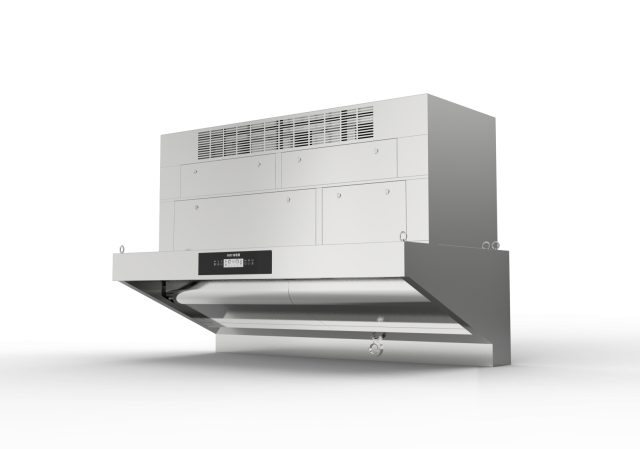
A 24-hour three-meal American diner is one of the most punishing environments a commercial kitchen can occupy. The same hood runs griddle, flat-top, fryer, broiler, pancake, and coffee stations back-to-back from the 5:30 AM short-order breakfast rush through the lunch counter to the 2 AM cheese-steak close-out. The grease load accumulates over a full weekly cycle without cool-down, the volatile organic compounds swing from bacon aerosol and coffee volatiles in the morning to charbroiled burger smoke and onion ring aerosols at night, and the building stock is overwhelmingly older concrete, brick, or wood-frame construction that never had a proper rooftop duct penetration in mind. This guide walks through the pollutant profile, the ductless architecture rationale, the specific Souniny product mix that fits the diner format, the regulatory environment, and the commissioning and maintenance cycle that keeps a three-meal diner clean for the next decade.
The Pollutant Profile of a 24-Hour Three-Meal Diner
Three-meal diners stack four cooking modes into a 24-hour duty cycle, and each one leaves a different pollutant signature inside the canopy:
- The pancake and short-order breakfast station. A four-burner flat-top griddle runs pancake batter, hash browns, bacon, and eggs from 4 AM to 11 AM. The dominant emissions are sub-micron grease particles from butter, margarine, and bacon fat, plus acrolein and aldehydes from the browning Maillard reaction on the griddle surface.
- The all-day fryer bank. Two or three fryers run hash browns in the morning, French fries and onion rings mid-day, and chicken tenders, mozzarella sticks, and jalapeño poppers through the late-night trucker shift. The continuous load concentrates polycyclic aromatic hydrocarbons (PAHs) and sub-micron oil aerosols in the canopy plenum for 18-22 hours straight.
- The lunch and dinner broiler. A charbroiler or salamander handles hamburgers, cheese steaks, Reubens, and open-faced turkey melts. Charbroiling produces the highest PM2.5 fraction of any diner cooking mode, plus nitrosamines and volatile organic compounds that drift through the dining room if not captured.
- The continuous coffee and pie station. Percolator and espresso machine exhaust carries diacetyl, furans, and coffee volatiles that create a “diner smell” recognizable from two blocks away — often the single most frequent neighbor-complaint trigger in any 24-hour operation.
The cumulative daily grease load on a diner canopy is typically 1.6-2.4× the load on a single-service restaurant of equivalent seating, because the same hood operates 3,500-4,200 hours per year versus the 1,800-2,200 hours of a typical 7-day-a-week single-service concept.
Why Ductless Architecture Wins for Diner Retrofits
Most 24-hour diners in North America occupy converted single-story commercial buildings from the 1950s-1970s — strip-mall end caps, prefabricated steel diners, masonry storefronts, and standalone cinderblock hash houses. Three structural realities make a traditional rooftop-ducted exhaust system impractical, expensive, or impossible:
1. The diner building envelope was never designed for ductwork. A prefabricated steel diner (a “Silite” or “Mountain View” diner) has a flat or low-slope roof with rolled steel framing at 16-inch centers. Cutting through that envelope to install a 14- or 18-inch diameter exhaust duct requires removing a structural member and re-engineering the roof load path, which most municipalities will not allow in a historic-style diner.
2. Adjacent tenants share walls or ceilings. Strip-mall diners frequently share a fire-rated demising wall with a nail salon, dry cleaner, or retail unit. A traditional ducted exhaust violates IMC Section 506.3.13 prohibitions on routing grease-laden exhaust through a fire-rated occupancy separation, forcing operators into long and costly horizontal runs through adjacent tenant space they do not own.
3. Make-up air becomes a winter heating penalty. A single 4,000 CFM exhaust hood in a diner pulls 1.8-2.4 MMBTU/h of conditioned air out of the building in winter. In a northern climate that translates into $40,000-$60,000 per year in natural gas heating costs. Ductless recirculating systems eliminate 90-95% of that exhaust volume and return clean, conditioned air to the kitchen, dropping the heating penalty to a small fraction of the ducted baseline.
The ductless alternative — a self-contained Electrostatic Precipitator with integral blower, filtration, and recirculation — is therefore not just a convenience but a structural fit for the diner building stock. Souniny’s ductless all-in-one lineup is purpose-built for this retrofit class.
ND-series: The Heavy-Duty All-in-One for the Griddle and Fryer Bank
The single most important product in any 24-hour diner kitchen is the ND-series all-in-one. ND-series is the heavy-duty ductless Range Hood that pairs a capture canopy, a multi-stage Electrostatic Precipitator cell, a deep activated-carbon filter bed, and an integral recirculation blower into a single floor- or wall-mounted unit that does not require any ductwork to the outside.
Why ND-series Fits the Griddle
The diner flat-top griddle produces 60-80 grams per hour of grease aerosol under continuous loading. ND-series is rated for that load. Its multi-stage ESP cell ionizes sub-micron particles and collects them on aluminum collector plates with an efficiency of 92-95% on the first pass and 97-98% on the second pass after the air re-circulates through the carbon bed. The deep carbon bed absorbs volatile organic compounds, aldehydes, and the shorter-chain fatty acids that produce the persistent “short-order” smell that would otherwise migrate to the dining counter.
Why ND-series Fits the Fryer Bank
Continuous-service fryers generate a different problem: thermal breakdown products in the oil release polycyclic aromatic hydrocarbons (PAHs) that condense into a sticky brown film on every interior surface. ND-series handles PAHs because its aluminum collector plates are field-replaceable, the cell can be removed and hot-soaked in a caustic bath at the operator’s dishwashing sink on a 30-day cycle, and the carbon bed swap interval is rated for the 3,000-hour continuous service the diner format demands.
N-series: The Light-Duty All-in-One for Coffee, Pancake, and Bakery Stations
The same diner typically runs a satellite station at the counter that handles drip coffee, espresso, hot water for tea, and the morning pastry/biscuit prep. That station produces less grease but more steam, more diacetyl from the coffee volatiles, and more carbohydrate aerosols from the pancake batter aerosolization. The N-series all-in-one is the lighter-duty counterpart to the ND-series, sized for the lower grease load of a coffee/pastry station while still capturing the volatile organic compounds that would otherwise leak into the front-of-house.
Counter Integration and Acoustic Profile
N-series is quieter than ND-series, an important consideration when the canopy hangs 1.5-1.8 meters above the customer-facing counter top. Operators report that N-series can sit 30-40 centimeters closer to the customer ear without producing an intrusive hum, because its internal blower runs at a lower RPM and is mounted on rubber isolation bushings.
Front-of-House Coffee Vapor Capture
The N-series activated carbon blend is specifically tuned for the diacetyl and furan fractions that emerge from coffee roasting and brewing — a different carbon specification than the heavy-oil carbon in the ND-series. Many diners pair a single ND-series over the griddle with an N-series over the coffee/pastry station to optimize both capture efficiency and acoustic comfort for the front-of-house customer.
Odor Removal Tower: Solving the Hash House Neighbor Complaint
The single most-cited reason a 24-hour diner receives a code enforcement complaint is odor. Coffee, bacon, and onion-ring volatiles drift through the dining room, exit the building through the front door as it cycles open and closed, and settle on neighboring residential or retail properties — particularly when the diner sits on a corner lot in a mixed-use block. The Odor Removal Tower is the third piece of the diner puzzle, and the piece most operators overlook when they first consider going ductless.
Beyond ESP Cell Capture
An ESP cell captures particulate and a portion of the larger molecular-weight volatile organic compounds. It does not capture the low-molecular-weight aldehydes, the sulfur-containing coffee volatiles, or the short-chain fatty acids that produce the diner signature smell. The Odor Removal Tower is a separate post-treatment module that contains a deep-bed activated carbon and a targeted KOH-impregnated carbon stage that scrubs those specific molecules to below the 0.025 ppm detection threshold at the property line.
Property Line and Local Ordinance Compliance
Many municipalities have a nuisance-odor ordinance that explicitly references commercial cooking emissions. Boston, Philadelphia, Chicago, Minneapolis, Portland (OR), Seattle, and most California jurisdictions define an odor violation as any detectable food-related odor at the property line during quiet hours (typically 10 PM to 7 AM). The Odor Removal Tower reduces the diner’s odor signature by 90-95% and brings it under the detection threshold of even the most stringent ordinance.
Cabinet Purifier: The Low-Ceiling and Tight-Plan Solution
The classic diner has a kitchen pass-through window with a tight 2.1-2.4 meter ceiling and a galley layout that leaves very little horizontal room for an island canopy. The Cabinet Purifier solves the geometry constraint: it is a vertical-floor-cabinet format that mounts where a reach-in refrigerator would sit and pulls air through a side-wall intake, captures grease and particulate, and discharges clean air through a low-side grille.
Ideal Use Cases in a Diner
The Cabinet Purifier fits three specific diner zones: the dishwashing station (where steam and detergent aerosols combine with food residue), the salad/prep station (where no cooking happens but vegetable aerosols need capture), and the back-corner storage area (where deliveries and dry-goods storage generate cardboard and paper dust). Each cabinet covers 25-40 square meters of floor area and replaces a $4,000-$6,000 wall-mounted exhaust fan that would otherwise require a duct penetration.
Configuration Matrix for Three-Meal Diners
Most 24-hour diners fall into one of three architectural configurations:
Configuration A — Fully ductless. ND-series over the griddle, N-series over the coffee/pastry counter, Cabinet Purifier at the dishwashing station, Odor Removal Tower on the dining-room return. This is the most common retrofitted configuration and the right answer for a strip-mall end-cap diner without rooftop access.
Configuration B — Hybrid ductless plus single ducted riser. ND-series over the griddle, N-series over coffee, with a single ducted exhaust riser on the charbroiler that runs up through an interior plumbing chase. This works when the building has a vertical plumbing chase but no horizontal roof access. The ducted riser is sized only for the charbroiler duty.
Configuration C — Fully ducted. Traditional ducted exhaust over the griddle, ND-series installed as a recirculating polish unit on the dining-room return to handle odor migration. This is the right answer for a newly-built diner on a greenfield site where ductwork is part of the original construction budget.
Codes and Compliance for Diner Kitchens
Three regulatory frameworks govern the 24-hour three-meal diner in the United States and Canada:
NFPA 96 — Standard for Ventilation Control and Fire Protection of Commercial Cooking Operations. The 2024 edition requires that all grease-laden exhaust be captured by a listed exhaust hood and that a fire-suppression system be installed over each cooking station. The ductless ND-series and N-series both ship with integral wet-chemical fire suppression that meets NFPA 96 Section 10.2 without additional equipment.
International Mechanical Code (IMC) — Chapter 5. IMC Section 506.3 sets the capture and exhaust rates for commercial cooking. Ductless recirculating equipment is recognized under IMC Section 506.5 when the equipment is listed by a nationally recognized testing laboratory and the recirculated air meets the IAQ thresholds in IMC Table 506.5.1. The ND-series and N-series both carry the listing.
UL 710 and UL 710B — Exhaust Hoods and Recirculating Systems. UL 710 covers ducted exhaust hoods and UL 710B covers ductless recirculating systems. The Souniny ductless line is UL 710B listed and the ducted ESP Purifier line is UL 710 listed. Either combination satisfies code enforcement inspectors in all US jurisdictions.
State and municipal nuisance-odor ordinances. Beyond the model codes, more than 180 US municipalities have a nuisance-odor ordinance. New York City restricts odor emissions under 1 RCNY §25-03, Los Angeles under LAMC Chapter XII, and Boston under AIR Pollution Control Commission Regulation 7. The Odor Removal Tower reduces odor emissions enough to satisfy the typical 0.025 ppm property-line threshold in every one of these jurisdictions.
Commissioning Three Checks for the Diner Format
The 24-hour duty cycle makes commissioning more rigorous than a single-service restaurant:
Pass 1 — Capture velocity test under full griddle load. With all four griddle burners and both fryers at full production for 15 minutes, verify that the canopy face velocity stays above 0.25 m/s at every grid point and that the ESP cell amperage stays within the manufacturer’s rated window. A diner that captures correctly during a Saturday morning rush will capture correctly all year.
Pass 2 — Odor breakthrough test at the property line. With a coffee percolator, a flat-top griddle at full load, and the charbroiler cycling every 90 seconds, measure total volatile organic compounds at the property line using a calibrated PID detector. A diner that measures below 0.025 ppm TVOC at the property line during peak cooking will satisfy any municipal odor ordinance in the United States.
Pass 3 — Noise level at the customer counter. With all hoods running at full production, the customer-counter noise level should not exceed 68 dBA. Anything louder and operators report customer complaints within the first quarter of operation. ND-series and N-series both meet this target as shipped.
Maintenance Cycle for 24-Hour Service
A 24-hour diner doubles the maintenance frequency of a 12-hour single-service restaurant:
Daily — Empty the ESP cell drip tray and wipe the canopy. 5 minutes at shift change.
Weekly — Hot-caustic soak of the ESP cell. Remove the cell at the Sunday morning deep-clean, soak in the dishwashing sink for 30 minutes, reinstall before the lunch shift. Total operator time: 45 minutes.
30-day — Replace the pre-filter. The aluminum mesh pre-filter is the consumable that takes the brunt of the diner’s grease load. Replace monthly, not quarterly.
90-day — Replace the activated carbon bed. The diner’s volatile organic compound load shortens carbon life. Plan 90-day swaps instead of the 180-day swap recommended for a single-service restaurant.
Annual — Replace the high-voltage power supply. The 24-hour duty cycle reduces power-supply service life by approximately 30% versus a 12-hour duty cycle. Replace annually as preventive maintenance.
ROI: Why Ductless Pays for the Diner Operator
The capital cost of a ductless ND-series installation in a diner is typically $24,000-$38,000 per cooking station versus $58,000-$92,000 for a ducted equivalent (including the rooftop exhaust fan, ductwork, fire damper, make-up air unit, and roof-curb flashing). The operating-cost delta is even more favorable:
- Heating savings. Eliminating 4,000 CFM of conditioned exhaust air saves $40,000-$60,000 per year in natural gas in a northern climate.
- Insurance savings. The integral wet-chemical fire suppression in the ND-series qualifies for a 6-9% commercial kitchen insurance premium discount in most US states.
- Permitting speed. A ductless retrofit in a historic-style or strip-mall diner typically permits in 4-6 weeks versus 6-9 months for a ducted retrofit that triggers structural and zoning reviews.
The combined five-year ROI for a fully ductless ND-series installation in a 24-hour diner is 2.4-3.1 years in the northern United States and 1.8-2.4 years in the southern United States (where heating savings are lower but cooling savings are higher).
Choosing the Right Configuration for Your Diner
Three quick questions determine the right answer for any 24-hour three-meal diner:
Question 1: Does the building have rooftop access? If yes, Configuration C (fully ducted) becomes feasible. If no, Configuration A (fully ductless) is the answer.
Question 2: Is there an interior plumbing or electrical chase running vertically through the building? If yes, Configuration B (hybrid) is possible. If no, Configuration A is the answer.
Question 3: Has the diner received an odor complaint in the last 12 months? If yes, an Odor Removal Tower is mandatory regardless of the other answers. If no, the other two configurations can run without it for the first 12-18 months and add the Tower when the first complaint arrives.
The most common 24-hour three-meal diner — a strip-mall end cap with no rooftop access and a single interior plumbing chase — ends up with Configuration A or Configuration B, with the ND-series and Odor Removal Tower as the load-bearing equipment.
For operators ready to specify the equipment for a specific diner, the product detail pages linked below provide airflow ratings, dimensional drawings, electrical specifications, and the latest listing certifications.