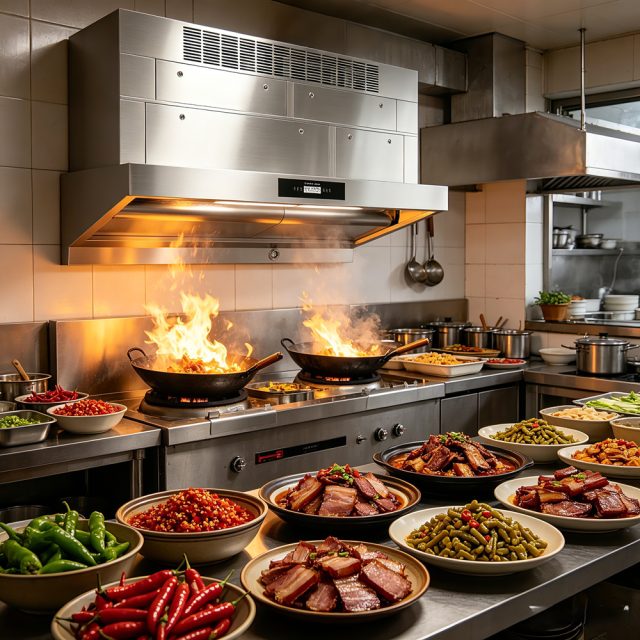
An Argentine parrillada is more than a restaurant line — it is a piece of asado culture exported abroad. Wood and charcoal combustion, continuous 24-hour asado cooks, empanada fryers, and chimichurri prep rooms share the same kitchen envelope, and each one pushes a different pollutant into the same dining room. Most Argentine restaurants abroad operate inside older buildings without rooftop duct access, which is exactly why a ductless ND-series, N-series, and Odor Removal Tower stack has become the standard solution for the modern parrillada.
1. The Argentine Parrillada and Its Ventilation Burden
Argentine asado is built on three pillars that converge on the line: the parrillada — a wood- and charcoal-fired grill built from angle iron and expanded metal — the empanada station that fries or bakes a dozen regional varieties per service — and the cold kitchen that preps chimichurri, salsa criolla, and provoleta for the pass. Unlike a Western sauté line, the parrillada burns solid fuel at 600 to 800 °C for the entire service, the empanada fryer sits at 175 °C on standby with intermittent drops through peak hours, and the prep room runs continuously from morning mise en place through close. The dining room — the salón principal — sits 4 to 7 meters away with no physical separation in most converted-storefront locations, which means every gram of grease-laden vapor, every PAH from a charcoal flare-up, and every drop of chimichurri VOC reaches the guest.
The spread abroad has been rapid: Buenos Aires native concept La Carniceria opened its first US parrillada in Miami’s Wynwood, and London has seen three new asado rooms in Bermondsey and Hackney since 2023. Sydney, Auckland, Madrid, and Mexico City now host standing asado menus that run from Thursday through Sunday. None of these venues started with a purpose-built kitchen; nearly all run inside pre-existing retail or office buildings, and most cannot install rooftop ductwork without a full building-envelope engagement. That constraint is what makes the ductless + odor-removal stack the most economical way to launch an Argentine concept.
2. Four Pollutant Streams an Asado Kitchen Generates
2.1 Parrilla Grease and Charcoal Combustion
When beef fat drops onto coals and wood embers, the result is a flash flame that aerosolizes long-chain aldehydes and very fine sub-micron particulate (PM2.5 and smaller). These aerosols stay airborne for hours and carry polycyclic aromatic hydrocarbons (PAHs), which are the strongest smoking-gun component of any solid-fuel cooking plume. NFPA 96 has classified this as a Type I hood payload since the 2017 edition — solid-fuel cooking requires a listed extinguishing system over the grill surface, and that hood needs high capture velocity, typically ≥0.4 m/s at the perimeter of the grill, to keep the plume from leaking past the canopy edge.
2.2 Empanada Fryer and Buñuelo Stations
Argentine beef empanadas (salteñas, tucumanas, picanas) and chicken empanadas (santiagueñas) are either deep-fried or oven-baked. The fryer emits sub-micron oil aerosol from the high-temperature breakdown of beef tallow, chicken skin fat, and onion-wine-soaked filling drips. The buñuelos fritos and torta frita stations push intermittent but heavy fat plumes that peak at service (8:30 PM onward on Friday and Saturday nights). A single empanada fryer load can spike 30 to 60 seconds of visible haze above the pot, even when the oil is at correct temperature.
2.3 Chimichurri and Salsa Criolla Prep
The cold kitchen emits low-rate but constant VOCs: parsley and garlic allyl sulfide from chopping, oregano terpenes, red wine vinegar acetic acid, and the citrus peel oils squeezed over each plate on the pass. These VOCs are not visible and do not show up as grease load on filters, but they linger in the salón principal for 90 minutes after service if not intercepted at the prep table.
2.4 The 24-Hour Asado and Continuous Make-Up Air Burden
Many true parrilladas do not reset the line each night: the embers are buried, the grill holds warm coals, and the parrilla a la estaca (cross-style spit) might run for 14 hours continuous Sunday service. That continuous-load profile means the exhaust system never idles for long; capture velocity drifts up and down through the night. In ducted systems this would mean a constant make-up air draw from outside — in ductless recirculating systems the make-up air requirement drops by 80 to 90% because the room does not lose heated or cooled air through the duct.
3. Why Ductless Wins for Most Argentine Restaurants
Three property realities push the ductless architecture to the front for the typical Argentine venue abroad:
3.1 Heritage and mid-century building envelopes. The most common parrillada locations are 1950s to 1970s steel-and-masonry boxes in cities like Buenos Aires’ San Telmo and Palermo, New York’s Garment District, or Madrid’s Lavapiés. These buildings cannot easily host a 30-meter vertical duct run from the kitchen through the roof structure without a shaft extension and roof curb — an engineering project that can cost as much as the kitchen build-out itself.
3.2 Shared party-wall and condominium associations. An Argentine restaurant in a multi-tenant building almost always faces neighbor objections to fan noise and stack discharge. Ductless systems sit the blower inside the unit, eliminating rooftop-discharge noise entirely.
3.3 Asado’s signature aroma is also its regulatory problem. Wood and charcoal smoke at service smells like grass-fed beef tallow at low concentration, but at property-line concentration it is reportable as a nuisance discharge under most US jurisdictions’ general nuisance ordinances. A ductless unit that recirculates most of its air and treats the rest with a dedicated adsorbent brings odor to sub-detectable at property line without a civil engineering project.
That is why the standard parrillada stack has become an ND-series all-in-one over the grill, an N-series over the fryer line, plus an Odor Removal Tower on the room’s exhaust leg. The ductless design removes the structural retrofit problem, and the ductless efficiency removes the make-up air penalty.
4. Configuration A: A Standalone Parrilla Station (Ductless ND-series Lead)
The most common configuration abroad is a single dedicated parrillada room of 50 to 100 m² with one main line: a heavy-duty ND-series all-in-one mounted 1.6 to 2.4 m above the parrillada grate, with an Odor Removal Tower tee’d off the room’s supply stream to scrub the residual olor a asado before air returns to the salón principal.
This configuration fits the majority of US and European Argentine restaurants for three reasons. First, the parrillada is the dominant emitter: closing it down stops 70 to 80% of total kitchen emission. Second, ND-series units are designed specifically for heavy-duty grease loads and long-shoulder capture — they carry an electrostatic precipitator stage that drops captured grease to a sealed collection tray, so the operator never has to scrape the canopy itself. Third, the Odor Removal Tower handles the long-tail odor that a charcoal parrillada will leak even after the canopy captures most aerosols. The tower cycles a wide-spectrum adsorbent that breaks down long-chain aldehydes and the volatile fraction of PAHs that survive the electrostatic stage.
5. Configuration B: Empanada Fryer and Chimichurri Compact Line
Many Argentine venues operate the parrillada as the hero line and the fryer plus chimichurri prep as a tighter, faster-changing operation. In this compact layout an N-series light-duty unit paired with a Cabinet Purifier over the chimichurri prep station hits the right cost point: N-series absorbs the fryer aerosol and intermittent pastry-bake smoke, and the Cabinet Purifier scrubs the herb-and-vinegar VOC at the prep table. Both units are ductless, so the chef can rearrange the line without re-engineering the front- and back-of-house geometry as menus evolve. The combined configuration is also acoustically friendly: both products are sub-50 dBA at 1 m, which matters when the línea caliente sits 2 to 3 m from a guest counter where patrons watch the empanadas come out.
6. Configuration C: A High-Volume 24-Hour Asado with a Back-of-House Grill Pantry
6.1 When Ducted Makes Sense
For the largest Argentine venues — multi-floor destinations in Buenos Aires’ Puerto Madero or the high-volume asado rooms at Miami’s La Paternal — the ducted approach remains valid. The driver’s decision matrix changes when: (a) total grill surface exceeds 8 m², (b) the venue operates parrilla a la estaca with a continuous cross-spit, or (c) the venue runs an open-flame Argentine wood-fired oven for provoleta and a clay horno for chanfaina. In these cases a ducted configuration with an ESP Purifier on the grill line plus a Centrifugal Fan on the upper-discharge leg is the right primary. This is the venue class where kitchen electrostatic precipitator units earn their install cost — high grease load, high continuous duty, and the existing rooftop is engineered for stack discharge.
6.2 Pairing the Electrostatic Precipitator with the ND-series
Even at high-volume venues, the ductless ND-series remains useful as a secondary over auxiliary stations: the dry-aging cabinet, the croqueta prepper, the post-grill carving station. Operators typically install one ducted main for the heavy emitter and one or two ND-series for the supporting stations — the main carries the bulk of the discharge on the rooftop side, and the ND-series carry the trim and prep-side aerosol without adding to the ducted stack. This keeps the make-up air requirement proportional to the main-line duty rather than the full kitchen load.
7. Regulatory and Standards Compliance
7.1 United States (NFPA 96, IMC, UL, NYC FC §509)
Solid-fuel cooking in the United States falls under NFPA 96 (Standard for Ventilation Control and Fire Protection of Commercial Cooking Operations, 2024 edition), which Class A limits — typically the strictest in the standard — apply to the parrillada line. Specifically, NFPA 96 §10.2.4 lists cooking equipment that produces grease-laden vapors at rates high enough to require Type I hood suppression, and §14 calls for an automatic fire-extinguishing system over any solid-fuel cooking surface. The International Mechanical Code (IMC) §506.3 requires Type I grease-rated hoods over solid-fuel cooking surfaces; Table 506.5.1 sets minimum exhaust rates for solid-fuel broilers. UL 710 and UL 710B provide the certification path for grease extractors and downdraft units, respectively. In New York City, Fire Code §509 imposes additional requirements on commercial cooking equipment in occupancy groups A, B, E, I-2, and R-2, and the 2014 NYC Fuel Gas Code §614 covers salamander-and-wood-burning appliance placement. Many Argentine restaurants across NYC’s five boroughs are non-compliant with these codes at opening because the original owner’s architect under-projected the asado load.
7.2 Argentina and the Southern Cone (IRAM, GCBA Decreto 198)
In Argentina the applicable standards are IRAM 3705-1 (Cocinas comerciales. Condiciones generales) and IRAM 3705-2 (Cocinas comerciales. Condiciones específicas para campanas de extracción), published by Instituto Argentino de Normalización y Certificación. These set minimum canopy sizes, capture velocity, and filter access for commercial kitchens. In the City of Buenos Aires, the governing food-and-ventilation ordinance is Ley N° 2688 (Régimen de prevención y control de la contaminación atmosférica) — which is enforced as Decree 198/GCBA/2006, Regulating Decree — together with Ley 1.540 GCBA (Treatment of gaseous effluents and odors). The Argentine regulator is particularly focused on the asado column: any parrillada within 200 m of a school, hospital, or daycare has additional limits on chimney height under Anexo IV of Decreto 198/06. Uruguay has its own UNIT-ISO equivalency; Chile references NCh 3055 (Cocinas industriales). Parishes adjacent to the Argentine food halls of Buenos Aires still fall under these national-level rules.
7.3 Europe and Australia (EN 16282, AS 1668.2)
In EU member states, parrilladas in Spain, Italy, France, Portugal, and Germany are subject to EN 16282-9 (Kitchen ventilation — Part 9: Performance testing of extraction systems for commercial kitchen extractor hoods). In the UK (BS 6173 for catering extraction) and Germany (DIN 18869 part 5) additional restrictions on grease discharge from solid-fuel cooking apply. In Australia, AS 1668.2 governs commercial kitchen extraction, with solid-fuel cooking calling for Type 1 hoods and provision of a spark arrester to prevent ember escape from the duct. The parrillada’s open-flame ember source means any European or Australian installation needs a spark arrester at the discharge, not just an electrostatic stage — a fact that many operators ignore when importing a unit from the US market.
8. Acoustic Management and the Salón Principal
The open salón principal is part of the asado experience — guests see the charcoal and hear the wood crackle. The kitchen ventilation cannot interfere with that. Ductless ND-series units, when sized and balanced, run at sub-55 dBA at 1 m because the blower is inside the unit rather than on the rooftop. For venues that require even quieter operation during wine-pairing dinners, an N-series or Cabinet Purifier on the prep side drops that further to sub-45 dBA. The ductless architecture also removes the rooftop stack as a noise source — important when the venue sits in a heritage district or in a multi-tenant building where any rooftop plant causes complaints.
9. Cleaning Cycles and Charcoal Season
An ND-series unit in a parrillada sees heavy grease deposition because of the continuous grate use. Most operators run a 14 to 30 day cleaning cadence aligned with charcoal-stock restocking; the easy-empty collection tray on ND-series is designed to take a full weekend service without emptying. The ash and char residue from the parrillada itself should be cleaned daily into a metal ash bin — never into plastic — and the cabinet filter on the N-series can be swapped in 5 minutes during a slow service. Summer service is the highest-load part of the year; the verano runoff of December through March in the Southern Hemisphere and May through August in the Northern Hemisphere both push the venue to 70%+ capacity for consecutive days, which is the operational test that separates a properly-spec’d ductless stack from an undersized ducted retrofit.
10. Implementation Checklist
For a new Argentine restaurant or a retrofit from a non-Argentine predecessor, the safer sequencing is: site survey and pollutant load estimate → review of local fire and health regulations → review of building envelope and rooftop access → ND-series selection for the parrillada line and N-series selection for the fryer + prep → Odor Removal Tower sizing using the projected odor-load profile → Cabinet Purifier for the chimichurri prep station → acoustic verification against the salón principal background → commissioning with the local code official present → 14-day observation period at peak service → cleaning schedule setup → handover to operations. If any of these steps is skipped, the venue is at risk of having an under-sized capture, an over-drafting make-up air burden, or a property-line odor complaint.
For venues that are scaling up or converting from a non-Argentine predecessor, the practical decision boundary between ductless and ducted is small (8 m² of grill surface, sustained 12+ hour per day service, presence of a rooftop stack). Below that threshold ductless wins on cost, permits, and speed of install. Above it, ducted with an ESP Purifier becomes the wiser long-term investment — but the ductless ND-series backbone remains the right complement for trim and prep stations even on ducted sites.