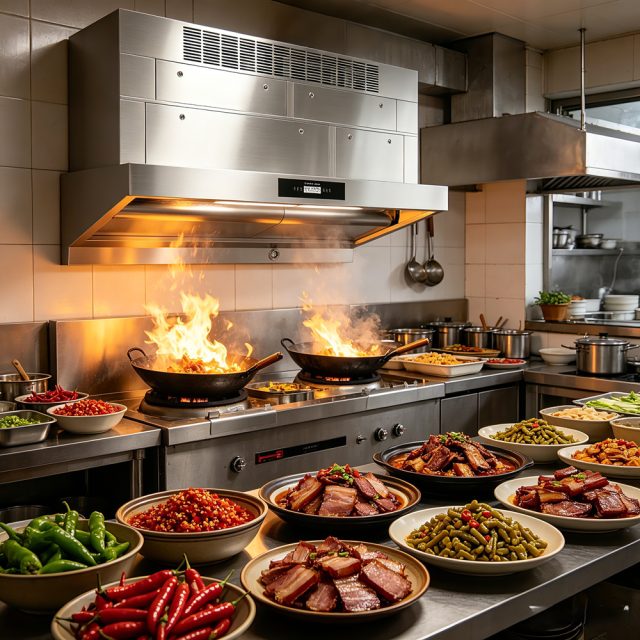
A premium steakhouse or classic chophouse lives or dies by two sensory impressions: the sizzle on the plate and the air in the dining room. When broilers, infrared salamanders, plancha griddles, and searing stations run at full output, they generate a concentrated load of grease-laden vapor, sub-micron particulate, polycyclic aromatic hydrocarbons (PAHs), and volatile organic compounds (VOCs). In many locations, routing a new exhaust duct through a landlord-managed building or a historic facade is either prohibitively expensive or structurally impossible. Souniny solves this with a ductless product mix built for heavy American protein cookery: the ND-series heavy-duty all-in-one range hood for the broiler and griddle line, the N-series light-duty all-in-one range hood for prep and finishing stations, and the Odor Removal Tower to neutralize the distinctive aroma of dry-aged beef and rendered fat before it reaches the dining room.
Why Steakhouse Exhaust Is Different from a General Restaurant
Steakhouses and chophouses do not produce the same emission profile as a café or a sandwich shop. The dominant sources are:
- Broilers and overhead infrared burners — 650–870 °C radiant heat that instantly vaporizes surface fat, creating a dense plume of grease-laden vapor.
- Plancha griddles and flattops — continuous rendering of intramuscular fat, generating a steady stream of fine particulate and odor.
- Pan-searing stations — high-temperature contact with butter, oil, and beef juices, producing smoke bursts and aerosolized grease.
- Dry-aging rooms and butcher prep — not a cooking source, but a persistent odor reservoir that can migrate through corridors and HVAC.
- Charcoal or wood-fired finishing — when present, adds sub-micron carbon particulate and PAHs to the load.
Together, these loads push the kitchen toward a heavy oil-fume classification at the broiler line and a light-to-medium classification at prep, pastry, and garde-manger stations. A single generic hood is rarely the right answer; the ventilation plan must be zoned by cooking intensity. That is why Souniny recommends a layered ductless architecture rather than a one-size-fits-all ESP box.
The Ductless Advantage in Urban Steakhouse Fit-Outs
Steakhouses often occupy ground-floor retail in mixed-use buildings, basements, hotel pods, or converted heritage banking halls. In each case, penetrating floors, ceilings, or facades to install a traditional grease duct can trigger landlord rejection, fire-department scrutiny, or months of permitting. A ductless commercial range hood recirculates purified air back into the kitchen or conditioned space, eliminating the need for an external exhaust riser.
Ductless is not a downgrade when the correct unit is selected. The Souniny ND-series and N-series integrate multi-stage filtration — mesh pre-filter, electrostatic precipitator (ESP) cell, and activated-carbon deodorization — inside the hood canopy itself, achieving capture and purification in one footprint.
For steakhouse operators, the practical benefits include faster lease negotiation, no rooftop penetration, preserved building envelopes, lower HVAC make-up air burden, and the ability to relocate or expand stations without re-engineering a grease duct. This is especially valuable for multi-unit steakhouse brands that need a repeatable, scalable kitchen module.
ND-series: The Heavy-Duty Core for Broilers and Griddles
The ND-series heavy-duty all-in-one range hood is engineered for the highest-load stations in a steakhouse: open-flame broilers, infrared salamanders, plancha griddles, and cast-iron searing tops. Its capture face is sized for high-temperature radiant cooking, and the internal airflow path is designed to handle grease-laden vapor without saturating the filter media.
Key operational points for steakhouse specifiers:
- Position directly above the broiler line at the recommended mounting height to maximize capture before the hot plume expands and cools.
- Capture both ends of a double broiler; do not rely on one hood for two high-output appliances unless the unit airflow and face velocity are explicitly rated for the combined load.
- Pair with the Odor Removal Tower when the dining room is open to the kitchen or when dry-aged beef storage is nearby, because heavy grease capture and odor neutralization are separate problems.
- Schedule daily wipe-downs of the pre-filter and weekly ESP cell inspection; heavy fat rendering loads the cells faster than light frying.
The ND-series uses aluminum collector plates and a ceramic-insulated high-voltage section, the same consumable-wear design used across Souniny ESP purifiers. Plates can be removed and cleaned in a sink or dishwasher, keeping downtime to a single shift. For chains, this predictability supports standardized maintenance contracts and consistent fire-risk management.
N-series: Light-Duty Coverage for Prep, Sides, and Dessert
Not every station in a steakhouse produces heavy smoke. Salad assembly, cold appetizer plating, sauce finishing, pastry work, and coffee service generate lower volumes of aerosol and odor but still need local extraction to keep the pass and dining area clean. The N-series light-duty all-in-one range hood fits these zones with a slimmer footprint and lower airflow, reducing both capital cost and operating noise.
Typical N-series placements in a chophouse include:
- Sauce and garnish station — captures steam, butter aerosol, and occasional searing smoke without over-specifying the hood.
- Pastry and dessert corner — controls sugar caramelization fumes and oven-door puffs.
- Expeditor pass — removes residual heat and odor from plated food before it leaves the kitchen.
- Bar kitchen or private-dining satellite — provides localized ventilation in secondary cooking areas that do not warrant a full ducted riser.
Because the N-series is ductless, it can be added after the main kitchen is commissioned, making it ideal for pop-up steakhouse concepts, ghost-kitchen steak brands, and hotel restaurants that need a fast retrofit.
Odor Removal Tower: Controlling Dry-Aged Beef and Rendered-Fat Aroma
Steakhouse ambiance depends partly on controlled aroma. Guests expect a subtle note of char and beef; they do not expect to wear the smell home. Dry-aged beef releases ketones, aldehydes, and sulfur compounds that are perceptible at very low concentrations. Rendered fat from broilers and griddles adds aldehydes and PAHs. A standard grease filter removes particulate but does little for molecular odor.
The Souniny Odor Removal Tower is a dedicated deodorization stage that works alongside the ND-series and N-series hoods. It adsorbs and breaks down odor-bearing VOCs after the ESP cells have removed the bulk of grease and particulate. Install it:
- Between the kitchen and the dining room as a return-air polishing stage.
- Adjacent to dry-aging rooms or walk-in butcher storage to prevent odor migration into corridors and guest areas.
- At the discharge point of recirculated air to ensure the conditioned space receives cleaned, deodorized air.
For chophouses with exposed kitchens or chef’s counters, the Odor Removal Tower is often the difference between a dining room that smells appetizing and one that smells like a working kitchen.
Cabinet Purifier for Dry-Aging and Butcher Prep Rooms
Many high-end steakhouses operate an in-house dry-aging program or a visible butcher station. These spaces generate odor continuously, even when no cooking occurs. The Souniny Cabinet Purifier is a compact, self-contained ductless unit that can be ceiling-mounted or wall-mounted in aging rooms, prep corridors, or receiving areas.
It provides the same ESP plus carbon filtration technology found in the range hood series, but in a cabinet form factor that does not require a cooking canopy. Used in combination with the ND-series over the broiler and the Odor Removal Tower for general air polishing, it completes a full-zone strategy for the steakhouse environment.
Zoning a Typical Steakhouse Kitchen
A practical ductless layout for a 120–160 cover chophouse might look like this:
- Hot line — broiler, griddle, salamander: one or two ND-series heavy-duty all-in-one hoods depending on appliance length and peak output.
- Sauce, garnish, and pass: one N-series light-duty hood to control residual heat and light aerosol.
- Dry-aging room / butcher prep: one Cabinet Purifier for continuous odor and particulate control.
- Return-air path to dining room: one Odor Removal Tower as a final deodorization stage.
This layout avoids any external duct, preserves the building envelope, and still separates grease capture from odor control — the two functions that are often lumped together incorrectly in generic systems.
Compliance and Safety Considerations
Even ductless systems must satisfy local kitchen ventilation codes. Souniny equipment is designed with reference to major standards including NFPA 96 (fire safety in commercial cooking), UL 710/710B (exhaust hoods and grease extractors), IMC (International Mechanical Code provisions for grease-laden vapor), EN 16282 (European kitchen ventilation design), and ASHRAE 154 (ventilation of commercial cooking operations). Specifiers should still confirm local fire-department and health-department acceptance of ductless recirculation for the specific occupancy and menu.
Fire risk in steakhouses is concentrated at the broiler and griddle. Regular ESP cell cleaning, grease-tray management, and hood canopy wipe-downs are not maintenance luxuries; they are code-aligned fire-prevention practices.
Because the ND-series removes grease before it can deposit in ducts, the ductless approach also reduces the long-term fire load that accumulates in traditional grease ducts — a maintenance and insurance advantage for multi-location operators.
Operational Economics: Lower HVAC Load and Faster Fit-Out
Traditional ducted systems eject conditioned air along with grease-laden vapor, forcing the building’s HVAC plant to replenish that air continuously. In a steakhouse, where the kitchen runs at high output during a compressed dinner service, the make-up air penalty can be severe. Ductless recirculation returns cleaned air to the kitchen, reducing the thermal and humidity load on the central plant.
For a steakhouse brand planning ten or more locations, the savings compound: no grease duct fabrication, no rooftop fan curb, no landlord negotiation over riser penetrations, shorter contractor schedules, and a repeatable kitchen module that can be deployed in basements, retail pods, and hotel backfills. The ND-series and N-series become standardized kitchen infrastructure, while the Odor Removal Tower protects each restaurant’s relationship with neighboring tenants and guests.
Maintenance Best Practices for Steakhouse Operators
Heavy fat rendering shortens filter service intervals. A steakhouse using ND-series hoods should observe the following cadence:
- Daily: wipe the canopy interior and empty grease collection trays; inspect pre-filters for saturation.
- Weekly: remove ESP cells and soak or pressure-wash according to the Souniny manual; dry thoroughly before re-installation.
- Monthly: inspect ceramic insulators, collector-plate alignment, and carbon deodorization media in the Odor Removal Tower.
- Quarterly: measure airflow and voltage output to confirm ESP performance has not degraded.
Souniny offers a 12-month whole-unit warranty; ESP cells, aluminum collector plates, sealing strips, and ceramic insulators are normal consumable wear items and should be kept in stock for high-volume operations.
Conclusion: The Right Ductless Mix for a Steakhouse
Steakhouse and chophouse ventilation is not a single-appliance problem. It is a zoning problem: heavy grease at the broiler, light aerosol at the prep line, persistent odor in dry-aging and storage, and guest-area air quality to protect. Souniny answers this with a layered ductless portfolio led by the ND-series heavy-duty all-in-one range hood, supported by the N-series light-duty all-in-one range hood, the Odor Removal Tower, and the Cabinet Purifier. Together they let operators deliver the sear, the aroma, and the clean-air dining room — without cutting a hole in the building.