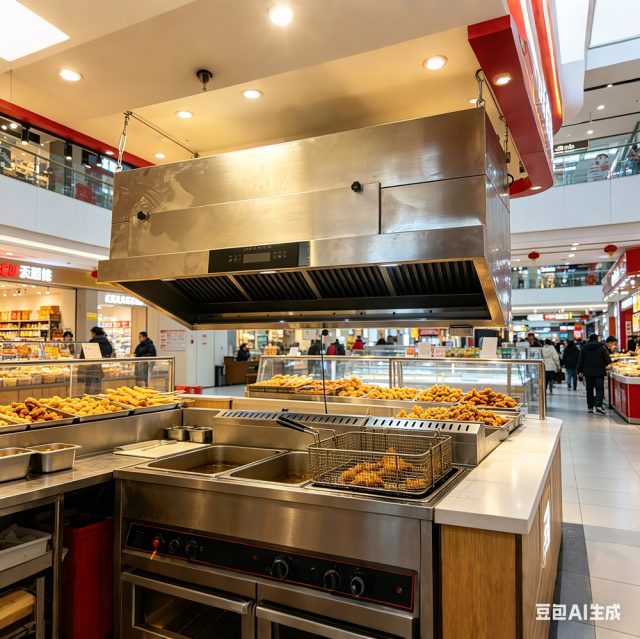
Quick-service restaurants (QSRs) operate on razor-thin margins where every second of throughput counts and every square foot of kitchen space is monetized. Unlike full-service dining, QSR kitchens run continuous high-heat cycles—frying, grilling, and toasting—often in compact footprints tucked inside retail plazas, airport concourses, or highway travel plazas. Traditional ducted exhaust systems demand costly roof penetrations, long duct runs, and ongoing grease-duct cleaning contracts that erode profitability. SOUNINY’s ductless N-series and ND-series all-in-one range hoods, paired with the Odor Removal Tower, eliminate ductwork entirely while capturing grease-laden vapor and sub-micron particulate at the source. For mobile or seasonal QSR concepts, the CV-A, CV-B, and CV-C ventless catering carts extend the same purification technology to front-of-house and pop-up locations.
Why Ductless Ventilation Fits the QSR Model
Speed and consistency define QSR operations. Kitchens are engineered around assembly-line workflows where fryers, flat-top griddles, conveyor toasters, and high-speed ovens run simultaneously during peak rushes. This intensity produces dense grease-laden vapor, volatile organic compounds (VOCs) from hot oil, and fine carbonized particulate that conventional canopy hoods struggle to capture without massive airflow and extensive duct runs.
Ducted systems in QSR environments face three structural barriers. First, many QSRs lease space in multi-tenant retail strips or mall food courts where landlords prohibit roof penetrations. Second, the low ceiling heights typical of converted retail units (2.4–2.7 m) make grease-duct routing impractical. Third, NFPA 96 mandates regular duct cleaning—an operational cost that QSR franchisees, already managing tight labor budgets, find difficult to absorb.
The N-series light-duty all-in-one range hood and the ND-series heavy-duty all-in-one range hood replace the entire ducted chain—canopy, ductwork, roof fan, and cleaning contract—with a self-contained purification unit installed directly above the cooking line. Both series use multi-stage filtration: a stainless-steel baffle pre-filter captures large grease droplets; an electrostatic precipitator (ESP) cell ionizes and collects sub-micron particulate; and activated-carbon modules adsorb odor-causing VOCs. The purified air recirculates into the kitchen or dining area, eliminating the need for external exhaust.
Grease Capture at Fryer-Intensive Stations
French fries, chicken tenders, and battered fish generate some of the highest grease loads in commercial cooking. When oil reaches 175–190 °C, it aerosolizes into fine droplets (0.5–5 µm) that remain suspended in kitchen air. Without effective capture, these droplets settle on HVAC coils, light fixtures, and ceiling tiles, creating fire hazards and sanitation issues.
The ND-series heavy-duty all-in-one range hood is engineered for exactly this load profile. Its high-capacity ESP cell maintains collection efficiency across sustained frying cycles, while the integrated centrifugal fan delivers uniform face velocity across the full cooking surface. Unlike ducted canopies that lose suction at the edges, the ND-series maintains capture efficiency from front rail to back wall—critical in QSR lines where fryers and griddles sit shoulder-to-shoulder.
For QSRs running dual fryer banks or high-volume breakfast programs with continuous griddle use, spec the ND-series. For lighter profiles—sandwich toasting, panini presses, or limited frying—the N-series provides the same ductless architecture with a smaller footprint and lower energy draw.
Odor Control in Compact Dining Rooms
QSR dining rooms are small. A 60-seat unit may share a single air volume with the kitchen, meaning any fugitive cooking odor migrates to the customer area within minutes. In mall food courts, where neighboring tenants include clothing retailers and beauty salons, odor complaints from landlords are a leading cause of lease violations.
The Odor Removal Tower (除味箱) addresses this by adding a dedicated deodorization stage after the ESP cell. Its activated-carbon bed targets the aldehydes and ketones responsible for the “fried food smell” that clings to fabrics and surfaces. When paired with the N-series or ND-series, the tower reduces perceived odor intensity to levels indistinguishable from ambient mall air—allowing QSR operators to maintain positive landlord relationships and repeat customer traffic.
Front-of-House and Pop-Up Deployment
Modern QSR brands increasingly experiment with front-of-house cooking—open kitchens, live-grill stations, and limited-time pop-ups in high-foot-traffic locations. These setups cannot accommodate ductwork, yet they produce the same grease and smoke as back-of-house lines.
The CV-A ventless catering cart provides a fully mobile, ductless cooking station with integrated purification. Its stainless-steel countertop supports griddle or wok cooking, while the built-in ESP and carbon filtration capture emissions at source. The CV-B countertop cart offers a compact footprint for kiosk-style deployment, and the CV-C tempered-glass cart adds a visual showcase element for brand activations and mall atrium events. All three models roll into position, plug into standard power, and begin operation without landlord approvals or construction permits.
Compliance Without the Compliance Burden
QSR franchisees must comply with local mechanical codes, fire safety regulations, and mall-specific tenant guidelines—often across dozens of jurisdictions. Ducted systems trigger IMC and NFPA 96 inspections at installation, annually for duct cleaning, and at every lease renewal. Ductless systems simplify this landscape.
The N-series and ND-series carry CE certification and are designed to meet EN 16282 kitchen ventilation standards without external ductwork. Because there is no grease duct, there is no duct-cleaning log to maintain, no access-panel inspection to schedule, and no rooftop fan to weatherproof. For franchise development teams, this translates to faster permitting, lower insurance premiums, and reduced liability exposure.
Energy and Labor Economics
QSR profitability is measured in basis points. A ducted exhaust system consumes conditioned air at rates of 500–1,500 m³/h per hood, forcing HVAC systems to compensate with make-up air heating or cooling. In climates with extreme seasonal temperatures, this thermal load can add 15–25 % to monthly utility bills.
Ductless recirculation eliminates this penalty. The N-series and ND-series return filtered air to the kitchen at near-ambient temperature, reducing HVAC load. The integrated design also eliminates the separate roof exhauster and its associated motor maintenance. Labor savings are equally material: without grease-duct cleaning contracts (typically $800–2,000 per visit, 2–4× annually), franchisees redirect capital to staff training, equipment upgrades, or marketing.
Maintenance Designed for High-Turnover Staff
QSR kitchens experience among the highest staff turnover rates in foodservice. Complex maintenance protocols fail when crews change monthly. The N-series and ND-series are designed for daily wipe-down and weekly filter removal—tasks that take under 10 minutes and require no tools. The ESP cell slides out on guide rails, rinses clean in warm water with neutral detergent, and air-dries overnight.
For operators who prefer hands-off maintenance, SOUNINY offers the Self-cleaning ESP option with automated wash cycles and a Smart Water Tank that manages detergent dosing and rinse scheduling. These upgrades are particularly valuable in 24-hour QSR locations or airport units where maintenance windows are narrow.