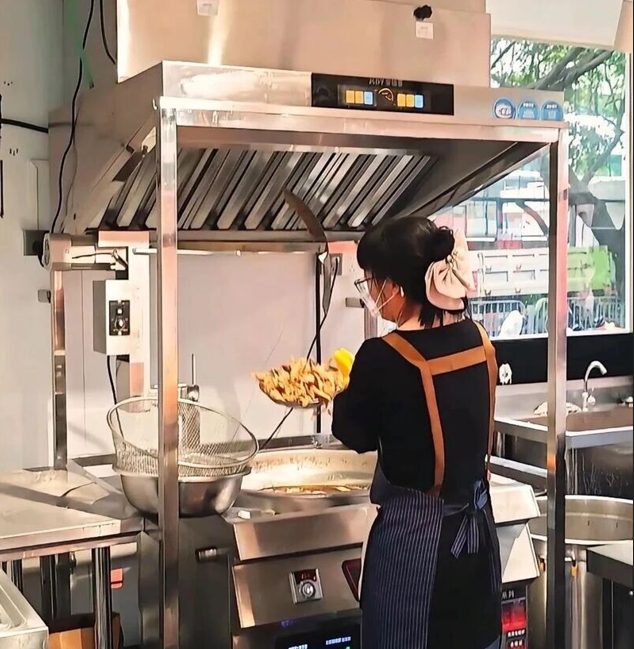
The breakfast and brunch café is one of the most demanding light-fume kitchens in modern foodservice. Back-to-back egg orders, sizzling bacon on a flat-top griddle, waffle batter hitting hot plates, and espresso steam that never stops create a persistent cocktail of grease-laden vapor, humidity, and aroma. In an open café layout, that cloud drifts straight toward guests who came for a calm morning coffee, not the smell of last order’s fryer oil. A ductless range hood system captures these emissions at the cooking line and returns clean air to the room, letting cafés serve crispy hash browns and fluffy omelets without a single roof duct.
Why Morning Kitchens Need More Than a Ceiling Fan
Breakfast cooking looks gentle compared with wok stir-frying or charcoal grilling, but its emissions are persistent and sneaky. Bacon and sausage release fine oil aerosol and acrid smoke the moment they hit a hot griddle. Eggs cooked in butter add protein-laden vapor that condenses into sticky films on walls and banquettes. Syrup, honey, and caramelized sugar produce sweet volatile organic compounds (VOCs) that linger for hours. Meanwhile, commercial espresso machines emit hot steam that raises humidity and can fog windows in cooler weather.
When a café has no source-capture ventilation, these pollutants spread through the entire floor plan. They coat the pastry display case, dull the shine of the espresso bar, and settle into upholstery. Staff breathe the highest concentrations because they stand over the cooking surfaces all shift long. Many operators respond by cranking up exhaust fans or opening doors, but ceiling fans only redistribute the aerosol, and open doors invite drafts that make an exhaust hood’s capture zone unpredictable. The professional answer is a hood with built-in electrostatic and deodorizing filtration, sized to the actual cooking load and positioned directly over every emission source.
Breakfast and Brunch Venues in the Real World
Breakfast and brunch service happens in many property types, and each one changes the ventilation strategy. A freestanding diner may have the budget and roof access for a conventional ducted system. But the majority of growth in this segment happens in leased retail space: a corner unit on a high street, a ground-floor slot in a mixed-use building, a café inside a hotel lobby, or a counter inside a food hall. These spaces rarely provide a grease-rated duct to the roof, and landlords routinely refuse to allow new external penetrations.
In heritage buildings and older shopping streets, cutting into the facade or roof is often forbidden entirely. Yet the menu ambition keeps growing: all-day brunch menus now include fried chicken and waffles, loaded breakfast burgers, shakshuka cooked at the pass, and pancake stacks griddled to order. The result is a kitchen whose true fume load sits between the lightest café and a full restaurant. That middle ground is exactly where a ductless all-in-one hood family shines, because it can be specified per station instead of per building.
The N-series for Light Oil Fume and Everyday Griddle Work
Souniny’s N-series is the light oil-fume, ductless all-in-one range hood, and it is the natural backbone for a breakfast café’s main cooking line. The unit hangs directly over the griddle, range, and fryer bank, drawing the hot plume into a stainless-steel baffle pre-filter that separates large grease droplets. The remaining fine aerosol, including sub-micron particulate that simple mesh filters cannot catch, then enters a high-voltage electrostatic field where particles are charged and collected on stainless-steel plates. Air leaves the unit cleaned of the oil mist that would otherwise settle on tables and latte art.
Because the N-series recirculates air back into the room instead of exhausting it outside, it does not depressurize the café. That matters at breakfast time, when doors open constantly and a strong negative pressure would pull cold air in and make the dining room drafty. The unit’s internal blower keeps the airflow balanced with the hood aperture, so capture performance stays consistent as the griddle works through the morning rush. For most egg, pancake, and light-fry stations, the N-series delivers the capture and filtration the menu needs with a footprint that fits tight café kitchens.
ND-series When the Brunch Menu Turns Serious
Not every brunch menu stays light. Fried chicken and waffles, corn dogs, loaded potato skins, and deep-fried French toast push the cooking load upward, and a busy Saturday service can keep several fryer baskets in constant rotation. For these heavier frying stations, Souniny’s ND-series heavy oil-fume all-in-one hood is the right partner. The ND-series shares the same ductless architecture as the N-series but is engineered with a larger capture envelope and a more robust electrostatic core, matching the higher volume of vapor that commercial fryers release.
A practical pattern in many cafés is a split configuration: an N-series over the griddle-and-egg station, where loads are lighter, and an ND-series over the fryer bank, where the aerosol load peaks. Because both series recirculate, the two units can be installed without coordinating rooftop ductwork or balancing a shared make-up air system. Owners gain the flexibility to upgrade one station as the menu evolves, rather than replacing a single oversized central system.
Ductless recirculation suits light-to-heavy frying done indoors with moderate volume. For extremely high-volume production kitchens or heavy charbroiler work, a ducted ESP purifier with a Centrifugal Fan remains the correct architecture.
Odor Removal Tower: Clearing Bacon, Syrup, and Coffee Notes
Odor is where breakfast cafés win or lose. The same bacon aroma that smells appetizing at the pass can become cloying by noon, and sweet breakfast smells can linger into the afternoon when the menu has switched to lunch service. Souniny’s Odor Removal Tower is a dedicated deodorizing module that pairs with the N-series and ND-series hoods, using activated carbon and engineered media to strip the VOCs responsible for lingering fried, sugary, and dairy notes.
The tower is sized to the café’s cooking load and mounts inline with the hood’s recirculated airstream, so guests smell fresh espresso and citrus cleaner rather than stale oil. Servicing is straightforward: the media cartridges are accessible and replaceable during a routine closing shift, with no special tools and no need to open the ductwork. For multi-location breakfast brands, the predictable media life makes odor control a line item in the operations budget rather than an emergency reaction to a bad review.
Cabinet Purifier for Islands, Pastry Bars, and Bakery Corners
Modern breakfast cafés spread cooking beyond the main line. A bain-marie holding station, a crepe or waffle island near the window, a small bake-off corner for croissants, and an omelet station in the dining room all generate emissions away from the central hood. Running duct to each of these spots is impractical. Souniny’s Cabinet Purifier gives operators a compact ductless unit that sits beside or beneath the appliance, pulling the local plume through the same electrostatic and deodorizing stages as the larger hoods.
This is especially useful for open kitchens where the chef cooks in full view of customers. A visible, quietly working purifier beside the flattop signals that the café takes air quality seriously, while preventing the greasy haze that would otherwise drift over the front counter. The Cabinet Purifier’s smaller format also makes it the practical choice for pop-up brunch corners inside a food hall or hotel lobby, where overhead hoods may be prohibited by the venue’s design rules.
CV-B Mobile Carts for Brunch Pop-Ups and Weekend Markets
Breakfast brands increasingly test new neighborhoods with weekend pop-ups and farmers-market stands before signing a lease. Souniny’s CV-B Countertop Cart brings the same ductless purification to a mobile footprint, supporting a compact griddle, waffle iron, or mini fryer while capturing the vapor on the spot. For operators who need a display-friendly unit, the CV-C Tempered Glass Cart offers the same ventless performance in a showcase format that lets customers watch pancakes being made without smelling the oil.
Because the cart family recirculates cleaned air, a pop-up can run legally and comfortably in spaces with no foodservice ductwork at all. That flexibility lets a breakfast brand test locations, cater private brunch events, or service hotel lobbies during morning hours, all with the same trained staff and the same maintenance routine as the flagship café.
Hood Positioning and Capture Design
Equipment quality matters little if the hood is not positioned where the plume actually rises. For a breakfast line, the hood should extend beyond the griddle and fryer footprint on every side, and its lower edge should sit roughly 0.75 to 1.0 meter above the cooking surface. Keeping the capture zone clear of hanging utensils, ticket rails, and signage preserves the airflow pattern that pulls vapor into the baffles instead of letting it spill toward the dining room.
Island and display cooking needs extra care because cross-drafts from guest traffic and air conditioning can push the plume sideways. When a griddle sits at an island, operators should add a Cabinet Purifier on the exposed side or choose an island-style N-series configuration with a deeper capture canopy. Whatever the layout, the goal is the same: every hot surface that produces grease-laden vapor or steam should sit inside a defined capture envelope, so the front of house stays clean and comfortable.
Codes, Standards, and Fire Safety
Ductless hoods are regulated equipment, not accessories. In the United States, recirculating systems should meet UL 710B, and the overall exhaust arrangement should follow NFPA 96 guidance for grease removal and cleaning. European operators should reference EN 16282 for kitchen ventilation system design, and Australian outlets should check AS 1668.2. Souniny’s CE certification provides a documented compliance baseline for brands expanding across markets.
Fire safety is another reason source-capture matters. Grease that is allowed to accumulate on walls, ceiling tiles, and equipment is a fuel load waiting for a spark. An electrostatic hood collects the grease before it deposits, and the stainless-steel baffle and collection components are designed for routine cleaning that keeps the system from becoming a hazard. Insurers increasingly ask about kitchen exhaust maintenance, and a documented ductless hood cleaning schedule is a strong answer during a risk review.
Daily and Weekly Maintenance Rhythm
Ductless hoods reward a simple, consistent cleaning rhythm. At the end of each service, staff should wipe the exposed baffle surfaces and empty any drip trays so grease does not harden overnight. Once a week, the baffles should go through the dishwasher or a degreasing soak. The electrostatic collector plates should be soaked and rinsed on a monthly cycle, or more often during peak seasons when the griddle runs continuously. The Odor Removal Tower’s carbon media should be replaced at its rated interval, which depends on the volume of fried and sweet cooking.
Operators can rotate a second set of baffles and collector plates, so cleaning never forces the kitchen to stop. Because every unit in the N-series, ND-series, and Cabinet Purifier family shares the same cleaning principles, a multi-station café trains its staff once and applies the routine everywhere. That uniformity is a quiet competitive advantage for chains that want consistent performance across locations without hiring specialist ventilation contractors.
The Business Case for Clean Morning Air
Clean air pays for itself in a breakfast café faster than almost any other equipment investment. Guests who are not hit by a wave of grease smell when they walk in are more likely to linger over a second coffee, and lingering guests order more. Online reviews frequently mention atmosphere and cleanliness, and a fresh-smelling room earns repeat visits from families and remote workers who choose cafés as their daytime office.
On the cost side, ductless ventilation eliminates the capital expense of fabricating and insulating a grease duct, the structural work of a roof penetration, and the make-up air penalty of exhausting conditioned air. The recirculated air keeps heating and cooling inside the building, which matters in a space that opens early, when outdoor temperatures are at their coldest or most humid. Over the life of a lease, those HVAC savings plus faster opening timelines make the ductless hood family the economically rational choice for most breakfast and brunch concepts.
Conclusion
Breakfast and brunch cafés sit in the middle of the fume spectrum: lighter than a steakhouse, but heavier than a pastry shop, and open during the hours when guests are most sensitive to smell. Souniny answers that profile with a complete ductless toolkit. The N-series handles the everyday griddle and egg station, the ND-series takes over the serious fryer bank, the Odor Removal Tower strips lingering bacon and syrup notes, the Cabinet Purifier covers islands and bakery corners, and the CV-B mobile cart extends the brand to pop-ups. Together they keep the morning air clean, the reviews positive, and the kitchen ready for the next rush.