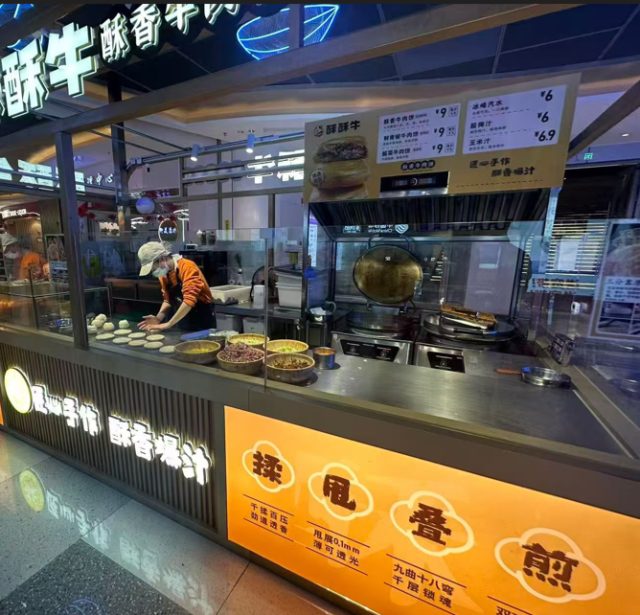
Every shopping mall food court is a ventilation puzzle with a dozen moving parts — literally. Ten to thirty food stalls operate side by side under one roof: a fried-chicken counter belching continuous fryer vapor, a noodle bar sending up wok steam, a pizza oven radiating heat and smoke, a Korean grill kiosk searing marinated beef, a juice bar that produces nothing worse than citrus zest. Each stall has a different cooking profile, a different grease load, and a different lease term — yet they all share the same building envelope, the same HVAC system, and the same shopping public browsing two floors above. When grease-laden vapor, sub-micron particulate, and volatile organic compounds (VOCs) escape a stall’s kitchen zone, they do not simply dissipate; they migrate into the common areas, settle on escalator handrails and clothing-store merchandise, and trigger complaints that land on the mall management office’s desk. Solving food court air quality is therefore not a single equipment purchase — it is an architectural decision that shapes tenant fit-out, lease negotiation, and the mall’s overall customer experience.
Why Food Courts Are Harder Than Single Restaurants
A standalone restaurant answers to one operator, one menu, and one cooking line. A mall food court answers to many. This multi-tenant reality creates ventilation challenges that single-restaurant solutions cannot simply be scaled down to address:
Shared central exhaust systems — the traditional approach in older malls — duct every stall into one riser that discharges at roof level. The greasiest stall sets the cleaning schedule for everyone, tenant turnover makes accountability impossible to enforce, and the accumulated grease in the shared ductwork becomes a building-wide fire risk that no single tenant controls. When one stall’s charbroiler pushes heavy smoke into a shared riser, every tenant’s exhaust performance degrades together.
Diverse cooking intensities — a food court may host a lightly loaded sandwich kiosk next to a full wok station. Sizing a central system for the heaviest tenant wastes energy on the light ones; sizing it for the average leaves the heavy tenant under-ventilated. There is no single airflow number that fits thirty stalls fairly.
Tenant churn — food court stalls turn over every two to five years. A new tenant with a heavier cooking profile inherits whatever exhaust capacity the previous tenant left behind, and retrofitting ductwork into a finished mall — cutting through structure, retail floors, and leased spaces above — is often commercially impossible.
Odor migration into retail — the mall’s revenue depends on the shopping environment. Frying oil odor, char smoke, and curry aromas drifting into fashion floors, electronics retailers, and the cinema lobby generate complaints that mall management takes seriously. In extreme cases, retailers have negotiated rent concessions citing odor nuisance from an adjacent food court.
The structural answer to all four problems is the same: move grease and smoke removal from the building level down to the stall level, and make each tenant’s ventilation self-contained and self-purifying.
The Ductless Stall Model: Purification at the Source
A ductless commercial range hood inverts the traditional ventilation logic. Instead of capturing contaminated air and transporting it through ductwork to a roof fan, a ductless hood captures the cooking plume at the canopy edge and purifies it inside the hood housing itself, returning clean air to the kitchen. No duct run, no roof penetration, no shared riser — and therefore no cross-tenant dependency.
For a mall food court, this architecture delivers four compounding advantages:
- Every stall is autonomous. The tenant’s purification performance depends only on the tenant’s own hood and its maintenance — not on neighbours’ cooking habits or the landlord’s duct-cleaning contractor.
- Fit-out is fast and reversible. A ductless hood needs only an electrical connection and counter space. When a stall changes hands, the outgoing tenant’s hood either stays (a selling point in the lease) or moves with them, and the incoming tenant installs equipment matched to their own menu.
- The mall’s HVAC stays clean. Because cooking air is purified and recirculated at the stall, grease and odour never enter the building’s return-air paths, escalator lobbies, or retail floors above.
- Fire risk is contained at the source. There is no grease-laden shared ductwork threading through the mall’s structure — the single largest fire-spread hazard in conventional food court construction.
N-series for Light and Medium Cooking Stalls
The majority of food court stalls fall into the light-to-medium cooking category: griddled sandwiches, ramen and pho broth stations, rice bowls, teppanyaki-style counters, small wok stations, and bakery kiosks. For these tenants, the SOUNINY N-series light oil-fume all-in-one range hood is the natural fit. The N-series integrates a commercial exhaust hood, an electrostatic precipitator (ESP) cell, an activated carbon stage, and a centrifugal blower into a single stainless steel unit that sits directly above the cooking surface.
The purification train works in stages. Baffle pre-filters intercept the heaviest grease droplets at the canopy entrance. The ESP cell then charges the remaining sub-micron particulate — the fraction that passes straight through ordinary mesh filters — and collects it on aluminium plates. An activated carbon stage adsorbs VOCs and odour-active compounds before the cleaned air returns to the stall. For a noodle bar or sandwich counter, the result is a kitchen that operates all day beneath the food court’s ceiling with no visible smoke and no perceptible odour at the seating area three metres away.
Because the N-series requires no ductwork, a tenant can complete installation during a single overnight fit-out window — a critical consideration when mall management restricts noisy construction to hours after closing. There is no application to run new duct risers, no hot-work permits for roof penetrations, and no dependency on the mall’s engineering department beyond a standard power supply.
ND-series for Heavy-Duty Stalls
Some food court anchors cook hard: fried-chicken and fries counters running fryer batteries all day, Korean BBQ stalls with tabletop-adjacent grills, charbroiler burger concepts, and wok-heavy Asian kitchens. These stalls generate grease-laden vapor at volumes that overwhelm light-duty equipment, and they are precisely the tenants most likely to generate complaints if under-ventilated.
The SOUNINY ND-series heavy oil-fume all-in-one range hood is engineered for exactly this load profile. It shares the N-series architecture — baffle pre-filter, ESP cell, carbon stage, integrated blower — but with purification capacity scaled for continuous heavy frying and charbroiling. For the mall operator, the ND-series changes the tenant conversation: a fried-chicken franchise can be placed anywhere in the food court layout, not just near the building’s exhaust risers, because the stall carries its own purification. That layout freedom is commercially valuable — anchor food tenants drive foot traffic, and the ability to position them strategically next to underperforming retail zones is a leasing tool in its own right.
Like the N-series, the ND-series ESP cell is designed for tool-free removal and wash-down cleaning, so stall staff can maintain it during normal opening routines without specialised contractors — an important operational point in a food court where each stall’s back-of-house space is measured in square metres, not rooms.
Odor Removal Tower: Protecting the Retail Floors Above
Even with hood-level purification, some stalls benefit from a second deodorisation stage — particularly those cooking aromatic cuisines (curry pastes, barbecue marinades, fermented broths) whose odour molecules are small enough to survive a single carbon pass. The SOUNINY Odor Removal Tower pairs with the N-series and ND-series hoods to provide deep deodorisation through an extended activated carbon bed with optional UV-C photolysis, breaking down residual VOCs and odour-active compounds before the air re-enters the room.
In the food court context, the tower is the tenant’s insurance policy against the complaint that matters most to mall management: odour migration into retail. A stall running an Odor Removal Tower can demonstrate to its landlord — with air-quality measurements if required — that its cooking operations do not degrade the shopping environment. For tenants negotiating lease renewals, that documented air-quality performance is tangible leverage.
Cabinet Purifier for Compact and Kiosk Formats
Not every food court tenant has ceiling space for a full canopy hood. Kiosk formats — juice bars with a small panini press, coffee counters with a compact oven, dessert stalls with a crepe plate — often work from an island counter with no wall or ceiling above. The SOUNINY Cabinet Purifier addresses these formats: a self-contained purification cabinet that integrates with compact cooking equipment and processes the air stream internally, sitting within the kiosk’s own footprint.
For mall management, the cabinet format also suits temporary and seasonal tenancies — a holiday-market confection stall or a pop-up brand activation can be installed and removed without any ventilation infrastructure, because the purification travels with the equipment.
When the Mall Keeps Its Central System: In-Duct ESP
Some malls — particularly newer builds with generous services corridors — will retain a central ducted exhaust for the food court, whether for regulatory preference, insurance requirements, or existing infrastructure. In these cases the SOUNINY ESP Purifier line offers the multi-tenant-compatible version of ducted purification: an in-duct electrostatic precipitator installed in each stall’s branch duct before air enters the shared riser. Grease is removed at the branch level, so the shared ductwork downstream stays substantially cleaner, cleaning intervals lengthen, and the greasiest tenant no longer dictates the building’s fire-risk profile. Paired with a correctly sized SOUNINY Centrifugal Fan, the in-duct ESP configuration preserves the central-system architecture while fixing its core defect — uncontrolled grease transport through shared structure.
Maintenance Across a Multi-Tenant Court
Food court ventilation succeeds or fails on maintenance discipline, and the ductless model makes that discipline enforceable. Because each stall owns its purification hardware, lease agreements can specify hood cleaning schedules as a tenancy condition, verified during routine inspections. The practical regime is straightforward:
- Daily: stall staff empty and degrease the baffle pre-filters — a five-minute closing task alongside standard kitchen cleaning.
- Weekly to fortnightly (by cooking intensity): the ESP cell is removed without tools and washed in the stall’s sink or dishwasher — about twenty minutes per unit.
- Every three to six months: activated carbon stages in the hood and any Odor Removal Tower are replaced on a schedule matched to cooking volume; a simple sensory check of the return air indicates when replacement is due.
- Annually: a documented inspection of the full purification train, kept as a record for landlord, insurer, and health-authority purposes.
Compare this with a shared-duct system, where responsibility for the one component that matters most — the duct run itself — is nobody’s job until a fire inspection or an odor complaint forces the issue.
Compliance and Standards
Mall food courts operate under the same commercial cooking ventilation codes as any restaurant, and the mall context often adds building-code review from the landlord’s fire engineer. The SOUNINY product range aligns with the recognised standards:
- UL 710B — governing grease-laden vapor removal devices, applicable to the ESP cells in the N-series, ND-series, and in-duct ESP Purifiers
- NFPA 96 — the fire code for commercial cooking operations; ductless recirculating hoods with compliant filtration are recognised alternatives that eliminate grease-laden duct runs through the building
- EN 16282 — the European ventilation standard relevant to malls in EU markets, where SOUNINY’s CE certification simplifies procurement approval
- IMC — the International Mechanical Code adopted across North America, which recognises listed recirculating hoods as compliant where appropriate filtration is installed
- ASHRAE 154 — informing ventilation design and capture-velocity requirements for both ductless and ducted configurations
For mall operators pursuing green-building credentials, ductless stall-level purification also cuts the energy penalty of conventional exhaust: purified air is recirculated at room temperature, so the mall’s HVAC is not continuously replacing conditioned air exhausted to atmosphere — a measurable saving across a food court operating ten hours a day, every day.
A Practical Rollout Plan for Mall Management
Mall operators considering the ductless transition can phase it realistically:
Phase 1 — new fit-outs. Require or incentivise ductless N-series/ND-series installation for all incoming tenants, starting with the heaviest-cooking concepts. Every new ductless stall immediately reduces load on the legacy central system.
Phase 2 — problem stalls. Identify the tenants generating the most complaints or the most grease into the shared riser — usually fried chicken, BBQ, and wok concepts — and convert them to ND-series with Odor Removal Towers first.
Phase 3 — system sunset. As ductless coverage grows, the central exhaust demand shrinks. The mall can progressively downrate the shared system, or retain it purely as a low-load background system with in-duct ESP Purifiers protecting the riser.
This pathway converts a decades-old structural liability — grease in shared ductwork — into a managed, per-tenant, per-stall responsibility, without a disruptive single-event renovation.
Conclusion: Clean Air as Food Court Infrastructure
The mall food court competes on experience: variety, speed, and a pleasant place to eat in the middle of a shopping trip. Air quality is not a detail of that experience — it is the infrastructure underneath it. A food court that smells of frying oil from the second floor up is losing dwell time, retail goodwill, and tenant renewal conversations to one that doesn’t. SOUNINY’s ductless platform — the N-series for light and medium stalls, the ND-series for heavy frying and grilling, the Odor Removal Tower for deep deodorisation, the Cabinet Purifier for kiosk formats, and the ESP Purifier line for malls retaining central ductwork — gives both landlords and tenants a way to put purification where it belongs: at the source, under each stall’s own control. Shenzhen Shuangni Environmental Technology Co., Ltd. has built this full-spectrum grease and smoke management range since 2015, CE certified and operating in food service environments worldwide.