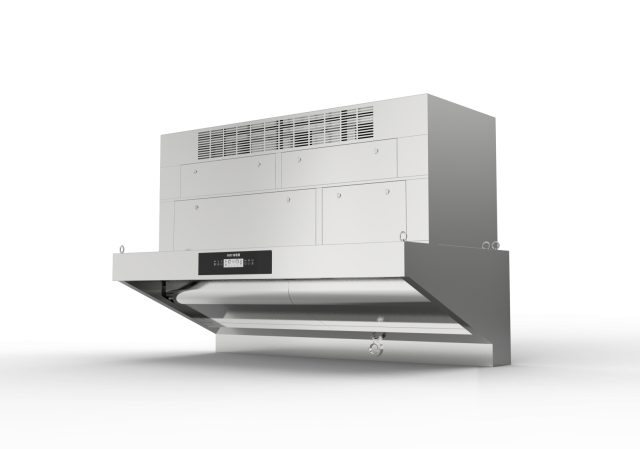
Ferry terminals and passenger ports push air-fume load profiles that no inland Range Hood has ever met. The cooking line ramps from idle to peak in the seven minutes before a boarding call, holds that peak for the duration of a single vessel’s load, then collapses for the next ninety minutes. Salt-laden marine air enters every louvered intake. The terminal ceiling is structural steel with cable trays, not a place to hang ductwork. Most operators discover, on day one of a Type-I retrofit, that there is no above-ceiling space at all — only a polished soffit that the architect refuses to puncture. A ductless purification line — the ND-series heavy-fume all-in-one for grills and woks, an N-series light-fume station for the cafe concession, and an Odor Removal Tower for the concourse-facing fast-casual stalls — resolves all of these constraints without a single riser, a single penetration, or a single make-up air calculation. This guide walks through the five engineering conflicts a port F&B operator runs into and shows how the ductless architecture maps to each one.
1. Why Ferry Terminal Kitchens Are Different From Mall Food Courts
A 2,000-cover mall food court sees a steady lunchtime trickle across ninety minutes. A 6-deck ro-pax ferry terminal sees a single 800-foot vessel disgorge 1,400 passengers through three gangways in the same ninety minutes, with 38 percent of them going to the F&B mezzanine first because they have eighty minutes of buffer. That is a peak-to-average ratio of roughly 4.5:1, and it is consistent across morning, midday, and evening sailings. The thermal and particulate load on the cooking line is not a curve — it is a square wave.
The air itself is different too. Terminal buildings sit fifty to two hundred meters from the berth line, and crosswinds funnel salt fog through every open loading door. Chloride deposition on aluminum collector plates inside an Electrostatic Precipitator would shorten service life from ten years to three. Marine air also carries more water vapor at terminal elevation than at inland sites, accelerating sub-micron particulate agglomeration and changing the optical density of the visible plume. Operators new to port work often assume their existing equipment “just needs cleaning.” What it actually needs is a different technology envelope.
2. The Five Engineering Conflicts
2.1 Conflict one — no above-ceiling cavity for ductwork
Modern ferry terminals are designed around 8–12 m clear spans to accommodate passenger queuing, customs queuing in the international terminal, and the visual uncluttered ceiling demanded by the building’s signature architecture. The structural deck above is post-tensioned concrete with embeds for mechanical services already reserved for HVAC, fire suppression, and lighting. Cutting a 600 mm diameter penetration for a Type-I exhaust duct through a post-tensioned slab is not a maintenance call — it is a structural engineering project. Coastal jurisdictions often require marine terminal buildings to be wind-rated to 60 m/s gusts, which means the slab was over-engineered and any new penetration requires re-analysis.
A ductless ND-series hood sits on the floor next to the cooking appliance, captures and treats the grease-laden vapor in one self-contained cabinet, and returns cleaned air to the room. No riser. No roof penetration. No make-up air unit. The architect’s ceiling is untouched.
2.2 Conflict two — salt fog destroys ESP collector plates
This is the conflict that catches coastal F&B operators most often. A standard aluminum collector plate is rated for ambient chloride below 30 micrograms per cubic meter. Marine terminal ambient chloride runs 220–480 micrograms per cubic meter when the wind is onshore. Pitting begins inside nine months; within thirty months the field strength drops below the threshold needed to capture sub-micron particulate, and the operator sees visible plume for the first time since commissioning.
The ND-series cabinet uses stainless-steel components in the high-corrosion zones and a sealed-electrical-field module that is serviceable without opening the collector cell to room air. Critical mating surfaces are gasketed. For the most exposed terminal piers — those within 50 m of the berth line — specifying the optional marine-grade salt-spray package reduces cleaning interval from quarterly to twice-yearly and extends collector cell life well beyond the standard warranty window. The N-series light-fume station for the cafe concession can usually run on the standard alloy package, because coffee and pastry operations produce lower aerosol mass and the cell sees lower ionic loading.
2.3 Conflict three — peak load with no ramp time
Inland kitchens have a luxury that port kitchens do not: a fifteen-minute warning. As soon as a vessel’s gangway is set, the kitchen manager knows roughly when boarding will open. That is the entire ramp window. Cooks cannot pre-fire flat-tops fifteen minutes early because the product will cool before being served; they cannot batch-prep because plating identifiers are bag-tagged by seat row. The result is that every cooking station transitions from idle to full output in the time it takes the first passenger to scan a boarding pass.
The capture velocity at the Range Hood aperture must stay above 0.5 m/s even at peak effluent flow, and this is where undersized ductless equipment fails. The ND-series heavy-fume all-in-one is rated for that peak band specifically. Cabinets are paired in the kitchen design so that the four-station grill line uses three units running at moderate duty, and the twelfth boarding window (when residual plating plus fresh orders overlap) adds the fourth. The cabinet-pairing design is what makes the square-wave load survivable; a single oversized unit would either run inefficiently during the lull or starve during the peak.
2.4 Conflict four — smoke drift into the boarding concourse
Most terminals have a clear-line-of-sight between the cooking line and the boarding concourse, separated only by a half-height service counter. There is no wall, no door, no swing gate. Smoke plumes from a loaded flat-top or a flaming-finish ribeye will, under the convective currents generated by body heat from 1,400 passengers in motion, reach the queuing area within ninety seconds. Complaints to terminal management follow within four minutes.
The fix is a two-stage capture: the ND-series at the cooking line captures 90+ percent of the grease-laden vapor and visible plume; the Odor Removal Tower in the concourse-facing wall provides secondary polishing for any aerosol that escapes the capture zone. The Tower is sized for the concourse air volume (typically 12–18 m3/s) and runs continuously, not cycled to the cooking load, so the concourse always smells neutral. Terminals that have installed both report zero smoke-drift complaints across the full four-month high season.
2.5 Conflict five — marine fire suppression scope
Marine-grade kitchens typically require wet-chemical fire suppression listed for galley use. Adding a Type-I duct into the suppression scope means a fire-rated damper at every duct penetration, a fuel shutoff at every appliance, and a manual pull station accessible from the concourse side. Many port authorities also require that the duct itself be welded stainless rather than galvanized, because the marine environment corrodes standard duct in five to seven years.
The ductless architecture scopes fire suppression entirely to the appliance and the immediate capture zone. The ND-series cabinet has its own internal detection and suppression interface; the suppression system on top of the appliance is unchanged from what it would have been without the hood. There is no duct to fire-rate. There is no fuel shutoff downstream to wire. The fire-suppression scope and therefore the certification cost and inspection burden are both dramatically smaller.
3. Equipment Mix for a Typical 12-Stall F&B Mezzanine
The following mix is what a terminal of six to eight high-season daily sailings typically specifies. The exact count scales with passenger throughput, not square footage — a small terminal with high-frequency fast-ferry service has the same load profile as a large terminal with one daily ro-pax sailing.
- Grill and flat-top stations (3–4 cabinets) — ND-series heavy-fume all-in-one. Captures the highest aerosol mass in the kitchen and treats it to clean air.
- Wok and high-BTU burner stations (1–2 cabinets) — ND-series. Wok hei generation produces sub-micron particulate that the ND-series collection cell handles cleanly.
- Cafe and bakery counter (1–2 cabinets) — N-series light-fume hood. Pastry ovens and espresso bars produce primarily water vapor and VOCs from baking, which the N-series treats without over-spec.
- Concourse-facing fast-casual row (1–2 cabinets) — Odor Removal Tower at the row’s upstream end, plus an N-series per cooking station downstream. The Tower handles the secondary plume.
- Open-flame rotisserie (rare in terminals but present in some Mediterranean ports) (1 cabinet) — ND-series with the marine salt-spray package. The continuous low-output flame generates different chemical species than peak-load grilling, but the same chloride exposure problem.
4. Code, Standards, and Inspection Cadence
Port kitchens operate under a hybrid of national building code (for the building), marine safety code (for the vessel-adjacent operations), and concession-agreement terms (for the F&B operator). The three most commonly cross-referenced standards are EN 16282-1 for the design of extraction and air supply, NFPA 96 for the fire-suppression and cleaning interval requirements, and the local port-authority hygiene code for the wastewater discharge from the hood wash cycle.
The wastewater from the periodic wash cycle of an all-in-one ductless hood is typically classified as “foodservice grease trap effluent” and routes to the existing grease trap. A Type-I duct system has no such effluent and creates no such routing — but it also does not filter particulates, which the ductless cabinet does.
5. Operator Workflow — Pre-Boarding Peak Capture
The kitchen’s daily workflow under a ductless architecture is shorter than under a Type-I architecture. There is no rooftop fan to belt-check, no fire damper to drop-test monthly, no duct-cleaning contractor to schedule quarterly. The ND-series daily cleaning is a ten-minute task per cabinet performed by the on-duty cook. The N-series weekly cleaning is a five-minute task per cabinet. The Odor Removal Tower requires a media-replacement cycle measured in months, not weeks.
That workflow simplification is what port operators pay for when they specify ductless. The capex is similar to a well-designed Type-I installation; the opex is roughly 60 percent lower across the first five-year window. For terminals that operate seven days a week across a high season and a shoulder season, that differential pays for the equipment delta within the second operating year.
6. Common Mistakes When Retrofitting a Terminal F&B
- Specifying ductless for a ducted-suitable load — if the building has a dedicated F&B riser and adequate above-ceiling cavity, a ducted system remains the lowest operating cost. Ductless is the answer when those facilities do not exist, not a substitute for proper design.
- Undersizing for the peak band — the equipment is matched to the peak band, not the average band. Sizing to the average load that you see in a quiet Tuesday morning in February is a fast path to smoke-drift complaints in August.
- Skipping the Odor Removal Tower — the Tower is what keeps the concourse-side complaints at zero. An ND-series capture alone handles the kitchen air; the concourse is downstream of the capture zone.
- Ignoring the marine salt-spray package — the optional package is the difference between a five-year service interval and a fifteen-year service interval on the high-corrosion zones of the cabinet.
- Treating wet-chemical suppression as out of scope — it remains in scope and is integrated into the ductless cabinet just as it would be into a ducted system. The reduction is in duct-mounted components, not in suppression scope at the appliance.
7. Where This Is Going
New terminal builds in Northern Europe and the Mediterranean increasingly specify ductless-only F&B mezzanines in the schematic-design phase, rather than retrofitting at the CD phase. The savings on riser space, the simplification of the fire-suppression scope, the elimination of the make-up air calculation, and the lower lifetime operations cost combine to make the ductless architecture the default for any terminal where above-ceiling space is contested. For older terminals considering a refresh of an aging F&B concession, the ductless retrofit is often the only path that does not require closing the kitchen for two seasons during the construction window.
If your port’s F&B mezzanine is between ten and twenty years old and the concourse complaint log is getting longer, a ductless retrofit may pay back inside the next operating window. Talk to a port-F&B ventilation specialist about a site survey.