No foodservice category generates more grease-laden vapor per square metre than fried chicken. A pressure fryer running six batches before the lunch rush, an open fryer blanching french fries, a flat griddle toasting buns — all inside a six-square-metre kitchen behind a forty-square-metre shopfront. Facebook inquiries for fried chicken shops and fry stations are among the most frequent we receive, and they share a pattern: the space is small, the landlord will not approve ductwork, and the existing exhaust hood is “not enough for daily capacity.” This guide explains what a fry station actually emits, why it defeats ordinary kitchen ventilation, and how a ductless ND-series purification hood with an Odor Removal Tower solves the problem without a single metre of duct.
Why Fried Chicken Is the Hardest Fume Category to Treat
Deep frying looks simple from the dining room: food goes down into hot oil, food comes up golden. From an air-quality standpoint, it is one of the most demanding processes in commercial cooking. At 175 to 190 degrees Celsius, cooking oil does not just heat — it repeatedly flashes, cracks and re-condenses. Every batch drop creates an instantaneous burst of oil aerosol, and every moisture-loaded piece of chicken sends a plume of steam carrying fine oil droplets upward into the exhaust hood.
Three properties make this emission unusually difficult:
First, droplet size. Fryer aerosol is dominated by sub-micron particulate — droplets far below one micron. Large droplets are easy: baffle filters catch them, and gravity does much of the work. Sub-micron droplets behave almost like gas; they follow the airstream around baffles, pass straight through mesh filters, and stay airborne long enough to travel well beyond the kitchen.
Second, oil that is already “used.” Fryer oil is never clean. Free fatty acids, polymerized triglycerides and food debris all change how the aerosol behaves and how it fouls surfaces. Used-oil aerosol is stickier and darker; it forms the amber film operators know too well on walls, ceilings and the inside of any duct it reaches.
Third, odor chemistry. Frying generates volatile organic compounds and aldehydes — including acrolein, the sharp, eye-watering compound created when fats break down past their smoke point. Acrolein is not merely unpleasant; it is a respiratory irritant and a recognized marker of cooking-oil degradation. Odor molecules of this class are too small and too chemically diverse for any mechanical filter to catch. They require adsorption — activated carbon — or they will simply pass through the purification stage and announce the kitchen to the entire block.
A conventional mesh or baffle hood rated for “general cooking” typically captures a fraction of fryer aerosol and almost none of the odor fraction. This is why fried chicken shops so often report that their kitchen passes a grease inspection yet the neighboring tenants still complain about smell.
The Pollutant Profile of a Typical Fry Station
Walk through a working fried chicken operation and inventory the equipment. Each piece contributes a distinct slice of the emission profile:
Pressure fryers (the workhorse of broasted and Southern-style chicken) operate sealed, so their direct emission is comparatively modest while the lid is closed — but every lid lift releases a dense cloud of superheated oil vapor. Open deep fryers running fries, wings or karaage emit continuously, with the heaviest bursts during batch drops and basket agitation. Flat grills and salamanders used for buns, burgers or breakfast items add their own char and grease vapor. Churro irons, donut fryers and small-countertop units — increasingly common in dessert-led fried chicken concepts — are small but positioned at counter height, right in the breathing zone of front-of-house staff.
The combined stream leaving the exhaust hood therefore contains: visible blue smoke (fine oil mist), invisible gas-phase odorants (VOCs, aldehydes, PAHs from any charred breading), water vapor that condenses on cold surfaces and binds oil film to them, and heat load that must be removed to keep the kitchen workable.
Notably, breading and batter change the equation. Flour dust and crumbs carbonize in the fry vat and get lofted into the plume, adding a particulate fraction that a pure oil-mist strategy underestimates. A shop that fries breaded product needs filtration capacity sized for the busiest hour, not the average hour — a point every operator who has upgraded after an undersized first install already knows the hard way.
Why the Existing Hood Is “Not Enough for Daily Capacity”
Inquiries frequently use almost identical wording: the shop already has a hood, the shop already has an extractor, and yet the dining area smells, the landlord has warnings on file, or the local fire authority has flagged the installation. The pattern behind these complaints is almost always the same mismatch — extraction without treatment.
An ordinary exhaust hood moves air. It does not clean it. Whatever leaves the kitchen through the duct is discharged — onto the neighboring property, into the alley, across the street into an apartment window. In dense urban retail rows, and especially in mixed-use buildings with residences above or beside the shop, discharge is precisely what triggers complaints, fines and forced shutdowns. In the Philippines, for example, Bureau of Fire and local environmental requirements have driven a wave of replacement demand among Metro Manila and Cebu fried chicken operators whose original vented hoods could not be made compliant where they stand.
The second structural problem is spatial. Fry stations cluster in exactly the kind of premises where ductwork is hardest to add: shopping-mall lower-ground units with no riser access, shop houses with residential floors above, leased corner units where the landlord forbids roof penetrations, and kiosk-format stalls inside food courts. When the building cannot give you a duct run, the conventional answer — “move to a unit with a shaft” — is simply not available.
This is the gap that ductless purification hoods were built to fill: recirculate the air instead of discharging it, and remove the pollutant load in the process.
The Ductless Architecture: ND-series All-in-One + Odor Removal Tower
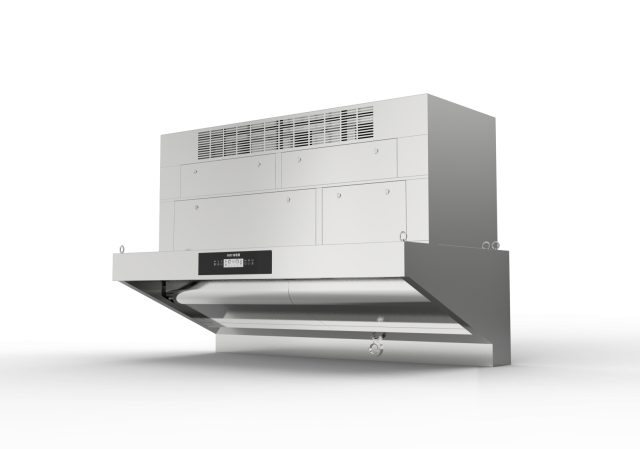
Souniny’s ND-series heavy-duty all-in-one hood is designed around exactly this fry-station emission profile. The unit integrates capture, multi-stage treatment and extraction into a single stainless canopy that mounts directly over the fryers — no duct, no external fan, no plant room.
The treatment train inside a ductless hood runs in sequence, and every stage has a specific job:
Stage one — capture and pre-filtration. The canopy geometry captures the rising plume; stainless baffles strip out the large and medium droplets and return that oil safely to a collection channel. This stage protects everything downstream and removes the visible, film-forming fraction.
Stage two — electrostatic precipitation. The heart of the unit is a stainless-steel Electrostatic Precipitator cell. Incoming aerosol passes an ionizer section that charges the sub-micron droplets, then a collector section whose alternating plates attract and hold them. This is the stage that answers the “small kitchen, heavy aerosol” problem: ESP technology is at its best precisely on the fine particulate that baffles cannot touch, and a washable, reusable cell keeps the operating economics sane for a high-volume fry shop.
Stage three — odor adsorption. For fried chicken, particulate removal alone is not enough — acrolein and other frying odorants pass through an ESP untouched. Pairing the ND-series with Souniny’s Odor Removal Tower (the deodorizing box in the ductless range) adds a large activated-carbon bed that adsorbs the gas-phase fraction. Shops with residential neighbors, enclosed mall locations, or an open counter where the kitchen is visible to diners should treat the carbon stage as mandatory, not optional.
Stage four — clean-air discharge. Treated air is returned to the kitchen. Because nothing is discharged, there is no duct to clean, no rooftop fan to maintain, and no neighbor downwind. The recirculated air is also pre-warmed in winter climates, reducing heating load compared with a make-up-air-hungry vented system.
Sizing shortcut used across our selection sheets: 1 metre of hood length corresponds to roughly 2,000 m3/h of airflow, and a single burner or fry vat corresponds to roughly 4,000 m3/h. A two-vat fryer plus one flat grill under a 3-metre canopy is a classic configuration; the ND-series hood length should be chosen so that total capacity covers the busiest hour with margin, because fryer aerosol is burst-heavy rather than steady.
Case Pattern: the 40 m2 Shop with a 6 m2 Kitchen
One of the most common real-world configurations in our fried chicken inquiries — repeatedly, and across several countries — is a compact takeaway: roughly forty square metres of retail area with a six-square-metre kitchen in the back. The menu is three to five fried items, equipment is one or two fryers plus a small grill or warmer, and the kitchen is enclosed on three sides with the counter opening toward the till.
For this footprint, the selection logic is straightforward:
If the menu is fryer-dominant (fried chicken, wings, karaage, churros), specify an ND-series hood sized to the fryer count and place it directly over the cookline. The heavy-duty rating exists precisely because breading-heavy frying fouls filters faster than clean-fuel light cooking.
If some cooking is genuinely light — a dessert counter with soft-serve and waffle irons alongside one small fryer — a mixed layout with an N-series light-duty unit on the light station and an ND-series on the fry line avoids overspending while keeping protection where the load actually is.
If the format is a counter or cart — a fried chicken stall inside a food court, a mall kiosk, or a takeaway window — the Snack Cart Purifier is the purpose-built deep-fryer purification unit for countertop fryers: compact, ductless, and engineered for exactly the oil-aerosol load of small-format frying.
In all three layouts, add the Odor Removal Tower whenever the kitchen shares a wall, ceiling or air volume with residences, dining areas or neighboring shops — which in practice means almost every fried chicken takeaway.
Fire Safety: Why Removing Grease Also Removes Risk
Fryer-related fire is the headline risk in this category, and ventilation is a first-order factor. Grease that escapes the hood deposits inside ducts, on fan blades and on rooftops, where it becomes fuel waiting for an ignition event. Duct grease is the reason vented systems require periodic professional duct cleaning — and the reason inspectors write up fried chicken shops more often than almost any other tenant type.
A ductless purification hood changes the fire geometry. Grease is captured at the canopy and held in washable metal components rather than accumulating along metres of inaccessible duct. NFPA 96 (the dominant US standard for commercial cooking operations) and its international counterparts treat duct access, grease accumulation and hood cleaning intervals as core compliance items; a system that never forms a duct run removes that entire failure surface. UL 710B governs the recirculating (ductless) hood category in the US framework, covering the filtration performance such units must demonstrate.
Two operational notes matter as much as the hardware. First, keep fryer oil within its rated life — degraded oil smokes at lower temperatures and multiplies both the odor load and the fire risk. Second, treat ESP cells, collection plates and carbon media as scheduled consumables: a saturated cell passes aerosol, and a spent carbon bed passes odor, regardless of how new the unit is. Souniny ships the ESP cell, aluminum collector plates, sealing strips and ceramic insulators as recognized wear items, with a 12-month whole-unit warranty on the machine itself.
The Operating Economics of a Ductless Fry Station
Fried chicken margins live and die on throughput, so the ventilation decision should be judged on cost per kilogram fried, not purchase price alone. Three cost lines move in the operator’s favor with a ductless ND-series installation:
Eliminated build-out. No duct fabrication, no shaft negotiation, no rooftop penetration, no fire-rated duct wrap, no make-up-air unit to replace the extracted air. For a small shop this frequently decides whether the location is viable at all.
Eliminated recurring duct service. Vented systems require professional hood-and-duct cleaning on a fixed calendar. A ductless system replaces that line item with in-house maintenance: wash the baffles, wash or exchange the ESP cell, replace the carbon media on schedule. Cell washing takes minutes with degreaser and hot water.
Climate-control savings. A vented fry kitchen ejects its air-conditioned air along with its fumes and must import replacement air. Recirculation keeps the conditioned air in the shop — meaningful in both tropical climates running air conditioning year-round and cold climates heating it.
Location freedom. Perhaps the largest economic effect is the one least visible in a quote sheet: a fried chicken concept that does not require ductwork can trade in locations that vented competitors cannot touch — lower-ground mall units, heritage shop houses, mid-block storefronts with apartments above, seasonal kiosks. Site flexibility is a revenue capability, not just an engineering convenience.
Choosing the Right Configuration: A Short Decision Guide
Heavy fry line, full menu, small kitchen: ND-series ductless hood over the fryers and grill, plus Odor Removal Tower for the odor fraction. This is the default configuration for a fried chicken takeaway.
Mixed light-and-heavy counter: N-series on the light station, ND-series on the fry line. Match the machine to the emission, not to the shop’s total area.
Countertop fryer, kiosk or cart format: Snack Cart Purifier — the compact deep-fryer purifier built for countertop vats in food courts, malls and event stalls.
Very high volume or existing ductwork: where a large central kitchen or commissary already has duct infrastructure and volume far beyond a single shop, a ducted line — ESP Purifier in the duct with a Centrifugal Fan — remains the correct tool. Ductless wins where ducts are impossible or uneconomic, not where ducts already exist and are well maintained.
Fried chicken will never be a low-emission cuisine, and it does not need to be. With capture at the canopy, electrostatic precipitation on the sub-micron fraction, carbon adsorption on the odor fraction, and recirculation instead of discharge, a six-square-metre fry kitchen can sit metres from diners and neighbours without becoming the building’s complaint generator. That is what turns a fry station from a compliance liability back into what it should be: the most profitable square metres in the shop.