The Philippine foodservice scene is expanding faster than almost anywhere else in Southeast Asia. New cafes, fried chicken counters, Korean grill tables and resort restaurants open every month across Metro Manila, Cebu, Davao and the island provinces — yet most of these kitchens are built inside leased mall units, mixed-use towers and retrofit storefronts that were never designed for a grease duct. At the same time, the Bureau of Fire Protection (BFP) enforces the Fire Code of the Philippines with growing consistency, and grease-laden cooking exhaust sits squarely in its line of sight. The result is a market where ventilation is no longer just an equipment choice; it is a compliance decision. This guide walks through the fire code reality, the building constraints that stall conventional ducted systems, and why ductless all-in-one range hood technology has become the practical default for Philippine commercial kitchens.
Why the Philippines Is a Unique Ventilation Market
Start with where Filipinos actually eat. The country is one of the most mall-centric food markets in Asia: SM, Ayala and Robinsons malls alone host thousands of food stalls, kiosks and full-service restaurants, and a large share of them sit on lower ground or basement levels where no exhaust riser reaches the roof. A tenant on the LG level of a Manila mall cannot simply punch a hole through five floors of structure to run a conventional grease duct. Whatever ventilation that kitchen uses has to fit inside the leased box.
The same logic applies outside the malls. Most Philippine restaurant operators lease their premises, and landlords are reluctant to grant roof rights, facade modifications or shaft penetrations for a tenant who might be gone in two years. Ground-floor F&B in condominium towers along EDSA, Quezon City and Bonifacio Global City faces the same constraint: the building already exists, the duct does not, and the residents above have opinions about smoke.
Climate adds a third constraint. Philippine kitchens inside malls and modern buildings sit within air-conditioned envelopes, so every cubic meter of air exhausted through a ducted hood is paid for twice — first to cool it, then to replace it. And as an archipelago, the Philippines depends on equipment that ships in a container, fits through a standard service corridor, and installs without on-site duct fabrication in Cebu, Palawan or Davao. Self-contained systems are not a luxury here; they are how projects stay on schedule.
The Bureau of Fire Factor: How the Fire Code Touches Your Kitchen
The legal anchor is the Fire Code of the Philippines, Republic Act No. 9514, as amended, together with its Implementing Rules and Regulations. Enforcement sits with the Bureau of Fire Protection, whose Fire Safety Inspection Certificate (FSIC) is a prerequisite for business permits — and, critically, must be renewed as part of the annual permit cycle. A restaurant that passes inspection in year one can still be flagged in year two if its kitchen exhaust condition has degraded.
Why does a commercial kitchen attract attention from fire inspectors? Because cooking produces grease-laden vapor, and grease is a fuel. When that vapor travels through a conventional ducted exhaust system, a portion of it condenses on duct walls, gradually building a flammable coating inside a hidden shaft that nobody sees and few operators clean on schedule. Duct grease fires are among the most destructive fires in commercial buildings worldwide, and Philippine fire authorities are well aware of the pattern.
In practice, what do BFP inspectors and mall fire safety officers look for in a kitchen? Mechanical ventilation that actually captures cooking effluent at the source, grease handling that keeps accumulated deposits out of concealed spaces, and documentation showing the system is maintained. Philippine mall administrators and design consultants commonly benchmark kitchen exhaust against international practice such as NFPA 96 — the standard behind Type I hoods and grease-tight duct construction — even where the national code does not spell out every detail. A kitchen that can show source capture, filtration and a cleaning log walks into any of these conversations with a much stronger position.
There is also a quieter signal worth reading: a meaningful share of Philippine replacement inquiries begins with the words replace existing hood, and the trigger is often an inspection remark, a mall fire audit, or an insurance question about grease accumulation. Compliance pressure, not only new-store construction, is one of the strongest demand drivers in this market.
Why Ducted Systems Stall in Philippine Buildings
None of this means ducted exhaust is wrong — for a ground-floor hotel kitchen with an existing shaft, an inline ESP Purifier and Centrifugal Fan remain the professional answer. The problem is that in the Philippines, the buildings that need new kitchens most are precisely the ones where ducts are hardest to add.
Consider the typical cases. A food stall in a mall food court on the LG level: no riser, no shaft, no roof access, and a mall administration that controls every penetration. A second-floor restaurant in an older building in Manila or Cebu: adding a vertical grease duct means cutting through occupied floors above. A resort kitchen in El Nido or Boracay: roof penetrations fight the monsoon, and salt air corrodes every exposed component. A delivery-only counter in a Makati condominium: the landlord will not permit any duct at all.
Even when a duct is physically possible, it carries a lifetime of obligations. Grease builds up inside the run, which means recurring cleaning contracts, access panels, and a permanent fire load overhead — plus the renewal-season anxiety of proving to the next inspector that the shaft was actually cleaned. And because Philippine kitchens share walls with residences, offices and neighboring restaurants, any ducted exhaust that leaks odor becomes an immediate neighbor-complaint problem in a way that a filtered, recirculating system simply cannot be.
Inside a Ductless All-in-One Range Hood
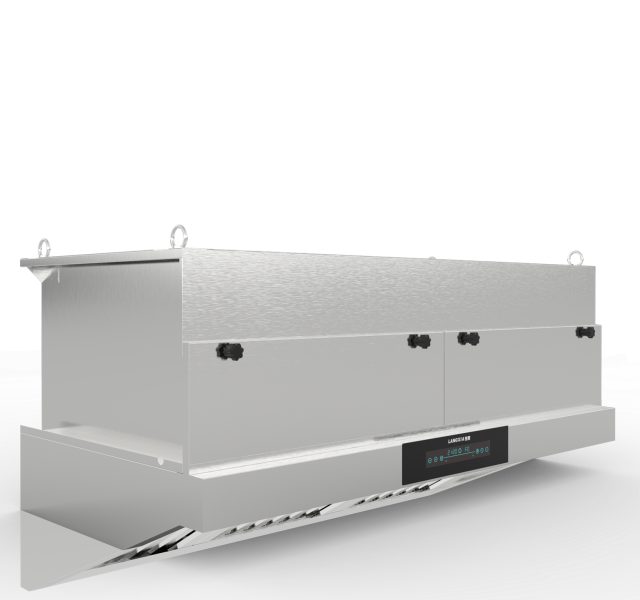
A ductless all-in-one unit solves the problem by refusing to create it. The architecture is a complete purification train packed into the hood itself: the canopy captures rising grease-laden vapor at the cookline; a pre-filter strips out larger droplets; an electrostatic precipitator (ESP) cell charges sub-micron particulate and collects it on washable plates; and a final activated-carbon deodorizing stage — often extended by an external Odor Removal Tower — removes the residual volatile organic compounds that carry smell. What leaves the unit is cleaned, recirculated air.
Three consequences follow, and each one matters in the Philippine context. First, grease never enters a duct because there is no duct — nothing accumulates in hidden shafts, nothing needs professional duct cleaning, and the fire load stays at the appliance where it can be seen and cleaned. Second, recirculation keeps conditioned air inside the building envelope, which malls and air-conditioned restaurants notice directly in their electricity bills. Third, installation collapses to a power connection: most units run on a standard 220 V supply, which matches Philippine mains exactly — no three-phase service, no site-fabricated ductwork, and an install measured in hours rather than weeks.
For BFP and mall audit purposes, the headline is simple: a ductless hood removes grease from the exhaust stream before any surface can accumulate it. That single fact reframes the entire inspection conversation.
Matching Equipment to Filipino Cooking Profiles
Filipino menus are not shy about smoke. Sisig arrives on a sizzling plate still throwing vapor; inihaw grills run for hours; lechon belly and crispy pata come out of fryers in batches; and fried chicken — arguably the country’s most competitive food category — keeps fry stations loaded from opening to close. These are heavy-fume profiles, and they belong on the ND-series heavy oil-fume all-in-one, which pairs a deep capture canopy with an ESP cell and carbon stage sized for exactly this load.
Lighter concepts need lighter hardware. Milk tea shops, cafes and bakeries, steamed dim sum and noodle stations, and hot-food counters built around convection ovens produce far less grease-laden vapor, and the N-series light oil-fume all-in-one handles them with a lower-profile unit, quieter operation and lower running cost. Choosing between the two lines is a menu decision, not a preference: if the menu sizzles, fries or grills, specify the ND-series; if it steams, bakes or brews, the N-series is usually the better fit.
Odor deserves its own line item. Vinegar-forward dishes — the adobo, sinigang and paksiw family — throw sour aromatics that survive particulate filtration, and grill smoke drifts into dining areas in open-plan layouts. Pairing the hood with an Odor Removal Tower gives the kitchen a dedicated second deodorizing stage, which is the difference between a kitchen that merely passes inspection and a kitchen whose neighbors never complain.
Then there is the mobile half of the market. Mall common-area kiosks, weekend food parks, Christmas-season bazaars and beachfront BBQ counters all need plug-and-cook setups that move when the lease ends. The CV-A, CV-B and CV-C ventless catering carts integrate a cooktop, a capture hood and a purification system on wheels, running from a standard 220 V outlet — the reason they appear in so many Philippine mall and event inquiries.
For hotels, banquet kitchens and resort central kitchens that already own ductwork, the ducted path remains valid: an inline ESP Purifier matched with a Centrifugal Fan treats high airflow volumes economically, and auto-cleaning or water spray ESP variants reduce washing labor for the highest-volume operations.
Sizing Rules of Thumb That Hold Up in Meetings
A few practical numbers carry most Philippine sizing conversations. For a conventional commercial cookline, plan roughly 2,000 m³/h of airflow per meter of hood; for an open display cookline where the customer sits across the counter, raise that to about 2,500 m³/h per meter. Working burner-first instead? Allocate around 4,000 m³/h per open burner. A typical heavy-fume two-burner line — a fryer and a grill, the standard fried chicken configuration — lands on a 2.0–2.4 m hood.
Run the numbers against a real pattern: a 40 m² fried chicken shop with a 6 m² kitchen needs roughly a 1.5–1.8 m ND-series hood, which fits the kitchen, leaves service access in front of the fryers, and keeps the whole purification train inside the leased space. Undersizing shows up fast — smoke spilling past the canopy edges, a greasy film collecting on menus and ceilings, odor settling into the dining area — while oversizing wastes money and creates noise complaints. When in doubt, size to the menu’s heaviest appliance and add an Odor Removal Tower before adding hood length.
What Philippine Buyers Are Actually Asking For
Aggregated inquiry patterns from across the Philippine market tell a consistent story. The single most frequent category is fried chicken and fry station ventilation — small shops, delivery-focused counters and mall kiosks built around pressure fryers and open fryers. Close behind: lower-ground mall units with no exhaust exit asking whether a ventless hood is workable; operators on upper floors of buildings without ducts; and a steady stream of replace existing hood requests that follow a BFP remark or a mall fire audit.
The geography is just as clear. Metro Manila dominates — Quezon City, Makati and Bonifacio Global City generate the densest flow of restaurant, BPO canteen and delivery-kitchen questions. Cebu City follows with its mix of mall F&B and tourism dining, while Palawan resort and beach-bar projects ask about island logistics and salt air. Add Pampanga’s restaurant cluster, Davao’s expanding food scene, and the bazaar vendors who need a ventless cart that survives a weekend food park, and the pattern is complete: Philippine demand is ductless by necessity far more often than by preference.
One more pattern deserves attention: delivery-only and takeaway counters. Philippine food delivery penetration is among the highest in the region, and a delivery-only kitchen needs full cooking capability with the smallest possible footprint and zero exhaust infrastructure. A compact ductless hood plus a fryer is, for many of these operators, the entire build-out.
Installing and Running Ductless Equipment in a Tropical Climate
Philippine electrical service is 220 V at 60 Hz, which aligns cleanly with the standard configuration of these ductless systems — most units plug into ordinary wall outlets, and small installations never need three-phase power. Confirm the site’s circuit capacity during the site survey, the same way you would confirm ceiling height and service clearance.
Humidity and heat accelerate everything in a kitchen, including maintenance. A realistic schedule for a heavy-fume Philippine kitchen: wash the ESP cell and aluminum collector plates roughly monthly, replace mesh pre-filters on the supplier’s interval, and treat sealing strips and ceramic insulators as consumable wear items to be inspected at every wash. Coastal locations — Manila Bay, Cebu’s waterfront, the island resorts — should add a corrosion check on housings and fasteners, since salt air works on stainless steel slowly but continuously.
Typhoon season argues for ductless on its own. A recirculating system has no roof penetration to waterproof, no external duct cap for driving rain to invade, and no wind-load concerns on the facade. And keep a simple maintenance log from day one: dated photos of clean cells and washed plates turn the annual FSIC renewal and any mall fire audit from a scramble into a five-minute conversation.
A Practical Compliance-Ready Checklist
- Survey the site: cookline length, menu fume class (heavy or light), ceiling height, available power, and the lease or mall administration rules on penetrations.
- Choose the architecture: a ductless all-in-one for the majority of leased, mall and upper-floor kitchens; an inline ESP Purifier with Centrifugal Fan only where ductwork already exists.
- Size the hood: about 2,000 m³/h per meter of hood (2,500 for open display) or roughly 4,000 m³/h per burner; 2.0–2.4 m of hood for a two-burner heavy-fume line.
- Add the odor stage when dining areas adjoin the kitchen, the menu is vinegar-forward, or the mall administrator requires deodorization.
- Document the package: spec sheets, CE certification, a layout drawing and handover photos — the file that answers the first BFP question.
- Keep the maintenance log current: cell wash dates, pre-filter changes, and consumable replacements. This log is what renews the Fire Safety Inspection Certificate smoothly, year after year.
Ventilation in the Philippines is a compliance system and a comfort system at once: it satisfies the Bureau of Fire Protection, keeps mall administrators calm, and keeps diners in their seats instead of complaining about smoke. Operators who treat it that way — sizing to the menu, documenting maintenance, and choosing ductless hardware that matches the building reality — spend their opening budget on food and front-of-house, not on ductwork they were never allowed to build.