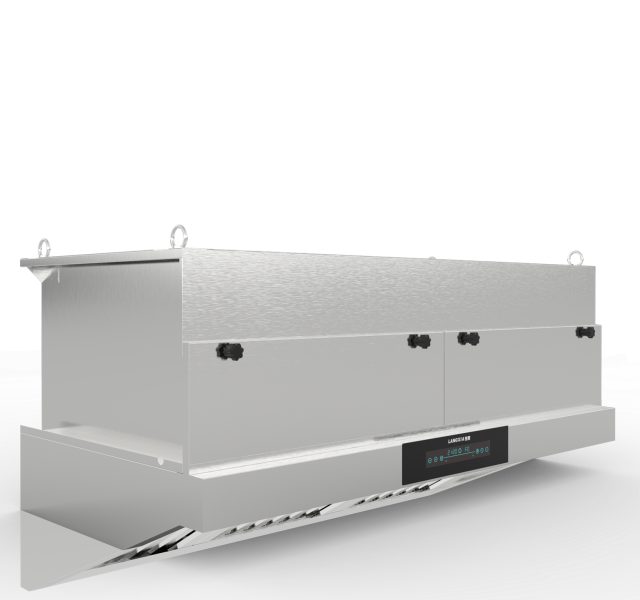
An ice cream or gelato shop may look like a low-emission environment, but the production kitchen hidden behind the counter generates a surprisingly complex exhaust profile. Pasteurizers heat milk and cream to 85°C, waffle cone irons release flour dust and caramelized sugar vapors, and fruit-syrup reduction pots emit sticky volatile organic compounds. When these warm, grease-laden vapors meet the shop’s chilled air—often kept below 18°C to protect display cases—they condense on ceilings, ductwork, and cold surfaces, creating sanitation risks, odor complaints, and costly cleaning cycles. A ductless N-series range hood captures these emissions at the source, removes particulate and odor internally, and returns clean air to the room so the front-of-house stays fresh and the back-of-house stays compliant.
Why Ice Cream Shops Need Dedicated Exhaust Capture
The assumption that ice cream production is “smoke-free” is common among first-time operators, yet health inspectors and HVAC engineers regularly flag these kitchens for inadequate ventilation. The reason is thermal conflict: the production zone operates at cooking temperatures while the sales floor is refrigerated. Without active capture, warm vapor from a pasteurizer or batch freezer will drift toward the display case, raise the local dew point, and force the refrigeration compressor to work harder. Over time, fat-laden condensation accumulates on ceiling tiles, light fixtures, and air-conditioning grilles, creating a slip hazard and a breeding ground for mold.
From an air-quality standpoint, dairy fat aerosols behave differently from typical cooking oil. Milk fat has a lower smoke point than vegetable oil but a higher tendency to form sticky films when cooled. Waffle cone batter adds starch particulate and Maillard-reaction by-products—polycyclic aromatic hydrocarbons (PAHs) and acrylamide precursors—that settle on surfaces and re-volatilize when the shop warms up each morning. Fruit-based gelato flavors introduce additional VOCs from berry and citrus reductions. Together, these pollutants demand a capture system designed for light-to-medium fume loads with integrated odor control.
Souniny’s ductless range hood family is engineered for exactly this mixed-load, temperature-sensitive environment. The N-series uses a dry electrostatic precipitator (ESP) cell to trap sub-micron particulate, followed by activated-carbon and HEPA stages to neutralize dairy odors and flour dust before the cleaned air is recirculated.
The Thermal Conflict: Hot Production vs. Cold Display
Most artisan gelato shops follow a split-floor plan: a small production kitchen (8–20 m²) behind a glass partition, with display cases and seating in the front. The production room houses a pasteurizer, batch freezer, blast chiller, and often a waffle cone iron or crepe station for made-to-order desserts. Equipment temperatures range from 85°C on the pasteurizer to −35°C in the blast chiller, while the sales floor is maintained at 16–20°C for customer comfort and product stability.
This steep temperature gradient creates a natural convection current that pulls warm, moist air from the kitchen toward the cold display cases. If the kitchen lacks a dedicated exhaust hood, the vapor plume will:
• Condense on the glass display front, obscuring product visibility and requiring constant wiping.
• Saturate ceiling insulation above the kitchen, reducing its R-value and increasing cooling load.
• Deposit fat films on air-conditioning coils, lowering heat-transfer efficiency and raising electricity bills by 10–20 %.
• Trigger false smoke-detector alarms when vapor reaches photoelectric sensors in the sales area.
A ductless N-series hood installed over the pasteurizer and batch-freezer loading zone interrupts this plume before it crosses the glass partition. Because the N-series does not extract conditioned air to the outside, the shop’s refrigeration and HVAC systems do not have to compensate for make-up air losses—a critical advantage in climates where every cubic meter of cooled air represents a direct energy cost.
Fume Profile: Dairy Fat, Flour Dust, and Caramel VOCs
Understanding the specific pollutants generated in an ice cream shop helps explain why a generic wall fan or residential range hood is insufficient. The three primary emission sources are:
Pasteurization and Batch Freezing
Heating milk and cream to 85°C for 15–30 seconds releases water vapor carrying dissolved milk proteins and butterfat. When this vapor cools, the proteins coagulate into a fine aerosol and the fat condenses into a sticky film. The particle size distribution is heavily weighted toward sub-micron diameters (0.3–1.0 µm), which bypass standard mesh filters and remain airborne long enough to travel across the shop. The odor signature is mild but persistent—a sweet, dairy note that can become cloying in an enclosed space.
Waffle Cone and Crepe Stations
Waffle irons and crepe plates operate at 180–220°C, well above the smoke point of butter and sugar. This produces a visible plume containing starch particulate, caramelized sugar aerosols, and trace PAHs from the Maillard reaction. The particles are larger (1–10 µm) and settle quickly, but the volatile fraction—furfurals, furans, and aldehydes—travels far and clings to fabrics and upholstery. In shops with front-of-house seating, this is the most common source of customer complaints.
Fruit Syrups and Chocolate Tempering
Reduction of berry or citrus syrups releases organic acids and terpenes. Chocolate tempering (45–50°C) is lower in particulate but emits cocoa-butter VOCs that contribute to the overall odor load. While neither process is as intense as deep-frying, the cumulative effect in a small kitchen can exceed the olfactory threshold within minutes if uncaptured.
A ductless N-series hood addresses all three fractions: the ESP stage traps sub-micron dairy and sugar aerosols; the HEPA stage intercepts flour dust and larger starch particles; and the activated-carbon stage adsorbs VOCs and odor molecules. The result is air that meets EN 16282-1 indoor recirculation standards without any connection to an external duct.
Sizing and Layout for Gelato Production Kitchens
Ice cream shop kitchens are compact, often sharing a single wall with the display area. Hood sizing must balance capture efficiency against the limited footprint. The following rules of thumb apply:
• Hood length: Match the hood to the longest cookline. A typical artisan setup with one pasteurizer (0.6 m wide) and one batch freezer (0.5 m) can be covered by a 1.2 m hood. If a waffle cone iron is added, extend to 1.5 m or install a second 0.9 m hood over the iron.
• Airflow: Light-fume loads in temperature-controlled rooms require approximately 2,000 m³/h per meter of hood length. For open-display or front-of-house live-cooking stations, increase to 2,500 m³/h/m to account for cross-drafts from customer traffic and display-case fans.
• Mounting height: The bottom of the hood should sit 1.9–2.1 m above the floor (0.5–0.7 m above the pasteurizer top). Lower mounting improves capture but must not obstruct operator access or violate local headroom codes.
• Clearance to display cases: Maintain at least 1.5 m horizontal separation between the hood edge and the nearest display case, or install a low-level air curtain to block the thermal plume.
For shops that also serve hot desserts—crepes, Belgian waffles, or warm brownie sundaes—the combined load may push the kitchen into medium-fume territory. In this case, the ND-series heavy-duty ductless hood offers a larger ESP cell bank, a water-cycle pre-wash stage for sticky sugar residues, and higher airflow capacity (up to 7,000 m³/h) while still operating without external ductwork.
Odor Control: The Missing Piece
Particulate capture alone does not solve the odor problem in an ice cream shop. Dairy vapors and caramelized sugar notes are pleasant in small doses but become overwhelming when concentrated in a sealed production room. Moreover, these odors adsorb into porous materials—wooden furniture, fabric upholstery, and even the shop’s branding signage—making them difficult to remove once embedded.
The Odor Removal Tower (除味箱) is designed as a secondary stage that can be paired with either the N-series or ND-series. It houses a deep activated-carbon bed (typically 25–50 kg of coconut-shell carbon) and an optional photocatalytic stage for VOC breakdown. In ice cream shop applications, the tower is usually installed adjacent to the hood, connected by a short flexible duct, and sized to process 5,000–10,000 m³/h. Because the tower is a standalone unit, it can be added later if odor complaints arise after opening—a common scenario when a shop expands its hot-dessert menu.
Shops located in mixed-use buildings or shopping malls face an additional constraint: landlord lease clauses often prohibit any penetration of the ceiling slab for ductwork. The ductless N-series plus Odor Removal Tower satisfies this constraint while delivering exhaust performance that meets mall management and fire-safety standards.
Mobile and Pop-Up Gelato Stations
Not all ice cream sales happen in a fixed shop. Seasonal pop-ups at farmers’ markets, festival grounds, and hotel pool decks require the same exhaust control in a portable format. The CV-B Countertop Cart provides a ventless cooking station with an integrated N-series-grade purification module, allowing operators to serve warm waffles, crepes, and made-to-order sundaes without any duct connection. The cart’s stainless-steel body resists salt-air corrosion for beachfront locations, and its compact footprint (typically 0.7 × 0.6 m) fits standard market stall dimensions.
For high-volume event catering—wedding dessert tables, corporate ice-cream socials, or festival gelato bars—the CV-C Tempered Glass Cart offers a larger work surface and a visible cooking area that doubles as customer entertainment. Both carts run on standard 220 V single-phase power and can be wheeled into position, plugged in, and operated within minutes.
Compliance and Standards
Ice cream shops fall under the same commercial-kitchen ventilation codes as restaurants, even though their menus are dessert-focused. Key standards include:
• EN 16282-1 (Europe): Defines minimum exhaust rates and indoor air-quality limits for commercial kitchens. Recirculating systems must demonstrate equivalent pollutant removal to ducted exhaust.
• NFPA 96 (North America): Requires grease-removal devices for any appliance that produces grease-laden vapors. Ductless hoods with ESP cells qualify if they meet the capture-efficiency thresholds in Annex B.
• IMC / ASHRAE 154: Provide airflow calculation methods and make-up air requirements. Because ductless systems do not exhaust conditioned air, make-up air load is reduced—an advantage in tightly sealed mall units.
• Local health codes: Many jurisdictions require a Type I hood for any operation involving cooking oils or fats, regardless of menu type. A certified ductless hood with documented ESP efficiency satisfies this requirement where the code explicitly permits recirculating systems.
Souniny’s N-series and ND-series carry CE certification and have been tested for grease-removal efficiency in accordance with EN 16282-1. Test reports and compliance certificates are available from the Download Center for permit applications.
Installation and Maintenance Considerations
Ice cream shop kitchens are often retrofitted into existing retail spaces with limited ceiling height and no grease-duct infrastructure. The N-series is designed for these constraints: its body depth is approximately 850 mm, allowing installation in rooms with 2.5 m ceilings or higher. For heritage buildings or basement locations with headroom below 2.4 m, the GC10 or GC11 cabinet purifier offers a split configuration where a shallow canopy captures over the cookline and a floor-standing cabinet (520 mm wide) handles purification remotely.
Maintenance intervals in ice cream shops are typically longer than in fried-food kitchens because the fume load is lighter. The ESP cell in an N-series handling pasteurizer and waffle-iron vapor usually requires cleaning every 60–90 days, compared with 30–40 days for a heavy-duty ND-series over a wok line. Cleaning is straightforward: the cell slides out, is soaked in a warm degreasing solution, rinsed, and air-dried overnight. No specialist tools or service contracts are required, although Souniny offers a 12-month whole-unit warranty and consumable spare-part kits for operators who prefer to stock replacement plates and sealing strips.
The activated-carbon stage in the Odor Removal Tower should be inspected every 6–12 months and replaced when breakthrough odor is detected. In shops with high waffle-iron usage, carbon life may shorten to 4–6 months due to the heavy VOC load from caramelization. Replacement is a simple cartridge swap that takes approximately 15 minutes.
Energy and Operating Cost Benefits
Because ice cream shops operate in a thermally hostile environment—hot kitchen, cold display, conditioned seating—energy efficiency is a major concern. A ducted exhaust system would remove large volumes of cooled air, forcing the HVAC system to recondition replacement air at significant cost. A ductless N-series eliminates this penalty: the air is cleaned and returned to the room at nearly the same temperature, so the cooling load remains stable.
Real-world estimates from European gelato shops suggest that switching from a basic wall-extractor fan to a ductless N-series with Odor Removal Tower can reduce summer HVAC energy consumption by 15–25 %, with payback periods of 18–36 months depending on local electricity rates. The savings are most pronounced in climates with high cooling-degree days and in mall locations where make-up air is not freely available.
Conclusion
Ice cream and gelato shops present a unique ventilation challenge: light but persistent fume loads, tight thermal boundaries, strict odor control requirements, and frequent installation constraints in retail and mall spaces. The ductless N-series range hood, paired with the Odor Removal Tower for odor-sensitive locations, provides a complete solution that captures dairy aerosols, flour dust, and caramel VOCs at the source without ductwork, energy-wasting exhaust, or structural modifications. For mobile and seasonal operations, the CV-B and CV-C ventless carts extend the same technology to pop-up and event settings. Whether you are opening a flagship gelateria in a historic city center or a weekend waffle-stand at a coastal resort, Souniny’s ductless range hood family offers a certified, energy-efficient path to clean air and compliant operations.