Donut shops are routinely treated as the quiet corner of foodservice ventilation – a sweet retail counter, a few trays, a coffee machine. The kitchen behind the counter tells a different story. A donut program means open fry-vats running from before dawn, a glazing line shedding warm sugar aerosol, yeast dough proofing in bulk, and powdered sugar settling on every horizontal surface. The exhaust load is lighter than a steakhouse grill yet chemically more varied than almost any other retail foodservice, and it usually sits inside a shopping mall or a shared-wall retail strip where the nearest neighbor is ten metres away. This guide covers what a donut kitchen actually emits, how sugar changes the odor problem, the compliance and landlord context, and the sizing and retrofit paths that work for fryer-based retail kitchens.
What a Donut Kitchen Actually Emits
The fry-vat is the anchor load. Ring and filled donuts fry at roughly 180-190 °C, and the water in the dough flashes to steam on immersion, shearing oil into a fine mist – the same mechanism as any wet-fried product, though gentler than loose batter because the dough holds its shape. What leaves the vat is a plume of oil mist, water vapor and frying aldehydes that rises fast and, if the canopy is undersized, drifts straight into the retail zone.
The glazing line adds a load most operators never think about. Glaze is pumped and recirculated warm, and its water-plus-sugar surface sheds a fine aerosol that evaporates down to microscopic sugar residue. Unlike oil droplets, that residue is hygroscopic and sticky: it cures onto canopy internals, filter faces and walls as a varnish-like film that no dry wipe will remove. Chocolate and icing glazes behave worse still.
Proofing contributes in a quieter way. Bulk yeast dough gives off ethanol, esters and moisture – pleasant in a bakery case at low level, cloying and damp at room scale overnight, and the humidity condenses on any cold surface the extraction fails to carry away. Powdered sugar and cinnamon dust complete the picture: they load the pre-filter first, and sugar dust near warm surfaces is both a hygiene issue and a combustible-dust consideration in bulk handling.
Then there is the clock. Donut production concentrates into the two or three hours before doors open, so the highest fume output happens in the early morning – exactly when residential neighbors upstairs and next door are most sensitive. A scheme that is comfortable at two in the afternoon can fail its neighborhood at five in the morning.
Why Sugar Changes the Odor Problem
Sugar hitting a hot surface or hot oil caramelizes and participates in Maillard reactions with the dough, releasing a distinct family of sweet-toast aroma molecules – furans, maltol and related compounds. Fresh, they are the signature customers love. Carried on oil mist and deposited on walls, filters and canopies, they re-emit for days as a stale, burnt-sweet note that reads as unclean even when the shop is spotless.
The transport mechanism matters for equipment selection. Sweet odor molecules are largely fat-soluble, so they ride on the oil mist aerosol rather than travelling as pure gas; that means a scheme which removes the mist removes much of the odor vehicle with it. But the fraction that stays gas-phase – ferment esters, frying aldehydes, aged-oil notes – sails straight through mesh and baffle filters, and only adsorbs onto activated carbon.
There is also a commercial subtlety unique to this format: the smell is the product. A donut shop wants the fresh-baked sweetness in the queue and gone from the neighbor’s bedroom. The filtration target is therefore selective – keep the pleasant volatiles in the retail zone at low level, strip the fry-oil and burnt-sugar residue from the exhaust. That is a carbon-stage argument as much as a mist-capture one.
Oil management sits underneath all of it. Donut frying oils degrade across long morning runs; as free fatty acids accumulate, each batch releases sharper, more irritating aldehydes. Daily filtering, top-up and scheduled oil replacement reduce the odor generated at source – the cheapest abatement stage a shop owns.
Compliance and the Landlord Problem
In the United States, commercial fryers fall under Type I hood requirements in the International Mechanical Code and NFPA 96 because the exhaust is grease-laden, and UL 710B provides the test path for ductless grease-filtration equipment that recirculates rather than ducts. Authorities having jurisdiction increasingly accept listed recirculating hoods for light fry loads – but the odor question, as always, sits outside the fire code and inside nuisance law.
In the UK, cooking odors from commercial premises fall under statutory nuisance in the Environmental Protection Act 1990, and a council environmental health officer responding to complaints can serve an abatement notice that stops frying until extraction is upgraded. DEFRA’s kitchen odour guidance and the BESA DW/172 specification give officers their reference points. Australia runs the equivalent logic through AS 1668.2 and council development approvals, with odour impact assessments commonly required where fryers sit near residences.
The landlord constraint is often tighter than the regulator. Shopping-centre leases typically forbid new roof penetrations, limit access to shared risers and require approval before any ductwork changes; high-street landlords on short leases refuse structural work altogether. More than one donut operator has solved the code question and then been stopped by the tenancy question – which is why the ventless path has become the default assumption for this format rather than the exception.
Sizing the Extraction
The canopy rules of thumb apply directly. An enclosed fryer line under a canopy needs on the order of 2,000 m³/h per metre of canopy length; where an open counter brings customers within a couple of metres of the vats, the figure rises to roughly 2,500 m³/h per metre. A donut line that places a two-vat fryer, a glazing trough and a warmer under a 1.8-2.4 m canopy therefore lands at about 3,500-5,000 m³/h at the hood – the number to have in mind before any equipment conversation.
Geometry does the capture work. The canopy should overhang the fryer edge by 150-300 mm, sit as low as lids and splashguards allow, and lead with baffle filters that take the coarse droplets out first. The glazer deserves an explicit decision: inside the canopy, or fitted with its own small capture point. Left to shed sugar aerosol outside the hood, it soils the retail zone and skips every filter in the system.
The proofer is a minor load but a real one – warm, humid air vented into the room instead of extracted will condense on cold shopfront glass every winter morning. And the open-counter pattern common to donut retail is worth the higher figure: customers standing at a pick-up counter beside the fryer line effectively make the shopfront part of the capture zone.
Real inquiry patterns confirm the band. Retail operators routinely describe a two-metre hood over a single fryer-and-glazer line and ask whether it is enough; the per-metre arithmetic above says yes, barely – and that capture geometry, not raw airflow, decides the answer.
The Building Problem
Mall kiosks and in-line foodcourt units are the hardest case: no external wall, no riser rights, and no permission to run construction during trading hours. High-street sites have the opposite profile – an external rear wall that could take a flue, in a building whose landlord will not approve one. Both constraints push toward the same conclusion: clean the air where it is produced, and avoid new penetrations entirely.
Where a sound flue already exists and consent allows it, the retrofit is to keep the duct and treat the air inside it: an inline electrostatic precipitator with a matched centrifugal fan sits in the existing run and discharges at the original terminus. The ducted ESP purifier range covers this path, and it suits larger donut production sites running several appliances through one system.
Where no duct is possible, purify at the hood and return the cleaned air to the room. The ductless range hood family – multi-stage filtration above the fryers, no roof work, no landlord fight – is the architecture most donut shops end up choosing, and the flexibility a three-year lease rewards.
Headroom and footprint have their own answers. Where a full stacked unit will not fit above the vats, a shallow capture canopy pairs with a floor-standing cabinet purifier in the back corridor, joined by a short duct. And the mobile fringe – weekend markets, seasonal pop-ups, a cart selling hot mini-donuts – is covered by ventless mobile food carts with onboard filtration, no fixed kitchen required.
The Design Response: Matching Stages to a Sweet Load
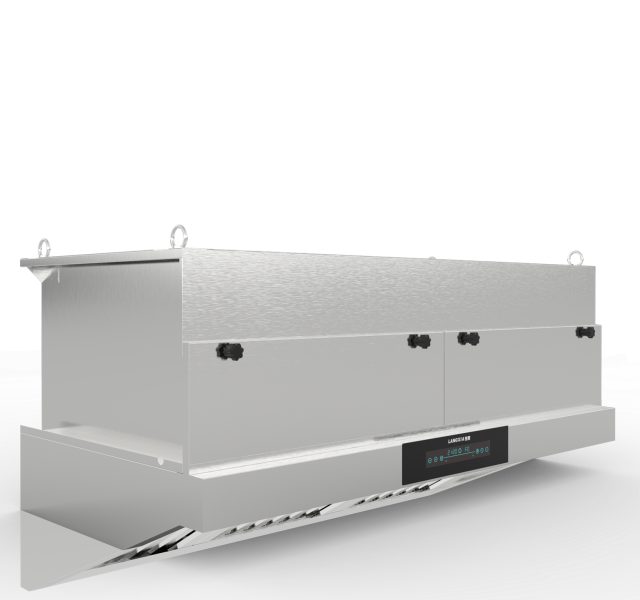
For a standard retail donut line, the workhorse is a light-duty ductless all-in-one hood. The N-series pairs electrostatic collection with high-efficiency particulate stages in a single-section body sized for the 4,000-7,000 m³/h class – which brackets the 3,500-5,000 m³/h a fryer-and-glazer line needs – and runs quiet enough for an open retail environment where the kitchen sits metres from the customer.
The sugar and ferment odors are the tower’s job. A carbon adsorption tower – the Odor Removal Tower – downstream of the hood holds activated carbon beds sized in the 5,000-20,000 m³/h class, and it is the stage that strips the stale-sweet note and aged-oil volatiles the mechanical stages pass through. In a format where the smell is the brand, this stage is not an accessory.
High-output production – a central bakery feeding several shops, or a factory store with continuous morning runs – moves into heavy-duty territory. The ND-series opens with a water-cycle stage that quenches the plume and catches the sticky fraction before it bakes on, then passes through electrostatic cells, an F8 medium filter and an H12 HEPA stage, with cells washing on a 40-60 day interval and self-cleaning variants for continuous sites.
Seafront and salt-air locations add a materials note, as they do across the fryer trades: Souniny builds its ductless and ducted ranges in stainless steel with CE certification, and the wear items – ESP cells, aluminium collector plates, sealing strips, ceramic insulators – are consumables replaced on condition, a cost to budget rather than a defect to claim.
Make-Up Air and Retail Comfort
Extracting thousands of cubic metres an hour from a sealed retail unit is a promise the unit cannot keep. If replacement air squeezes under the entrance, the shop runs at strong negative pressure: the door fights the customer, the queue goes cold in winter, and the canopy loses capture efficiency. A slight negative pressure is the target – enough to keep kitchen air drifting away from the counter, never enough to fight the door.
The donut-specific point is scent management. The entrance should let the fresh-baked aroma out and the queue should sit in it; the fry line should be the only thing under capture. A lobby or air curtain on the entrance line protects both jobs at once – it holds the retail scent in the front zone and keeps cross-draughts from peeling the plume off the canopy in summer, when the open front otherwise reverses the pressure balance the engineer specified.
Maintenance Rhythm for a Sugar Kitchen
Glaze residue makes every interval shorter. Sugar-laden film is stickier than grease alone, so baffle filters degrease weekly and canopy internals monthly at minimum; a shop that stretches those intervals will find the film has cured to a varnish that needs scraping. Powdered sugar and cinnamon dust load the pre-filter faster than any savory trade – check and swap it on condition, not on calendar.
The electrostatic cells wash on a 40-60 day cycle under continuous fry duty, and the carbon bed is condition-based: in a sweet kitchen it loads faster than in neutral cooking, so replace on odor breakthrough at the discharge or on a conservative summer schedule. Keep the dates in one log with the filter changes; when the environmental health officer or the mall facilities manager arrives, a dated maintenance trail is the cheapest document an operator can own.
A Commissioning Checklist Before the First Production Morning
The handover test runs at production load, not idle: fire a full batch of donuts, glaze them, and watch the air. Face velocity should hold along the full canopy; a smoke pencil at each vat edge should show everything drawn up and away; the discharge – room grille or external terminus – should show no visible plume and no fry-oil note at two metres.
Then walk the building. The front door should close on its own without fighting negative pressure. The queue should smell like fresh donuts, not old fryer. The neighbor’s window above the unit, and the corridor outside a mall kiosk, should carry nothing at all at six in the morning. Boundary noise should sit where a bedroom window can stay shut. Record the baseline readings and set the filter dates that day – a scheme that passes those checks before the first trading morning is a scheme that still passes them when the regulator, or the centre manager, walks in.
The engineering summary is short: a donut shop is a fryer in disguise, wearing a sweet retail uniform. Size the canopy from the vats and the glazer, give the gas-phase odors a carbon stage, pick the architecture the lease actually allows – treat the existing flue, purify at the hood, or split the plant into a floor cabinet – and then run the tighter maintenance rhythm that sugar demands. Do those four things and the shop sells the smell it wants to sell, to the people it wants to sell it to.