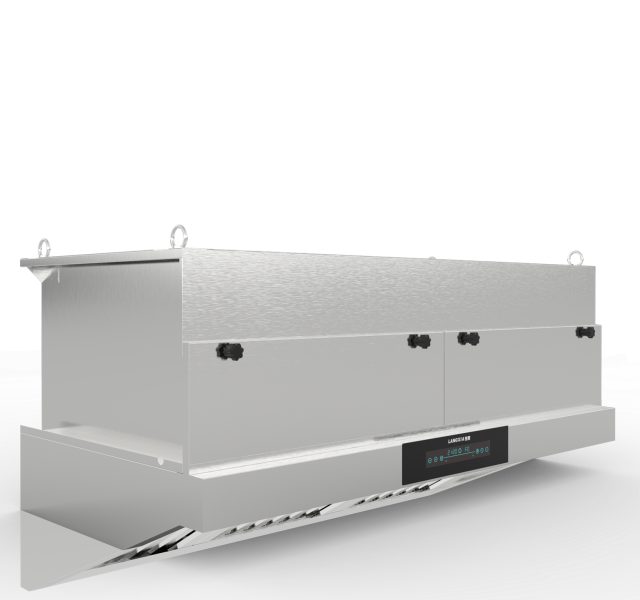
Rotisserie chicken occupies an unusual position in foodservice ventilation. The equipment is enclosed, so nobody expects a violent plume; yet the smell radiates further than almost any other cooking method, neighbours notice it within minutes of opening, and the hardest moment of the whole day arrives when a full cabinet is unloaded at once. This article looks at the emissions physics of spit roasting, why odour rather than grease is the complaint that actually threatens a rotisserie business, how duty classification and loading surges interact, and how to size and commission a line where most of the cooking happens behind glass.
What spit roasting actually releases
Cooking a bird on a rotating spit looks gentle compared with a wok or a charbroiler, and in some respects it is. There is no sear contact on a metal surface, no flare-up from fat hitting an open flame in the usual sense, and much of the process happens inside a glazed cabinet. But the chemistry is working exactly as hard as it does anywhere else.
Subcutaneous and intramuscular fat melts steadily as the meat rises through the rendering range. Much of that fat runs down the surface and drips, and where it lands on a hot element, a radiant panel or a drip tray, it flash-vaporises. The aerosol produced this way is fine, sticky and chemically aggressive; where the drip point runs hot enough, thermal decomposition of the fat generates acrolein and other short-chain aldehydes, which are both irritant and intensely odorous at very low concentrations.
Simultaneously, the browning reactions responsible for the product’s commercial appeal produce their own volatile load: Maillard-derived heterocyclics, sulfur compounds from muscle proteins, and the carbonyls that give roast bird its recognisable signature. None of these are grease particles. A filtration stage that removes particulate perfectly will pass almost every one of them unchanged, which explains a pattern owners report constantly: the canopy is clean, the ducts are clean, and the complaints about smell have not moved at all.
In most shops, the rotisserie is also not the only source. Holding cabinets for cooked birds, a gravy or jus station, roast potatoes finishing in fat, a two-basket fryer for chips, occasionally a charcoal or gas grill for marinated portions – often in a Portugese peri-peri format or a Latin American charcoal-roast format – all report to the same canopy. The rotisserie may be the signature appliance without being the dominant emitter, and sizing from the rotisserie alone is a common and expensive mistake.
A useful diagnostic distinction: cooking smell and rancid smell are different failures. If neighbours describe a stale, greasy, sickly odour rather than a roast aroma, suspect accumulated fat in drip trays, floor drains or an uncleaned section rather than overloaded filtration.
Where spit cooking sits in the duty classification
Classification frameworks such as ASHRAE 154 in North America, and the equivalent duty-based approaches embedded in EN 16282 and VDI 2052 practice in Europe, sort appliances into bands that describe how hard they drive the ventilation system. Rotisserie equipment straddles those bands, which is part of the reason it gets mis-sized.
A fully enclosed cabinet rotisserie, electric or gas, with a door that stays shut for most of the cycle, generally behaves as a medium-duty appliance. Its radiant load is largely contained by the cabinet; emissions are modest and comparatively steady while the door is closed. A bank of open spits rotating in front of a live gas flame, common in shopfront display and in some high-street formats, behaves differently: the products of combustion join the plume, radiant output is continuous into the room, and the units are effectively charbroiling from below while roasting from behind.
Where the rotisserie is driven by solid fuel – charcoal-fired spits for peri-peri, shawarma-style vertical broilers, or Latin-style rotisserie over embers – classifications move into the heaviest bands. Soot and polycyclic aromatic hydrocarbons join the stream, the required capture velocity rises, and pre-separation becomes non-negotiable rather than advisable.
A practical rule when an appliance sits on a boundary: classify upward, and then let the listing values published with the specific hood settle any remaining doubt. Undersizing a rotisserie line is discovered at lunch service on a hot day, which is the least convenient possible moment.
The unload surge is the real design case
Steady-state heat release is rarely what defeats a rotisserie canopy. The defeat arrives in a ten-second window, several times a day, when staff open the doors of a loaded cabinet.
Eight to twelve birds leave the cavity with the stored buoyancy of an oven cavity worth of hot, humid, fat-laden air. That volume does not trickle out; it releases as a coherent thermal slug that rises hard into the reservoir, expands, and needs somewhere to go. A hood sized only for continuous operation handles this badly, because continuous operation was never the peak load.
Three responses work, and they are complementary. The first is reservoir volume: a canopy that is deeper front-to-back, with a taller plenum, absorbs a surge rather than transmitting it to the lip. The second is generous overhang, giving the released cloud tolerance before it can roll past the leading edge. The third is protecting the cookline from lateral air, because a display rotisserie almost always sits somewhere draughty – facing the shopfront glass, close to a service door, under a busy corridor – and a 0.3 metre per second draught during an unload is all it takes to push that slug into the customer area.
Where operators have tried to solve the surge with fan capacity alone, they usually find the trade uncomfortable: the system becomes noisy, it removes more conditioned air than the shop can afford to replace, and the surge still escapes because the limiting factor was never average flow.
Why odour, not grease, threatens the business
Grease problems are visible and therefore get dealt with. Odour problems are invisible, arrive through somebody else’s window, and are handled by a third party – the neighbour, the landlord, or the environmental health officer.
The reason rotisserie generates complaints out of proportion to its particulate loading is threshold concentration. Human detection limits for many roast-meat volatiles sit in the low parts-per-billion range, orders of magnitude below any concentration that would show up on a particulate reading. A stream can be ninety-nine percent clean by mass and still be clearly, unmistakably present to somebody living forty metres downwind.
This cuts both ways, and good operators use it deliberately. Roast-chicken aroma is one of the strongest footfall drivers in food retail; plenty of shops aim their discharge – or their display – so that the plume reaches the street rather than the residential windows behind. The same physics that makes the smell a sales asset makes it a legal exposure, which is why the direction of the discharge is a design decision rather than an installation detail.
The technological consequence follows directly. Particulate stages, including electrostatic precipitator cells, remove aerosol exceptionally well and remove almost none of the volatile fraction. Activated carbon addresses the volatiles, but it is a consumable with a finite adsorption capacity, and its life depends almost entirely on how much grease reaches it first. A carbon bed blinded by grease stops working long before it is exhausted, and no amount of extra carbon fixes a missing pre-separation stage.
Where these shops actually live
The locations that suit rotisserie are precisely the locations that resist ductwork. High-street units in terraced rows with no rear service yard. Covered markets where horses rotate above food stalls and no riser exists. Supermarket concourses and forecourt stores where fitting-out permission stops at the ceiling grid. Kiosk footprints in shopping centres sharing a ventilation scheme with fifty other tenancies. Heritage shopfronts in European town centres where the facade is protected and the clear height after refurbishment is close to 2.4 metres.
In each of these, a Type I extract duct to a roof plant is either impossible or disproportionate to a tenancy of two or three years. Recirculating configurations exist for exactly this situation, subject to the recognition of the authority having jurisdiction and to the listing route covering the treatment stages rather than the capture geometry alone.
Fire considerations shape the answer too. Rotisserie produces grease-laden vapour and generally attracts Type I treatment, with its associated fire-suppression expectations; where a listed self-contained configuration demonstrates that its own filtration manages the hazard, some authorities will accept a reduced scope. The distinction matters commercially, because the difference between an appliance-scope suppression system and a full duct-and-plenum installation is often the difference between a viable fit-out and an abandoned one.
At the mobile end of the same sector – market pitches, festival sites, weekend pitches outside hardware stores and weekend markets – mobile food carts put capture and treatment at the cooking surface and remove both the canopy and the duct run from the problem entirely. The suitability of that route depends on whether the volume is genuinely mobile or only nominally so; a cart used at a fixed pitch every day deserves to be assessed as a fixed installation.
Sizing the line honestly
Two conversion methods cover almost every project. The per-linear-foot approach common in North American practice assigns roughly 300 cubic feet per minute per foot of hood length to medium-duty appliances and around 400 to its heavy counterparts; the flat flow-per-metre approach used widely in Europe and Asia works from around 2,000 cubic metres per hour per metre of canopy for a wall-mounted installation, rising to roughly 2,500 where the cookline is open to approach from more than one side. For a 1.2 metre deep canopy those methods converge, which is reassuring: they are two dialects of the same physics.
Taken literally for a typical shop – a 1.5 metre spit cabinet, a two-basket fryer, a bain marie and a small gravy station, arranged along roughly 2.8 metres of cookline – the flat method lands near 5,600 to 7,000 cubic metres per hour before any surge allowance. That is a substantial continuous flow for a small premises, and it should be, because the duty band demanded it.
Whether that arrives as one large assembly or two smaller ones working in parallel is usually decided by practical factors rather than by ratings: available wall length, available headroom, the electrical supply available for the section, and the fact that during a quiet Monday morning only half the line is operating. Splitting the duty lets one half idle, which cuts fan energy, filter loading and noise together.
Never size from the signature appliance alone. List every emitter including holding cabinets and gravy stations, classify each one, then add twenty percent against the surge before selecting equipment.
Cleaning chemistry specific to rendered fat
Fat rendered from poultry behaves differently from flash-fried oil mist. It condenses on every cool surface it passes – filter mesh, plenum corners, the first stage of any collector – and over days and weeks it polymerises into a hard, brown varnish that ordinary hot water will not touch. Left long enough it becomes the source of the rancid note neighbours describe.
That behaviour dictates a cadence rather than a single instruction. Daily work should include wiping the canopy face and emptying drip trays; rendered fat sitting warm in a tray for eight hours is already degrading. Weekly attention to removable filters prevents the coating from curing. On a monthly cycle the electrostatic cells are inspected; unglazed surfaces give up their film easily at that point, whereas leaving them for a quarter builds a film that needs chemical immersion to remove.
Activated carbon is judged differently from everything else in the train: it is replaced on evidence, not on calendar. The evidence is olfactory breakthrough at the discharge. A weekly sniff at the outlet – deliberately, recorded, by somebody who was not cooking that day – is the simplest reliable test in existence, and it costs nothing.
Matching the equipment to the duty band
Once the duty class, the flow and the surge are settled, the treatment train follows rather than being chosen from a list. The design question is what sits in front of the electrostatic cell and what sits behind it.
For enclosed cabinet rotisseries behaving as medium-duty appliances – the majority of high-street and supermarket formats – the stream is fat-rich but not particularly dense in solids, and a compact train works well. This is where the N-series fits: an electrostatic cell handling the sub-micron aerosol, backed by enough carbon to keep the volatiles below detection at the boundary of the property. Where the same shop runs a solid-fuel spit or an open gas bank, the band shifts into genuinely heavy territory, the sticky loading arriving at the cell increases sharply, and the ND-series answers it by putting a water-cycle section ahead of the cell so the bulk of the rendered fat is washed out before it can cure onto collector plates.
In both cases the second decision concerns the volatile fraction. Particulate stages do not touch it, and getting that right is what actually protects the relationship with the neighbours – so adding the Odor Removal Tower as a dedicated polishing stage, sized to the same flow, is usually what converts a compliant installation into a quiet one. It belongs downstream of the particulate stages, precisely because its working life is governed by how well those stages performed.
Space decides the rest. Shops with a usable roof path and very high volume typically keep the ducted route, where a higher-capacity unit handles large inline flows with centrifugal fan support; that option sits outside many of the locations described earlier, and for those the recirculating ductless range hood family keeps the entire train above the cookline. Where headroom is the binding constraint – the 2.4 metre European retrofit, or a listed unit where the ceiling cannot be touched – the answer is to separate capture from treatment: a shallow canopy does nothing but catch, and a narrow floor-standing cabinet takes the treatment into a service corridor or equipment recess, connected by a short duct. Where the building genuinely supports extraction at scale rather than recirculation, the ducted ESP purifier range handles the higher inline volumes with fan support behind it.
Commissioning and verification
Commissioning a rotisserie line is mostly about testing the moments that do not appear on a specification sheet.
Run a smoke trace along the canopy face with the units closed and again immediately after a full unload. Most revealed failures appear only in the second pass. Take a velocity grid across the entrance plane and look for uniformity before magnitude; a balanced face at a modest reading outperforms a high average delivered unevenly. Repeat the exercise with the shop door open and displays running, because that is the condition the business actually operates in.
Then establish the baseline that the next two years will be measured against: date-stamped velocity readings, a note of the carbon condition by smell at commissioning, and the cleaning intervals calendarised from day one. Filters and cells are only ever as disciplined as the record behind them.
Done in this order – duty class first, geometry second, airflow third, treatment train fourth – a rotisserie shop ends up with the outcome that actually matters commercially: the smell reaches the pavement where it sells chickens, and nothing reaches the windows above where it loses neighbours.