Few mainstream kitchens ask as much of an exhaust system as a Chinese restaurant. One service line can run two or three wok burners at full roar, a bank of dim sum steamers venting water vapor all afternoon, a roast oven lacquering duck with maltose syrup, and stock pots that have been simmering since dawn. Each of these stations produces a different pollutant, at a different rate, with different capture physics — and they all sit within a few metres of each other. Treating that line as a single “heavy kitchen” is why many first fit-outs end up with spilled smoke, waterlogged filters, and the one complaint that closes Chinese restaurants more reliably than any inspection: odor.
Four Production Zones, Four Fume Signatures
The starting point is to stop thinking about a Chinese restaurant kitchen as one load and start thinking of it as four distinct production zones, each with its own fume signature. Design for the zones and the whole kitchen works; design for an average of the zones and nothing works quite right.
The Wok Line: The Heaviest Pulse Load in Mainstream Cooking
A wok station is not a stove in the conventional sense; it is a pulse source of aerosolized cooking oil. Pan surfaces run between roughly 260 and 330 °C during stir-frying, hot enough to flash-vaporize oil on contact with food and with the steel itself. Every toss releases a burst of sub-micron oil mist and combustion product that rises faster than a static plume, and every wok hei moment — the breath of the wok that customers pay for — is a smoke event by design. In duty-class terms (the light, medium, heavy and extra-heavy scale used in ASHRAE 154 and echoed in EN 16282 and DW/172), a busy wok line sits at the top of the scale alongside charcoal grills. The plume is intermittent and turbulent, which matters enormously for capture: a hood sized for the average load will spill on every peak.
The Dim Sum Steamer Bank: Light on Grease, Heavy on Water
The dim sum steamer bank is the opposite problem. Bamboo steamers and cabinet steamers produce comparatively little grease but an enormous latent heat and moisture load: a steady column of water vapor that condenses on any surface below its dew point. Canopies over steam zones sweat; ducts collect condensate; and rice starch and wheat flour from dumpling skins add a fine, sticky particulate that turns into paste wherever it lands wet. Capture velocity here should be gentler than over a wok — pull too hard and you drag condensate off the bamboo and splash moisture into the filters downstream, which wet-loads them and collapses their effective life.
The Roast and Siu Mei Row: Aromatic Heavy Duty
The roast and siu mei row — char siu pork, soy chicken, roast duck — runs gas or electric rotisserie and chest ovens in which fat drips onto hot surfaces and marinade sugars caramelize. Dripping fat flashing against hot oven floors generates aldehydes and visible smoke; maltose and honey glazes throw off a brown, sweet, intensely aromatic aerosol that polymerizes into a lacquer-like varnish on every surface it touches. Many venues place this row in a separate back room, which is sensible: the fume is heavy-duty and among the most odor-active in the building, and it deserves its own capture solution rather than borrowing airflow from the wok line.
The Quiet Constants: Stock, Rice and Blanching
Finally, the quiet constants: master stocks simmering ten to twelve hours, rice cookers, noodle blanching pots, congee. Individually each is trivial; collectively they set the kitchen’s baseline heat and humidity for the whole day and produce a mild but persistent cooked-bone-and-aromatic odor. They are also why a kitchen can feel off at three in the afternoon, when no wok has been fired since lunch — the ventilation was sized for the peaks and never accounts for the zone that never stops.
Why Mixed Fume Is Harder Than One Bad Zone
The zones disagree about airflow. The wok line wants high capture velocity, deep overhang and tolerance for turbulence; the steamer bank wants moderate velocity and condensate management; the roast row wants grease storage capacity and odor stages; the stock corner wants almost nothing except patience. A single canopy sized to a compromise will under-capture the wok peaks and over-ventilate the steam bank, which is the classic Chinese-kitchen failure pattern: visible spill drifting toward the dining room during dinner service, and a steamer hood dripping onto prep at two in the afternoon.
Then there is the glue. Water vapor condensing onto grease-loaded baffles and filter media creates an emulsified film that is far harder to remove than either substance alone. Emulsified grease polymerizes with heat over weeks into a hard varnish that narrows filter apertures, raises face velocity and — the part fire authorities care about — becomes fuel. A kitchen that runs wok and steam through the same untreated path accumulates fire load faster than either a pure fry kitchen or a pure steam kitchen, and its cleaning intervals must shorten accordingly.
The odor problem is chemical, not mechanical. Scallion and garlic allium sulfides, star anise and five-spice volatiles, frying aldehydes such as acrolein, and Maillard reaction products all have human detection thresholds in the parts-per-billion range. Neighbors smell a Chinese takeaway at concentrations no smoke detector and no visual inspection will ever register. And because these molecules are gas-phase, removing every particle of soot does nothing to remove them — which is why a kitchen can pass a smoke test and still receive a nuisance notice.
Plume physics seals the argument. A wok plume is turbulent and pulsed; a steam column is steady and laminar; a roast oven plume is hot, greasy and continuous. One face velocity cannot be optimal for all three. Capture-and-containment — the hood must capture the plume and contain it without spillage at the design airflow — is achievable for a known, steady duty; it is a different exercise for four duties on one line.
Make-up air is the silent fourth problem. Exhausting 5,000–6,000 m³/h without replacing it drags air backwards through the building: through doorways, from the dining room, from the neighbor’s wall vent. Under-supplied kitchens in terraced and strip retail buildings run strongly negative, which both starves the hood (a starving hood spills) and pulls kitchen air — and kitchen odor — toward the dining room and the street.
Codes, Neighbors and the Real Approval Path
The regulatory starting point depends on jurisdiction, but the pattern repeats. In the United States, NFPA 96 treats grease-producing appliances — which absolutely includes wok ranges and roast ovens — as requiring a Type I hood with grease-tight exhaust, and the IMC carries the same requirement into building code. The recirculating path opened by UL 710B allows listed ductless equipment to purify and return air rather than duct it, which is what makes no-duct fit-outs code-compliant across much of North America.
In the United Kingdom, the enforcement that actually reaches Chinese restaurants and takeaways is rarely the building code; it is the Environmental Protection Act 1990, under which cooking odor affecting neighbors is a statutory nuisance. Terraced-row takeaways with residents above or beside the kitchen are the textbook case, and DEFRA guidance plus DW/172 design practice is the route to defending one. Across the EU, EN 16282 and VDI 2052 set the design baseline; in Australia, AS 1668.2 governs kitchen exhaust, with recirculating hoods assessed appliance by appliance in most jurisdictions.
Layered on top sit landlords and building physics. Retail basement units frequently have no riser capacity at all; heritage facades block new penetrations; malls cap kitchen emissions at the tenancy boundary. In a large share of Chinese restaurant fit-outs — especially the urban retrofit majority — a new duct run is simply not on the table, and the design conversation starts from purification at the source instead of transport of the plume.
Sizing the Zones Without Guessing
A workable baseline used across the industry: allow roughly 2,000 m³/h of exhaust per metre of hood length for closed cooking, 2,500 m³/h per metre for open display cooking, and on the order of 4,000 m³/h per wok burner. A 2.4-metre hood over a two-burner wok line therefore wants about 5,000–6,000 m³/h for that section alone; the roast row is sized per appliance, and the steamer bank by aperture area with its moisture handling addressed separately.
Two corrections keep the arithmetic honest. First, diversity: size for dinner service, when wok, roast and steam all peak together, not for the sum of nameplate loads at idle. Second, efficiency claims: at a typical raw emission concentration near 10 mg/m³, a genuine 99 percent removal leaves about 0.1 mg/m³ — visually smoke-free — while a 95 percent claim leaves five times that. An efficiency number without a test method, a particle size and a loading state is marketing, not engineering.
And for the steam zone, remember that airflow alone does not solve condensation. What solves condensation is geometry and drainage: baffle stages that drain forward, drip channels, a slight slope in the plenum, and filter media selected so that moisture passes through rather than wet-loading it. A steamer canopy that looks modest on paper but drains properly will outperform an oversized one that sheets water onto its filters.
The Architecture Fork: Ducted or Ductless
Where a riser, shaft or roof penetration genuinely exists, the classical ducted answer still works: capture at the canopy, transport in a grease-tight duct, and in-line purification — an electrostatic stage sized to the duty with a matching fan and, where odor receptors are close, a carbon section before discharge. That path suits high-volume wok lines in buildings designed for catering. The ducted ESP purifier range covers this high-volume end, and it remains the right call when the duct is already there.
Where the duct is not there — basement food courts, terraced retail rows, heritage buildings, mall tenancies without riser capacity — the modern answer is to purify at the canopy instead of transporting the plume. Souniny’s ductless range hood family does exactly this: multi-stage mechanical pre-filtration for grease, an electrostatic cell for sub-micron particulate, and a final media or carbon stage for residual odor, all in a unit that hangs over the cookline and needs no penetration of the building envelope.
The design move that separates a working layout from a compromised one is zone-splitting: instead of one long compromise canopy, run a heavy-duty hood over the wok and roast sections and a second, lighter capture over the steamer and stock bank. Two smaller units each operating at their correct duty beat one large unit operating at neither’s. The steam zone stays dry, the wok zone gets its velocity peaks, and the odor stages on the heavy line are sized for the load that actually produces odor.
Odor: The Complaint That Actually Closes Restaurants
Odor control deserves its own section because it is the complaint that ends leases. The physics is simple: an electrostatic stage is a particle collector, while odor molecules are gas. The standard answer is adsorption — activated carbon, and plenty of it, sized by mass and replaced on schedule rather than when it starts to smell, by which point it has smelled for weeks.
Discharge design does the rest. A discharge that terminates in a courtyard, under a neighbor’s bedroom window or into a shared alley will generate complaints regardless of how clean the exhaust is, because residual odor concentrates where the plume settles. Height, direction and distance from receptors are free variables that cost nothing at design time and are unbuyable after opening day.
There is a positive side: pressure. Keeping the kitchen slightly negative but the dining room positive means the aroma customers should smell stays front-of-house, while the aroma neighbors should not smell stays inside the treatment train. The smell of dinner is an asset in the dining room and a liability at the property line — the ventilation design decides which side of the wall each becomes.
Maintenance Rhythm for a Grease-and-Steam Kitchen
A grease-and-steam kitchen does not forgive lax maintenance. Hood grease gutters and baffle filters need weekly attention; electrostatic cells over the wok and roast zones need washing on the order of every four to eight weeks depending on hours and menu oil load; the steam zone’s needs are different — drained, dry baffles and clear condensate paths rather than frequent washing. Activated carbon is a consumable: track quantity against cooking volume and replace on a schedule, not on complaint.
The reason for the discipline is chemistry, not tidiness. Emulsified grease that dries and polymerizes becomes varnish, varnish becomes fuel, and a fire inside a grease-saturated hood assembly spreads in ways a clean assembly does not. Insurers and fire inspectors increasingly ask for cleaning records; a simple logbook of wash dates, cell condition and carbon changes is the cheapest compliance document a Chinese restaurant can own.
Commissioning closes the loop: a smoke-pencil trace at every zone at full dinner load, confirming capture without spillage at the hood edge, plus a check that make-up air actually arrives where it was designed to. An hour of verification in opening week prevents years of arguments about whose kitchen smells.
The Design Response: Zone-Matched Purification
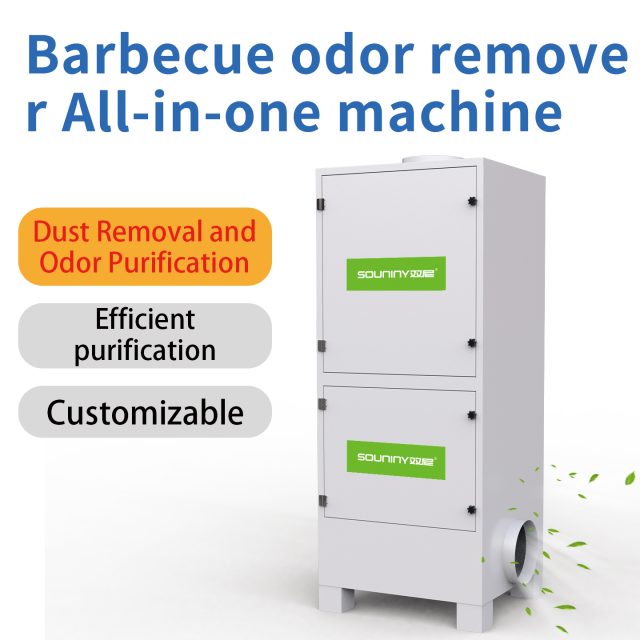
Put together, the zone-matched ductless answer looks like this. Over the wok and roast sections, a heavy-fume all-in-one unit — the ND-series — pairs multi-stage electrostatic filtration with the capture depth a pulsed plume needs, in a package that requires no duct run. Over the steamer bank and stock corner, a slimmer N-series light-duty unit manages moisture and light particulate without over-ventilating the room. And where neighbors sit close — a terraced takeaway, a mall tenancy with residences above — an Odor Removal Tower in the treatment path adds the gas-phase carbon capacity that particle removal alone cannot provide.
Layouts with a separate roast room, or kitchens where floor space rather than headroom is the constraint, can decouple purification from the canopy entirely with a floor-standing cabinet unit joined by a short connection. For open kitchens — the hand-pulled noodle counter, the Peking duck carving station, the dim sum trolley where the customer stands a metre away — mobile food carts bring ventless capture to wherever the performance happens.
None of this requires exotic engineering. It requires matching capture to duty per zone, providing gas-phase treatment wherever odor receptors are close, verifying with smoke at commissioning, and keeping the treatment train maintained on a schedule set by the menu. A Chinese restaurant does not need one giant hood; it needs the right capture over each of its four kitchens-within-a-kitchen — and then the only thing that escapes is the aroma customers were promised.