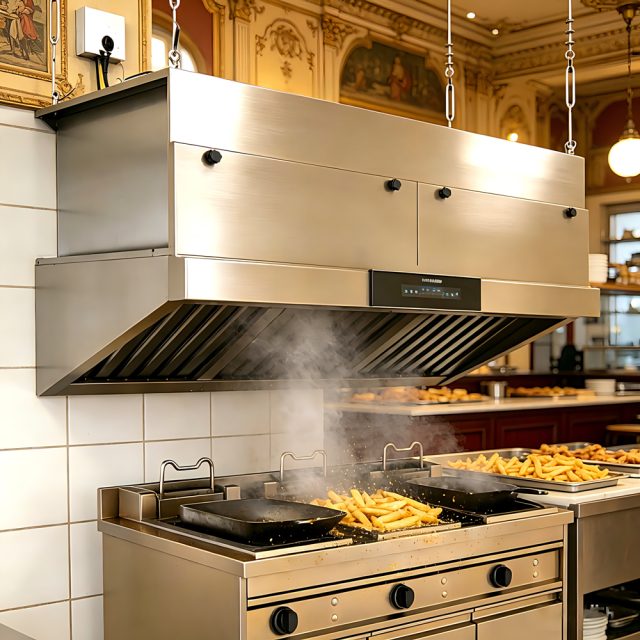
The breakfast segment is one of the fastest-growing categories in foodservice, yet its ventilation needs are often underestimated. A waffle iron pulsing steam at 200 °C, a griddle rendering bacon fat, and a glazing station caramelizing syrup create a fume cocktail that is chemically distinct from the steady grease plume of a fryer bank. For operators opening in strip malls, historic high streets, or airport concourses, the absence of a rooftop exhaust riser turns what looks like a light-duty kitchen into a real engineering puzzle. This article breaks down the pollutant physics, capture geometry, and code constraints of waffle and pancake shop ventilation, then maps them to practical hood architectures that do not require ductwork.
The Fume Profile: Griddles, Waffle Irons, and Caramelization
Unlike the continuous plume of a wok station, breakfast production is defined by intermittent pulses. A Belgian waffle iron cycles between a closed, pressurized steam burst (180–220 °C) and an open unload event that releases a cloud of moisture, butter aerosol, and Maillard volatiles in under ten seconds. The physics are governed by the Leidenfrost effect: when batter hits the hot iron, a vapor barrier forms, lifting the droplet and creating a miniature steam explosion that carries fine oil particles upward at velocities exceeding 1.0 m/s. A flat griddle cooking pancakes, hash browns, or bacon produces a steadier but lower-temperature grease-laden vapor stream, typically 150–180 °C at the surface, with particle sizes concentrated in the 0.5–2.0 µm range—small enough to remain suspended for minutes but large enough to coat surfaces with a sticky film.
The third source—the syrup or fruit-glaze warming station—adds a low-temperature but high-odor load. Sucrose heated above 170 °C generates furan-2-carbaldehyde, 5-methylfurfural, and a family of pyrazines with human detection thresholds in the parts-per-billion range. These compounds are polar and water-soluble, meaning they ride on steam droplets rather than grease particles, and they cling to fabrics, upholstery, and HVAC return grilles with tenacity that far exceeds their mass concentration. A pancake shop that smells “like breakfast” to passers-by may be registering a nuisance complaint from the upstairs tenant.
These three streams do not add linearly. The waffle-iron steam burst can temporarily overwhelm a hood designed only for griddle duty, creating a capture bypass that deposits sticky sugar varnish on ceiling tiles and diffusers. Meanwhile, the griddle’s fine grease aerosol behaves differently from the waffle iron’s larger steam droplets: the former requires electrostatic or high-efficiency mechanical capture, while the latter is primarily a latent-heat and moisture problem. A hood sized for average load will fail at peak breakfast rush when all three sources fire simultaneously.
Thermal Dynamics and Capture Geometry
ASHRAE 154 and EN 16282 both classify griddles as medium-duty appliances and open waffle irons as light-to-medium duty, depending on menu mix and operating hours. The key design case is not the steady-state thermal output but the door-open unload surge. When a waffle iron opens, the steam plume rises at an initial velocity of 0.8–1.2 m/s, nearly double the face velocity of many standard hoods. If the canopy overhang is insufficient or the cross-draught from a front-of-house door exceeds 0.2 m/s, this plume spills into the dining area within seconds. ASTM F1704, the standard test method for recirculating hoods, specifically measures capture efficiency during door-open events; a hood that scores 95 % on a steady griddle test may drop to 70 % when a waffle iron unloads.
Capture efficiency for breakfast equipment depends on three geometric variables. Overhang depth should be minimum 150 mm beyond the appliance front edge, and 200 mm is preferable for front-counter layouts where the customer stands 1.2 m from the cookline. Hood height should be 1.2–1.4 m above the cooking surface for low-ceiling sites, and never more than 1.8 m, because the thermal plume from a 160 °C griddle cools rapidly and loses buoyancy. Side panels are essential for island or front-of-house lines where cross-draught is uncontrolled; a three-sided partial enclosure can reduce the required exhaust airflow by 25–30 % compared with a full island canopy.
Replacement air strategy is equally important. Griddles and waffle irons together can exhaust 3,000–5,000 m³/h in a compact line. Without balanced makeup air, the kitchen pulls negative pressure, drawing cooking odors through wall cavities and under doors into adjacent retail or hotel corridors. In mixed-use buildings, this negative pressure can also back-draft gas water heaters or fireplaces in neighboring units, creating a life-safety issue that precedes any grease-fire risk. The ideal solution is a tempered makeup-air unit delivering 80–85 % of the exhaust volume at 18–20 °C, ducted to within 3 m of the hood but not directly into the capture zone.
Codes, Standards, and Lease Constraints
NFPA 96 defines Type I hoods for grease-producing appliances and Type II for heat and odor only. In practice, most waffle and pancake shops fall under Type I because griddle grease and waffle-iron butter aerosol meet the standard’s definition of grease-laden vapors. However, the International Mechanical Code (IMC) and UL 710B now recognize recirculating ductless hoods for light and medium duty, provided the unit is listed for the application and the discharge air meets local particulate and odor limits. The critical detail is that UL 710B requires a minimum 95 % grease-removal efficiency by weight at rated airflow, measured with a standardized cooking aerosol—not a laboratory dust load.
The real constraint is often the lease, not the code. Mall food-court tenants, airport concessionaires, and historic-street operators typically lack the right to core through the roof or share a communal riser. In these cases, the choice is not between a cheap and an expensive hood; it is between a ductless range hood family that recirculates internally and a costly building-wide duct retrofit that the landlord will not approve. UK operators face additional statutory-nuisance exposure under the Environmental Protection Act 1990, where neighbor complaints about syrup-caramelization odors can trigger enforcement regardless of NFPA compliance. DEFRA guidance DW/172 further requires that grease-extraction systems in commercial kitchens be capable of reducing emissions to levels that do not cause nuisance at the boundary of the premises.
In Australia, AS 1668.2 sets the mechanical ventilation standard for commercial kitchens, requiring that exhaust systems be designed to capture and remove contaminants at the source. For ductless installations, the standard defers to the manufacturer’s listed performance data, but the building certifier will still demand evidence that the discharge does not re-enter the building via intake louvers or openable windows. In continental Europe, EN 16282-1 provides the framework for kitchen ventilation design, while VDI 2052 offers detailed guidance on airflow rates and hood geometry. German operators in particular should note that Altbau and Gründerzeit buildings often have clear heights below 2.5 m, making traditional stacked hood-and-duct assemblies physically impossible without structural alteration.
Sizing Algorithms for Breakfast Lines
The rule of thumb for commercial canopy sizing—2,000 m³/h per metre of hood length for wall-mounted lines, 2,500 m³/h per metre for open display or island configurations—applies directly to waffle and pancake shops. A typical two-griddle, two-waffle-iron line measuring 2.4 m requires 4,800–6,000 m³/h of total capture airflow. Because breakfast rushes are compressed into a 90-minute window rather than spread across a dinner service, the duty factor is higher: the hood must handle near-continuous peak load without thermal overload. A simple arithmetic example illustrates the point:
Example sizing: A pancake house has a 2.8 m wall-mounted line with one 0.9 m griddle, one double waffle iron (0.6 m), and one syrup warmer (0.4 m), plus 0.9 m prep space. Base airflow = 2.8 m × 2,000 m³/h/m = 5,600 m³/h. With a 1.15 breakfast-rush duty factor = 6,440 m³/h. Rounded to the nearest standard unit rating = 6,500–7,000 m³/h effective capacity.
For operators adding a French-toast station or a breakfast-meat grill, the load shifts toward heavy duty. A 3.0 m line with griddle, waffle iron, and open grill can demand 7,500 m³/h or more. In these cases, splitting the line into two capture zones—one for the high-pulse waffle iron and one for the steady griddle—improves containment and reduces the chance of a single hood choking on mixed plume dynamics. The split also allows maintenance scheduling to match the actual soil load of each zone rather than averaging across dissimilar appliances. A two-zone layout adds roughly 10–15 % to the combined airflow compared with a single hood, but the gain in capture reliability and filter life usually justifies the incremental cost.
Odor Chemistry and Carbon-Stage Design
The characteristic “breakfast smell” that clings to uniforms and upholstery is not grease; it is the volatile fraction of caramelization and Maillard reactions. Furan-2-carbaldehyde and 5-methylfurfural, produced when glucose and fructose dehydrate above 160 °C, are polar, water-soluble compounds that pass through standard mesh pre-filters and even some ESP cells unless the ionization stage is tuned for sub-micron organic aerosol. Pyrazines, responsible for the nutty, roasted notes of browned batter, are even smaller and more mobile. Dimethyl trisulfide, generated when egg proteins and alliums react on a hot griddle, has a detection threshold below 0.01 ppb—meaning a single overcooked egg can scent a 200 m² dining room.
An effective odor-control train for a pancake shop therefore needs a dedicated carbon stage sized by mass, not by airflow alone. Industry practice calls for 0.5–1.0 kg of activated carbon per 1,000 m³/h of rated flow, with a contact time of 0.3–0.5 seconds. Coconut-shell carbon with a 4×6 mesh and iodine number above 1,000 mg/g performs well on the furan and aldehyde spectrum typical of syrup volatiles. The carbon bed must be accessible for replacement—ideally via a slide-out tray—because breakfast shops run high duty cycles and can saturate a small bed in 3–6 months. Some operators extend bed life by routing syrup-station exhaust through a separate, smaller carbon canister rather than loading the main hood’s carbon stage with low-concentration, high-volume air.
Maintenance Rhythm and Record Keeping
Breakfast equipment produces a unique soil profile: the waffle iron deposits a thin, polymerized sugar film on hood walls and filters, while the griddle loads the ESP cell with standard grease particulate. The sugar film is hygroscopic; if left uncleaned, it absorbs moisture from steam and swells, blocking airflow and creating a sticky fire load. Cleaning chemistry matters: alkaline degreasers (pH 11–13) dissolve grease effectively but can caramelize sugar deposits into a harder, more flammable varnish. For waffle-shop hoods, a two-step clean—neutral pH 7–8 sugar solvent first, followed by mild alkaline degreaser—yields better results than either chemistry alone.
Cleaning intervals should be shorter than for a pure griddle line: pre-filter wash every 7–14 days, ESP cell inspection every 4–6 weeks, and carbon replacement every 3–6 months depending on syrup-volume throughput. Operators should keep a logbook recording filter wash dates, cell voltage readings, and carbon replacement batch numbers. In the UK, this log is admissible evidence under DEFRA guidance; in the US, it supports insurance claims after a hood fire. Digital photos of clean filters and cells, time-stamped and stored in cloud folders, take thirty seconds to capture and can save weeks of dispute resolution.
Matching Architecture to the Menu Mix
For a compact waffle shop with one griddle and one waffle iron in a 20 m² kitchen, an N-series light-duty ductless hood with a two-stage train—pre-filter plus ESP cell—delivers sufficient grease capture, provided the syrup station is positioned under the same canopy or a secondary odor tower handles the caramelization load. The unit should be sized at the upper end of the light-duty range to absorb the waffle-iron pulse without bypass. In open-kitchen or front-counter layouts where guests watch the cook line, the low noise profile of a recirculating ductless system—typically 58–65 dB(A) at 1 m—preserves the conversational atmosphere that defines the breakfast experience.
When the menu expands to include bacon, sausage, and hash browns on a second griddle, the fume load crosses into medium duty. An ND-series heavy-duty ductless unit with water-cycle cooling, multiple ESP cells, and an integrated F8 medium filter prevents the grease-and-sugar emulsion from glazing the HEPA stage. The water-cycle stage is particularly valuable here: it quenches the hot griddle plume before it reaches the electrostatic cell, reducing thermal stress and extending cell-cleaning intervals from 4 weeks to 8–10 weeks in typical breakfast service.
Shops in heritage buildings with 2.4 m clear height or narrow service corridors can decouple the purification cabinet from the canopy. A floor-standing cabinet unit, 520 mm wide, stands behind the cookline or in an adjacent recess, connected to a shallow capture hood by a short duct. This split arrangement keeps the visual volume above the griddle minimal while still delivering 1,000–2,000 m³/h of treated airflow. For seasonal pop-ups, farmers markets, or airport rotisseries, mobile food carts with built-in ventless hoods allow breakfast service in locations where fixed infrastructure is impossible.
Operators who do have roof access and a heavy charcoal or wood-fired breakfast menu—such as Southern-style pit-smoked bacon or open-flame Dutch pancakes—may still need a ducted ESP purifier range with a centrifugal fan and dedicated grease-duct run. The decision fork is straightforward: if the building can support a full duct and the menu generates solid-fuel smoke, ducted remains the most robust path. If the building cannot, or if the menu is griddle-and-iron only, ductless eliminates the rooftop penetration while still meeting NFPA 96 and IMC recirculating-hood requirements.