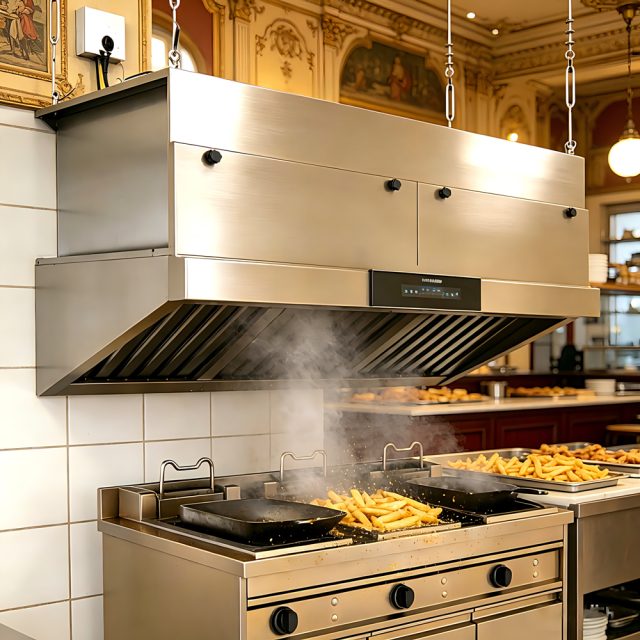
Few commercial kitchens serve customers who never place an order. At an aquarium or zoo cafe, the guests at the next table may include a school group, a pair of penguins behind acrylic glass, and a sea lion whose respiratory tract reacts to air quality changes long before any human notices. Food service inside zoological parks and aquariums is a ventilation challenge unlike any other: the exhaust system must protect animal welfare, preserve glass-clarity viewing experiences, respect life-support equipment rooms, and still deliver restaurant-grade capture of grease-laden vapor. Ductless purification built around the N-series light-duty all-in-one, the ND-series heavy-duty all-in-one, and the Odor Removal Tower has become the practical answer for operators who cannot — and should not — punch holes in a glass dome.
Why Zoological Food Service Is a Different Ventilation Problem
A standard restaurant ventilation design starts from two assumptions: the only occupants who matter are people, and the building can be pierced with ductwork wherever the layout requires it. Both assumptions collapse inside a modern aquarium or zoo.
First, the occupants. Zoological facilities operate under animal welfare legislation and accreditation frameworks — in the United States, the Animal Welfare Act administered by USDA-APHIS, and the accreditation standards of the Association of Zoos and Aquariums (AZA); in Europe, national animal welfare acts and the EU Zoos Directive. These frameworks require facilities to maintain environments that support species-appropriate behavior, and air quality is part of that environment. Birds, including penguins, raptors, and free-flight aviary species, possess a highly efficient flow-through respiratory system with air sacs that makes them extraordinarily sensitive to inhaled particulate and gaseous pollutants — the same reason canaries once served in coal mines. Marine mammals such as seals, sea lions, and dolphins spend their lives at the air-water interface, breathing whatever crosses the surface of their pools.
Second, the building. Contemporary aquarium halls are architectural statements: spanning glass roofs, acrylic tunnel walls, exposed structural steel, and tightly controlled humidity envelopes. Facility engineers guard the envelope carefully because every roof penetration is a condensation risk, a sealant maintenance liability, and — in a salt-air aquarium environment — a corrosion pathway. Meanwhile, the life support system (LSS) rooms that filter and circulate millions of liters of water need clean intake air, not kitchen exhaust drifting through a louver.
The design consequence: food service inside zoological facilities should minimize exhaust discharge entirely. Recirculating, ductless purification — capturing grease, smoke, and odor at the source and returning clean air to the space — aligns with animal welfare, envelope integrity, and energy goals simultaneously.
The Pollutant Profile of a Typical Zoo and Aquarium Cafe Portfolio
Zoo and aquarium food service is not one kitchen; it is a constellation of small stations scattered across the campus. Each has a distinct emission signature, and treating them identically wastes money.
Popcorn and Snack Kiosks
The classic zoo aroma — fresh popcorn — is a light-duty emission: butter-fat vapor, salt aerosol, and the warm Maillard notes of hot oil. Load levels are modest and intermittent, tied to show schedules and crowd waves. This is precisely the operating envelope of the N-series light-duty all-in-one ductless range hood: a compact unit whose stainless-steel electrostatic field captures the sub-micron particulate in popped-butter vapor, while integrated filtration stages polish the air before recirculation. Because popcorn kiosks frequently sit in open corridors or under atrium roofs where no duct route exists, a self-contained hood is often the only compliant option.
Grilled and Fried Fish Sandwich Stations
Aquarium cafes lean into seafood menus, and fish cookery changes the chemistry of the exhaust. Fatty fish species release long-chain fatty acids that oxidize into volatile aldehydes, and seafood cooking generates amines — including trimethylamine — the compound responsible for the penetrating “fish odor” that humans detect at extremely low concentrations. Animals detect it lower still. A griddle searing salmon burgers, or a fryer basket of fish sandwiches, produces a mixed stream of grease-laden vapor plus dissolved-gas odor molecules. Grease particulate is an electrostatic problem; amines and aldehydes are a molecular problem. This station calls for the ND-series heavy-duty all-in-one hood over the cooking surface, followed by an Odor Removal Tower to adsorb and decompose the odor fraction before air re-enters the hall.
Churro, Donut, and Sweet Treat Fry Stations
Cinnamon-dusted churros are a zoo staple, and their station emits hot frying-oil aerosol, caramelization byproducts, and acrylamide-bearing fine particulate from sugar browning. Emission volume is moderate but the odor is assertive and travels — through open concourses, into reptile houses with their own temperature envelopes, and toward aviaries. A light-to-medium duty ductless hood with odor-stage filtration contains the plume at the fryer.
Burger Grills and Flattop Stations
The main zoo cafe typically operates a flattop and a char-mark grill for burgers and chicken. Patties release rendered beef fat vapor, polycyclic aromatic hydrocarbons (PAHs) from fat pyrolysis on hot surfaces, and persistent grease aerosol that condenses on cold surfaces — including the acrylic panels of nearby exhibits, where a greasy film dims the view that guests paid to see. This is heavy-duty territory: an ND-series unit sized to the grill footprint, with its multi-stage electrostatic collection capturing the grease load before it can migrate.
Why Ductless Architecture Fits Zoological Buildings
Conventional thinking would run ductwork from each station to a roof-mounted exhaust discharge. In a zoological facility, every meter of that duct creates problems: penetrations through humidity-controlled envelopes, grease accumulation inside concealed duct runs that fire inspectors flag under standards like NFPA 96, exterior discharges near open-air animal habitats, and visual intrusion on landscape architecture. Where a campus central kitchen with existing ductwork exists, an inline ESP Purifier with a matched Centrifugal Fan remains the right ducted solution at high volume. But for the dispersed, small-footprint stations that define the guest-facing zoo cafe mix, ductless is the default.
A ductless all-in-one range hood recirculates: it pulls the plume directly from the cooking surface, passes it through pre-filtration and a high-voltage electrostatic field where charged grease and smoke particles precipitate onto collector plates, then through odor-treatment media, and returns cleaned air to the room. No roof penetration, no chase, no exterior discharge near animal habitats, and dramatically reduced make-up air demand — the last point mattering enormously in halls where conditioning air costs are driven by humidity control year-round.
Odor Control: The Odor Removal Tower as the Animal-Welfare Interface
Here zoological facilities diverge hardest from ordinary restaurants. In a shopping-mall food court, an odor episode annoys customers. In an aquarium hall, odor molecules are a behavioral stimulus for the animals. Husbandry teams monitor for stereotypic behavior and stress indicators, and unexplained behavioral changes trigger investigations that can include air quality review. Trimming odors at the source is therefore not cosmetic — it is part of the welfare documentation trail.
Electrostatic precipitation is outstanding at particulate — grease droplets, smoke, sub-micron aerosol — but odor compounds such as trimethylamine, aldehydes, and short-chain fatty acids are gas molecules that pass through an electrical field unaffected. The Odor Removal Tower exists for exactly this stage: positioned as the final purification stage after the hood’s electrostatic section, it treats the molecular odor fraction through adsorption and decomposition media. For zoo operators, the practical commissioning test is straightforward: stand at the exhibit acrylic nearest the cafe during peak frying service and verify that no identifiable cooking odor is perceptible — the same standard a sensitive neighbor would apply to a downtown restaurant.
Design rule of thumb for zoological projects: pair the ductless hood to the grease load (N-series for light stations, ND-series for grills and fryers), then pair the Odor Removal Tower to the odor load of the menu — seafood and fried menus need more odor capacity than pastry menus.
Mobile Carts: Seasonal and Show-Adjacent Food Service
Zoo operations are seasonal and event-driven: summer evenings, holiday light trails, feeding-show amphitheaters that suddenly need a snack point fifty meters from the nearest utility room. Hard-piped infrastructure cannot follow the crowd. This is the role of the ventless mobile cart line — the CV-A ventless-hood cart for live cooking with full onboard purification, the CV-B countertop cart for compact grab-and-go prep, and the CV-C tempered-glass cart where display merchandising matters as much as cooking.
Because these carts carry their own electrostatic purification and recirculate cleaned air, they can operate inside open barns, near amphitheater seating, or along boardwalks without any fixed exhaust connection — and they can be redeployed or winterized as the season dictates. For penguin-plaza ice treats in July and cocoa service at the reptile house in December, mobility is the entire point.
Humidity, Glass Clarity, and the Condensation Balancing Act
Aquarium halls run elevated humidity for exhibit comfort, and massive temperature differentials across acrylic and glazing. Every exhausted liter of conditioned air is replaced by outdoor air that must be reconditioned — and in a ducted design, each additional exhaust point increases the dehumidification load the HVAC plant must absorb. Recirculating ductless hoods cut that exchanged-air volume dramatically, which both lowers energy consumption and reduces the condensation cycling that fogs viewing panels and feeds microbial growth on seals.
The grease connection matters here too: uncontrolled grease aerosol migrates to the coldest surfaces in a space — exhibit glass is exactly that. A film of condensed cooking grease on acrylic panels requires alkaline cleaning that is labor-intensive and, near sensitive exhibits, must be scheduled around animal routines. Source capture with an electrostatic all-in-one hood prevents the film from forming in the first place, and guests see the difference in clarity within weeks of commissioning.
Compliance and Accreditation Touchpoints
A zoological ventilation project answers to several masters at once, and the documentation should anticipate all of them:
Animal welfare and accreditation. AZA accreditation reviews, USDA-APHIS inspections under the Animal Welfare Act, and European zoo licensing all touch environmental quality. Keeping cooking emissions out of animal areas — with the purification stages to prove it — belongs in the facility’s welfare management documentation.
Fire and grease safety. Kitchen fire codes such as NFPA 96 and international equivalents like EN 16282 focus on grease accumulation in exhaust paths. Ductless systems concentrate grease capture inside the hood’s washable electrostatic cells, simplifying inspection: the grease either sits on collector plates awaiting routine wash cycles, or it does not exist. For facilities teams already stretched across acres of habitat maintenance, removing the duct-clean audit burden is a quiet but significant win.
Guest-facing air quality. Indoor air quality expectations apply to staff and visitors under occupational health rules and general duty-of-care frameworks. Recirculated air in a zoo cafe must be genuinely clean, not merely relocated — which is why the multi-stage ductless approach with verified electrostatic collection efficiency and odor treatment earns its place.
Commissioning and Seasonal Verification
Commissioning a zoological ductless installation should follow the visitor’s nose. The verification sequence used on well-run projects: first, capture confirmation at each station during full menu output — smoke pencil or equivalent at the hood edge under worst-case loading; second, odor verification at the nearest exhibit sightline during peak frying; third, condensation observation across a two-week window on adjacent glazing; and fourth, a scheduled electrostatic cell wash cycle logged into the same maintenance system the facility already uses for LSS filter changes. Seasonal re-verification — before the summer surge and again before the holiday light season — keeps the system matched to the menu.
Cell washing deserves emphasis in this environment: aquarium facilities already run salt-laden, humidity-elevated air, and salt accelerates corrosion on any steel surface. Souniny builds its electrostatic fields in stainless steel precisely for washability and corrosion resistance, and the twelve-month whole-unit warranty is supported by treating collector plates, sealing strips, and ceramic insulators as scheduled consumables — the same replace-and-rotate discipline zoological maintenance teams apply to exhibit equipment every day.
A Practical Deployment Blueprint
For a mid-sized aquarium with an attached zoo campus, the pattern that emerges from successful projects is consistent: the main cafe with grills and fryers runs ND-series all-in-one hoods vented through Odor Removal Tower stages; the secondary stations — popcorn, churros, coffee — run N-series light-duty units sized to their modest plumes; seasonal and show-adjacent demand is served by CV-A/CV-B/C ventless carts; and the one genuinely high-volume central production kitchen, if it exists with legacy ductwork, is the sole location where an inline ESP Purifier and Centrifugal Fan remain the right ducted tools. Every station captures at its source, nothing discharges toward a habitat, and the facility’s precious building envelope stays sealed.
The result is a campus where the strongest smell in the penguin hall is the sea, the strongest smell at the grill is lunch, and the two never meet — which is, in the end, exactly what the animals, the guests, and the accreditation inspector all want.