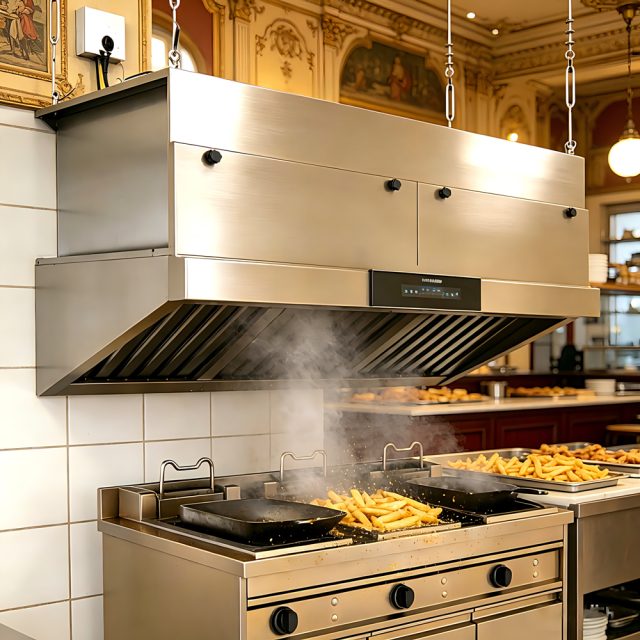
Bowling alleys have quietly become one of the most demanding foodservice environments in the entertainment industry. A modern bowling center may run a snack bar, a full burger-and-pizza kitchen, a sports bar lounge, and birthday-party rooms all under one roof — while hundreds of guests bowl, eat, and socialize just meters from the cooking line. Ventilating that kitchen the traditional way, with rooftop ductwork and a dedicated make-up air system, is often physically impossible and financially unreasonable in these buildings. This guide explains how bowling alleys solve the problem with ductless, ventless hood technology — and where an inline kitchen electrostatic precipitator still earns its place.
Why Bowling Alleys Are a Unique Foodservice Ventilation Challenge
A bowling center is not a restaurant with lanes attached; it is a multi-zone entertainment venue in which food is only one revenue stream — but a growing one. Operators have watched food and beverage margins become the difference between a surviving center and a thriving one, so kitchens keep expanding. The typical layout stacks four distinct foodservice zones into one open building: a walk-up snack bar serving fried finger foods, a full kitchen turning out burgers, wings, and pizza, a bar-lounge with casual plates, and reservable party rooms where groups expect hot food delivered mid-game.
Three structural realities make ventilation hard here. First, most bowling alleys occupy pre-engineered steel buildings or converted retail boxes with long roof spans, low ceilings, and no existing grease duct. Cutting a new penetration through that envelope for a Class I hood duct triggers fire-rated shaft construction, roof reconstruction, and often landlord resistance. Second, the floor plan is deliberately open — guests rent shoes, order food, and bowl in one continuous sightline, so any cooking effluent that escapes the kitchen drifts directly into the guest experience zone. Third, demand is spiky by nature: a Tuesday afternoon may see one fryer basket an hour, while a Saturday league night runs every piece of equipment at full load for four straight hours. Any ventilation design that only works at average load fails exactly when the money is made.
The core insight for bowling alley operators: the kitchen sits inside the guest experience, not behind a wall from it. Ventilation must therefore be treated as part of the guest-experience design, not just a code requirement.
The Cooking Load Profile of a Typical Bowling Center
Understanding what the air actually contains explains why equipment choice matters. A bowling alley kitchen’s load is dominated by fryers — french fries, mozzarella sticks, chicken wings, onion rings — plus flat-top griddles for burgers and quesadillas, conveyor or deck pizza ovens, panini presses, and pretzel warmers. That mix produces a characteristic emission profile: grease-laden vapor from the fryers and griddle, sub-micron particulate that passes straight through ordinary mesh filters, volatile organic compounds (VOCs) from frying oil degradation, and polycyclic aromatic hydrocarbons (PAHs) wherever a char-grill or flame grill runs at high temperature.
The odor component deserves special attention. Fried-oil odor molecules are tiny, persistent, and cling to fabric, carpet, and the porous surfaces around lanes. In a bowling alley this is a branding problem as much as a comfort problem: guests associate the venue with polished wood, fresh air, and family fun, not with a wall of stale fryer smell. Unlike a standalone restaurant where some kitchen aroma near the entrance can even be appetizing, a bowling alley needs cooking odors contained at the source — because the same air has to stay pleasant over the lanes, in the shoe counter area, and in the lounge.
Ductless Ventless Hood Systems: The Default Answer for Bowling Alleys
For the overwhelming majority of bowling centers, the right architecture is a commercial ventless hood system — a self-contained, recirculating unit that treats the air at the source and returns it to the room. No grease duct, no rooftop exhaust fan, no make-up air unit, no fire-rated shaft. The entire filtration train lives inside the hood above the cooking line.
SOUNINY builds this architecture around two ductless all-in-one Range Hood lines. The N-series (light-duty all-in-one) handles the light-to-medium load that defines most snack bars and party kitchens: electric fryers, griddles, steamers, and warming equipment. Multi-stage filtration inside the hood — a baffle/mesh pre-filter for grease droplets, a stainless-steel electrostatic cell for sub-micron particulate, and an activated-carbon stage for odor and VOCs — cleans the air and discharges it back into the space. The ND-series (heavy-duty all-in-one) takes the heavier end of the menu: char-grilled burgers, high-volume wing frying, and anything that produces dense smoke and stronger odor loads on peak nights.
The practical consequences for a bowling alley project are significant. Installation is an electrical connection, not a construction project — a center can add a full cooking line in days rather than shutting down for weeks of ductwork. Because the hood recirculates, it can be positioned anywhere the menu needs it: against a back wall, on an island line facing the lanes, or inside a converted storage room that becomes a satellite kitchen. And because there is no exhaust, the building’s HVAC balance is untouched — a real cost factor in a venue that already conditions a large, high-ceilinged bowl area.
For most operators the question is not “ductless or ducted” but “how many ductless units and of which series.” A two-line bowling alley kitchen frequently runs one N-series hood over the fryer-and-griddle line and one ND-series over the grill, each sized to its actual load.
Protecting the Guest Experience: Odor Control Beyond Grease
Gross grease capture keeps the fire marshal happy; odor control keeps guests coming back. In a bowling alley the two problems separate cleanly, because even a perfectly grease-free kitchen can still pump fried-food smell into an open floor plan. That is where the Odor Removal Tower earns its place in the design. Positioned as the final stage after the ductless hood — or paired with it for high-odor menus — the tower passes the cleaned airstream through an extended deodorizing media bed, stripping the residual odor molecules that carbon alone in the hood may not fully handle during a league-night rush.
Operators typically deploy the Odor Removal Tower in three situations: when the kitchen wall is directly exposed to the lanes with no buffer corridor, when the menu leans heavily on fried and char-grilled items, and when party rooms share an HVAC zone with the kitchen. The tower’s footprint is compact and its placement flexible, which matters in a building where every square meter near the kitchen was probably already planned for seating or storage.
Noise: The Forgotten Comfort Factor
Entertainment venues live on ambient sound, and ventilation noise is part of that mix. A ducted system’s rooftop fan is acoustically distant, but a recirculating hood is right there in the room. SOUNINY’s ductless units integrate the fan with multi-speed control, so operators can run higher speeds during peak load and step down during quiet periods — keeping the kitchen audible but unobtrusive over the sound of rolling balls and pin decks, which are loud enough to mask moderate equipment noise in most centers.
Flexible F&B: Countertop Carts for League Nights and Events
Bowling demand is event-shaped: league seasons, corporate parties, birthday weekends, and tournaments each create temporary food demand at locations that the fixed kitchen cannot economically serve. The CV-B countertop cart (from the Ventless Catering Carts line) addresses exactly this gap. It is a ventless, self-purifying mobile cart — griddle or fryer equipment with integrated filtration — that can be wheeled out beside the tournament lanes or into a party zone for the evening and wheeled away after.
Because the cart recirculates its own air, it needs no tie-in to the building’s ventilation at all. A center can run a popcorn-and-pretzel stand in the arcade corner during summer camp season, add a grilled-cheese cart next to the league desks on Tuesday nights, and support food service in a temporary tournament tent — all without a single meter of ductwork. For operators building event packages for corporate clients, the cart doubles as a live-cooking showpiece that needs no construction.
Legacy and High-Volume Centers: Where ESP Purifiers Still Fit
Some bowling centers do have existing ductwork — older purpose-built houses, or kitchens that previously ran a conventional hood — and a small number of high-volume venues run grills dense enough to justify a ducted architecture. In these cases the inline ESP Purifier (kitchen electrostatic precipitator) is the core device: mounted in the duct run between the hood and the exhaust fan, it collects sub-micron grease particulate from the whole kitchen’s combined airstream at high efficiency, keeping the duct interior dramatically cleaner and cutting exhaust odor before discharge.
A ducted retrofit pairs the ESP Purifier with a Centrifugal Fan matched to the system’s airflow, and — for venues with strict neighbor-odor complaints or tight local codes — an Odor Removal Tower in series before discharge. The maintenance story is well understood: the electrostatic cells slide out and wash on a scheduled cadence, and because the ESP removes the grease before it coats the duct, the frequency of professional duct cleaning drops substantially, which over a few years offsets a meaningful share of the equipment cost.
Rule of thumb for bowling alleys: no ductwork and the kitchen lives inside the guest floor — go ductless (N-series / ND-series + Odor Removal Tower). Existing duct and a single consolidated kitchen — an inline ESP Purifier in that duct is often the better-value path.
Compliance and Fire Safety in Entertainment Venues
Ventilation in a bowling alley sits at the intersection of several code frameworks, and operators should engage their local authority having jurisdiction (AHJ) early. In the United States, NFPA 96 governs commercial cooking operations, and the International Mechanical Code (IMC) governs the exhaust construction; recirculating hood systems are addressed through their own listing path, with UL 710B the recognized test standard for recirculating systems — which is precisely the architecture a ductless all-in-one follows. European projects work against EN 16282, while Australian centers reference AS 1668.2. Because requirements vary by municipality, the practical sequence is: confirm the venue’s allowable cooking appliance types under a ventless listing, verify the local fire marshal’s acceptance of recirculating technology for assembly-type occupancies, and keep the equipment’s certification documentation in the fire-safety file.
Fire safety economics favor the ductless architecture in this venue type. The grease that would otherwise accumulate along meters of duct is captured and washed out of the hood’s filters on site, so the two most common duct-related fire pathways — heavy duct fouling and duct-to-roof penetrations — are designed out of the building. Insurers increasingly recognize this: several operators report that documenting a listed ventless system simplified both the kitchen’s insurance underwriting and periodic inspections.
Running the System Through Peak Season
A bowling center’s ventilation maintenance calendar should follow its revenue calendar. During league season and holiday-party weeks, pre-filters should be checked and cleaned weekly — they are the first line of capture and the fastest to load with fryer grease. Electrostatic cells wash on a cadence set by actual load rather than the calendar alone: a center running heavy frying may wash cells every two to three weeks in peak season, and stretch to monthly or longer in the summer lull. The Odor Removal Tower’s media is refreshed on a slower cycle, typically quarterly depending on menu intensity. Because the filtration stages are modular and slide-out, all of this happens with a ladder and a sink — no contractor, no lift rental, no closed kitchen.
The Business Case: More F&B Revenue Without Construction
The financial argument for ductless kitchen ventilation in a bowling alley rests on four numbers. First, construction avoidance: a new grease duct through a pre-engineered roof — with shaft rated construction, roofing repair, and possible landlord negotiations — routinely costs multiples of the hood equipment itself, before counting the weeks of kitchen downtime. Second, speed: a ventless line is usually installed and passing inspection within days, so food revenue starts while the lanes stay open. Third, HVAC efficiency: recirculating hoods do not exhaust conditioned air, which in a high-ceilinged bowl building is a meaningful year-round saving. Fourth, revenue expansion: every satellite station — a cart by the tournament lanes, a second fryer line for party weekends — is incremental F&B sales in a business where food margin typically exceeds lane-rental margin.
A Practical Rollout Checklist for Bowling Alley Operators
Operators planning a kitchen addition or upgrade in a bowling center can sequence the project as follows:
1. Map the menu to the zones: decide which items run at the snack bar, which at the main kitchen, and which at event stations.
2. Match equipment series to load: fryer-and-griddle lines to the N-series, char-grill and high-volume frying to the ND-series.
3. Confirm appliance eligibility: check each planned appliance against the ventless listing and the local AHJ’s accepted-use rules.
4. Design the odor path: if the kitchen faces the lanes or party rooms, plan the Odor Removal Tower into the layout from day one.
5. Add flexibility: specify a CV-B countertop cart for tournaments and peak overflow before committing to fixed construction.
6. Plan the maintenance calendar: assign weekly pre-filter checks and cell-wash cadence to existing staff, aligned to league season.
7. Document for compliance and insurance: keep listings, filter logs, and cleaning records in one file the fire marshal and insurer can both read.
Done in this order, a bowling alley gains a kitchen that matches its actual business — spiky, event-driven, and physically embedded in the guest experience — without betting the building on ductwork that the structure was never designed to carry. That combination of guest-experience protection, code-clean installation, and revenue flexibility is why ductless ventilation has become the default architecture for bowling alleys and family entertainment centers worldwide.