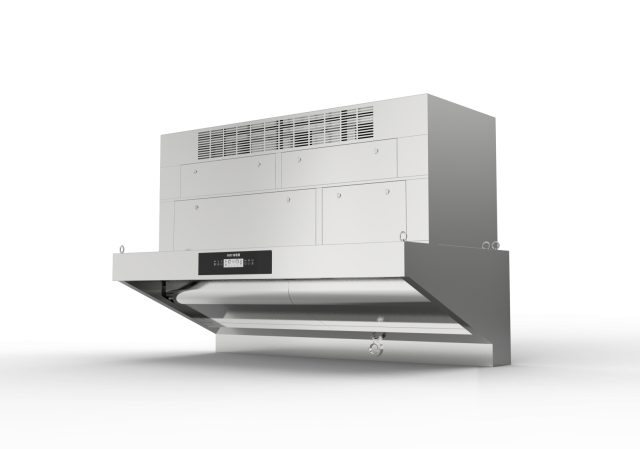
A busy burger joint runs on two sources of heat: the flattop griddle that sears patties by the minute, and the open fryer that finishes fries, onion rings, and chicken tenders. Smash burgers add another variable — a ball of ground beef pressed onto a 200 °C plate, which throws a sudden burst of moisture, grease-laden vapor, and fine smoke into the capture zone. The plume is short, hot, and heavy; it cools fast, deposits fat on nearby surfaces, and carries the charred-fat odor that clings to uniforms, counters, and dining-room upholstery. For operators in leased malls, converted high-street units, or food halls without a dedicated exhaust riser, the question is not whether to ventilate, but how to do it without cutting a duct through a roof they do not control.
What a Burger Line Actually Emits
Griddle cooking produces a different exhaust signature than frying or wok work. The surface is broad and flat, so the release is spread rather than concentrated, but the fat content is high and the smoke point of burger drippings is low. When a patty hits the plate, the Maillard reaction creates a pulse of fine particulate and volatile organic compounds (VOCs). Fries and battered items, meanwhile, generate aerosolized oil that cools into sticky droplets. Together the line emits a mix of sub-micron grease particulate, water vapor, carbonized solids, and odor-bearing compounds that standard building HVAC is not designed to remove.
The thermal plume from a griddle also behaves differently from a stock pot or fryer. It rises almost vertically at first, but because the heat source is shallow, the plume loses momentum within 600–900 mm of the cooking surface. That means the capture hood must sit low and close, or a large share of the load escapes into the kitchen and drifts toward the pass, the POS area, and the guest entrance. Ceiling-mounted general extraction is rarely fast enough to catch the short plume before it spreads.
Capture Geometry for Smash Burgers
Smash burgers increase the challenge by design. Pressing the patty maximizes contact with the hot plate, which speeds cooking but also aerosolizes more fat and creates visible smoke at the moment of contact. Because the menu item is made to order, the emission is pulsed rather than steady: a dozen orders in five minutes, then a quiet spell, then another burst. Hoods sized only for average load will fail during the peaks.
Best practice is to treat the griddle as a high-rate source and the fryer as a secondary source under the same capture plane. A continuous canopy over both appliances gives the most predictable airflow pattern and prevents cross-drafts from the pass door from pushing the plume sideways. The front edge of the hood should overhang the cookline by at least 150 mm, and the capture velocity at the hood face should be high enough to pull the short griddle plume upward before it cools and spreads.
Airflow Sizing for a Burger Operation
Rough airflow rules from commercial kitchen standards help turn the menu into a number. A griddle or fryer station under a canopy typically needs about 2,000 m³/h per metre of hood length for back-of-house use. For an open line where guests can see the cooking, or for a line with frequent smash-burger peaks, 2,500 m³/h per metre is a safer baseline. A single burger flattop and a single fryer can often be served by a 1.2–1.5 m hood; a high-output smash-burger line with multiple griddles and a fryer may need 2.0–2.4 m of capture and correspondingly higher airflow.
Rule of thumb: a heavy, open griddle line needs roughly the same hood length and airflow as a two-burner wok station, because the broad surface area and fat load compensate for the lower flame height.
Once the airflow target is known, the next choice is the treatment architecture. Ducted systems send the captured stream through an in-line electrostatic precipitator and a fan before discharging it outside. Where the building has a usable riser and the landlord allows a roof penetration, that path is effective. But many burger leases — especially in food courts, converted retail units, and basements — have no riser, no roof access, or a fire authority that treats any new duct as a penetration requiring separate approval. In those cases, a ductless range hood family that treats the air inside the unit and returns it to the kitchen becomes the practical default.
Odor and the Neighbor Problem
Grease capture is only half the battle in a burger joint. The charred-fat and frying-oil odor travels with the particulate and can migrate into adjacent retail units, residential apartments above the restaurant, or the dining room itself. Mall operators and high-street landlords routinely receive complaints about cooking smells in corridors, which puts pressure on the tenant to solve the problem at the source rather than rely on a roof fan that simply dumps the odor higher up.
Odor control therefore needs a dedicated stage after particulate removal. A packed activated-carbon tower sized to the airflow strips the VOCs and odor-bearing molecules before the air recirculates. The tower must be matched to the volume and replaced on a schedule; an undersized or saturated carbon bed will pass odor and create the same complaints as no treatment at all.
When Ducting Is an Option
If the unit is on a ground floor with an exterior wall and the lease permits a duct run, a ducted architecture can work well for burger operations. The captured stream passes through a mesh or baffle pre-filter to remove large grease droplets, then through an electrostatic cell that charges and collects sub-micron particles, and finally through a centrifugal fan sized to overcome the system pressure. This is the same path used for heavier charcoal or wok operations, and it scales to very high volumes. Where roof access exists and local codes allow the discharge, the ducted ESP purifier range is the high-capacity end of the decision tree.
Smaller Formats and Front-of-House Cooking
Not every burger outlet has a full back-of-house line. Food halls, market halls, and temporary pop-ups often run a single griddle or a compact flattop behind a counter, with the cook facing the customer. In those formats, a fixed canopy may be impossible because of ceiling height, structural limits, or the temporary nature of the lease. Mobile food carts with built-in capture and purification allow the operator to place the cooking station in the middle of the floor or against a wall without running ductwork through the landlord’s building. A countertop cart configuration fits a single griddle or panini press, while a tempered-glass cart configuration adds a display barrier for front-of-house live cooking.
Matching the Equipment to the Load
The right unit depends on how heavy the emission is and how permanent the kitchen is. A compact burger counter with a single griddle and fryer, operating in a small footprint with low ceilings, can be handled by a floor-standing cabinet unit that separates the capture canopy from the purification cabinet. The cabinet stands in a back corridor or recess and connects to a shallow hood over the cookline, removing the need for a tall stack above the stove.
A full high-output smash-burger line with multiple griddles, a pressure fryer, and continuous service needs a heavy-duty all-in-one ductless hood with a water-cycle grease removal stage, medium and HEPA filtration, and enough airflow to cover the broad capture surface. A lighter-duty all-in-one hood fits a back-counter burger station or a breakfast/griddle menu with lower fat load. In either case, pairing the hood with an odor-removal tower handles the smell that bypasses the particulate stage.
From a service standpoint, the consumable parts are predictable: pre-filters need regular cleaning or replacement, ESP cells need periodic wash-down, and carbon media in the odor tower needs scheduled change-out. The maintenance interval depends on hours of operation and fat load; a high-volume smash-burger shop will run shorter cleaning cycles than a cafe that only offers a few lunch burgers.
Installation and Compliance Notes
Code references for burger joints follow the same commercial-kitchen standards as other restaurants. NFPA 96 governs grease removal and fire protection in North America, EN 16282 provides the European framework for kitchen ventilation design, and AS 1668.2 / AS/NZS 1668.1 apply in Australia. Local authorities may also impose odor limits near residential boundaries or mall indoor-air-quality rules. A ductless installation must still produce a documented outlet concentration and a maintenance schedule that satisfies the inspector; the absence of a roof duct does not remove the obligation to control emissions.
When selecting equipment, operators should size for peak load, not average load, because smash-burger peaks are sharp. They should also plan for make-up air: a hood that exhausts or recirculates 6,000 m³/h needs the same volume of conditioned replacement air or the dining room will drift toward negative pressure, pulling odors and drafts from the entrance.
Commissioning and Performance Verification
Once the hood is installed, the system should be commissioned against the design airflow. A simple velocity grid test across the hood face confirms that capture is uniform and that no dead zones let the plume escape. For a ductless installation, an outlet spot check with a handheld particle counter or opacity meter verifies that the recirculated air meets the stated cleanliness target. These records matter if a landlord, mall operator, or fire inspector asks for proof of performance. They also create a baseline: a drop in face velocity or an increase in outlet readings is the earliest signal that filters need attention. Commissioning is not a paperwork step; it is the point where the design assumption meets the real menu and the real room.
Make-Up Air and Energy Balance
Burger joints are usually small rooms. The kitchen may be only 20–40 m², and the dining area is often separated from the pass by nothing more than a half wall or a service counter. When a hood removes 5,000–7,000 m³/h of air, that volume has to come back from somewhere. If the building envelope is tight and the air-conditioning unit is not sized to supply the same amount, the space drifts into negative pressure. The front door becomes hard to open, outdoor drafts pull in through every gap, and the dining-room HVAC fights to maintain temperature. More importantly, negative pressure can reverse airflow at the pass and draw cooking odors into the guest area.
Make-up air is therefore not optional for a ductless kitchen. The recirculated stream returns most of the captured air to the room, but heat and moisture are still removed at the cooking moment, and the room still loses air every time the service door opens. A properly balanced design supplies filtered, conditioned replacement air at low velocity near the dining area or under the counter, so the hood capture is not disrupted by cross-currents. Split-system air conditioners are rarely designed for this duty; the operator should confirm that the HVAC contractor has added the hood airflow to the cooling-load calculation. Ignoring this step is one of the most common reasons a perfectly good hood still leaves the dining room smelling like the fryer.
Maintenance Rhythm for a Burger Hood
The maintenance schedule for a burger operation is driven by fat load and operating hours, not by the calendar. A griddle deposits a continuous film of grease on pre-filters and collection surfaces. Left too long, that film carbonizes, reduces airflow, and creates a fire risk. A high-volume smash-burger shop running twelve hours a day typically needs to inspect the pre-filters every one to two weeks, clean or replace them as needed, and wash the electrostatic collection cells every four to six weeks. The exact interval depends on how much fat the menu produces and how often the griddle is scraped.
The odor tower also needs attention. Activated carbon does not fail suddenly; it loses capacity gradually. When staff notice that the dining room smells like cooking during peak service, the carbon bed is usually near the end of its useful life. A better approach is to log running hours and change the carbon on a schedule based on airflow and load rather than waiting for complaints. In a burger context, that typically means a carbon change-out every three to six months, with inspections every month in high-volume locations.
Finally, the capture geometry itself should be checked. Staff move equipment around for cleaning, and a griddle pushed even 100 mm backward can change the plume path enough to allow escape. A simple weekly check — hood overhang, griddle position, face velocity feel with a smoke pencil or ribbon — catches most operational drift before it becomes a complaint or a code issue.