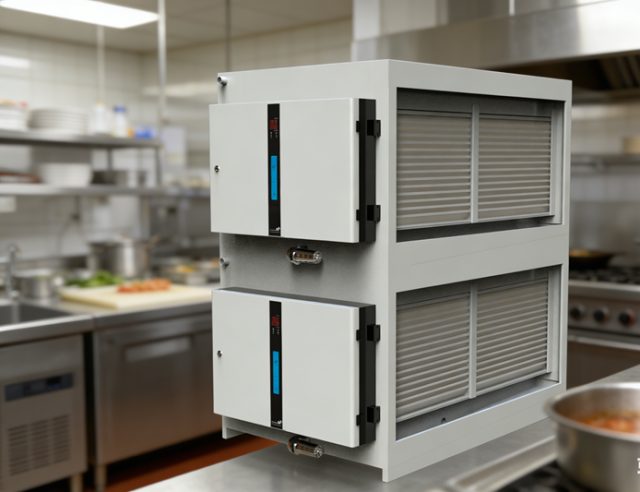
The drive-through lane is no longer a side channel of quick service restaurants (QSRs) — it is the business model. In mature markets, drive-through windows now account for 60 to 70 percent of sales at major burger and chicken chains, and many newly built locations are designed with no dining room at all. That concentration changes the exhaust problem: the same compact kitchen that once served a spread-out dining crowd now pushes nonstop lunch, dinner, and late-night order surges through a fryer bank, a clamshell grill, and a flat-top griddle in a space of a few dozen square meters. This article explains how a kitchen electrostatic precipitator — deployed in the Souniny ESP Purifiers line with the matching Centrifugal Fan — handles that duty, why the Odor Removal Tower is the decisive unit at the property line, and where ductless N-series and ND-series all-in-one hoods solve the zones a duct can never reach.
The Drive-Through Economy and Its Exhaust Problem
A drive-through QSR kitchen is a throughput machine. Orders arrive in bursts synchronized to traffic peaks — the morning breakfast window, the 12:00 to 13:30 lunch rush, the dinner curve, and, for 24-hour locations, a continuous overnight cadence. Unlike a sit-down restaurant where cook stations idle between services, the QSR line rarely drops to zero: pressure fryers and open fry vats hold temperature all day, the clamshell grill sears burger patties in under two minutes per batch, and the griddle runs continuously for eggs, sausage, and toasted buns.
That operating profile produces a pollutant stream with three defining characteristics. First, it is grease-dominant: deep frying generates fatty-acid aerosols and sub-micron particulate at rates far exceeding a typical table-service kitchen of the same floor area. Second, it is continuous: 18-hour or 24/7 duty means grease-laden vapor accumulates inside hoods and ducts without the overnight cooldown that lets other kitchens dry out. Third, it is neighbor-facing: because the building exhausts through a roof stack located meters from a drive-through lane, a parking apron, and frequently a residential property line, odor complaints are a zoning and licensing issue, not merely a comfort issue.
Facility managers at drive-through locations face a combination that classic baffle-filter ventilation was never engineered for: high grease density, around-the-clock emission, and a discharge point sitting in full view of customers and neighbors. That combination is precisely what electrostatic filtration addresses.
Pollutant Profile: What a QSR Kitchen Actually Emits
Designing purification for a drive-through kitchen starts with mapping each cooking station to its emission signature.
The fryer bank. Six to twelve open fry vats, sometimes duplicated across a chicken line and a fries line, are the anchor emission source. Frying at 170–190 °C atomizes cooking oil into a fine aerosol: droplets predominantly in the 0.1–1 µm range once vapor cools, together with acrolein from oil breakdown, formaldehyde, and polycyclic aromatic hydrocarbons (PAHs) as oil oxidizes over its life. Baffle filters intercept only the largest droplets — typically 30 to 40 percent of the grease mass — letting the sub-micron fraction pass straight into the duct, where it condenses as a combustible lining.
The clamshell grill. Double-sided rapid grilling vaporizes fats from ground beef in under 150 seconds. The result is a dense plume of grease-laden vapor with visible smoke spikes each time the clamshell opens — a pulsed load that a purification stage must absorb without breakthrough.
The flat-top griddle. Continuous egg, sausage, and pancake service generates butter and margarine aerosols plus a steady visible haze during breakfast hours, the highest-volume window for drive-through traffic.
The coffee and bakery corner. Modern QSR floor plans increasingly add a beverage and baked-goods zone in the customer lobby — coffee roasting and brewing volatiles, sugar caramelization from pastry ovens, and warm display-case convection.
The pickup lane and roof stack. Whatever leaves the building carries volatile organic compounds (VOCs) and odor-active molecules that particulate filtration does not capture: aldehydes, ketones, and short-chain fatty acids. When the stack terminates near a property line, these gas-phase emissions define the neighbor’s experience of the restaurant.
Why the Kitchen Electrostatic Precipitator Is the QSR Workhorse
The kitchen electrostatic precipitator is the technology of record for this emission profile, and the reason is particle physics. Grease aerosol from frying is overwhelmingly sub-micron — exactly the size range where mechanical filters collapse. An ESP works on a different principle: the exhaust stream passes through a corona-discharge ionization section that charges each grease particle, then through parallel collector plates carrying a strong electrostatic field that pulls the charged particles onto the plate surfaces. Because capture depends on charge, not on pore size, collection efficiency on sub-micron grease remains high where a mesh or baffle stage has already surrendered.
For QSR duty, three engineering features matter most.
Ionization and collection inside one washable cell
The Souniny ESP cell pairs high-performance stainless steel electrode fields with high-voltage ceramic insulators and a self-developed intelligent power supply that adjusts field strength as the cell loads with grease. Rather than discarding filter media, the operator removes the cell and washes it — in a high-volume QSR, a routine measured in minutes during a scheduled swap, not a filtration consumable budget measured in monthly cartridges.
Duty-matched high-voltage power
Continuous fryer load means the cell collects grease continuously. An intelligent power supply holds ionization voltage stable as plate contamination increases, sustaining capture efficiency across the full interval between washes instead of degrading silently — the failure mode that turns a “working” ESP into an expensive duct section.
Self-cleaning options for around-the-clock stores
The Self-cleaning ESP variant in the Souniny ESP Purifiers line automates cell washing on a timed cycle, which matters at 24/7 locations where no overnight shutdown window exists for manual maintenance. For 18-hour stores, the ESP Auto-cleaner accessories achieve the same goal on staged schedules.
In published testing of electrostatic precipitation on frying emissions, collection efficiency above 90 percent on sub-micron grease is the engineering baseline; the practical variable is not peak efficiency but how long that efficiency is held between cleaning cycles under real fryer load. That is why power-supply intelligence and washability dominate the specification.
Completing the Ducted Train: Centrifugal Fan and Duct Design
An ESP cell does not move air — it cleans it. The ducted system behind a drive-through kitchen therefore pairs the ESP Purifiers unit with a correctly sized Centrifugal Fan. The fan must hold design airflow against the static resistance of the hood, the duct run, the ESP cell itself (which adds pressure drop as it loads), and any downstream odor stage — while remaining quiet enough not to dominate the drive-through audio experience at the order speaker.
Three integration rules keep the combination reliable. First, size the fan on the dirty condition: calculate static pressure with the ESP cell at end-of-cycle contamination, so airflow does not sag precisely when capture efficiency needs it most. Second, respect grease-duct velocity — NFPA 96 expects duct transport velocity high enough to keep grease entrained rather than depositing in horizontal runs, and the fan must deliver it. Third, place the ESP unit at the position the layout allows but keep the interconnecting duct as short and straight as possible between hood and cell, because every meter of un-cleaned duct upstream of the ESP is a combustible-grease surface the ESP cannot protect.
Beyond Particulate: Odor Removal Tower for the Pickup Lane and the Property Line
Electrostatic precipitation is a particulate technology. It is geometrically incapable of capturing gas-phase molecules — the aldehydes, ketones, and fatty acids that a neighbor one property over perceives as “the smell of the restaurant.” As drive-through volumes grow, odor is increasingly the trigger for municipal complaints, permit conditions, and, in several jurisdictions, odor-nuisance ordinances enforced at the receiving property line rather than at the stack.
The engineering answer is staged treatment: particulate first, gas second. A Odor Removal Tower downstream of the ESP passes the already-degreased exhaust through an activated-carbon adsorption bed sized for the site’s daily emission mass. With the ESP removing grease droplets upstream, the carbon surface stays dedicated to the molecules it is meant to adsorb — protecting bed life and keeping breakthrough predictable.
At a typical drive-through site, the practical benefits are concrete. The lane itself stops functioning as a grease-and-odor plenum, improving the experience of customers queued with windows down. The roof discharge stops generating the repeated neighbor complaints that consume franchise management time. And where a local authority has written an odor threshold into the operating permit, tower staging converts an uncontrolled emission into a documented, testable compliance point.
Rule of thumb for QSR staging: size the carbon bed on total daily frying hours and oil throughput, and schedule media replacement on measured pressure drop and breakthrough indicators rather than the calendar. Fryer-dominant sites typically land in the 9-to-15-month media replacement band.
Ductless Inside the Store: Where the Duct Cannot Go
The ducted ESP train covers the heavy line — fryers, clamshell, griddle. But modern QSR floor plans contain emission sources the main hood does not serve, and urban infill locations sometimes permit no roof penetration at all.
The lobby coffee and bakery corner
The beverage-and-pastry zone lives in customer space, far from the back-of-house duct riser. A ductless all-in-one hood from the N-series — Souniny’s light-duty recirculating line — captures coffee roasting volatiles, oven caramelization fumes, and display-case haze at the source, filters them through its own purification stages, and returns clean air to the lobby. No ductwork crosses the customer ceiling; no roof opening exists to negotiate with the landlord.
Inline and urban stores with no roof rights
Strip-center and inline urban QSR locations increasingly operate under leases that forbid roof penetrations or share exhaust rights with other tenants. For those sites, the heavy-duty ND-series all-in-one hood applies the same electrostatic core in a ductless format over the fryer and grill line, paired with an Odor Removal Tower stage to scrub the recirculated stream before it re-enters the room. The self-contained approach also removes the make-up air penalty: conditioned air stays in the building instead of being exhausted through the roof, which in small-format stores measurably reduces HVAC load.
Three Configuration Matrices for Drive-Through Sites
Every drive-through project resolves into one of three architectures. Pick the configuration that matches the building and the lease, not the one-size catalogue default.
Configuration A — Full ducted train. Purpose-built drive-through box with its own roof: Type I hood over the cook line, ESP Purifiers unit in the duct, Centrifugal Fan at the stack, Odor Removal Tower on the discharge. This is the reference architecture for new construction and the strongest position for odor-sensitive zoning.
Configuration B — Hybrid. Existing store with functional ductwork and a lobby beverage corner: keep the ducted ESP train on the heavy line, add ductless N-series coverage over coffee and bakery, and stage an Odor Removal Tower at the stack when neighbor complaints or permit conditions demand it. This is the most common retrofit path.
Configuration C — Full ductless. Inline urban store, no roof rights, or mall food-court-adjacent formats: ND-series heavy-duty all-in-one hoods over fryer and grill, N-series units over light stations, Odor Removal Tower stages on the recirculation path, and recirculated rather than exhausted air. The configuration trades stack discharge for in-room recirculation and eliminates make-up air cost entirely.
Codes and Standards: What Inspectors and Insurers Ask For
Drive-through QSR exhaust sits under some of the most enforced codes in commercial building operation, because grease-laden duct systems are the leading fuel source in restaurant fires.
NFPA 96 — the Standard for Control of Grease-Laden Vapor in commercial cooking operations — governs hood construction, duct velocity, accessible cleanouts, and mandated cleaning frequency based on fuel load; a high-volume fryer operation falls into the most frequent inspection band. An ESP that keeps grease out of the duct does not exempt the system from cleaning schedules, but it demonstrably slows accumulation in the runs downstream of the cell — and documented reduced loading strengthens the position of longer intervals in jurisdictions that permit assessment-based scheduling.
UL 710 and UL 710B cover the exhaust hood and recirculating (ductless) hood listings respectively; UL 867 addresses electrostatic air cleaner safety, including arc-over protection — a listing insurers recognize on ESP equipment. The International Mechanical Code (IMC, Type I hood requirements) and ASHRAE 154 define airflow and classification fundamentals for the hood calculation. For chains operating in Europe, EN 16282 performs the equivalent role for commercial kitchen ventilation and air treatment equipment.
On the discharge side, the applicable constraint is usually local: zoning conditions, nuisance-odor ordinances, and health-department complaints. Those are the rules the Odor Removal Tower is there to satisfy. Insurance adds a final layer: carriers increasingly price kitchen policies on documented ventilation maintenance, and a washable ESP cell with logged cleaning intervals is a stronger underwriting file than a neglected filter bank.
Commissioning a Drive-Through ESP System
A three-pass commissioning protocol validates the installed system against design intent before the store opens — and produces the baseline dataset used for every later compliance conversation.
Pass one — capture verification. Measure face velocity across the hood perimeter over the fryer bank and griddle at full cooking load, confirming the design capture that keeps plume escape at zero during clamshell-open smoke spikes. Verify Centrifugal Fan airflow against the dirty-condition static calculation.
Pass two — ESP performance. With the fryer line at production load, sample particulate upstream and downstream of the ESP unit. The efficiency measured here — not the catalogue curve — is the number that predicts duct cleanliness and maintenance intervals for the next five years.
Pass three — property-line odor survey. Walk the drive-through lane, the parking apron, and the receiving property line under peak emission conditions, before and after the Odor Removal Tower stage. Instrumented VOC detection supplemented by panel evaluation documents the margin between the site’s discharge and the odor threshold a neighbor or inspector would apply.
Maintenance for 18-Hour and 24/7 Duty
Continuous duty moves maintenance from an inconvenience to a production variable: every hour of unplanned downtime is an hour of drive-through orders lost. The maintenance design that survives QSR operation is built on redundancy and scheduled washing.
ESP cell washing. Under continuous fryer load, plan cell service on a 7-to-14-day rotation for manual-wash installations — with a spare cell so the swap takes minutes and the dirty cell is washed offline. Self-cleaning ESP variants extend the manual interval substantially by automating the wash cycle in place. The intelligent power supply’s load signal is the honest indicator: rising field-current draw tracks grease accumulation and converts cleaning from guesswork into condition-based scheduling.
Odor Removal Tower media. Track pressure drop across the carbon bed and replace media on breakthrough indicators. With the ESP protecting the bed from grease, the 9-to-15-month replacement band typical of fryer-dominant sites holds; without upstream particulate control, carbon fouls early and unpredictably.
Hood and duct hygiene. NFPA 96-driven cleaning remains a legal requirement regardless of ESP performance. The practical benefit of electrostatic capture shows up in the duct downstream of the cell — reduced grease accumulation means faster certified cleanings, lower fire risk between cleanings, and cleaner documentation at inspection.
Record-keeping. Maintain the cleaning log as a compliance asset: dates, cell-wash intervals, media changes, commissioning baselines. Insurers, franchisors, and health inspectors all ask, and the file that answers in one page is the one that protects the operating permit.
The ROI Case: Throughput, Energy, Insurance, and Staff
The financial argument for a properly engineered drive-through exhaust system compounds across four line items.
Throughput protection. A drive-through store’s revenue is rate-limited by lane speed. A ventilation failure that closes the fryer line during peak — or an odor complaint that triggers an operating restriction — attacks the revenue engine directly. Redundant ESP cells and self-cleaning cycles convert that risk into scheduled maintenance.
Make-up air economics. Every cubic meter exhausted through the roof must be replaced with conditioned outdoor air. In a small-format QSR box, winter heating and summer cooling of make-up air is a meaningful utility line; ductless ND-series configurations in Configuration C eliminate it entirely, and hybrid layouts reduce it by shifting light stations to recirculation.
Insurance positioning. Grease-duct fire is the loss scenario underwriters price. Documented ESP capture, reduced downstream duct loading, and logged maintenance support favorable premium treatment and simplify claims handling when the file already tells the story.
Staff environment and retention. QSR kitchens run hot, fast, and continuously exposed to frying emissions — and cooking-oil fume exposure is an occupational-health concern in high-volume frying exactly as it is in any professional kitchen. Cleaner air at the cook line contributes measurably to comfort, to compliance with workplace exposure limits, and to the retention economics of an industry with chronic turnover.
Choosing the Right Configuration
Start from the building, then work inward. A purpose-built drive-through box with its own roof takes Configuration A — ESP Purifiers cell, Centrifugal Fan, Odor Removal Tower on the stack — and gains the strongest odor and zoning position available. An existing store with working ductwork and a lobby beverage corner takes Configuration B, layering ductless N-series coverage where the duct cannot reach. An inline urban site with no roof rights takes Configuration C, running the ND-series ductless line with Odor Removal Tower staging and banking the make-up air savings.
Souniny supplies all three architectures from one product platform: the ESP Purifiers line for the ducted train, N-series and ND-series ductless all-in-one hoods for recirculating zones, the Odor Removal Tower for gas-phase control at the discharge, and the matching Centrifugal Fan for dependable airflow against real-world static loads. Contact the Souniny engineering team to size a configuration for your site’s fryer count, operating hours, and property-line conditions.