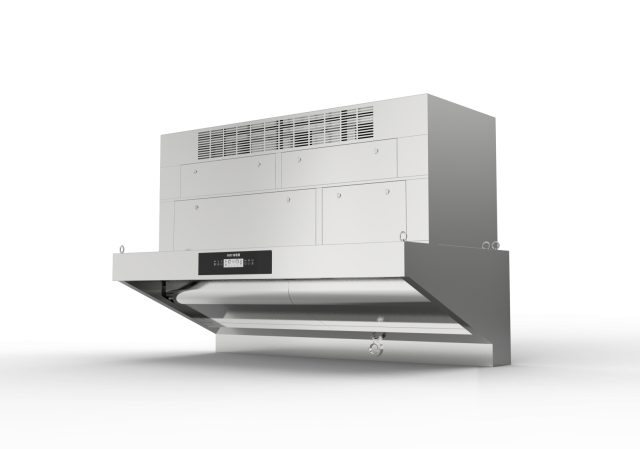
Ethiopian and East African cuisine has moved from a regional specialty to one of the fastest-growing segments of the global restaurant scene, driven by the communal injera platter, the deeply aromatic berbere spice blend, and the theatrical coffee ceremony. For a commercial kitchen, that popularity brings a ventilation problem few operators anticipate: a single East African line produces steam, grease-laden vapor, pungent spice aerosol, and heavy roast smoke in close succession, often inside small urban storefronts and repurposed heritage spaces where running new ductwork is impractical or impossible. The solution is a ductless strategy built on the N-series and ND-series all-in-one range hoods paired with an Odor Removal Tower, a configuration that captures the full emission profile without piping, without major construction, and without pushing cooking odors into neighboring tenants.
Why Ethiopian Cooking Is Harder to Ventilate Than It Looks
At first glance, an Ethiopian restaurant seems easier to manage than a charbroiler-heavy steakhouse or a wok-focused Chinese kitchen. There is no open flame pit, no deep fryer battery, and no continuous high-volume searing. In practice, however, the East African menu compresses several distinct emission types into a small space and, critically, into a shared dining room where guests eat from a common platter only a few feet from the cooking line. The result is a kitchen that demands filtration tuned for odor and sub-micron particulate as much as for visible smoke.
Three ingredients drive the difficulty. First, berbere — the roasted dried-chili and spice blend at the heart of dishes such as doro wat and misir wat — is prepared by dry-toasting dozens of chilies, spices, and aromatics on a hot pan. Dry-roasting releases capsaicin-laden aerosol and volatile organic compounds (VOCs) that irritate the eyes and throat and cling to surfaces long after the flame is off. Second, the coffee ceremony roasts green coffee beans in a flat pan over live heat, generating dense, aromatic smoke plus a chaff and fine particulate plume that a conventional baffle hood simply deflects rather than removes. Third, the mitad, or injera griddle, runs continuously through service, producing a steady column of steam and starch aerosol that condenses as grease film on every nearby surface.
The core challenge is not volume — it is composition. Steam, grease, spice VOC, and roast smoke arrive together, and each needs a different removal mechanism. A single-purpose exhaust hood leaves the odor and fine particulate behind, which is exactly what tenants, inspectors, and diners notice first.
Mapping the Emission Sources Across the Menu
Designing an effective capture strategy starts with separating the menu into its emission types, because each station calls for a different level of filtration and a different hood placement.
Injera and the Mitad Griddle: Continuous Steam and Starch Aerosol
Injera, the spongy fermented flatbread that doubles as plate and utensil, is baked on a large mitad — a flat, clay or metal griddle kept hot for hours. Fermented teff batter is poured in a thin spiral and steamed under a lid, releasing a steady stream of water vapor mixed with fine starch particulate. On its own this is a light fume stream, but it is relentless: because injera is served throughout the day, the griddle rarely cools, and the cumulative aerosol condenses into a slick film on hoods, ceilings, and cabinetry. A light-duty all-in-one hood such as the N-series is well matched here, capturing steam and starch particulate while recirculating cleaned air back into the kitchen — a major advantage in a small space where make-up air is scarce.
Berbere and Dry-Roasted Spices: Pungent Aerosol and VOC
Berbere, shiro, and their regional cousins are built on dry-roasted chili, garlic, ginger, fenugreek, and a dozen other aromatics. Roasting these in a dry pan at high heat volatilizes the spice oils, producing a sharp, eye-watering plume that is chemically closer to a light smoke than to ordinary cooking vapor. This stream is dominated by sub-micron particulate and VOCs, which pass straight through grease filters and require a treatment stage that can neutralize odor, not just capture droplets. Here the pairing of a heavy-duty ND-series hood with an Odor Removal Tower is the key design decision, because the tower provides the deodorizing stage that a mechanical filter alone cannot deliver.
Tibs, Kitfo, and Pan-Searing: Grease-Laden Vapor
Dishes such as tibs (seared meat with onions and peppers), kitfo (minced beef), and gored gored are cooked fast and hot in shallow pans. Rapid searing aerosolizes animal fat into grease-laden vapor, which is the classic commercial-kitchen pollutant: it coats surfaces, fuels fire risk inside ductwork, and carries odor deep into the dining room. This is the one stream where the physics resembles a standard grill line, and it is precisely where the ND-series heavy-duty hood earns its place, using electrostatic precipitation to capture grease particles at high efficiency while the all-in-one form factor keeps the whole capture stage compact.
The Coffee Ceremony: Heavy Smoke and Intense Aroma
The Ethiopian coffee ceremony is both a cultural centerpiece and the most demanding single emission event on the menu. Green beans are roasted in a flat pan over charcoal or gas, stirred until they crack and smoke, then ground and brewed in a jebena. The roasting phase produces dense smoke, chaff, and the signature roasted-coffee aroma — wonderful in the dining room at low intensity, overwhelming and acrid when it accumulates. Because the ceremony is often staged near the front of house for guests to watch, the capture system must be quiet, visually discreet, and extremely effective on odor. A dedicated ND-series hood over the roasting station, venting into the shared Odor Removal Tower, removes the visible smoke and the odor without a noisy overhead exhaust that would spoil the experience.
For operators who roast coffee at production volume — beyond the ceremonial scale — a dedicated ducted solution is available in the form of a Coffee Exhaust Purifier. For the restaurant-scale ceremony, however, the ductless ND-series plus Odor Removal Tower combination is usually the cleaner, lower-cost fit.
Why Ductless Fits the Typical East African Restaurant
Ethiopian and East African restaurants cluster in dense, mixed-use urban neighborhoods — street-level storefronts under residential units, converted brownstones, small shopping-center bays, and heritage buildings where penetrations are restricted. These are precisely the sites where a traditional ducted canopy is hardest to install: there is no riser to the roof, the landlord forbids new penetrations, or the distance to an exterior wall is too long for an effective run. A ductless system removes the architectural constraint entirely.
The N-series and ND-series all-in-one range hoods are engineered for this situation. They combine capture, electrostatic precipitation, and recirculation in a single self-contained unit, so no ducting is required and filtered air returns directly to the room. When odor control is paramount — and with berbere and coffee it always is — the Odor Removal Tower adds a dedicated deodorizing stage that scrubs the VOC and aroma compounds the electrostatic stage does not fully address. The result is a system that can be installed above a griddle line, a roasting station, and a searing station without disturbing the building envelope.
There is also a practical service advantage. In a shared building, a ducted hood that exhausts onto a courtyard or into a stairwell can generate complaints from neighbors and trigger costly remediation. A ductless configuration keeps emissions inside the kitchen where they are treated, which is often the difference between a smooth lease negotiation and a failed opening.
Configuring the Product Mix by Station
Because the East African line is heterogeneous, the best results come from matching each station to its fume class rather than installing one oversized hood and hoping it covers everything.
- Injera mitad and light simmering — N-series (light-duty) all-in-one hood, sized for continuous steam and starch aerosol with air recirculation.
- Berbere dry-roasting, tibs searing, and coffee ceremony — ND-series (heavy-duty) all-in-one hood, sized for grease-laden vapor, sub-micron particulate, and roast smoke.
- Shared odor control — Odor Removal Tower serving the heavy stations, neutralizing spice VOC and roasted-coffee aroma before recirculation.
- Supplementary zones — a Cabinet Purifier for pastry, salad, or prep corners that need spot treatment without a full hood.
- Modular expansion — Ductless Range Hoods provide a flexible, reconfigurable capture layer as the menu or layout evolves.
A common layout pairs one ND-series hood over the searing and roasting zone, one N-series hood over the griddle line, and a single Odor Removal Tower behind the heavy hood. This keeps the equipment count low while giving each fume class the treatment it actually needs.
Compliance, Fire Safety, and Standards
Even a ductless system must be specified and operated to recognized standards. In North American projects, NFPA 96 governs ventilation control and fire protection for commercial cooking operations, and the International Mechanical Code (IMC) sets the framework for capture and air treatment; where recirculating or ductless equipment is permitted, the system should carry relevant certification such as UL 710 / UL 710B for grease-laden air-handling components. European projects reference EN 16282 for kitchen ventilation efficiency, while ASHRAE 154 and the Australian AS 1668.2 provide performance guidance used across international fit-outs. Operators should confirm local authority requirements for ductless recirculation before specifying, as acceptance varies by jurisdiction.
Fire safety is a particularly important argument for the electrostatic approach in an Ethiopian kitchen. Dry-roasting berbere and roasting coffee both generate combustible particulate; when that particulate is left to accumulate inside a duct run, it becomes a fire load. A ductless electrostatic system captures the grease and particulate at the source and, because there is no long duct run, substantially reduces the surface area where a fire could travel. For operators in older buildings with limited fire-suppression options, this is a meaningful risk reduction.
Maintenance That Keeps the Aroma in the Dining Room, Not the Hood
An Ethiopian kitchen runs long, continuous shifts, and a filtration system is only as good as its maintenance schedule. The all-in-one N-series and ND-series units use stainless-steel collection cells that are designed to be removed and washed, so a closing staff routine — pull the cell, degrease, rinse, reinstall — restores performance without specialist labor. The Odor Removal Tower is serviced on a longer cycle for its deodorizing media. Establishing this routine from day one matters more in an East African kitchen than in most, because spice oils and coffee residue are unusually persistent; a cell that is left fouled will quickly lose capture efficiency and let odor bleed into the dining room.
Souniny systems ship with a 12-month whole-unit warranty. As with any electrostatic equipment, the collection cells, aluminum collector plates, sealing strips, and ceramic insulators are consumable wear items and are replaced on a normal maintenance cycle rather than covered for the life of the unit.
Choosing the Right Configuration
The guiding principle is simple: treat the Ethiopian and East African kitchen as a collection of small, high-intensity emission sources rather than a single large one. Match light, continuous fume (injera, simmering) to the N-series; match heavy, odor-laden fume (berbere roasting, searing, coffee ceremony) to the ND-series; and route the pungent streams through an Odor Removal Tower for the deodorizing stage that protects the dining room, the neighbors, and the lease. Add a Cabinet Purifier or Ductless Range Hoods as modular supplements where the menu or layout demands them.
Configured this way, the kitchen keeps the communal, aromatic experience that defines Ethiopian dining — the smell of roasted berbere and fresh coffee drifting into the room — while the capture system quietly removes the grease, smoke, and excess odor that would otherwise accumulate. For operators who are planning an East African concept in a dense urban storefront, a heritage building, or any space where ductwork is off the table, this ductless combination is the fastest path from empty space to a compliant, comfortable, and neighbor-friendly kitchen.