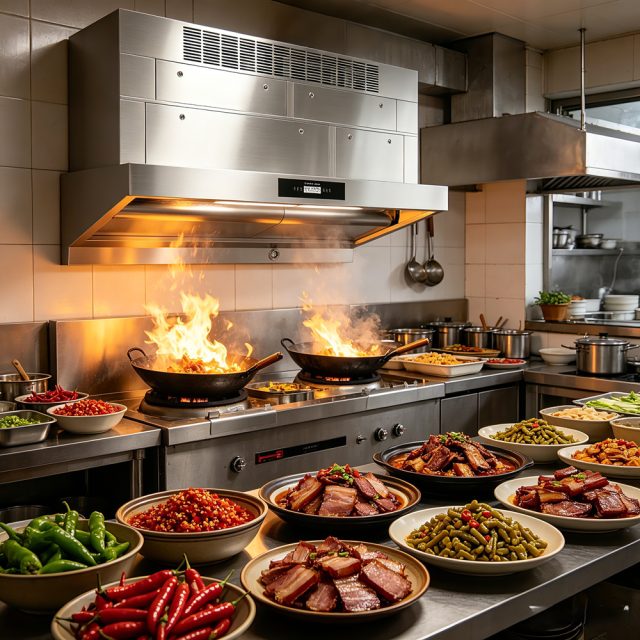
A falafel shop is one of the most space-efficient formats in foodservice. A single deep fryer, a pita oven, a cold counter of salads and pickles, and three metres of service line can carry a full lunch rush out of a unit smaller than most living rooms. The same compactness makes its ventilation easy to underestimate. One fryer running chickpea batter all day, a dry oven pushing heat and steam, and — in roughly half the formats — a vertical broiler for shawarma put three different emission profiles under one shallow ceiling. In street retail, where the pass is two steps from the dining chairs and a residential unit often sits directly overhead, the ventilation decision decides whether the shop becomes a neighborhood fixture or the next odor complaint at the municipal office.
A Small Kitchen With a Three-Way Load
Mediterranean fast casual is one of the most durable segments in street food. Berlin’s falafel counters, London’s lunchtime wrap shops, Parisian and New York piterias and the hummus bowl chains spread across North America all run the same core equipment: a batch fryer for falafel and eggplant, a deck or conveyor oven for pita, a cold line of salads, pickles and tahini, and in many shops a vertical broiler turning meat for the mixed plates. The format rewards tiny footprints: twenty-five to sixty square metres, one or two staff, and service concentrated into a lunch rush.
That equipment mix is what separates a falafel kitchen from the fryer-centric formats it superficially resembles. A fish-and-chips shop or a fried chicken store runs a large, continuous, grease-dense fry battery; its ventilation problem is dominated by aerosolized cooking oil. A falafel shop runs a smaller fryer in vegetable oil, adds a dry oven and steam, and often finishes with a broiler that produces the heaviest local plume in the room. Three emitters with different chemistry share one shallow canopy, and the odor signature — cumin, coriander, parsley and frying onion — is persistent enough to define the shop to everyone within a block, for better and for worse.
What the Exhaust Actually Contains
Start with the fryer. When batter meets hot oil, water in the mix flashes to vapor and tears out through the oil surface, mechanically shearing oil into an aerosol of droplets. A significant share of these droplets sit in the sub-micron range, which matters because mesh and baffle filters only intercept the coarse fraction; the fine fraction travels until it deposits on walls, ceilings and the facade outside. Oil mist is also condensible: it cools as it leaves the hood and turns into a sticky film, which is why walls near a fry line feel waxy within weeks when capture is poor.
Above roughly 200 degrees Celsius of oil temperature, fats also begin to decompose into acrolein and other reactive aldehydes, alongside small amounts of polycyclic aromatic hydrocarbons. Falafel is typically fried at moderate setpoints rather than wok temperatures, so the thermal load is milder than in high-heat Asian kitchens, but the odor chemistry is more distinctive. Cumin, coriander, parsley, onion and sesame all release volatile organic compounds at low concentration but high odor activity — a few micrograms of cumin aldehyde register to the nose across an entire street. This is the fraction that makes falafel shops famous and, in mixed-use buildings, makes them complained about.
The pita oven contributes a different problem: convective heat, water vapor from the dough, and light flour dust near the oven mouth — closer to a bakery load than a fryer load. The broiler, where present, is the single heaviest emitter in the room: continuous grease-laden vapor off rotating meat, plus occasional flare-ups when fat hits the burner shield. Add the moisture that escapes the fryer with every batch of wet batter, and the exhaust is best described as a four-part stream: aerosol, vapor, odor molecules and water.
Type I, Type II, and the Pita Oven Question
Classification follows the appliance, not the shop. In the International Mechanical Code tradition, a hood serving grease-producing appliances is a Type I hood, built for grease-laden vapor; a hood serving only heat- and moisture-producing appliances is Type II. The fryer and the broiler both produce grease-laden vapor, so the section of canopy over them carries Type I duty. A pita-only oven section is closer to Type II: heat and steam with minimal grease. Many small shops put everything under one canopy, which is acceptable provided the whole hood is grease-rated and the grease-producing appliances sit inside the effective capture zone rather than at its fringe.
Codes also open a door that matters enormously for street retail: the recirculating path. NFPA 96 governs grease-producing appliances in North America, and the IMC permits listed recirculating Type I hood systems in lieu of a duct run in many occupancies — the listing to look for is UL 710B, written specifically for recirculating systems. In Europe, EN 16282 and DIN 18869 treat appliances by emission class and hygiene zone, and VDI 2052 remains the standard reference for airflow design. A listed recirculating hood is not a loophole; it is an engineered route with its own maintenance obligations, and an inspector will ask about the filters before anything else.
Odor is a separate compliance layer from grease. Grease codes protect the duct, the roof and the fire marshal; odor rules protect the neighbors. In the UK, cooking smells that unreasonably interfere with neighbors’ use of their property fall under statutory nuisance in the Environmental Protection Act 1990, and local authorities act on complaints. German municipalities handle kitchen odor complaints through local ordinances and building law, case by case. Layered on top are lease clauses: street landlords increasingly write odor-control obligations directly into retail tenancy agreements, because a food tenant that triggers complaints endangers the upstairs residential units the building also monetizes.
Sizing Capture in a Twenty-Five Metre Shop
The industry rule of thumb is a starting point, not a substitute for the arithmetic: roughly 2,000 cubic metres per hour of extraction per metre of light-to-medium hood line, rising to about 2,500 m³/h per metre where the canopy fronts an open display. A compact falafel line — 1.8 metres of fryer, 1.2 metres of broiler, 1.2 metres of oven — is 4.2 metres of line and therefore in the region of 8,000 m³/h if the whole run sits under one canopy. Many shops split the load instead: one grease-rated canopy over fryer and broiler, a lighter canopy or plenum over the oven, which also matches the Type I / Type II split and lets a smaller ductless unit carry the grease section.
Geometry matters as much as volume. The hood should overhang the appliance edges by 150 to 300 millimetres, with end panels on open sides, because the cooking plume spreads as it rises and spills past an exactly-as-wide canopy. Capture velocity at the hood face lands around 0.4 to 0.5 metres per second for this duty class; below that, the plume rolls out at the pass and the dining room smells like the menu — precisely what the customer ordered but the landlord did not. The most common failure in small street units is not a weak fan. It is an undersized canopy with no overhang, mounted under a 2.3 metre ceiling that gives the plume almost no run before it escapes.
The Duct Is the Real Constraint
Given the load above, ducting a falafel shop sounds straightforward until the building’s owner answers the phone. A vertical duct from a street-front unit means penetrating a facade that may be protected, a roof that may not belong to the tenant, or residential floors where a grease duct becomes a fire-rated shaft with cleaning access doors, insulation clearances and a cleaning contract attached. Upstairs residents, quite reasonably, do not want a grease duct passing through their bedroom wall or a fan bolted to the party wall. In older retail stock there is often a dead riser left by a previous tenant, but reusing one requires the landlord’s consent and a survey of its condition.
This is why recirculating architecture became the default for exactly this segment. When a duct is refused, impractical or priced out of a small tenant fit-out budget, a listed ductless hood treats the air at the source and returns it to the room: no facade termination, no roof penetration, no shaft through residential floors. The trade is maintenance discipline, discussed below, and it is a good trade for a format where the alternative is often not ducting but no shop at all.
How a Recirculating Hood Carries a Fry Line
A ductless hood over a falafel fryer is a staged purification train in a shallow box. The first stage is a baffle or mesh pre-filter that intercepts the coarse oil droplets and protects everything behind it; it is washable and lives close to the plume, so it takes the dirtiest work. The second stage is an electrostatic precipitator cell: an ionizer charges the remaining droplets and particles, and oppositely charged collector plates pull them out of the airstream. This is the stage that handles the sub-micron fraction mesh filters miss — the fraction responsible for that waxy film on surfaces.
The third stage is adsorption: an activated carbon bed positioned after the ESP stage, so grease does not foul the carbon before it can work on odor molecules. Carbon adsorbs the spice and herb VOCs that define the falafel smell; dwell time — how long the treated airstream stays in contact with the carbon — decides how much of it survives the journey. This staged logic is what the ductless range hood family from Souniny is built around, and the same physics holds from a one-metre counter unit to a full service line: capture first, remove particulate, then polish odor.
Because the air returns to the room, the system’s health is visible and testable. A shop that skips pre-filter washes will grease-foul its ESP cell within weeks; a shop that skips cell cleaning will push fine aerosol into the carbon and cut its life dramatically. The cadence that works in single-operator falafel kitchens: pre-filter washed weekly, or rinsed daily at high volume; ESP cell pulled and washed every two to four weeks depending on fry hours; carbon replaced on odor breakthrough or on the manufacturer’s interval, typically every few months. Ten minutes of routine, logged, is what keeps a recirculating hood inside its listing.
Layout and Make-Up Air in a Narrow Unit
Capture is a layout decision before it is a fan decision. Put the fryer deepest in the kitchen where the hood has end panels on two sides, the broiler in the middle of the grease section, and the pita oven toward the pass where its lighter plume is easiest to contain. Keep the pass low and shielded — a sneeze guard doubles as a plume guard. The dining side supplies the make-up air: transfer grilles in the servery partition or a door plenum let replacement air flow from front to back, so the shop runs slightly negative in the kitchen and cooking air never drifts into the dining room.
Two layout mistakes recur in fit-outs. First, supply diffusers that blow straight across the fryer: a cross draft shears the plume off the canopy edge and defeats capture regardless of hood size. Second, an airtight shop with no transfer path: the hood starves, capture velocity collapses, and the kitchen goes positive, pushing odor out of every gap in the door. In summer, recirculation pays a second dividend — the shop keeps its conditioned air instead of exhausting it, which in a street unit with full glass frontage is not a rounding error but a noticeable share of the electricity bill.
The Cart Version of the Same Problem
Falafel carts are the founding format of the segment — the street cart with a compact fryer, a stack of pita and a line of regulars predates every hummus chain on the high street. A cart has no duct in any universe: no building, no roof, sometimes no fixed pitch at all, just a market stall, a festival slot or a university plaza. The engineering answer is the same staged train in miniature — capture hood, particle stage, carbon stage — packaged above or beside the fryer inside a ventless cart body.
This is the use case for purpose-built ventless food carts: a fryer, a griddle or a broiler integrated with its own purification and extraction, movable to wherever the pitch is and plug-compatible with ordinary single-phase power. Operators use them for weekday pitches, weekend markets, catering and as a low-commitment first unit before signing a retail lease. The ventilation logic transfers unchanged: capture close, treat in stages, maintain on schedule — with the added constraint that everything must survive being wheeled over a curb twice a day.
When the Building Already Has Ductwork
Some falafel sites do not face the duct problem at all: food halls with shared risers, purpose-built retail kitchens, and 1980s and 1990s commercial units that already carry a grease duct in usable condition. Where a duct run exists and the landlord accepts the load, a ducted inline system is often the lower-maintenance choice: an electrostatic purifier installed in the duct line, sized to the airflow, with a centrifugal fan providing the static pressure and discharging to the riser. Purification then happens out of sight, the kitchen side of the system stays simpler, and the riser’s existing fire protection does the code work.
The decision fork is short. Duct available, landlord willing, riser surveyed: the ducted ESP purifier range covers that high-volume end efficiently and keeps the kitchen equipment lean. Duct impossible — protected facade, residential above, priced out of the fit-out: recirculating ductless hoods carry the load with a maintenance discipline. Both routes demand the same staged physics; they differ in where the stages sit and who has access to service them.
Matching Equipment to the Load
Specification follows the menu band. A shop running the full mix — fryer and shawarma broiler under one canopy, pita oven beside them — needs the heavy-duty ductless all-in-one class: an ND-series unit engineered for grease-dense fume, paired with an Odor Removal Tower where the building is mixed-use and the odor signature has neighbors attached. A hummus-forward menu with an electric counter fryer, an oven and no broiler sits comfortably in the light-duty class: an N-series unit with the same staged architecture at a lower capture volume. Where the back of house is a corridor rather than a room, a narrow floor-standing cabinet unit decouples purification from the canopy and stands in a 520-millimetre recess, joined to a shallow capture hood by a short duct.
Equipment in this class is CE-certified, and from manufacturers such as Souniny ships with a twelve-month whole-unit warranty, with ESP cells, collector plates and sealing strips treated as consumable wear items — an honest division, because those are exactly the parts the maintenance rhythm exercises. Whatever the badge on the hood, the specification questions are identical: does the capture width cover the fry line with overhang, is the carbon stage protected behind an ESP stage, can one person service the filters in minutes, and is the system listed for recirculating grease duty in the jurisdiction where the shop operates.
Commission the shop the way a commissioning engineer would, even if the shop is nine square metres. Wave a smoke pencil along the pass and along each appliance edge to confirm the plume actually leaves for the canopy. Check capture at the fryer’s full basket-drop moment, not just at idle. After the first lunch rush, stand at the front door and then out on the pavement and judge the odor honestly. Then write the filter cadence on the wall next to the fry hours — in a falafel shop the ventilation routine is not overhead, it is the same discipline that keeps the oil fresh, and it decides whether the block remembers the shop for its food or for its smell.