Few formats punish the air like a fish and chip shop. The menu looks simple – fish, chips, a pie warmer – but the kitchen runs twin vats of hot oil through wet batter twice a day, six or seven days a week, in a room that is often smaller than thirty square metres. Wet-batter frying, fish proteins and malt vinegar together push the exhaust load of a chippy closer to a steakhouse grill line than to the sandwich bar it resembles from the street. This guide works through the fume physics, the odor chemistry, the compliance context in the UK and Australia, and the sizing and retrofit paths that hold up in a real fry house.
Why Wet Batter Loads the Air Harder Than the Floor Plan Suggests
The difference starts the moment wet batter meets oil. Par-fried frozen chips shed a comparatively light aerosol; batter is a water-and-flour slurry, and at 175-180 °C the surface water flashes to steam within the first seconds of immersion. The expanding steam shears the surrounding oil into a fine mist, so the visible white plume over a batter fryer is really condensing steam carrying oil droplets and batter particles with it. A dry fryer smokes; a batter fryer breathes.
That plume also has a harder droplet spectrum. Wet frying produces more sub-micron particulate and finer oil mist than dry frying, and fine droplets stay airborne instead of settling inside the canopy. What escapes capture ends up as a sticky film on the shop fascia, the window, the door frame and – in a terraced row – the wall of the flat next door. Owners who wipe their window every morning are wiping evidence of under-captured oil mist.
Duty cycle does the rest. Fish takes four to six minutes per batch against roughly three for chips, and the servery peaks between 11:30 and 14:00 and again from 17:00 to 20:00. Oil degrades across multi-day frying cycles as free fatty acids accumulate, so an older oil emits more aldehydes per kilogram fried than a fresh one. Back-to-back batter batches at Friday teatime keep the plume effectively continuous rather than intermittent. A ventilation scheme sized for the menu card, rather than for wet-batter duty, will be undersized by design.
The Odor Chemistry: Complaints Are About Smell, Not Smoke
Three odor families leave a chippy kitchen. The first comes from the oil itself: frying degrades triglycerides into aldehydes such as acrolein and hexanal, the sharp old-fryer note. The second comes from the fish: whitefish releases amines, above all trimethylamine, the classic persistent fishy smell, which binds readily to damp and cold surfaces. The third is the vinegar: malt vinegar aerosolises as acetic acid, carried on salt particles from the shaker and the chips.
Grease is the visible nuisance; odor is the one that generates complaints. Grease deposits close to the source and announces itself as stickiness on the fascia. Gas-phase odor travels on the air, passes through open windows, and adsorbs into fabrics, carpets and curtains one floor up. Trimethylamine remains perceptible at very low concentrations, which is why a neighbor two doors away can identify tonight’s menu from a window that never saw any smoke.
This is where the engineering split matters. Mechanical filtration and electrostatic precipitation remove particulate and grease-laden vapor – the fraction that makes exhaust visible and ducts flammable. Gas-phase molecules sail straight through mesh and baffles; they are only reduced where they adsorb onto activated carbon. Any chippy scheme that stops at grease removal has solved the fire and smoke problem and left the complaint problem untouched. Acetic acid adds a corrosion footnote: unprotected mild-steel ducting downstream of the vinegar corrodes faster, which is one more reason stainless surfaces dominate this trade.
The Compliance Context: UK, Australia and Complaint-Driven Enforcement
In the UK the operative law is the Environmental Protection Act 1990. Cooking odors from commercial premises fall under statutory nuisance, and a local authority environmental health officer who upholds a complaint can serve an abatement notice that effectively stops frying until the extraction is upgraded. DEFRA’s odour guidance for commercial kitchen extract systems and the BESA DW/172 specification give officers an objective reference, and planning consent for a hot-food takeaway frequently carries an explicit extraction condition – the scheme approved at planning is the scheme that must be built.
Australia runs the same logic through development approval. AS 1668.2 governs the mechanical ventilation design, and councils increasingly require an odour impact assessment where fryers sit near residential premises or inside mixed-use buildings; state EPA guidance fills in the discharge and buffer expectations. New Zealand follows a comparable district-plan pattern.
Enforcement, in both systems, is complaint-driven. One persistent neighbor, a summer of open windows and a prevailing wind toward the promenade is usually enough to start a file. Seafront and heritage sites carry their own constraints: listed facades and conservation areas resist new roof penetrations, and short leases make landlords reluctant to consent to structural ductwork at all. The compliance question in a chippy is therefore rarely whether a standard exists – it is what happens on the fourth complaint.
Sizing the Extraction: Start From the Fryers, Not the Floor Plan
The working rules of thumb are canopy-based. For an enclosed fryer line under a canopy, around 2,000 m³/h of extraction per metre of canopy length is the standard starting point; where an open counter brings customers within a metre or two of the fryers, the figure rises to roughly 2,500 m³/h per metre. A 2.0-2.4 m canopy spanning twin vats and a pie warmer therefore lands at about 4,000-5,000 m³/h at the hood face – a number worth having in mind before any sales conversation begins.
Geometry does as much work as volume. The canopy should overhang the fryer edge by 150-300 mm, sit as low as the fryer lids and splashguards allow, and lead with baffle filters that strip the coarse droplets first. Capture velocity at the fryer surface is what actually controls the plume; raw airflow figures mean little if the canopy sits high or the overhang stops short of the vat edge.
Real inquiry patterns confirm the band. Owners of small fryer shops routinely describe their need as an 8 ft, 3 m or 200 cm hood over a twin-vat line – which maps almost exactly onto the 2.0-2.4 m heavy-fume recommendation. When a proposal arrives dramatically smaller than that, the arithmetic above is the first sanity check to run.
The Building Problem: Terraced Rows, Seafront Arcades and Short Leases
The classic chippy building is a narrow terraced unit with the kitchen tucked behind the servery, a rear wall shared with a neighbour or a yard, and – if it is lucky – an old flue running up through the building. Many seafront shops sit in arcades and listed frontages where nobody is drilling a new hole in the roof, and the flue, where one exists, may be shared, undersized or in poor condition.
Where a sound flue exists and consent allows it, the lowest-friction upgrade is to keep the duct and clean the air inside it: an inline electrostatic precipitator with a matched centrifugal fan sits in the existing run and discharges at the original terminus. The ducted ESP purifier range covers this retrofit end, and it suits shops with higher volumes or several appliances sharing one system.
Where the flue must be capped – no consent, shared stack, heritage facade – the modern answer is to purify at the hood and return the cleaned air to the room. The ductless range hood family does exactly this: multi-stage filtration above the fryers, no new penetration, no roof work, and the flexibility a short lease rewards.
Headroom has its own answer. Where the ceiling is too low for a full stacked unit above the fryer, a shallow capture canopy over the vats can be paired with a floor-standing cabinet purifier – about half a metre wide – standing in the back corridor and joined by a short duct. Nothing vertical sits above the hood at all.
And the trade has a mobile fringe: seafront kiosks, weekend market pitches and seasonal events that fry full menus without any fixed kitchen. Ventless mobile food carts carry their own onboard filtration and make the seasonal pitch work without a single metre of duct.
The Design Response: Matching Filtration Stages to the Load
For a wet-batter fry line, the ductless workhorse is a heavy-duty all-in-one hood. The ND-series opens with a water-cycle stage that quenches the hot plume and catches the sticky batter fraction before it can bake onto anything, then passes the air through up to four electrostatic cells, an F8 medium filter and an H12 HEPA stage. Units in this class are sized for 4,000-7,000 m³/h – which brackets the 4,000-5,000 m³/h a two-vat chippy needs – and the electrostatic cells wash on a 40-60 day interval under batter duty, with self-cleaning variants available for the busiest sites.
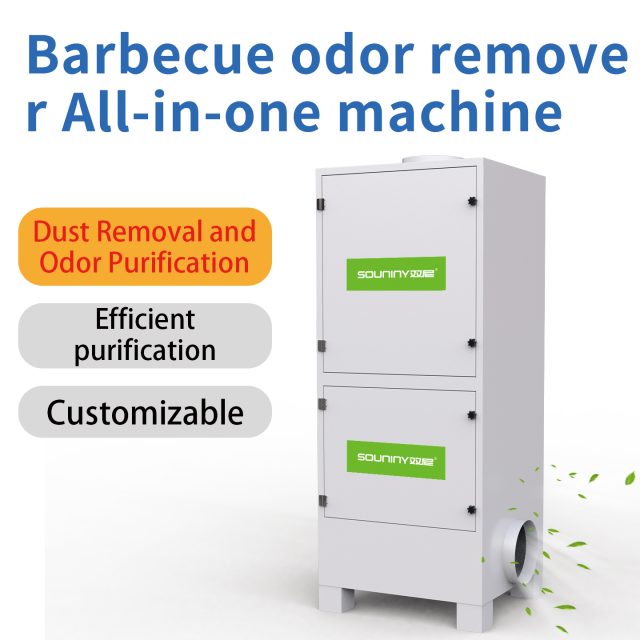
Odor is the tower’s job. A carbon adsorption tower – the Odor Removal Tower – placed downstream of the hood holds activated carbon beds sized in the 5,000-20,000 m³/h class, and it is the stage that actually addresses trimethylamine, frying aldehydes and acetic acid. In a fish-focused shop this stage is not an optional extra; it is the difference between clean exhaust and no complaints.
The lighter stations do not need the same artillery. A slimmer all-in-one such as the N-series – a single-section body suited to lower loads – covers the pie warmer, the side griddle or a vegetable-fry line, freeing the heavy unit for the vats.
Where the flue stays, the equivalent ducted layout pairs an inline electrostatic precipitator with a matched centrifugal fan and discharges at the existing terminus – the layout that suits premises running several appliances through one duct system.
Seafront sites add one materials note: salt fog eats unprotected steel. Souniny builds its ductless and ducted ranges in stainless steel with CE certification, and the wear items – ESP cells, aluminium collector plates, sealing strips, ceramic insulators – are consumables, replaced on condition rather than treated as defects. Budgeting for them is part of sizing honestly.
Make-Up Air and the Winter Fry Cycle
Extracting 4,000-5,000 m³/h from a sealed room is a promise the room cannot keep. If replacement air has to squeeze under the back door, the kitchen runs at strong negative pressure: the door becomes a wind tunnel, the servery goes cold, and the canopy loses capture efficiency as the room starves. A slight negative pressure is the target – enough to keep odor in, not enough to fight the door.
The fixes are unglamorous: a transfer grille or lobby between servery and kitchen, a tempered supply path so winter air is not delivered raw at head height, and a self-closing front door. In winter the cold glass of a shopfront condenses frying vapor the moment extraction underperforms; in summer the open front reverses the problem, as cross-draughts peel the plume out of the canopy. An air curtain or a lobby on the entrance line protects capture at both ends of the year, and keeps the make-up air the engineer specified instead of the weather’s.
Maintenance Rhythm for a High-Load Fry House
Wet-batter duty shortens every cleaning interval, and the log that satisfies an environmental health officer is built from that reality. Baffle filters degrease weekly; canopy internals monthly. Under batter load the electrostatic cells wash on a 40-60 day cycle – a shop that waits for the failure light is already discharging uncollected mist. Oil management at the source matters just as much: skimming, filtering and topping up on schedule lowers free fatty acids, and lower free fatty acids mean fewer aldehydes generated per batch.
The carbon bed is condition-based, not calendar-based. Fish amines and vinegar vapor load carbon faster than neutral cooking would, so replace on odor breakthrough at the discharge – or on a conservative schedule through summer – rather than letting the neighbours set the standard. Keep the replacement dates in the same folder as the baffle-filter log; when the environmental health officer calls, a dated maintenance trail is the cheapest compliance document a chippy can own.
A Commissioning Checklist Before the First Friday Rush
The handover test is simple: fry wet batter at service load and watch the air. Face velocity at the canopy should hold along its full length; a smoke pencil at each vat edge should show everything drawn up and away; the discharge – room grille or external terminus – should show no visible plume and no fishy note at two metres.
Then walk the building. The front door should close on its own without fighting negative pressure. The neighbour’s side of the party wall, and the window above, should smell of nothing at 18:30 on a Friday. Boundary noise should sit where a bedroom window can stay shut. And the log should already have its first entry – baseline readings taken, filter dates set, carbon change scheduled. A scheme that passes those checks on day one is a scheme that still passes them when the council arrives on a warm July evening.
The arithmetic of a chippy never changes: wet batter multiplies the aerosol, fish supplies the most persistent odor molecules in foodservice, and the buildings are the smallest and most constrained on the high street. Size the canopy from the fryers, insist on a carbon stage for the gas-phase fraction, choose the duct path the building actually allows – clean the existing flue, purify at the hood, or split the plant into a floor-standing cabinet – and then run the maintenance rhythm the load demands. Do those four things and the shop trades on its food, not on its smell.