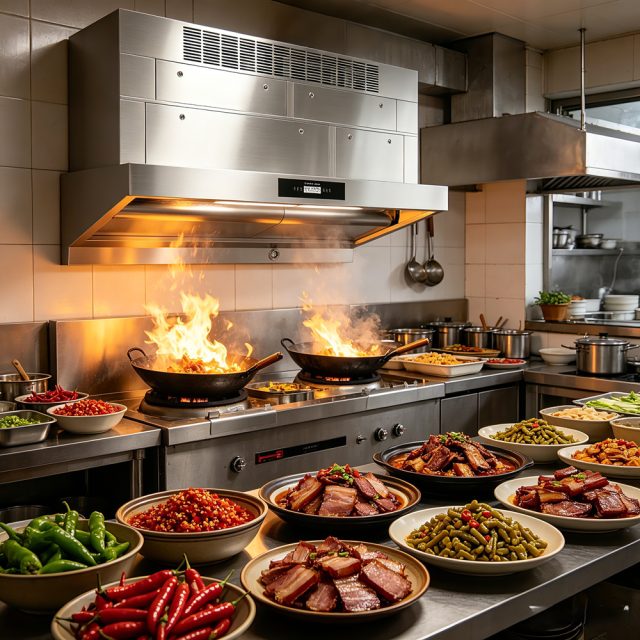
A food truck park is not a single kitchen — it is a small city of cooking operations sharing one slab of concrete, one power service, one grease interceptor, and one outdoor air environment. From container kitchens that operate year-round to pop-up stalls that arrive for one weekend, every site in the yard generates its own stream of grease-laden vapor, smoke, and cooking odor. Ventilation is the part of the central infrastructure that decides whether the park is a comfortable dining destination or a smoky lot that customers walk past. For multi-vendor lots, container kitchens, and open-air festival sites, ductless all-in-one systems — ND-series, N-series and the Odor Removal Tower — give each vendor self-contained capture and treatment without drilling a single rooftop penetration.
Why food truck parks need a different ventilation approach
Traditional restaurant ventilation assumes one canopy above one fryer line feeding into one duct run to one roof fan. A food truck park breaks every one of those assumptions. Vendors cook in small mobile boxes, on trailers with built-in appliances, or in converted shipping containers that roll into place for a season. They share power from a common pedestal, water from a common tap, and diners from a communal seating area. Ventilation, when it exists at all, has usually been left to each vendor to improvise — a charcoal trailer venting into a side wall, a fryer cart exhausting into the queue, a woks-on-wheels box leaking unburned grease aerosol toward neighboring stalls.
The result is the most common complaint from food truck park operators: smoke drift, grease fallout on shared patios, and odor carryover across the lot. Customers smell charcoal from vendor A while they are eating ramen from vendor B, and the park’s identity becomes a haze rather than a destination. Ductless all-in-one capture and treatment solves this at the source, inside each vendor’s kitchen envelope, without requiring the park’s central building permit to be re-engineered for ducted rooftop fans.
The ventilation load each vendor brings
Every cookline in the park produces a different emissions profile. Charcoal and wood-fired trucks are the heaviest producers of polycyclic aromatic hydrocarbons (PAHs), sub-micron particulate, and visible smoke — the same compounds an ND-series heavy-duty all-in-one is rated to handle. Wok-driven Asian trucks — Thai, Vietnamese, Korean, Chinese — produce high-temperature grease aerosol loaded with fine oil droplets that recondense on every shared surface. Fryer trucks emit a constant baseline of particulate and acrolein from oil breakdown. Pizza ovens, taco grills, coffee bars, and dessert stations add wood smoke, broiler fumes, and pastry aerosols respectively.
Treating the park as one combined kitchen is mathematically tempting but practically wrong — the odor signature of a charcoal Argentine asado truck should not mix with the molecular output of a pastry stall in the same air handler. Each vendor’s capture and treatment must be local, packaged, and tunable to that vendor’s own menu. The ND-series ductless unit pairs heavy fume capture with multi-stage electrostatic and filtration stages; the N-series is the light-fume variant for grills, fryers, and steamers that produce less particulate load; the Odor Removal Tower finishes the airstream so that recirculated air into the dining canopy — or back over the patio — is free of the volatile organic compounds (VOCs), fatty acids, and Maillard-reaction volatiles that make a communal lot smell like a single big kitchen.
Container kitchens and semi-permanent stalls
The most ambitious food truck parks now install container kitchens — 20- or 40-foot shipping containers fitted with commercial appliances, exhaust hoods, plumbing, and fire suppression. These vessels are part building, part vehicle. They have a finished ceiling, so a ducted rooftop penetration is either forbidden by the park’s lease or practically impossible because containers butt against each other with millimeter clearance. The ventilation solution must therefore be entirely internal — capture, filter, and recirculate inside the container envelope.
This is exactly the ductless all-in-one architecture. A Cabinet Purifier installed above the cookline pulls fume through stainless baffles into a multi-stage electrostatic cell, then through activated carbon and HEPA-style final filters, and finally returns treated air to the container interior. The vendor does not touch the container’s outer shell, does not need a landlord-approved rooftop penetration, and does not contribute to a shared duct that any neighbor can smoke into. Container kitchens that run charbroilers and woks use the heavier ND-series; those that focus on assembly, pastry, coffee, or pan-frying can step down to the N-series sized for the appliance lineup.
Pop-up stalls, festival sites, and temporary parks
Not every food truck park is permanent. Weekend markets, music-festival food courts, county-fair concession rows, and seasonal plaza activations operate from wheeled trailers, gazebo tents, or temporary counters with no fixed infrastructure. The ventilation requirement is real — smoke from a charcoal trailer at a summer festival is the difference between a pleasant afternoon and an evacuation-worthy air-quality incident — but ducted extraction is unavailable because there is no building to penetrate.
Trailer-mounted CV-A, CV-B, and CV-C carts serve vendors who do not want to bring their own canopy at all — these compact, self-contained cooking carts integrate capture and filtration into a wheeled appliance that an operator can roll into a 10×10 booth space, plug into a 220V outlet, and cook a full service without venting. Where a vendor prefers to bring their own trailer or container and only needs the cleaning stage, an in-line ESP Purifier can be mounted in the trailer’s existing duct run before the recirculation port.
The shared dining canopy and patio zone
Many food truck parks enclose their dining area with a tensile canopy, a glass pavilion, or a simple pole barn. This shared zone is what most parks sell to customers — comfortable seats, weather protection, music, lighting — but it is also the air volume where every vendor’s exhaust eventually settles. Even with per-vendor ductless capture and treatment, residual cooking aroma, residual smoke from a charcoal chimney upwind, and entrance-door drafts can pull cooking emissions into the canopy from across the lot.
The Odor Removal Tower is designed specifically for these large, semi-enclosed ambient volumes. Mounted at canopy height or above the highest dining table, the tower continuously samples the canopy air, removes residual VOCs and fine particulate via deep carbon and electrostatic stages, and recirculates treated air back into the seating zone. The result is a dining environment that smells like food — pleasantly — rather than like the byproducts of cooking. For parks with adjacent outdoor patios that have no enclosure at all, low-profile ceiling-mounted N-series units can be installed under awnings to scrub patio air without creating downdrafts that disturb paper napkins and tablecloths.
Compliance with local air-quality rules
Many cities now regulate outdoor cooking emissions as a public nuisance and as a particulate-source air-quality concern. Food truck parks cluster dozens of high-emission sources in a small footprint, which makes them attractive targets for municipal inspectors who want to demonstrate enforcement. The two regulatory frameworks that bite parks hardest are local nuisance ordinances (visible smoke, odor complaints from neighboring residential or commercial tenants) and air-quality permits for operations above a defined emissions threshold.
Ductless all-in-one capture and treatment is the most regulator-friendly architecture for parks because every vendor’s emissions are handled at source. There is no single rooftop plume that inspectors can photograph; there is no shared duct that a fire inspector can fail for grease accumulation; and the ND-series, N-series, and Odor Removal Tower are designed to meet restaurant-grade capture and treatment targets across a range of national standards — NFPA 96 for fire-safe construction, EN 16282 for European capture efficiency, and equivalent ASHRAE and IMC recommendations in North America. The cabinet-style installation also keeps the fire-suppression integration simple: the capture appliance is the suppression boundary.
Operating economics across the park
A park operator’s revenue model depends on vendor turnover, vendor satisfaction, and dwell time. Ventilation affects all three. Smoke and odor complaints drive customers to leave before they finish their second drink, which compresses dwell time and pushes them toward drive-through competitors. Vendor turnover rises when trailers cannot find a park that will host them because the existing tenant’s smoke drives away diners. And vendor satisfaction collapses when a chef has to apologize to customers for the haze over their food.
The ductless architecture also keeps the park’s central capex predictable. There is no single giant air handler to size, no duct risers to route between containers, and no rooftop equipment to maintain. Each vendor brings or buys their own ductless unit, sized for their menu, and the park’s central infrastructure stops at power pedestals, water, grease interceptors, and seating. Expansion is additive: a new vendor arrives with their own appliance. Contraction is symmetric: a tenant leaves and takes their unit with them.
Practical deployment checklist
For park operators and vendors evaluating ductless capture and treatment for a multi-vendor lot, the path forward is straightforward. First, classify each vendor’s cookline as heavy-duty (charcoal, wood, heavy wok, broiler, tandoor) and assign the ND-series sized for the appliance lineup, or as light-duty (fryer, griddle, steamer, pan, oven) and assign the N-series. Second, evaluate the shared dining canopy — if it is enclosed or semi-enclosed, add one Odor Removal Tower for every 150–200 square meters of canopy area. Third, for vendors with high-chimney-trailer or wok-torch operations, plan at least one Odor Removal Tower per 4–6 trailers on the windward edge of the site. Finally, for vendors who roll in and out weekly or seasonally, supply CV-A, CV-B, or CV-C carts so that the food-truck-park experience includes occasional pop-ups without forcing permanent infrastructure.
Food truck parks are the future of casual dining in dense cities because they bring variety, flexibility, and price points that single-operator restaurants cannot match. Keeping them pleasant places to eat, work, and linger depends on getting the air right — and ductless, source-level capture and treatment is the only architecture that scales across a multi-vendor lot without forcing each new vendor to negotiate a roof penetration.