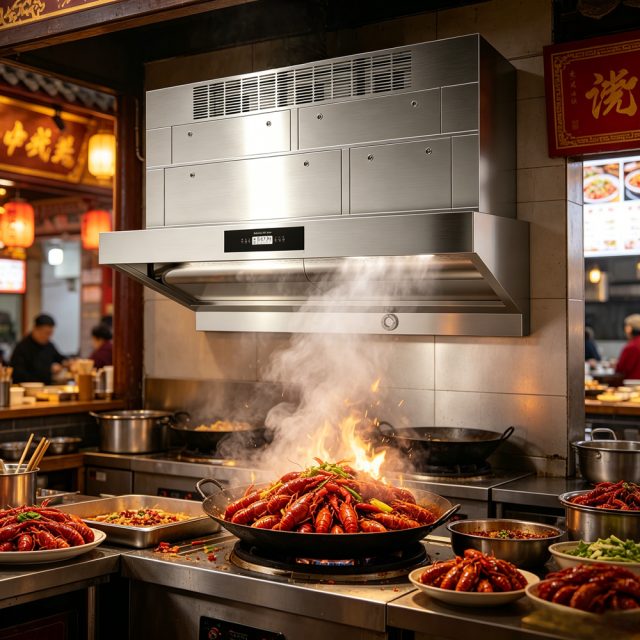
A modern gastropub is the most demanding small-footprint foodservice format in HoReCa: a single open room hosts a bar, a banquette, a chef’s pass, and a kitchen line that typically combines a char-grill broiler, a flat-top griddle, a deep-fryer bank, a sauté station, and a slow-braise or low-temperature oven — all under one canopy, with diners seated within two to three metres of the cooking line. The result is a hybrid fume load: sub-micron particulate from searing and charring, grease-laden vapor from the fryer, condensed water vapor and hop aromatics from the bar-back dishwasher, and the lingering beef-fat-and-malt signature that defines the gastropub atmosphere. Souniny’s ductless approach — an all-in-one Range Hood (the light-duty N-series for sauté and fryer duty, the heavy-duty ND-series for char-grill and griddle duty) paired with an Odor Removal Tower — is purpose-built for this mixed-pollutant environment, and it does not require rooftop ductwork, which is what makes it viable in heritage high-street buildings, basement pubs, and converted retail units.
Why the Gastropub Is a Different Ventilation Problem
Conventional restaurant ventilation theory separates the kitchen from the dining room. The gastropub deliberately fuses them: the chef’s pass is theatre, the broiler flare is part of the brand, and the bar seating faces directly into the cooking line. Designers routinely specify a single Commercial Range Hood that spans the full line and recirculates air into the same room. That single architectural decision changes the engineering brief in three ways.
First, capture efficiency has to be high at very low canopy heights. A gastropub ceiling is often 2.4–2.7 m because the venue sits inside a Victorian terrace, a basement vault, or a converted shop unit with a structural slab above. Standard ducted canopies need 600–900 mm of vertical clearance between the cooking surface and the capture plane to entrain smoke reliably; at gastropub heights that geometry collapses, and plume spill becomes visible to diners. Ductless all-in-one canopies are designed for low-clearance capture because they integrate the filtration and the blower into a single housing — there is no long duct run that drives static-loss assumptions.
Second, the pollutant mix is genuinely mixed. A steakhouse is dominated by rendering and char. A gastropub, in a single service, runs rendering (chicken thigh on the char-grill), aqueous aerosol (mash and steamed mussels), frying (chips, calamari, beer-battered cod), and reduction (sticky toffee pudding, braised short rib). The electrostatic cell in a ductless unit is tuned for that range, and the Odor Removal Tower downstream addresses the volatile organic compounds — hop oils from the bar-back, caramelised sugars from the dessert station, beef-fat aerosols — that a particulate filter alone cannot remove.
Third, the venue cannot rely on negative pressure or make-up air balance. Heritage façades, party-wall neighbours, and basement conversions mean the gastropub usually has poor or uncontrolled infiltration. A ducted canopy that dumps 2,000–4,000 m³/h of treated air out through a wall or roof creates a pressure imbalance that pulls cold air down the chimney breast, smokes up neighbouring extractor fans, and triggers complaints. The ductless architecture solves the air balance because the air it processes is returned to the room — only heat, water vapor, and a small leakage fraction leave the building envelope.
The Pollutant Inventory of a Typical Gastropub Service
A practical design starts with the actual emissions, not with generic code tables. Across one dinner service in a 90-cover gastropub, the line typically produces:
Sub-micron particulate from char and sear: The char-grill broiler is the signature piece of equipment. Whether it is a lava-rock grill, a radiant broiler, or a Spanish-style brasa, the dripping fat flashes into sub-micron droplets that carry deep into the dining room if not captured. These particles are too small for a mesh pre-filter — they need a high-voltage electrostatic field to charge and collect. This is the workload the ND-series heavy-duty ductless hood is engineered for.
Grease-laden vapor from the fryer: Even a single basket of triple-cooked chips at 180 °C oil temperature emits a continuous aerosol plume of triglyceride condensate. A baffle filter will catch the large droplets; the fine mist travels further and redeposits on ceiling beams, lighting tracks, and bar shelving, where it oxidises into the persistent “chip-shop” smell that no gastropub wants. The N-series light-duty ductless hood integrates an ESP cell that targets this aerosol fraction specifically.
Aqueous vapor and hop oils from the bar: A surprising share of the olfactory load in a gastropub comes from the bar side: glasswashers steaming off sanitizer, draft lines purging yeast, and the constant agitation of hop residue in the dispense lines. These are volatile organic compounds, not particulates, so particulate filtration does not remove them. The Odor Removal Tower uses activated carbon and a photolysis stage to break down these VOCs before the air returns to the room.
Pan-sear aerosol from sauté and griddle: The duck confit, the burger smash, the mushroom sauté — all produce a protein-and-fat aerosol that is odour-active even at low concentration. Without targeted removal, it accumulates in soft furnishings and becomes the “stale gastropub” smell that triggers negative reviews.
Why Ductless Fits the Gastropub Floor Plan
The argument for ductless in a gastropub is not “ductless is cheaper” — it is that ductless is the only architecture that survives the constraints of the typical gastropub real estate.
Heritage and planning constraints. British high-street gastropubs routinely sit in Grade II listed buildings, where any rooftop plant or external flue requires planning consent and often English Heritage or local conservation officer approval. A ductless installation typically needs only a power supply and a condensate drain; the external envelope is untouched, and the conservation case is straightforward.
Basement and semi-basement operations. Many of the most atmospheric gastropubs are below street level — vault ceilings, brick arches, no roof access. A ducted system in a basement requires a vertical shaft, a breakout through the ground-floor slab, or a noisy inline centrifugal fan mounted in a chimney breast. The ductless approach puts the entire air-handling package at the canopy itself.
Front-of-house visibility. Designers and operators increasingly want the canopy to be a design feature — a brass-trimmed island, a copper-clad rectangular hood, or a simple satin-stainless box. The ductless N-series and ND-series are designed to be seen, not hidden in a back-of-house ceiling void.
Make-up air simplicity. Because the ductless canopy returns filtered air to the room, the operator does not have to engineer a separate make-up-air path. In a small gastropub, that can be the difference between a feasible HVAC retrofit and an impossible one. Code compliance under EN 16282-1 (the European standard for commercial kitchen ventilation) and NFPA 96 (the US standard for cooking equipment ventilation) is easier to demonstrate when the air is conditioned and recirculated rather than dumped and replaced.
Equipment-to-Hood Mapping: What Goes Under Each Series
Gastropub line designers quickly learn that one hood size does not fit all stations. Souniny’s product split is intentional and mirrors the typical gastropub brigade layout.
ND-series (heavy-duty ductless all-in-one) — char-grill, flat-top, salamander, charcoal broiler. This is the high-temperature, high-particulate end of the line. The ND-series integrates a heavy-gauge stainless collecting cell, a high-voltage power supply, and a centrifugal blower sized for the resistance of the cell at cooking-peak conditions. Mount it directly over the broiler and the griddle. The all-in-one form factor means no rooftop curb, no external flue, no duct riser through the dining room floor above.
N-series (light-duty ductless all-in-one) — fryer, sauté, pasta station, low-temperature oven. The fryer and the sauté range produce more aqueous aerosol and less sub-micron char, so they sit under the lighter-duty N-series canopy. The N-series also has a smaller footprint, which suits the narrow pass many gastropubs run between the bar and the dining room.
Odor Removal Tower — paired at the canopy outlet. The Tower is the third piece of the ductless gastropub solution. It contains activated carbon for the volatile fraction (hop oils, beer-back residue, Maillard-reaction products, caramelised sugar) and a UV photolysis stage for low-molecular-weight odorants. It mounts onto the ductless canopy outlet and treats the air before it returns to the dining room. In tight gastropub footprints where multiple canopies feed one open space, the Tower is what makes the room smell like the gastropub intends — fresh bread, seared beef, hops — and not like a working kitchen.
Where the ducted ESP Purifier line still applies. A subset of gastropubs — large-format destination venues, gastropubs inside hotels, or units with very high broiler throughput — do benefit from a ducted ESP Purifier installed in a service corridor with a Centrifugal Fan on the roof. For those projects, the ducted architecture handles higher static pressure and longer filter service intervals. But for the typical 60–120 cover high-street gastropub, the ductless N-series + ND-series + Odor Removal Tower is the right default.
Compliance Pathways: EN 16282, NFPA 96, and the Local Inspector
Ventilation codes are written assuming a ducted canopy. Ductless canopies are not an exemption from the code — they are a different way of satisfying the same intent. The relevant standards for a gastropub operator planning a ductless retrofit are:
EN 16282-1 (Europe). The European standard for commercial kitchen ventilation sets capture and containment criteria, exhaust flow assumptions, and recirculation limits. A ductless installation can demonstrate compliance when the manufacturer’s airflow, capture, and filtration data are submitted to the local authority having jurisdiction. Souniny publishes the relevant test data for both N-series and ND-series, including grease and particulate removal efficiency at the relevant cooking loads.
NFPA 96 (United States). For US gastropubs — particularly in dense cities where rooftop ductwork is impractical — NFPA 96 Section 4.2 permits ductless cooking equipment under specific conditions, including a listed automatic fire suppression system integrated with the canopy and a maintenance schedule. The ND-series integrates a suppression port; the operator is responsible for the inspection contract.
ASHRAE 154 and local indoor-air-quality rules. ASHRAE 154 covers odor transport in commercial kitchens and is the closest US guidance to the European recirculation framework. Where a local jurisdiction has a restaurant odor ordinance (common in US mixed-use zoning), the Odor Removal Tower is the engineered response.
IMC and local mechanical codes. In US jurisdictions adopting the International Mechanical Code, ductless cooking equipment has its own listing path. The operator’s mechanical engineer should confirm that the canopy carries the relevant certification for recirculating operation in a venue of the proposed occupant load.
Across all jurisdictions, the practical message is the same: arrive at the inspector’s office with the manufacturer’s data sheet, the capture efficiency at the proposed cooking load, the noise rating, the fire suppression interface, and the maintenance interval. Ductless projects get approved when the documentation is prepared; they stall when the operator shows up with a generic box.
Operation, Cleaning, and the Sunday Service Reality
The gastropub format runs harder and longer than the typical sit-down restaurant. Open at 11:00 for lunch, close at 23:00 — and that is on a weekday. Saturday covers three meal periods plus the late trade. The cleaning and maintenance regime has to fit that tempo, not the other way around.
The N-series and ND-series ductless canopies are designed for daily wipe-down of the capture surface and a weekly electrostatic cell wash. The collecting cell slides out on rails and goes through a hot-soak cycle in the pot-wash, then drops back in. No specialised tooling, no on-site technician, no service contract premium. The Odor Removal Tower carbon stage has a typical service interval of 12–18 months in a gastropub duty cycle; the UV lamps are an annual swap.
This is the operational case that matters to a gastropub owner: the kitchen team can clean the canopy themselves on a Sunday afternoon, and the equipment does not require a third-party service visit every quarter. Ducted systems with rooftop access, lift hire, and duct cleaning crews have a recurring cost and downtime profile that the ductless approach sidesteps.
A practical note on filter care: the electrostatic cell’s performance depends on the cell being clean. A grease-loaded cell loses capture efficiency, the blower works harder, and the canopy noise rises. The N-series and ND-series are designed so the cell is reachable without tools and without ladders — wash it on the same schedule as the floor.
Front-of-House Air Quality: What the Diner Actually Notices
The diner at the gastropub bar stool is the unit test. Three things determine whether they stay for a second pint.
Visible plume. A properly sized ductless canopy with a clean electrostatic cell contains the cooking plume inside the capture zone. The bar area, three metres away, sees clear air. If plume is visible at the bar, either the canopy is undersized for the load or the cell needs a clean.
Smell layering. The gastropub wants to smell like the gastropub — seared beef, woodsmoke from the broiler, baked bread, hops — not like a working kitchen. The Odor Removal Tower targets the off-notes (sanitiser, stale fryer oil, dishwasher steam) and lets the signature aromatics through at low concentration. The result is the difference between a venue where the front-of-house smells intentional and one where it smells accidental.
Noise. A ducted canopy plus inline centrifugal fan is loud. A ductless canopy has the blower integrated, the duct run is zero metres, and the acoustic profile is tuned for occupant comfort. For a gastropub that runs music, conversation, and sport on screens, the canopy should not be the loudest thing in the room.
The Retrofit Scenario: Converting an Existing Pub Kitchen
Many of the enquiries Souniny receives are from operators who have taken on a second-generation pub lease with an existing kitchen. The inherited canopy is usually a domestic-style extractor hood or a ducted commercial canopy that no longer extracts properly. The retrofit follows a predictable path:
- Survey of cooking equipment: equipment type, heat input, hourly cooking load, peak service surge.
- Capture assessment: existing canopy dimensions, mounting height, clearance to ceiling, any structural limitations.
- Pollutant mapping: where the char-grill sits, where the fryer sits, where the bar dishwasher vents — and where the diner seating is in relation to each.
- Selection: ND-series over char-grill and griddle; N-series over fryer and sauté; Odor Removal Tower on each canopy or shared at the return path.
- Electrical and drainage: the canopies need a clean power circuit and a condensate drain; the Odor Removal Tower is line-voltage only.
- Commissioning: airflow balancing, capture verification with smoke pencil or equivalent, noise measurement at diner seating.
The whole process, in a typical 80-cover gastropub, completes in two to three working days with no structural work and no planning application. The kitchen closes for one service, the canopies go in, and the chef tests capture on the first fry of the relaunch.
Comparing Ductless vs Ducted for the Gastropub
The honest comparison comes down to a small set of questions. Will the building permit a rooftop breakout? Is the cooking load dominated by char-grill (which favours a ducted ESP Purifier + Centrifugal Fan in a service area) or by mixed sauté and fry (which favours a ductless ND-series + N-series + Odor Removal Tower at the canopy)? Is the dining room within three metres of the line? If yes to the last question, ductless is almost always the right answer, because the alternative is a ducted installation that still cannot dump air into the dining room without an extensive make-up-air and acoustic treatment package.
For the typical gastropub — heritage envelope, low ceiling, mixed line, close seating, a charismatic chef who wants the canopy to be a design feature — the ductless N-series + ND-series + Odor Removal Tower solution is engineered for the brief. The ducted ESP Purifier line remains the right choice for the higher-volume cases, where the venue’s architecture supports it.