Grease does not respect filters. However good the capture at the canopy, a measurable fraction of cooking aerosol always travels past the baffles into the plenum, the duct and the fan — where it cools, sticks to bare steel and slowly builds an invisible fuel line that runs from the cooktop to the roof. Grease duct cleaning is not housekeeping; it is the most code-sensitive maintenance activity in a commercial kitchen, and the one most often deferred until an inspector, an insurer or a fire makes it impossible to ignore. This guide sets out what the standards actually require, why access panels decide whether compliance is even physically possible, and how the contamination load can be cut before the duct ever sees it.
Where Grease Actually Accumulates
The exhaust path is a chain of grease reservoirs, and it helps to see it that way. The hood interior and its grease gutters are the first and most visible reservoir, dealt with in weekly cleaning. Behind them sits the filter bank: baffle filters capture a large share of the grease that enters them, but no impact separator is perfect, and the fraction that slips through is precisely the fraction of finest, most dangerous droplets. Behind the filters is the plenum — barely visible, rarely wiped — and then the ductwork itself, where aerosol that has cooled below its condensation point deposits on the walls as a sticky film. The journey ends at the fan, where grease collects on the wheel and housing, unbalances the rotor and adds contamination at the exact point the fire code treats as a likely ignition-and-spread location.
The physics of deposition is unforgiving. Cooking aerosol leaves the cookline hot and partly vaporized; the moment it touches duct steel a few degrees cooler, it condenses. The film that forms traps soot and carbonized particles, and heat from continuous operation slowly polymerizes it into a hard varnish that no ordinary wipe will remove. Deposition concentrates where the air slows or turns: elbows, horizontal runs, transitions and the fan itself hold the heaviest deposits. A kitchen that cleans only the visible hood is maintaining the smallest reservoir in the chain and ignoring the one that burns.
Two forces make the chain worse than it looks. First, filter bypass concentrates at the edges: undersized or warped filters sitting loosely in their frames let unfiltered air stream past the bank — which is why frame condition matters as much as media condition. Second, low airflow through a loaded or undersized system lowers capture at the hood, and the spilled plume makes the front-of-house smell while the duct keeps loading in silence. A kitchen whose dining room carries last night’s fryer note is usually reporting a maintenance problem, not an aroma.
What the Standards Actually Require
In the United States, NFPA 96 treats the entire exhaust system — hood, plenum, filters, ducts and fan — as one assembly that must be cleaned by trained, qualified personnel on a schedule set by cooking type and volume. The widely applied intervals run from monthly for solid-fuel and charcoal cooking, through quarterly for high-volume kitchens operating around the clock, to semiannually for moderate-volume operations and annually for low-volume or seasonal sites. Critically, the schedule is not a ceiling on contamination: the code also carries a corrective trigger, under the order of 500 micrometres (0.02 inches) of measured buildup, at which cleaning is required regardless of when the last service fell. A kitchen that cooks harder than its interval assumed must shorten the interval — the schedule follows the menu, not the calendar.
Other jurisdictions reach the same destination by different routes. In the United Kingdom, DW/172 governs system design while the TR/19 grease framework sets cleanliness grading and post-clean measurement practice — the idea that a clean must be verified by measuring residual grease depth, not by looking at it. Across the EU, EN 16282 and VDI 2052 define hygienic and fire-safety requirements for kitchen ventilation, and German inspectors have long treated documented duct cleanliness as part of the building’s fire file. In Australia, AS 1668.2 governs kitchen exhaust and state-level guidance adds explicit cleaning expectations. The details differ; the principle is identical: the whole system must be clean, the cleaning must be evidence-based, and the evidence must be written down.
There is also a related rhythm worth syncing with: wet-chemical suppression systems require their own semiannual inspection, and fire authorities increasingly expect the two schedules — suppression and exhaust cleaning — to be planned together, because both end with the same sticker on the same kitchen wall.
Responsibility, finally, is the question every lease answers differently. In most commercial tenancies the tenant cleans and the landlord maintains the fabric, but shared risers in multi-tenant buildings blur the line: one kitchen’s grease enters a common duct that others also feed, and the cleaning obligation has to be written into the lease before the first dispute, not after. Operators in shared buildings should know exactly which duct sections they own, who cleans the commons, and where the last certificate for the shared run is filed.
Access Panels: The Detail That Decides Everything
A duct that cannot be reached cannot be cleaned, and a duct that cannot be cleaned cannot be compliant. For this reason the codes require access openings at every change of direction, along horizontal runs, and at dampers and the fan connection — sized and positioned so that cleaning tools and inspection eyes can actually reach the surfaces behind them. In practice, missing, undersized or painted-shut access panels are among the most common findings in kitchen exhaust inspections, and the finding is rarely cheap: the system is treated as contaminated until proven otherwise.
Retrofit buildings feel this hardest. Panels must be cut into insulated or fire-rated assemblies, each penetration has to preserve the rating it interrupts, and in a crowded ceiling void there is sometimes nowhere legitimate to put a panel at all. New builds have no excuse: designing the cleanable path — short horizontal runs, generous bends, panels where the deposits will actually be — costs a fraction at drawing stage of what it costs after drywall. Old buildings force a choice between an engineered panel plan and an exhaust strategy that reduces the duct’s role, a fork covered at the end of this guide.
What a Proper Cleaning Event Looks Like
A compliant cleaning is a controlled industrial process, not a mop and a bucket. The crew protects appliances and surfaces, applies chemical degreaser to soften the polymerized film, scrapes the heavy deposits, then pressure-washes and wet-vacuates the loosened grease through the whole train — hood, plenum, duct, fan. The wastewater is not ordinary water: it is grease-laden liquid waste, and jurisdictions increasingly regulate where it goes, requiring collection and disposal rather than a drain run-off. The event ends with a post-clean inspection — grease-depth measurement or documented photographic evidence — and a certificate or sticker showing the date and the responsible company.
The paperwork is not decoration. Between the dated certificate, the service logbook and, in some regions, waste-transfer records, the rule of thumb in fire investigations is blunt: a cleaning that left no record legally never happened. Well-run operators treat the log the way they treat food-safety temperature logs — a standing document, updated every visit, available the day an inspector or insurer asks.
The Fan and the Discharge: The Reservoir at the End of the Line
The fan deserves its own attention because it sits where two problems meet. Grease collecting on the wheel changes its balance; the vibration that follows wears bearings and seals until the fan fails — usually on the hottest, busiest evening of the year. A grease-wetted wheel and housing is also among the most probable ignition points in the whole system, sitting directly between the duct and the open sky. Every proper cleaning therefore ends at the fan: wheel degreased, housing wiped, belt tension and bearings checked, access confirmed for the next visit.
Beyond the fan, the discharge itself has a contamination story. Grease-laden exhaust leaving the discharge point drips onto the roof membrane, and roof stains are how more than one neighbor dispute and more than one landlord notice has started. Codes and good practice increasingly call for a grease containment device at the discharge — an absorbent or tray assembly that catches drips before they reach the roof — with its own replacement rhythm. It is the last reservoir in the chain and the easiest to forget, because nobody walks the roof every week.
Records, Insurance and Liability
After a duct fire, the sequence is predictable: the investigator’s first document request is the cleaning history. Current records support a claim; overdue or missing records invite denial, and several insurers now audit kitchen exhaust documentation at policy renewal and price the risk accordingly. Landlords and franchisors have learned the same lesson, and multi-site restaurant groups increasingly standardize cleaning intervals, approved contractors and record formats across their estates — because one location’s neglected duct can burn down a brand.
Liability also runs through design. A system built without adequate access, or with a filter stage so weak that the duct loads up months ahead of its interval, is not merely inconvenient — it is an argument that the operator knew the system could not be maintained to code and ran it anyway. Compliance, in other words, begins on the drawing board, not on the cleaning contractor’s calendar.
Setting the Internal Rhythm
Codes tell an operator how often to clean; they do not tell him how to run the program. The working translation starts with the menu: map every appliance to its duty — charcoal or wok equipment to the most frequent end, light-fume café gear to the other — and set the interval from the heaviest zone, not the average. Then choose the contractor as carefully as the schedule: properly trained and certified, insured for the work, able to state the method, to handle wastewater legally and to issue the certificate on the day of service. The cheapest quote is usually the one that skips the plenum.
Between professional visits, a light internal rhythm keeps surprises out: grease gutters checked weekly, a monthly look at the plenum and filter frames, and a visual of the fan housing wherever access allows. When the filter bank or gutters load faster than the interval assumed — visible long before the duct itself is — that is the cue to shorten the schedule deliberately rather than discover it after an inspection. Kitchen managers who own this rhythm consistently report fewer emergency cleanings, fewer findings, and a maintenance line that behaves itself in the budget.
Cutting the Load Before the Duct Sees It
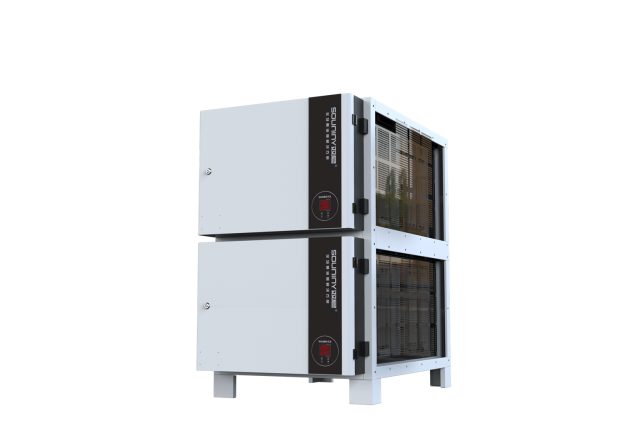
The most underused lever in duct compliance is arithmetic: the duct’s contamination rate equals what escapes capture and filtration, so anything that improves either stage stretches the interval and shrinks every bill that follows it. Correct face velocity and hood geometry improve capture; a proper baffle bank with drained gutters takes out the coarse droplets; and a purification stage inside the train removes the sub-micron fraction that baffle separators miss before it can deposit downstream. Where a full duct run exists, the ducted ESP purifier range sits exactly at this point in the system — an electrostatic stage sized to the duty, with a matching fan, stripping grease aerosol upstream of the most inaccessible duct sections. The cleaning rhythm of the purification stage itself can be automated: a Self-cleaning ESP washes its own collector cells on schedule, replacing the highest-frequency manual task in the train with a machine cycle and a log entry.
Where the duct itself is the problem — a legacy run that cannot be inspected, panels that cannot legally be cut, a landlord who will not open the ceiling — the strategic answer is to remove the duct from the equation. Recirculating ductless hoods purify at the canopy and return air to the room: no duct to clean, no access panels to cut, and a compliance file that lives in the unit’s own maintenance log. Souniny’s ductless range hood family takes this path, and for heavy wok or charcoal duty a ND-series all-in-one unit pairs multi-stage electrostatic filtration with a carbon odour stage over the cookline itself. For venues with no fixed cookline at all — market stalls, pop-ups, live stations — mobile food carts carry ventless capture wherever cooking happens, and never generate a duct to inspect in the first place.
Whichever path a kitchen takes, the compliance triad is the same: an interval set by measured contamination rather than wishful thinking, upstream capture and filtration that slow the deposits to a manageable rate, and records that prove both. Get those three right and duct cleaning stops being an emergency and becomes what it should have been all along — a scheduled, priced, boring line on the maintenance calendar.