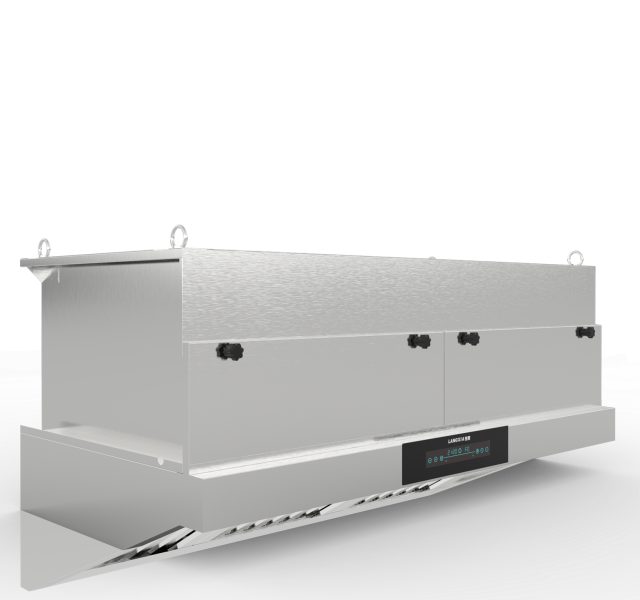
A Greek taverna runs five kitchens inside one room. A vertical gyros spit turns in front of an open charcoal or gas radiant, a souvlaki grill lays pork skewers over live coals, a moussaka oven holds a stack of béchamel-topped casseroles, a spanakopita station bakes trays of spinach-and-feta filo, and a keftedakia fryer cycles meatballs through hot oil. Above all of this, a single passive mesh hood will not keep up; the brigade and the customers share the same air, and the oregano, thyme, olive oil, and charcoal smoke signature of Hellenic cooking is one of the strongest in any cuisine. This guide walks operators through the pollutant profile of Greek taverna cooking, the ductless equipment strategy that fits Plaka heritage buildings, Astoria storefronts, and Melbourne diaspora kitchens, and how to combine the N-series, ND-series, Odor Removal Tower, Cabinet Purifier, and the broader Ductless Range Hoods category into a configuration that captures grease-laden vapor, sub-micron particulate, and spice aerosols without sending a kilogram of charcoal smoke into the dining room.
Why Hellenic Kitchens Are a Special Ventilation Challenge
Hellenic cooking is not one cooking method; it is five happening in parallel inside a small footprint. The same brigade that grills pork souvlaki over charcoal at 11:30 will lay down a tray of moussaka at 11:35, fry keftedakia meatballs at 11:40, and bake spanakopita at 11:45 — all within three meters of one another. Every one of these stations releases a different pollutant, and a single-piece Electrostatic Precipitator or a passive baffle filter is rarely sized for all of them at the same time.
Two architectural pressures make the challenge harder. First, the majority of Greek tavernas — in Plaka, Thessaloniki, the islands, and the diaspora neighborhoods of Astoria, Queens; Tarpon Springs, Florida; and Lonsdale Street, Melbourne — sit inside a building with no roof chase or shared wall vent path. The kitchen is often a back room of a converted house, a basement, or a heritage-listed stone building where drilling through load-bearing masonry for a duct run is not permitted. Second, the Mediterranean climate makes the operator unwilling to bring in 1500 m³/h of hot outside air to balance a traditional exhaust hood. A ductless, recirculating purification architecture is not a luxury in this geography; it is the only architecture that fits the building envelope.
Industry standards still apply. EN 16282 parts 1 through 9 cover extraction and pollution control for commercial kitchens across the EU and are the baseline for any venue operating inside Greece, Cyprus, or the Hellenic diaspora in the EU. NFPA 96 in the United States, and UL 710B for recirculating systems, govern the grease fire and cleanability requirements that every packaged purifier has to meet. ASHRAE 154 supplies the make-up air and exhaust balance logic on which any ductless layout has to be calculated.
The Pollutant Profile of Souvlaki, Gyros, Moussaka, and Spanakopita
Before specifying equipment, it helps to inventory what each Hellenic station actually releases, because the capture problem for a slow-baked moussaka is not the same as the capture problem for a charcoal souvlaki grill.
Souvlaki and Charcoal Skewer Stations
Souvlaki is pork, chicken, or lamb skewered on a flat metal pin and grilled over an open charcoal or olive-pit fire. The release is grease-laden vapor, sub-micron particulate, polycyclic aromatic hydrocarbons (PAHs), and visible smoke with a strong oregano-and-lemon aerosol signature. The aerodynamic capture problem is harder because the contaminant plume is buoyant and travels straight upward into the customer’s eye line if the kitchen is open to the dining room. A ductless equipment layout will not work here with a passive baffle filter; it requires a packaged purifier that integrates mechanical extraction with electrostatic collection. The Souniny ND-series heavy-duty ductless Range Hood is the system that fits both the heritage wall constraint and the operator’s need to keep the dining room appetizing.
Gyros and Vertical Rotisserie Stations
The gyros spit is a vertical cone of pork, chicken, or a mixed loaf pressed around a vertical rotisserie, trimmed continuously in front of a gas radiant or electric element. The release is sustained medium- to heavy-oil fume with rendered fat aerosol, spice aerosols (paprika, oregano, cumin), and a continuous release of grease-laden vapor. A hood above the spit needs to capture both the rising thermal plume and the trimmings aerosol released horizontally as the chef cuts. The ND-series all-in-one ductless hood sized for heavy-oil fume is the right fit, paired with a downstream Odor Removal Tower for the residual charcoal-and-paprika aroma.
Moussaka, Pastitsio, and Oven-Baked Casserole Stations
Moussaka and pastitsio are layered casseroles baked in deep hotel pans. The dominant emissions are steam from the béchamel and tomato sauces, a fine aerosol of olive oil and cinnamon, and a low but sustained release of grease-laden vapor from the lamb or beef layer. Because the oven contains most of the aerosol, the cooking area can run on an under-counter or ceiling-mounted N-series ductless Range Hood if the oven is at full line capacity. The N-series is engineered for sustained light- to medium-oil fume, which describes the cumulative output of two to four casseroles running a two-hour dinner service.
Spanakopita, Tiropita, and Filo Pastry Stations
Spanakopita (spinach and feta) and tiropita (cheese) are baked in large rectangular trays. The release is butter aerosol from the filo layers, steam from the spinach or cheese filling, and a fine aerosol of egg and olive oil. The N-series again is the right match; pair it with a Cabinet Purifier mounted above the pastry station if the ceiling clearance is tight or the operator wants the unit integrated into the millwork.
Keftedakia, Fried Calamari, and Dolmades Stations
Keftedakia (Greek meatballs), fried calamari, and the occasional loukoumades (honey doughnuts) release medium- to heavy-oil fume from deep frying, plus aerosolized breadcrumb and flour particulate. A Commercial Range Hood or ductless range hood with an ESP (Electrostatic Precipitator) cell from the N-series handles the grease fraction; the spice and olive oil odor benefits from the post-filtration Odor Removal Tower which uses activated carbon to absorb the residual oregano, thyme, and lemon carry.
Tzatziki, Meze, and Cold Prep Stations
The tzatziki, tirokafteri, hummus, and dolmades stations release little oil fume; the dominant pollutant is garlic aerosol and a fine cucumber-water vapor. A passive mesh filter is usually adequate, but the N-series sized for the line still recaptures any cross-contaminated air from the cooking stations, so the meze prep area does not absorb the souvlaki aroma into the cold dishes.
A practical rule of thumb: any Hellenic kitchen that operates a charcoal or wood fire indoors for more than 30 minutes per service hour should plan for at least one ND-series heavy-duty ductless hood plus an Odor Removal Tower, even if the rest of the line is N-series. The charcoal souvlaki grill alone will saturate a passive mesh filter within a single service.
Why Ductless Architecture Fits Hellenic Building Stock
Three building types dominate the geography, and all three have weak duct routing options:
Plaka and Island Heritage Venues. Walls are stone masonry or hand-laid brick with no insulation cavity; running ductwork through them is structurally risky and frequently disallowed by heritage authorities. A ductless hood that purifies and recirculates the air inside the cooking room removes the need for any external penetration.
Astoria and Tarpon Springs Storefronts. Where a Greek restaurant occupies a narrow ground-floor unit, the kitchen usually sits beneath a residential floor or a neighboring restaurant. Building codes in New York City, Tarpon Springs, and other diaspora hubs require either a fire-rated enclosed duct up to roof level or a UL 710B-style ductless recirculating hood. The ductless architecture is faster to permit because there is no riser to design.
Melbourne, Toronto, and Montreal Diaspora Malls. Greek counters inside a hotel buffet line, an airport food court, or a suburban mall have no chase access. A packaged ventless hood with a built-in blower and a filter pack (ESP cell plus activated carbon) plugs into a standard power socket and meets the local authority’s smoke and grease requirements.
The consistent thread is the absence of a duct path. The Souniny Ductless Range Hoods category, which includes both the N-series light-fume unit and the ND-series heavy-fume all-in-one, was designed around exactly this constraint. Each unit combines a centrifugal blower, multi-stage filtration (baffle pre-filter, ESP cell, optional activated carbon), and a clean-air recirculation grille. There is no external wall penetration, and the smoke that would otherwise exit a ducted kitchen is instead captured as sub-micron particulate on aluminum collector plates that the operator can remove and wash in a commercial dishwasher.
Product Mix: The Hellenic Ductless Configuration
A typical Hellenic service covers five to seven cooking stations, each with its own emission profile. The ductless configuration below is the one we recommend for full-menu Greek taverna restaurants from Athens to Astoria:
N-series Light- and Medium-Duty All-in-One (Above the Moussaka, Spanakopita, and Meze Line)
The N-series ductless Range Hood is sized for cumulative light- to medium-oil fume. Above a bank of moussaka and pastitsio casseroles, a spanakopita oven, a keftedakia fryer, and a tzatziki cold prep line, the N-series replaces the passive mesh filter with a true ESP cell plus a baffled pre-filter, retaining cooking aromas inside the hood rather than exhausting them. It also pairs cleanly with a Cabinet Purifier when the ceiling is too low for a ceiling-mounted hood or when the operator wants a back-of-house unit that integrates into the millwork.
ND-series Heavy-Duty All-in-One (Above the Souvlaki Grill and Gyros Spit)
The ND-series ductless Range Hood is the heavy-fume flagship. It is designed for sustained heavy-oil fume and visible smoke; the souvlaki charcoal grill, the gyros vertical rotisserie, and any lamb chops or bifteki station should sit directly underneath an ND-series hood. Because the ND-series is ductless, no wall penetration is required, and the discharge is recirculated back into the room as clean, grease-free air. The unit runs on standard three-phase or single-phase power depending on the size class.
Odor Removal Tower (After-Filtration Stage)
The Odor Removal Tower is the activated-carbon polishing stage that captures the spice, charcoal, and grill aromas that escape electrostatic capture. In a Hellenic kitchen, the carbon stage is not optional; oregano, thyme, lemon, and charcoal smoke have a strong enough odor profile to be noticeable in a customer dining room after one hour of service. The Tower sits in line with the ND-series or in a fan-powered recirculation loop with the N-series. Its modular cells are drop-in replaceable, so the operator does not need a service technician for routine carbon swap.
Cabinet Purifier (For Tight Spaces, Satellite Lines, and Meze Prep)
The Cabinet Purifier is the right unit for low-clearance applications: a Plaka basement, a mall kiosk, a hotel buffet satellite kitchen, a catering prep room, and a meze cold-prep line. It is ductless, free-standing, and uses the same ESP cell technology as the N-series, scaled to a smaller air movement footprint. Mount it above the tzatziki prep table, the dolmades rolling station, or the pastry finish line and it will capture the grease without dominating the kitchen visually.
Centrifugal Fan (Where Duct Routing Is Finally Possible)
For the rare Hellenic venue where a duct chase actually exists (a new-build hotel, an airport concession, a supermarket hot line, a large diaspora restaurant in a custom-built building), the ducted variant pairs an ND-series or N-series hood with a roof- or wall-mounted centrifugal fan. This is the architecture that meets the strictest NFPA 96 or EN 16282 compliance regime. The advantage of a packaged fan is that it can also feed an ESP Purifier downstream of the hood for sites that want a third filtration stage before the discharge stack.
Site Integration: From a Plaka Taverna to Melbourne Lonsdale Street
Once the equipment mix is defined, the ductless architecture has to be coordinated with the building’s available service connections, fire suppression, and make-up air.
For a Plaka taverna, the typical constraint is a single 16 A or 32 A circuit per station. The ND-series and N-series both run on standard utility power; the Odor Removal Tower draws modest additional current at the recirculation fan and can be wired into the same panel. Where the kitchen shares a wall with a neighbor, an acoustic enclosure around the centrifugal blower of the Tower is recommended to keep the brigade noise below 65 dB(A) at the property line.
For a hotel buffet line in Athens, Mykonos, or Santorini, multiple ND-series hoods can be mounted side-by-side and recirculated into a common ceiling plenum that returns clean air through perforated diffusers in the dining room. The Cabinet Purifier is the right answer for the pastry and bread stations where the chef wants a clear visual sightline from the buffet to the kitchen.
For an Astoria, Queens, or Tarpon Springs, Florida storefront, the ductless system removes the residential-floor fire-rated duct riser requirement that the New York City Department of Buildings or the local fire marshal normally imposes. The packaged hood satisfies the recirculating path of UL 710B when installed per the manufacturer’s instructions and re-validated annually.
For a Melbourne Lonsdale Street or Toronto Danforth Avenue diaspora restaurant, the ductless architecture combined with the Odor Removal Tower keeps the air discharge circulated and locally treated, preventing the cross-contamination of adjacent Greek, Italian, or Middle Eastern restaurants in the same block.
For an airport or train station operator, the kitchen serves passengers transiting from gate to gate; air quality complaints from neighboring tenants are not tolerated. The ductless architecture combined with the Odor Removal Tower keeps the air discharge circulated and locally treated, preventing the cross-contamination of adjacent food stands.
Standards, Compliance, and the Case for Ductless Under EN 16282 and UL 710B
Hellenic operators serving the EU market should validate three things. First, the exhaust and purification equipment should carry a documented performance curve against EN 16282 parts 1 through 9, including capture and containment tests. The Souniny N-series and ND-series have been independently validated against EN 16282 capture requirements.
Second, where the ductless hood recirculates back into the room, the clean-air discharge should meet the recirculation path of UL 710B, which sets limits on grease emission from the clean-air side of a packaged hood. The Souniny packaged ductless range hood line has been third-party tested to UL 710B, with documented clean-air grease emission below the published limits.
Third, in the United States, NFPA 96 still governs fire suppression in the kitchen exhaust stream, even when the hood itself is ductless. The ductless architecture does not exempt an operator from the standard; it just moves the fire suppression architecture to the hood body and the ESP cell rather than a duct riser. A wet chemical fire suppression bottle mounted over each ND-series hood is the typical configuration for a souvlaki grill.
In Greece and Cyprus, the local authority is the municipality, and requirements vary. We have installed Souniny ductless systems in Athens, Thessaloniki, Heraklion, and Limassol where the authority approval was based on the equivalent of EN 16282 plus a local civil defense fire signoff. The packaged nature of the equipment, with documentation bundled, accelerates approval.
Operational Practices for a Hellenic Ductless Kitchen
Even the best engineered hood underperforms if it is not maintained. The following are the operational practices we recommend for a Greek taverna running the ductless configuration above:
Daily: Wipe the baffle pre-filter of each ND-series and N-series hood with a degreasing cloth. Inspect the Cabinet Purifier’s pre-filter for oil buildup. Replace the drip trays on the souvlaki and gyros stations.
Weekly: Remove the ESP cell from each hood (the cells are drop-out, no tools required) and rinse it in a commercial dishwasher at 55 °C with low-alkaline detergent. Reinstall once fully dry. Check the Odor Removal Tower’s pre-filter for grease carry.
Monthly: Inspect the activated carbon cells in the Odor Removal Tower; replace when the differential pressure rises above 250 Pa or when the dining room starts to notice a return of oregano or charcoal odor. Inspect the centrifugal blower’s bearing on the same interval.
Quarterly: Validate the clean-air side of each hood against UL 710B standards using the in-room sensor if available, or with a periodic third-party audit. The odor control on the Tower is the prime indicator; when carbon is past its useful life, the dining room will smell the oregano and the charcoal.
Annually: Schedule a Souniny technician visit (or in-house, if trained) for a full hood audit: ESP cell condition, blower current draw, carbon pressure drop, control board firmware (if the hood is IoT-equipped for central monitoring).
Common Hellenic Misconfigurations and How to Avoid Them
Using the N-series above a charcoal souvlaki grill. The N-series is rated for light- to medium-oil fume; a souvlaki grill over live coals releases heavy-oil grease-laden vapor with sustained sub-micron particulate. The N-series ESP cell will saturate within weeks and the carbon stage will lose effectiveness long before its design life. Use the ND-series heavy-duty ductless unit for the souvlaki and gyros stations.
Skipping the Odor Removal Tower on the reasoning that “the air is going outside.” In a Plaka taverna or an Astoria storefront, the air is recirculating into the customer’s dining room, not going outside. The activated carbon stage is what removes the oregano, thyme, and charcoal smoke. Skip the Tower and the dining room will smell like a charcoal grill within an hour of service.
Mounting the Cabinet Purifier on the wrong wall. The centrifugal blower’s intake should pull across, not against, the thermal plume. Mount the unit where the convection column of the cookline flows naturally into the intake, not against it.
Sharing a single hood between a souvlaki grill and a spanakopita station. A spanakopita or baklava station releases butter and sugar aerosols that clog an ESP cell faster than grease. Keep the ESP cell dedicated to the heavy-fume station and use a passive mesh filter plus a ducted carbon stage for the pastry line.
Choosing the Right Configuration
A Hellenic operator has three primary configurations to consider:
Configuration A — Ductless, full line. ND-series above souvlaki and gyros, N-series above moussaka, spanakopita, and meze, Odor Removal Tower in series with the heavy station, Cabinet Purifier above any satellite line. Recommended for Plaka heritage, Astoria storefront, hotel buffet, food court, and mall kiosk venues without a usable duct chase.
Configuration B — Hybrid. ND-series above souvlaki and any charcoal or wood station, plus a ducted centrifugal fan and exhaust riser for the heavy line only. The remaining stations stay on the N-series plus Cabinet Purifier, recirculating locally. Recommended for venues where a partial duct chase exists or where the local authority prefers a hybrid architecture.
Configuration C — Ducted heavy, ductless light. Centrifugal fan + ESP Purifier in a full ducted riser for the souvlaki grill and high-volume stations, N-series recirculating hoods above the lower-heat stations. Recommended for new-build hotel kitchens, airport concessions, and large-scale central production kitchens that handle Hellenic volume cooking.
The Hellenic taverna’s signature is the simultaneous use of open charcoal, vertical rotisserie, slow bake, deep fry, and cold prep. The cooking line is unusually dense, and the building envelope is unusually constrained. A ductless, packaged purification architecture — with the ND-series heavy-duty all-in-one at the heavy stations, the N-series all-in-one across the rest of the line, the Odor Removal Tower as the carbon finishing stage, and the Cabinet Purifier for tight or satellite applications — captures grease-laden vapor, sub-micron particulate, and spice aerosols without drilling a single hole through the wall.