Opening a restaurant inside a heritage-listed building is one of the most rewarding — and most constrained — projects a hospitality operator can attempt. The architecture is characterful, the location is often prime, and the story sells itself. But the moment the kitchen design hits the ventilation chapter, a hard wall appears: conservation officers will not permit a steel duct to punch through a protected facade, nor a rooftop exhaust plume above a listed roofscape. For decades this meant heritage sites simply could not host a serious kitchen. The ductless all-in-one range hood changes that equation entirely — recirculating cleaned air with no external discharge, no roof penetration, and no structural alteration.
Why Heritage Buildings Break the Conventional Ventilation Model
A standard commercial kitchen exhaust system is built around removal. Grease-laden vapor and cooking odors are captured at the Commercial Range Hood, pushed through metres of galvanised duct, and ejected to the outside world via a fan on the roof or an external wall. That model assumes you are free to modify the building envelope. A heritage asset does not grant that freedom.
In a listed townhouse, a converted warehouse, a former bank, a mill, a church hall, or a protected courtyard building, the constraints are consistent across jurisdictions: no penetration of the historic roof; no visible duct runs across a protected elevation; no alteration of original masonry, timber, or glazing; and often a requirement that any intervention be fully reversible at lease end. Conventional make-up air and ducted extraction collide head-on with every one of those conditions. The result is a planning risk that can stall an opening by months or kill it outright.
The constraint is almost never “you cannot cook.” It is “you cannot discharge to the exterior.” That single distinction is what makes a recirculating, ductless system the compliant answer rather than a compromise.
How a Ductless All-in-One System Actually Works
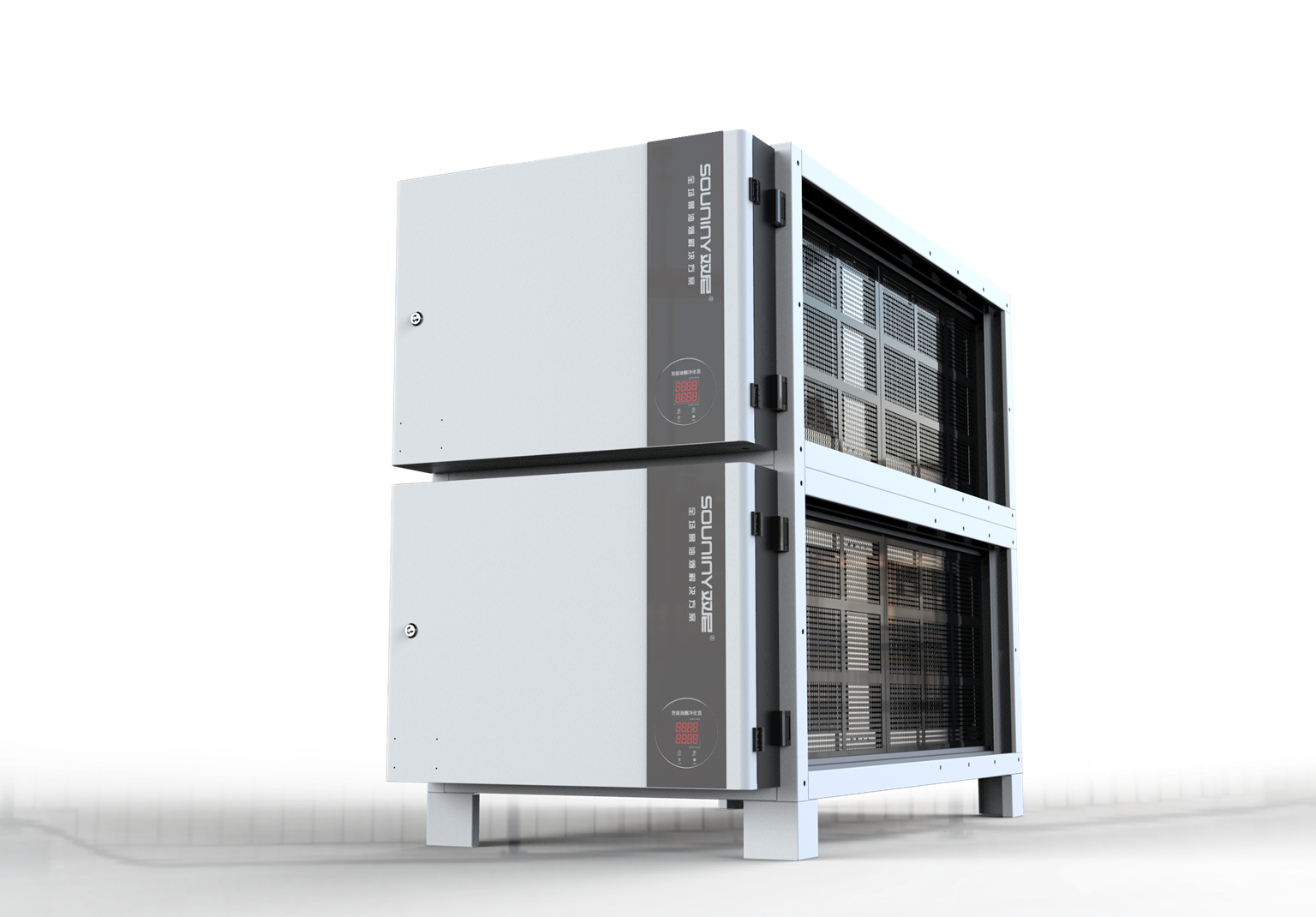
The principle behind a ductless range hood is multiple purification without piping. Instead of transporting contaminated air away from the building, the unit treats it on the spot and returns clean air to the same room. A well-engineered ductless all-in-one runs the captured airstream through a staged cascade:
- Metal grease filtration — the first stage intercepts the bulk of the grease-laden vapor and larger aerosols before they reach the sensitive components downstream.
- Stainless steel electrostatic precipitator (ESP) — a high-voltage electric field charges and collects sub-micron particulate, the fine smoke fraction that ordinary filters miss and that causes the lingering haze and film on surfaces.
- Deodorizing stage (除味箱 / Odor Removal Tower) — activated-carbon and self-developed deodorizing technology break down volatile organic compounds (VOCs) and cooking odors, not just the grease, so the air returned to the room smells neutral.
Because there is no duct to the outside, there is no roof cowl, no wall louver, and no plume. The building envelope stays intact, and the system can be installed, serviced, and eventually removed without trace.
N-series: The Light Oil-Fume All-in-One
For venues where the cooking load is moderate — a heritage café, a tearoom, a wine-bar kitchen, a breakfast and light-lunch operation, or a gallery restaurant with a short, delicate menu — the N-series (轻油烟一体机, light oil-fume all-in-one) is the natural fit. It delivers the full grease-and-odor cascade in a compact, comparatively quiet footprint, which matters in older buildings where the kitchen may sit close to dining rooms or thin-walled function spaces.
The N-series is designed for the realities of a protected site: lower ceiling heights, tighter back-of-house footprints, and a preference for discreet stainless-steel finishes that do not fight the period interior. Operators get compliant air quality without sacrificing the very character that made the building worth opening in the first place.
ND-series: Heavy Oil-Fume Capability Without the Duct
Not every heritage kitchen is gentle. A converted banking hall serving a full à la carte menu, a restored mill with a fryer line, or a historic coaching inn running grills and woks all generate a heavy oil-fume load. This is exactly where the ND-series (重油烟一体机, heavy oil-fume all-in-one) earns its place. Built for higher capture and a more aggressive purification cascade, the ND-series keeps a full-production kitchen clean and odor-neutral while remaining fully ductless.
The key point for specifiers is that “ductless” no longer means “low capability.” The ND-series closes the gap that once forced heritage operators to either dumb down their menu or abandon the building. Heavy frying, charbroiling, and high-heat sautéing are all on the table.
The Odor Removal Box: Closing the Smell Gap
Grease capture alone has never been enough in a customer-facing heritage venue, where the smallest odor drift into a dining room or a neighbouring tenancy becomes a complaint. Pairing the N-series or ND-series with the 除味箱 / Odor Removal Tower is what turns a filtration unit into a genuine ventilation solution. The tower’s activated-carbon and self-developed deodorizing technology target the VOC and odor fraction that grease filters ignore, so the recirculated air is not merely “less greasy” but genuinely neutral.
This pairing is also what protects the building itself. In heritage sites that double as museums, galleries, or libraries — or that sit beside them — accumulated cooking film is a known threat to artifacts, bindings, and finishes. Removing odor and sub-micron particulate at source is an asset-protection measure, not just a comfort one.
Fitting a System Into Tight, Protected Spaces
Older buildings rarely offer the generous ceiling voids of a modern shell. Low beams, shallow soffits, and awkwardly shaped sculleries are the norm. Beyond the N-series and ND-series, the broader Ductless Range Hoods line includes options such as the Cabinet Purifier for compact, furniture-integrated installs, letting the ventilation disappear into millwork rather than dominate the room.
The design discipline is the same as the conservation discipline: intervene as little as possible, and make what you add easy to undo. A ductless unit mounted to existing structure, fed from local power, and returned to the room needs none of the chases, risers, and roof penetrations that a ducted scheme demands.
Standards, Compliance, and Conservation Consent
A ductless approach does not exempt an operator from air-quality or fire-safety duties — it meets them differently. Relevant references include EN 16282 (food-premises ventilation in the EU), NFPA 96 (US commercial kitchen fire and exhaust standards, applied to the equipment and any connected make-up air), ASHRAE 154 and the IMC for design guidance, and AS 1668.2 in Australia. The practical advantage is that with no exterior discharge, there is no facade or roof element for a conservation authority to object to, which materially simplifies the consent conversation.
Where a heritage building already contains historic ductwork from a previous use, a ducted route may still be viable — in which case the ESP Purifiers line paired with a Centrifugal Fan becomes the appropriate core. But for the majority of protected sites with no existing route, ductless is both the faster and the safer consent path.
Reversible Installation and Lifecycle
Because the system makes no structural penetration, installation is straightforward and reversible — a decisive advantage for tenanted heritage properties where the landlord expects the building returned in its original state. Servicing follows the same logic as any electrostatic system: the stainless-steel collector cells are accessible, washable, and reinstated without special tooling. Scheduled cleaning keeps capture efficiency high and prevents the gradual buildup that degrades both air quality and component life.
Operators should treat the cleaning cadence as a function of cooking intensity — a heavy ND-series line warrants a tighter schedule than a light N-series café — and document it. That record is useful both for internal hygiene assurance and for demonstrating duty-of-care to a conservation or environmental body if ever questioned.
Choosing the Right Ductless Configuration
The selection logic is simple once the building constraint is accepted. Light cooking in a protected shell → N-series with an Odor Removal Tower. Full production cooking in the same shell → ND-series with the same tower. Tight or furniture-bound spaces → add a Cabinet Purifier from the ductless line. Existing historic duct available → ESP Purifiers plus Centrifugal Fan. In every case the goal is identical: compliant, odor-neutral, fire-aware kitchen air, achieved without touching the building’s protected fabric.
Heritage buildings are among the most demanding ventilation briefs in the industry, but they are no longer out of reach. With a ductless all-in-one strategy, a protected historic site can host a serious, profitable kitchen — and still look exactly as it did the day the conservation officer first signed off.