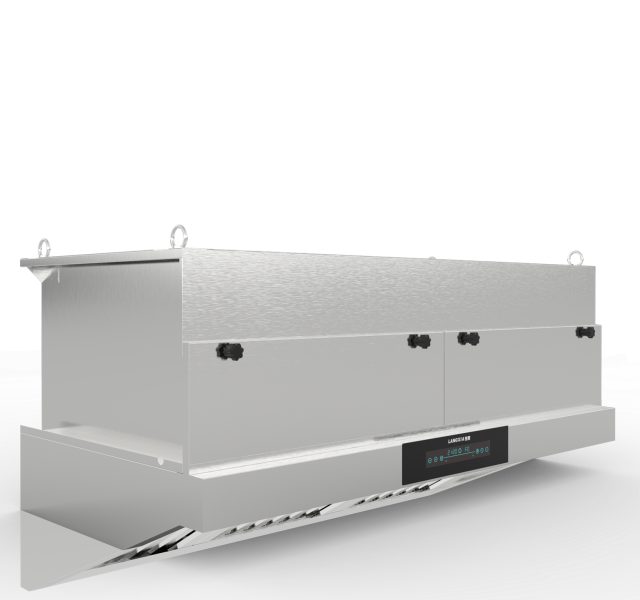
The question arrives almost daily from a particular kind of cook — not a restaurateur, but someone at home who cooks seriously. A condominium owner who fires up a wok three nights a week in an open-plan living room. A homeowner who installed an indoor teppanyaki plate and discovered what searing does to a ceiling. A family whose weekend fried chicken and biryani sessions leave a grease film on the cabinets by Wednesday and a faint curry note in the bedroom by Friday. Domestic cooker hoods were never designed for this duty, and property rules, domestic power, and shared walls rule out most commercial answers. This guide is the decision map for that situation: why domestic hoods fail against real cooking, what a home can actually install, how recirculating ductless purification works inside a living space, and how to choose between the Household Series, Little Prince Series, and the commercial-grade N-series and ND-series.
Why Domestic Cooker Hoods Fail Against Real Cooking
A domestic cooker hood is engineered around an assumption: that home cooking is light duty. Small axial or centrifugal fans, low static pressure, a thin mesh grease filter, and — in the recirculating versions that most apartments depend on — a small cassette of carbon-impregnated foam or a handful of charcoal pellets. That architecture handles pasta water and Sunday pancakes. It meets serious cooking the way a household vacuum meets a workshop.
The failure shows up in three places. First, capture: a domestic hood moves too little air to control a real plume, so grease-laden vapor escapes the catch zone before the hood can pull it in — this is why the ceiling and the tops of cabinets get sticky even in homes that always use the hood. Second, filtration: a mesh filter traps only large droplets, while the sub-micron particulate and odor-carrying volatile organic compounds that make cooking smell travel straight through; the token carbon cassette saturates within weeks of heavy frying and then does nothing at all. Third, noise: small fans pushed to their limit to compensate for weak capture get loud, and loud hoods in open-plan homes get switched off — which returns the problem to the living room.
Meanwhile the pressure on home kitchens is rising, not falling. Open-plan layouts removed the door that used to close the kitchen off from the rest of the home. High-rise apartments removed the external wall a duct could pass through. And home cooking has become more ambitious, not less — wok banquets, indoor grills, deep-fried weekend menus, Korean tabletop sessions. The gap between what the kitchen does and what its ventilation handles has widened into one of the most common air-quality complaints in residential buildings.
What a Home Can Actually Install: The Four Constraints
Before choosing any product, a homeowner needs to know the fence lines. Residential kitchens differ from commercial ones not because the cooking is easier but because the installation options are few, and four constraints define almost every home project.
No duct rights. In a condominium or managed apartment, the facade belongs to the building, the riser belongs to everyone, and the corridor belongs to the fire code. Penetrating an external wall, tapping a shared exhaust shaft, or simply discharging toward a neighbor’s window is usually prohibited — and in rented homes, usually impossible. This single constraint eliminates the classic commercial answer of a ducted hood with an inline fan and pushes the whole residential market toward recirculating systems.
Domestic power. A home kitchen offers a ordinary socket on a lighting or socket circuit — 13 A in most of the world, 120 V circuits in North America — not the three-phase supply a commercial extraction plant assumes. Any home solution must run on that supply, start without tripping it, and ideally shut off politely when the circuit is shared with other appliances.
Noise and proximity. In an open plan, the hood sits a few meters from the sofa and, in apartments, a shared wall away from the neighbors. A system that howls at boost speed is a system that does not get used at dinner time. Noise is not a comfort detail in a home — it is the difference between a purification habit and a decorative object.
Non-professional maintenance. No commercial kitchen cleaning contractor visits a private apartment. Whatever is installed must be serviceable by the homeowner: filters that come out by hand, cells that wash in the sink, and carbon stages that swap without tools. Maintenance design decides whether the system still performs in year two.
Put the four constraints together and the shape of the answer is fixed before any brand is chosen: recirculating, plug-friendly, quiet, and homeowner-serviceable, with capture and filtration genuinely sized for cooking rather than for a showroom.
Why Recirculating Ductless Purification Is the Residential Answer
A modern ductless purification hood treats the air in stages instead of throwing it away, and each stage maps to one of the failures listed above.
The first stage is mechanical: a baffle pre-filter forces the grease-laden vapor to change direction repeatedly, dropping the heavy droplets out of the airstream into a washable tray. Unlike a thin mesh, a baffle presents real surface and real mass to the plume, and it goes in the dishwasher.
The second stage is electrostatic. An ESP — electrostatic precipitator — cell charges the remaining fine particles as they pass a high-voltage field and collects them on oppositely charged plates. This matters at home for two reasons. It catches the sub-micron fraction that mesh and even some disposable filters miss, which is the fraction that carries smell and deposits as that fine greasy dust on walls and electronics. And it does so at very low airflow resistance, which means the fan does not have to fight the filter — which is precisely what keeps a purifying hood quiet enough to run during dinner.
The third stage is adsorption: activated carbon, which takes the odor molecules and VOCs that no mechanical stage can hold. In a dedicated finishing unit such as the Odor Removal Tower, the carbon volume is sized as a real consumable with a replacement rhythm, not as the afterthought cassette inside a domestic hood that dies in a month.
Recirculation itself is a feature, not a compromise, in a residential building. Nothing penetrates the facade, so strata and landlord objections largely disappear. Nothing is dumped into a shared riser, so the building’s fire risk from grease-lined ducts is removed rather than added to. And in winter or in air-conditioned homes, the heat the kitchen generates stays inside instead of being exhausted and repurchased by the HVAC system — one of the quiet reasons ductless purification has spread so fast through high-rise residential markets.
One honest engineering note: recirculating purification removes grease, smoke particles, and odor; it does not remove heat or steam. A home that simmers stock for six hours still needs a window or general ventilation for comfort and humidity, and homes with gas cooking must always retain some general ventilation for combustion byproducts. Purification replaces the duct, not common sense.
Matching the Series to the Home
With the architecture settled, the selection question becomes concrete: which unit, for which kitchen, at which duty. The Souniny residential-relevant range splits along fume weight and space, and the choice is easier than it looks once the cooking is honestly assessed.
Household Series. This is the purpose-built home line: units sized and finished for domestic kitchens, running on ordinary household power, with the acoustic profile a living space demands. It is the default answer for the everyday serious home cook — the three-nights-a-week wok, the weekend deep-frying — in an apartment or condo where a commercial appliance would be overkill in noise and underkill in nothing. Capture and filtration are designed around real frying and stir-frying duty, not showroom steam.
Little Prince Series. The compact entry point. It takes an ESP-only approach — no HEPA stage — which keeps it small, quiet, and affordable, and suits enclosed smaller kitchens where the cooking is medium-duty: pan frying, grilling on an electric plate, weekday stir-fries. For very small apartments and starter homes it is the least invasive way to get genuine electrostatic purification rather than a token carbon cassette. (A dedicated compact model for tiny kitchens, the KL-D-B9, is covered separately in its own guide.)
N-series. The light oil-fume all-in-one from the commercial ductless line. Choose it when the kitchen is open to the living space and the cooking is light-to-medium — steaming, baking, teppanyaki-style plates, light stir-fry — but the owner wants commercial-grade capture and a washable ESP cell rather than anything domestic. It is also the natural choice for the open-kitchen home that entertains: the unit looks after the living room because it was built for front-of-house duty.
ND-series. The heavy oil-fume all-in-one. This is for the home that cooks like a small restaurant: wok hei pursued seriously, indoor charcoal or Korean BBQ sessions, banquet weekends. Where the house — rather than a condo — gives room for a full-width unit and the cooking is genuinely heavy, the ND-series brings restaurant-class capture and purification into a residential shell without needing a duct, a riser, or a building permit.
Two boundary notes. If a private house does have duct rights and a heavy, high-volume cooking habit, a ducted train — capture hood, inline ESP Purifier, Centrifugal Fan — remains a legitimate option and is covered in the commercial guides. And for patio, poolside, or courtyard home entertainment cooking, a ventless cart such as the CV-A moves the whole problem outdoors-with-equipment: its own capture, purification, and worktop, rolling out for the weekend and back into the garage.
Sizing a Home Kitchen Without the Guesswork
Commercial sizing arithmetic can be borrowed, but it must be scaled honestly. The planning baselines used in restaurant work — roughly 2,000 m³/h of airflow per meter of hood for enclosed heavy-duty cooking, on the order of 4,000 m³/h per burner, and near 6,000 m³/h total for a light-fume line — describe continuous commercial service. A home kitchen cooks in short, intense bursts with recovery time between them, and a domestic circuit sets a ceiling on what the fan may draw.
In practice, three measurements decide most home selections. First, width: the hood should cover the cooktop with an overhang of roughly 100 mm on each side, because a plume that escapes the footprint sideways is a plume no amount of airflow will chase back. A 90 cm domestic hob wants a hood at or beyond a meter. Second, duty: count what actually fries, sears, and woks. One serious wok burner with weekend frying sits comfortably in Household Series or Little Prince territory; a two-burner heavy line with an indoor grill pushes toward the ND-series. Third, room: an open-plan space means the hood competes with the whole living volume, so capture efficiency and carbon finishing matter more than raw numbers — and ceiling height above the cooktop changes which units physically fit.
These figures are planning aids for narrowing a choice, not a substitute for specification: the final unit should match the actual cooktop fuel, the appliance duty, and the room geometry — and when in doubt, send the kitchen’s dimensions and menu to the manufacturer before ordering.
Run-the-hood discipline matters more at home than in a restaurant, because no one is shouting about it. Start the unit a few minutes before the first pan and let it run ten to fifteen minutes after the last one; the after-run clears the plume tail that lingers at head height and is what actually drifts into bedrooms. On multi-speed units, low speed during normal cooking and boost during searing keeps noise and capture in balance.
Power, Noise, and Placement
Power is the first practical check. Confirm the unit’s nameplate voltage against the market — 220–240 V across most of Asia, Europe, and Australia; 120 V in North America — and plan to give the hood its own socket on a circuit that is not already fighting a kettle, an air fryer, and a microwave. Extension leads and daisy-chained power boards are the most common self-inflicted residential installation fault, and they are also the one that voids insurance narratives fastest.
Noise is managed by placement and habit as much as by specification. In an open plan, a wall-mounted hood behind the cooktop captures better and presents less of its noise to the sofa than an island unit fighting cross-draughts; if the kitchen is an island, expect to run boost more often and choose the unit for its low-speed acoustic rating, not its headline maximum. Keep clearances to the cooktop per the manufacturer’s instructions — gas cooktops demand more height than induction — and remember that a recirculating unit needs its cleaned air to have somewhere reasonable to go: not directly at a seating position and not straight up at a smoke alarm.
Smoke alarms deserve a deliberate word. Serious home cooking trips alarms — that is what the alarms are for — and disabling them is never the answer. Relocating the cooking, improving capture with a genuinely adequate hood, and where regulations allow, using heat-rise rather than ionization alarms near kitchens are the legitimate moves. An insurance-conscious homeowner documents the upgrade rather than the disconnection.
Neighbors, Building Rules, and Fire Sense
The rules that constrain home kitchens are simpler than commercial codes but stricter in one direction: never discharge into a shared or adjacent space. Exhausting a kitchen into a corridor, a stairwell, a ceiling void, or toward a neighboring window is prohibited essentially everywhere, and it is the single most common mistake in DIY kitchen ventilation. A recirculating purifying hood sidesteps the entire question — treated air stays in the home, and the building’s shared shafts stay grease-free, which is precisely why building managers increasingly prefer them in renovations.
Formal commercial standards such as NFPA 96 and EN 16282 govern commercial kitchens, and homes fall under residential mechanical codes instead. But the physics does not downgrade: grease still accumulates where vapor deposits, and the fire load in a neglected home hood — a mesh filter glazed with polymerized oil — is real. The residential answer is to keep the grease in washable, inspectable components: baffle pre-filters washed on schedule, ESP cells cleaned so plates do not glaze, and carbon stages replaced rather than run to permanence.
For condo and apartment dwellers, one more document matters: the building’s own rules on cooking appliances. Indoor charcoal, open-flame grills, and sometimes even large wok burners are restricted in certain high-rise buildings — a rule enforced far more often in Southeast Asian and Middle Eastern high-rises than newcomers expect. Checking the house rules before ordering equipment is a two-minute task that prevents an expensive mistake; and where open-flame indoor cooking is restricted, high-output induction with a heavy-duty ductless hood delivers much of the wok experience within the rules.
Maintenance the Home Way
A purification system only stays quiet and effective if its consumables are treated as consumables, and the residential rhythm is forgiving enough to keep on a calendar.
Weekly in normal use, the baffle pre-filter goes through the dishwasher or a hot degreasing soak — five minutes of attention that protects everything downstream. On its scheduled interval, the ESP cell comes out for a degreaser wash and a thorough rinse, then must dry completely before it returns to the power supply; a homeowner who cooks heavy most days should treat this as a monthly habit, and a weekend cook as a quarterly one. The carbon stage is the true consumable: heavy home cooking consumes it in months, not years, and odor creeping back while the cell looks clean is the classic signal that the carbon — not the electrostatics — is spent.
Keep the box the unit shipped in, keep a two-line log of wash and replacement dates, and buy the replacement carbon ahead of need rather than after. Souniny backs its units with a 12-month whole-unit warranty and treats the ESP cell, collector plates, sealing strips, and carbon as scheduled wear items — the same parts list a commercial operator manages, at a rhythm a household can sustain.
The Pre-Purchase Checklist
Seven questions, answered honestly, choose the unit almost by themselves.
One: what do you actually cook — and how often do you fry, sear, or wok, as opposed to boil and bake? Two: how wide is the cooktop, and is it gas, induction, or electric? Three: does the home have any duct rights at all — facade permission, riser access, or is recirculating the only architecture? Four: which circuit will the unit sit on, and what else shares it? Five: is the kitchen open to the living space or enclosed, and how high is the ceiling above the cooktop? Six: what does the household consider acceptable noise during dinner — and does anyone cook late at night within earshot of neighbors? Seven: who will wash the cell and replace the carbon, and on what realistic rhythm?
The answers map directly: light duty and open plan points to the N-series; enclosed small kitchens and starter budgets to the Little Prince Series; everyday serious home cooking to the Household Series; restaurant-grade home duty to the ND-series; and patio entertainment cooking to a ventless cart. Buyers who send these seven answers with kitchen dimensions and a photo of the cooktop get a specific recommendation from the manufacturer instead of a catalogue — and the recommendation is free.
Scenario Quick Picks
A high-rise condo in Metro Manila, open-plan, weekend wok and fried chicken sessions, facade untouchable: a Household Series unit over the cooktop with carbon finishing sized for the living volume — and induction rather than open flame if the house rules restrict it, which many Manila towers do.
A London terraced house where indoor grill nights are the weekly ritual and the listed facade rules out any new penetration: an ND-series all-in-one over the cooking zone, its ESP cell and carbon stage doing the work a duct to the roof once did.
A light-cooking open kitchen in an Australian apartment — steaming, baking, teppanyaki plates, light stir-fry — where the owner wants the living room to stay neutral: an N-series hood, run on low during service with a boost habit for searing.
A first-home enclosed kitchen on a budget: the Little Prince Series delivers genuine electrostatic purification in the smallest footprint, with the washable-cell habit established early.
The pattern across all five scenarios is the same: match the series to the honest cooking duty, let recirculating purification remove the duct question entirely, keep the grease in washable components, and treat carbon as a dated consumable. A home that does these four things cooks the way it wants, in a living space that never smells like a restaurant kitchen the morning after.