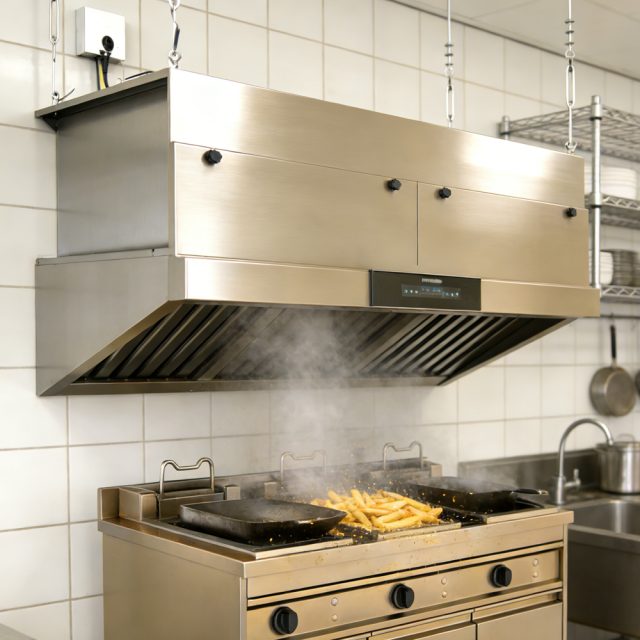
Most kitchen extraction systems are bought the way most capital equipment is bought: datasheets, a factory visit, a reference call, a signature. For a single standard installation that process is usually sufficient — the specifications are code-driven and the risk sits in execution. But when the order is a fleet — a restaurant group converting twenty sites, a hotel brand standardising across a region, a commissary feeding multiple outlets — the datasheet stops being enough. The system will run against your menu, your staff, your cleaning routine and your neighbours, none of which appear on a datasheet. A pilot trial converts the supplier’s promises into your own measurements before the fleet contract locks them in. This article is the playbook for running one properly.
What a Pilot Can Prove — and What It Cannot
A pilot trial is worth designing only after being honest about its limits, because both over-claiming and under-claiming its value produce bad decisions.
What a pilot genuinely proves
Performance against your actual menu. A pressure-fryer bank, a charcoal grill, a wok line and a steamer station produce radically different pollutant profiles — grease-laden vapor loads, sub-micron particulate, and the volatile organic compounds that drive odour complaints. No generic demo room replicates your cookline. Four weeks of real service is worth more than any laboratory curve.
Operational fit. How long the ESP cells actually take to wash in your sink bay, how fast the carbon stage saturates given your hours of operation, whether your Friday rush pushes capture beyond the hood’s design envelope, and whether your team follows the maintenance routine or ignores it. These are the questions that decide whether the fleet performs in year two, and only a pilot answers them.
A measured baseline for the fleet contract. This is the most under-used function. The pilot installation becomes the reference: the airflow you measured, the current draw the ESP stage held, the cleaning time your team logged. Those numbers convert directly into fleet acceptance criteria — which is what turns a 20-unit purchase from a leap of faith into a controlled extension of something you have already verified.
What a pilot cannot prove
Long-term reliability. Six weeks says nothing about year-three motor bearing wear or cell corrosion. Reliability evidence comes from the supplier’s installed base, not your trial — ask for reference customers with consumables purchase history, as covered in any serious supplier due diligence.
Compliance. Certification attaches to the model and the test standard — UL 710B listings, CE conformity under EN 16282 design principles, NFPA 96 installation rules — not to your site. A successful pilot does not substitute for the permits and sign-offs the fleet sites will each need.
Economics at scale. A single pilot unit carries full freight, full installation and none of the container-load efficiency. Unit economics at fleet volume are a separate calculation.
When a Trial Is Worth Its Cost — and When to Skip It
A properly run trial costs real money: freight both ways or a discounted purchase, installation labour, monitoring time, and four to six weeks of management attention. The decision rule is straightforward.
Run a pilot when: the rollout is five units or more (the measurement value amortises across the fleet); the menu is at the heavy end — charcoal grills, pressure fryers, wok stations; the site is odour-sensitive (shared extraction, residential adjacency, mall landlords with complaint-driven lease clauses); the engineering case is marginal and hinges on one claim, such as a supplier’s stated carbon replacement interval; or the organisation has been burned before and needs institutional confidence, not just contractual protection.
Skip the pilot when: the installation is a single standard unit whose selection is already code-driven; the ducted architecture is settled and the equipment is commodity-adjacent; or the kitchen timeline cannot absorb six weeks — in which case compress the discipline into a strict commissioning acceptance regime instead: airflow within ±10% of design, static pressure within ±5%, purification stages verified energised, before the retention payment releases.
The expensive failure mode is not skipping a trial on a standard install — it is running a trial informally, without a written protocol, and letting both sides read whatever they want from the result. An unstructured pilot is a demo with paperwork.
Structuring the Trial: Scope, Duration and Baseline
Scope: one cookline, not the whole kitchen
Pilot the highest-load production line in the venue — the fryer bank, the grill station — under a hood section sized to that line, not the entire kitchen. The sizing anchor stays the same as in full design: roughly 2,000 m³/h per metre of hood length for conventional lines, higher for open display cooking, with face velocity held in the 0.25–0.5 m/s band for light duty and 0.4–0.6 m/s for heavy duty. A single-line pilot produces cleaner data than a whole-kitchen trial because every change in measurement is attributable to one system, one menu and one crew.
Duration: long enough to close the loop twice
The minimum useful window is four to six weeks of continuous production service, structured to cover at least two full cleaning cycles — because the maintenance burden, not the first-day performance, is what a fleet lives with. Where the menu is seasonal, place the trial against the heaviest season; a trial run across a quiet August says nothing about a December grill programme. For a venue operating six or seven days a week, six weeks typically delivers 40+ production days — enough for a statistically meaningful ΔP trend on the filter stages and a realistic carbon saturation curve.
Baseline: measure before the unit arrives
The trial’s evidence value depends entirely on the before-and-after comparison, and the “before” is the part buyers skip. In the week prior to installation, log: odour complaints and sensory observations at the property boundary and at closing time; grease deposit condition in any existing duct or on the existing hood; the current system’s filter loading and wash frequency; cleaning labour minutes per week; and — where the landlord or authority requires it — a simple olfactometry reference. Without the baseline, the pilot can only produce impressions, and impressions do not survive a fleet tender review.
The Metrics That Decide the Trial
Agree the measurement set and the pass/fail thresholds in writing before the unit ships. A defensible core set:
1. Face velocity and capture. Measured on a grid across the filters (nine points is the practical convention), averaged and checked against the design band for the duty class. Capture is verified behaviourally during the two busiest services of the trial — plumes escaping the hood edge at peak are the capture verdict, not the datasheet.
2. ESP stage electrical stability. Log the high-voltage supply’s current draw weekly. A healthy ESP stage holds steady operating current; a rising arc count or falling current at constant cooking load indicates cell fouling outpacing the cleaning schedule — exactly the finding that changes the fleet’s maintenance plan.
3. Carbon stage saturation. Track sensory assessment at the discharge and in the dining area on a fixed schedule (same time, same assessor, same checklist), referenced against the baseline. Where the odour question is contractual, EN 13725 dynamic olfactometry on samples taken early and late in the trial brackets the removal performance objectively.
4. Filter pressure trend. Record ΔP across the pre-filter and fine stages weekly. A predictable, slow rise with a defined wash cadence is the good outcome; a steep climb means the pre-filter stage is undersized for the grease load and the fleet specification needs a larger pre-filter or more frequent service.
5. Cleaning labour. Minutes per cycle, logged by the crew, both wet-wash and wipe-down. This single number usually decides which system the operations team actually wants, and it is the number facilities managers will ask for when the fleet arrives.
6. Boundary noise. One evening measurement at the nearest sensitive boundary, since discharge noise is the most common late-stage surprise — and the cheapest thing to fix in specification rather than after installation.
7. Consumable consumption. Count every washable, every carbon refill and any chemical usage. This converts the supplier’s “consumables are economical” claim into a per-unit-per-year number that feeds the fleet’s five-year cost model directly.
Report each metric against its threshold — face velocity in band or out, ESP current stable or drifting, cleaning minutes above or below the agreed target — so the trial closes with a pass/fail table rather than a narrative.
The Commercial Terms of a Demo Unit
Trials fail commercially more often than technically, because nobody agreed who bears which cost. Settle the money before the unit ships:
Purchase models. Three structures dominate. A paid demo credited against the fleet order — the buyer owns the unit outright, the fleet contract prices it back in as the first fleet unit or as a spares donor; cleanest for both sides, and the model that keeps the buyer’s leverage intact. A loan with deposit — typically 10–20% of unit value held against return in original condition, with freight and installation costs allocated in writing; workable for short trials, but it leaves the buyer testing equipment they do not control. A discounted pilot purchase — the unit is bought outright at a modest discount and kept as a service spare or second-site unit; common when the venue genuinely needs the equipment regardless of the fleet decision.
Price validity on the fleet quote. The fleet pricing triggered by a successful trial should carry a defined validity window — 60 to 90 days is standard — so the trial result cannot be used to reopen negotiation on the very terms that made the trial worth running.
Test data ownership. The measurement report belongs to the buyer, delivered as a contractual output of the trial, in a form that can be pasted into a fleet tender. Suppliers will resist nothing here if asked early; asked late, it becomes a negotiation.
Insurance and risk. Who insures the loaned unit against fire and damage during the trial period, and who bears the risk of loss in transit — the same title-and-risk questions that govern any equipment shipment, simply applied to a smaller order.
Converting Trial Results into the Fleet Contract
The trial’s output is not a feeling of confidence; it is four documents that make the fleet order mechanically better:
Acceptance criteria. The measured face velocity band, the ESP current signature, the ΔP trend and the commissioning airflow tolerance become the fleet’s acceptance tests — every site commissioned against the numbers the pilot established, with the same ±10% airflow / ±5% pressure discipline applied per unit.
The cleaning SOP. Drafted during the trial by the crew that actually did the work: cadence, method, chemicals, responsible role, and the log sheet format. This is the document that keeps a fleet consistent, and writing it during a pilot costs nothing extra.
The spares position. Consumable consumption measured over the trial scales directly: cells, carbon refills, filters and seals per unit per year, which sizes the fleet’s central spares store and the per-site emergency kit.
Training coverage. Train two staff per site during the pilot and use them as the trainers for the rollout — institutional memory that survives staff turnover, the same discipline that governs any multi-site operation.
The Failure Modes of a Badly Run Trial
Each of these has ended real pilots with the wrong conclusion:
The missing baseline. Without the “before” measurements, the “after” is uninterpretable — the most common and most fatal omission.
Menu mismatch. A trial run on the café’s oven line tells the fleet nothing about the grill programme. Trial the heaviest line or do not trial at all.
Smell-only verdicts. Judging by casual sensory impressions at closing time, without the fixed assessor and checklist, produces decisions that reverse in week two. Odour claims deserve at minimum a structured sensory protocol — and EN 13725 olfactometry where the stakes justify it.
Indicator-light judging. A glowing ESP status LED is a power-supply indication, not a performance measurement. Weekly current logging is the actual evidence.
The perpetual trial. Trials that drift past their window serve the supplier’s showroom and delay the buyer’s decision. Fix the end date and the pass/fail table at the start, and close on schedule.
Success theater. A trial conducted with the supplier’s own technician on site daily proves their technician is diligent — not that your crew can run the system. At least half the trial period should run with your team unsupervised.
Architecture Choices and the Trial
The trial also settles architecture questions that datasheets blur. Where the roof cannot be penetrated or ducting is impossible, a ductless range hood system with a multi-stage purification train is the realistic route — and because its performance concentrates in the electrostatic and carbon stages, the trial metrics above apply to it most directly. Where a full duct run is possible and volumes are high, a ducted ESP filter arrangement inline in the ductwork competes on a different cost structure — and where the comparison is genuinely close, a trial of each architecture on adjacent production periods is a legitimate, if demanding, way to decide. And for formats with no fixed cookline at all — market stalls, pop-ups, live cooking stations — ventless catering carts follow the same trial logic at cart scale: same pollutants, same measurement set, smaller numbers.
How This Is Solved in Practice
Equipment intended for fleet duty should be specified so that a pilot can measure everything that matters. In heavy-fume ductless applications — fryers, grills, charcoal-adjacent menus — the ND-series all-in-one hood pairs the electrostatic stage with an activated-carbon odour stage sized to its own airflow, which is the architecture a heavy-line trial measures. For lighter loads — cafés, steaming and boiling lines, display cooking — the N-series carries the same multi-stage design at a lighter duty point. Where odour, not grease, drives the specification, the Odor Removal Tower extends the carbon stage as a separate module with its own measured saturation interval. A capable manufacturer that has already served multi-site buyers will offer structured demo terms, fleet price validity and acceptance criteria built from pilot data — and, with CE certification behind the product line, the certification file travels with the model to every fleet site.
The closing discipline is simple: a fleet order signed on datasheets is a bet on the supplier’s average customer; a fleet order signed on your own pilot measurements is a controlled extension of a system you have already run. Six weeks and one cookline buy that conversion.