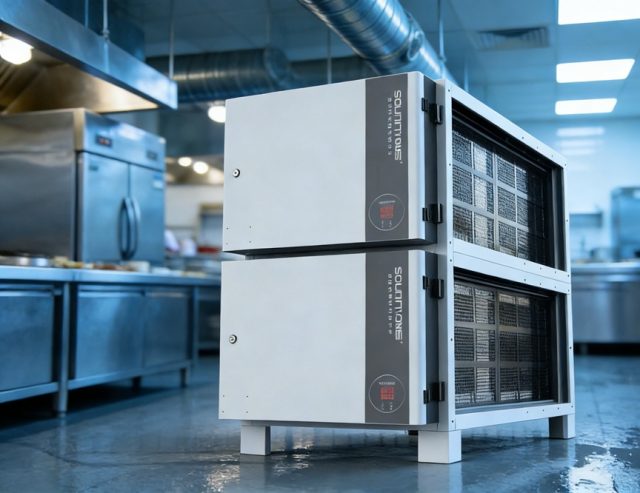
Kitchen workers are exposed to some of the highest occupational particulate concentrations of any indoor profession. Studies have documented PM2.5 levels of 200-500 μg/m³ in poorly ventilated commercial kitchens — 10-25× the WHO guideline of 15 μg/m³. ESP purification dramatically reduces this exposure, with measurable health and business benefits.
| Parameter | Specification |
|---|---|
| Typical Kitchen PM2.5 (no ESP) | 200-500 μg/m³ during peak cooking |
| With Souniny ESP | 25-50 μg/m³ (80-90% reduction) |
| WHO Guideline | 15 μg/m³ (24-hour mean) |
| Health Impact Documented | Reduced respiratory symptoms (cough, phlegm, wheeze) among kitchen staff; Reduced eye and throat irritation; Improved lung function measurements in longitudinal studies |
| Business Impact | Reduced sick leave; Lower staff turnover (documented 25-40% reduction); Improved kitchen morale and productivity |
Application Scenarios
- University occupational health study: A university research team conducted a before-and-after study at 3 restaurants that installed Souniny ESP. Kitchen PM2.5 dropped from an average of 285 μg/m³ to 42 μg/m³. Staff reported: 60% reduction in “cough during/after shift,” 45% reduction in eye irritation, and 35% reduction in “feeling short of breath.” Staff sick days decreased by 28% in the 12 months post-installation.
- Restaurant chain staff retention analysis: A chain with 25 locations analyzed staff turnover rates. Locations with Souniny ESP had 32% lower kitchen staff turnover than locations with conventional ventilation. Exit interviews at non-ESP locations frequently cited “kitchen conditions” (heat, smoke, smell) as a reason for leaving. The HR director calculated that ESP installation paid for itself in reduced recruitment and training costs within 2 years.
- Occupational health regulatory compliance (Europe): Under the EU Carcinogens and Mutagens Directive (amended to include cooking fume exposure), employers are required to assess and control exposure to cooking oil fumes. A restaurant group used Souniny ESP performance data and occupational hygiene monitoring to demonstrate ALARP (As Low As Reasonably Practicable) exposure levels, satisfying the regulatory requirement without additional administrative controls.
- Kitchen asthma case study: A chef with occupational asthma (diagnosed and documented as cooking fume-related) was able to continue working after her restaurant installed Souniny ESP. Pre-ESP: peak expiratory flow dropped 25% during shifts. Post-ESP: flow remained stable throughout shifts. The occupational health physician documented the case as evidence that ESP represents an effective engineering control for cooking fume-related respiratory disease.