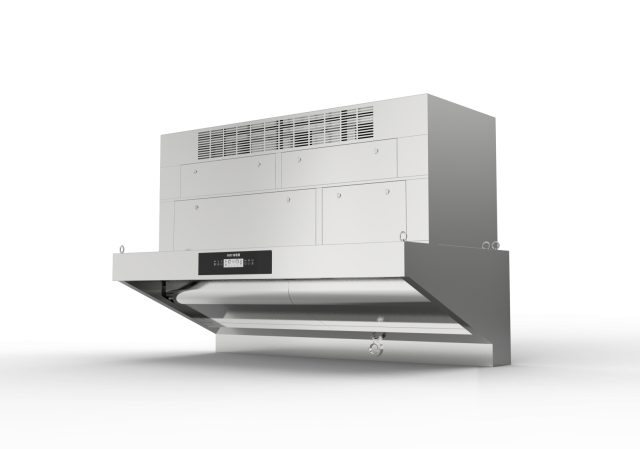
Ask anyone quoting a ductless kitchen for the first time and the same question comes back within minutes: the N-series and the ND-series look almost identical in the brochure—both hang over the cookline, both recirculate cleaned air back into the room, both promise at least 99 percent purification—so which one does my kitchen actually need? The honest answer is that the choice is not primarily about kitchen size or budget tier. It is about your menu’s fume load, your ceiling and floor, and how much residual odor your landlord, your neighbours, and your local fire authority will tolerate. This guide walks through the same four-step selection process Souniny’s export team uses when quoting distributors and restaurant groups, using the real specifications of both series rather than marketing generalities.
One Architecture, Two Filtration Depths
Both series belong to Souniny’s ductless range hood family: self-contained units that combine capture, filtration, and fan in a single stainless housing. Neither needs a riser, a shaft, or a rooftop penetration. Both run on ordinary single-phase 220–240 V power—no three-phase supply required—and both are CE certified with a rated purification efficiency of at least 99 percent for grease and smoke particulates. Both offer nine-speed fan control, both can be ceiling-hung or placed on a floor stand, and both are built from SUS201 stainless steel with SUS304 available for corrosive coastal sites.
The difference is what happens to the air after it enters the hood, and that difference is larger than most buyers expect.
The N-series is the dry, light-duty line. Air passes a stainless baffle and oil-tray stage that intercepts roughly 60–70 percent of grease by mass, then reaches one or two electrostatic precipitator cells that charge and collect sub-micron particulate, then a bank of two to four HEPA filters that polish the stream before it re-enters the room. There is no water anywhere in the machine. Current models span four lengths: the KL-D-N12 at 1,200 mm and 4,000 m³/h, the KL-D-N16 at 1,600 mm and 5,000 m³/h, the KL-D-N20 at 2,000 mm and 6,000 m³/h, and the newly added KL-D-N24, which stretches the line to 2,400 mm and 7,000 m³/h. All share an 800 mm depth and a low 850 mm profile, with weights running from about 100 kg on the shortest unit to 180 kg on the longest. Power draw is modest—roughly 360 to 600 W on the 1.2 m model depending on revision, rising with length—which is one reason light-duty units are so often chosen where electrical capacity is tight.
The ND-series is the wet-assisted, heavy-duty line. Before air ever reaches a filter, it passes a water-cycle stage: a built-in water tank—36 litres on the 1.6 m model—feeds a recirculating curtain that knocks down bulk grease, cools the stream, and catches embers before they can reach anything flammable. The air then crosses a single-zone ESP field with one to four cells depending on hood length, an F8-grade medium filter, and an H12-grade HEPA layer. The range mirrors the N-series lengths: KL-D-ND12 at 4,000 m³/h (1,300 W), KL-D-ND16 at 5,000 m³/h (1,800 W), KL-D-ND20 at 6,000 m³/h (2,400 W), and KL-D-ND24 at 7,000 m³/h (2,800 W). The deeper 1,100 mm body stands 1,365 mm tall and weighs 180 to 380 kg, and each unit ships with a suspension kit—four lifting rings, eight metres of wire rope, four turnbuckles, and four expansion anchors. The two-section body separates into upper and lower halves for handling, which matters more than buyers expect when the only route to the kitchen is a narrow service corridor. Water safety is engineered in: a level sensor locks the unit out when the tank runs dry so the pump cannot burn, and an overflow port acts as a second guard. Auto-cleaning versions of the ND line have now been introduced as well, washing both the upper and lower stages on schedule.
Step 1: Put a Number on the Fume Load
Nearly every mis-specified ductless hood we have traced back to a complaint started the same way: the buyer sized by floor area, seat count, or gut feel instead of by cooking load. Souniny’s own selection tables use two lenses, and applying both takes about ten minutes.
The hood-length lens. Allocate 2,000 m³/h of design airflow per metre of hood for enclosed back-of-house cooklines, and 2,500 m³/h per metre where the line is open to guests—an open display cookline needs the extra capture velocity because cross-drafts from the dining room compete with the hood. A 1.2 m noodle station therefore designs to roughly 2,400–3,000 m³/h; a 2.2 m two-burner line designs to roughly 4,400 m³/h.
The burner lens, as a cross-check. Allocate about 4,000 m³/h per dedicated heavy-fume burner—a wok range, a char-grill, a pressure fryer bank. A two-burner heavy line typically pairs with 2.0 to 2.4 m of hood, which is exactly where the two lenses begin to disagree; when they do, take the higher number and you will rarely be wrong. For lighter menus, a total around 6,000 m³/h comfortably serves larger all-electric lines with no open flame. One more conversion is useful when a client sends equipment specs instead of menu descriptions: roughly 800 m³/h of exhaust per 10,000 BTU/h of open-flame burner rating. And if the building can support a full duct run, the calculation changes scale entirely—ducted installations move far larger air volumes, and Souniny’s ducted ESP purifier range covers that high-volume end with in-line electrostatic cells and centrifugal fans.
Worked examples. A 1.2 m ramen and gyoza station with an induction hob and a small griddle lands at 2,400–3,000 m³/h—the KL-D-N12 covers it with margin. A fried-chicken takeaway with two pressure fryers and a flat griddle on a 1.6 m line sits near the 5,000 m³/h mark by the burner lens—KL-D-ND16 territory. A community-canteen wok line, three burners across 2.4 m of hood, designs beyond 10,000 m³/h by the burner lens—past the ceiling of any single all-in-one unit. The right answer there is not one oversized machine but two ND20-class units forming one continuous capture run.
Step 2: Let the Menu Pick the Series
Once the airflow target is known, the menu decides which filtration architecture fits.
Choose the N-series when the load is grease-light and flame-free: steaming and boiling stations, noodle and rice-powder lines—the current N-series tuning was developed around exactly these stalls—breakfast griddles, sandwich and panini presses, bakery ovens, and coffee equipment. The dry ESP-plus-HEPA chain carries more filtration surface than buyers expect—four HEPA cartridges on the 2 m model—and with no water tank there is nothing to fill, drain, or worry about in an unheated unit. Earlier N-series revisions built their track record on fried-snack counters and lighter Western lines, so the series is not limited to gentle Asian steam service; the operating principle is simple. If the worst your kitchen produces is a hot-oil aerosol without open-flame char, the N-series is the lighter, quieter, lower-power answer.
Choose the ND-series when flame meets fat: wok ranges, char-grills and skewer stations, pressure fryers, teppanyaki plates, rotisserie and spit roasting. These loads produce char, ember risk, and grease volumes that a dry baffle alone cannot pre-strip; the water-cycle stage exists precisely for them, catching bulk condensate and hot particulate before they can blind the ESP cells and shorten the cleaning interval.
Mixed menus are the common case, and they have two clean answers. Zone the cookline—one ND unit over the wok and grill end, one N-series unit over the steam and pastry end—if the two halves sit far enough apart. Or run a single ND unit spanning the whole line and add an Odor Removal Tower when the menu is only moderately heavy. Over-specifying the capture stage is almost always cheaper than retrofitting after the first complaint. Where there is no fixed cookline at all—market stalls, pop-up service, front-of-house live cooking—the same filtration logic moves onto wheels with Souniny’s mobile food carts.
Step 3: Measure the Room
Four physical checks decide whether the series you want can actually live in the building.
Ceiling height. The N-series’ 850 mm body hangs under ceilings from about 2.3 m up, which is why it keeps appearing in old-town shops and mezzanine food units. The ND-series stands 1,365 mm tall and needs more: reserve the unit height plus cooking clearance below and service space above. Where a ceiling hangs too low for even the N-series—and the load is light—the split GC10 and GC11 cabinet purifiers move the purification hardware to the floor and leave only a shallow canopy overhead. They are the third option in the same ductless family and worth a quote when headroom, not fume load, is the binding constraint.
Structure and handling. An N12 asks the slab for about 100 kg; an ND24 wants 380 kg plus suspension hardware. Older timber-floor buildings and light steel mezzanines need checking before delivery, not after. The ND’s two-section split and its standard suspension kit exist for exactly these sites—narrow doorways and long corridor carries are the norm, not the exception, in the dense urban districts where ductless units sell best.
Air supply. This is the rule most often broken, and the specification sheet states it plainly: heavy-duty ND units must not run in a sealed room. The machine recirculates air, but the kitchen itself needs ventilation—operable supply air, mechanical make-up, or an HVAC circuit holding the room at slight negative pressure—both for combustion safety on gas lines and for the unit’s own capture efficiency. A ductless hood in a sealed box under-captures no matter how it is sized. Light-duty N-series rooms need less, but some air exchange is still assumed.
Water and drainage. The ND-series needs a tap within hose reach and a route for the drain line—fill port, drain port, and overflow port all sit on the body. A floor drain within a few metres keeps daily top-ups trivial. The N-series has no water requirement at all, which quietly matters in kiosks and food halls where adding plumbing means renegotiating with the landlord.
Step 4: Decide How Clean “Clean” Has to Be
Both series leave the hood at roughly 99 percent grease and particulate removal. As a working calculation, a kitchen stream near 10 mg/m³ of fume concentration leaves a 99-percent unit at or below 0.1 mg/m³—visually smoke-free. What that number does not capture is odor, which travels on gas-phase compounds and finer residues than an ESP cell is asked to catch.
Where the exhaust re-enters the room the cook works in, the residual odor of an N-series unit—already carrying two to four HEPA stages—is usually a non-issue, and many buyers stop there. Where the kitchen shares a wall, a floor, or a courtyard with neighbours, or sits on a mall level where landlords police smell as strictly as smoke, the second stage matters. Souniny’s Odor Removal Tower range adds a HEPA-and-activated-carbon V-bank stage in modules from 5,000 up to 20,000 m³/h, with the vertical W700-class tower standing just 1,750 mm tall and reaching up to 99.9 percent on the odor stage. An ND16 feeding a tower is the standard answer for a fried-chicken shop above a residential podium: the pairing converts “no visible smoke” into “no noticeable smell,” which is the standard tenants and landlords actually argue over.
Decide this before ordering, not after. Carbon stages bolt on far more cleanly at specification time than as a retrofit squeezed into a finished ceiling.
The Two Series Side by Side
| Attribute | N-series (light duty) | ND-series (heavy duty) |
|---|---|---|
| Airflow by model | N12 4,000 / N16 5,000 / N20 6,000 / N24 7,000 m³/h | ND12 4,000 / ND16 5,000 / ND20 6,000 / ND24 7,000 m³/h |
| Pre-filtration | Stainless baffle and oil trays (60–70% of grease) | Water cycle, 36 L tank on the 1.6 m model |
| Deep filtration | 1–2 ESP cells + 2–4 HEPA filters | 1–4 ESP cells + F8 medium + H12 HEPA |
| Body | 800 mm deep, 850 mm high | 1,100 mm deep, 1,365 mm high, two-section split |
| Weight | 100–180 kg | 180–380 kg |
| Power | About 360–1,200 W by length | 1,300–2,800 W by length |
| Water and drains | None | Fill, drain, overflow ports; low-water lockout |
| Room air rule | Air exchange recommended | Make-up air or slight negative pressure required |
| Best for | Steam, noodles, griddles, bakery, coffee | Wok, char-grill, fryers, teppanyaki, rotisserie |
Five Selection Mistakes That Come Back as Complaints
1. Sizing by floor area. Seats and square metres say nothing about wok burners. The two lenses in Step 1 exist because load follows the menu, not the room.
2. Installing an ND-series in a sealed box. Every centimetre of rated airflow assumes the kitchen can breathe. Without make-up air, capture efficiency drops, gas combustion suffers, and the kitchen fills with the very heat the unit was meant to remove.
3. Forgetting the service swing. ESP cells on the ND line are specified for cleaning every 40 to 60 days under heavy loads, and the N-series HEPA banks need periodic inspection and replacement. Hang the unit where cells and filters can be reached without dismantling the suspension, and keep the lowering route clear.
4. Treating odor control as an accessory. A ductless unit that passes the smoke test can still fail the smell test in a shared building. Decide the odor target with the landlord’s fit-out clause in hand, and specify the tower stage with the hood.
5. Chasing maximum airflow. Nine-speed control exists for a reason: oversized capture drafts across the cookline, chills the chef, and pushes noise into the dining room. Match the number from Step 1—do not max it.
Scenario Quick Picks
Fried-chicken takeaway, two pressure fryers and a griddle, mall lower ground—a configuration our Manila inquiries return constantly: KL-D-ND16 plus an Odor Removal Tower. The tower is what the landlord’s fit-out clause is really asking for.
Ramen and gyoza bar, 1.2 m station, old terrace with a 2.3 m ceiling: KL-D-N12—dry filtration chain, no plumbing, no three-phase power, and the low 850 mm body clears the ceiling with room to serve.
Community canteen, three-burner wok run on 2.4 m of hood: two KL-D-ND20 units in one continuous capture run. Do not bridge the gap with a single undersized unit and hope.
Bakery and coffee bar, light load, no extraction history in the tenancy: KL-D-N12 or N16; odor control stays optional unless the neighbours are very close.
Heritage or low-ceiling kitchen, light-fume load, no room for even 850 mm overhead: the GC10 or GC11 split cabinet units behind the cookline, joined to a shallow canopy by a short duct.
The N-series and the ND-series are not good-better-best tiers; they are two different answers to two different cooking loads. Put a number on the fume load, check the ceiling and the air supply, decide how far odor control must go—and the series chooses itself. When the picture is still ambiguous, send Souniny your menu and hood length rather than your floor plan: the fume load, not the floor area, is what our engineers will size from anyway.