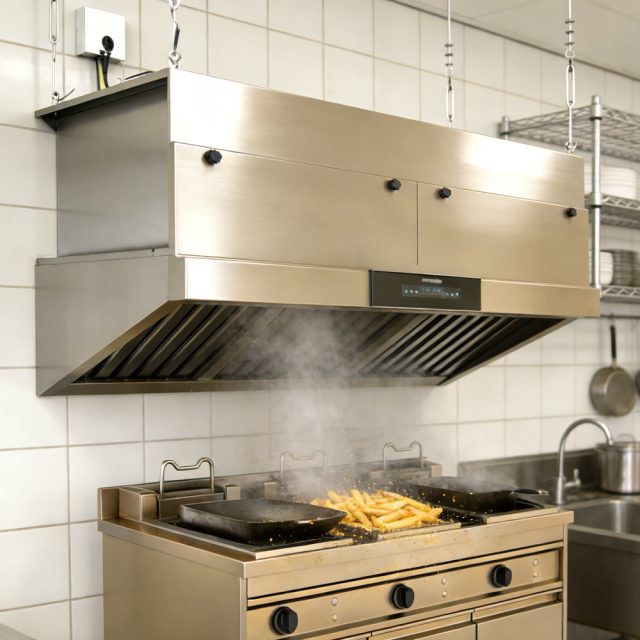
Hand-pulled noodles, soup dumplings, pho, udon, gyozo – the noodle and dumpling bar has become the defining open-kitchen format of the past decade, from shopping-centre food halls to airport concourses and street-front small boxes. Guests line up to watch the show: dough stretched overhead, bamboo baskets of dumplings lifted steaming off the stove. What they are watching, technically, is a kitchen dominated by water vapour – and that is precisely why its ventilation so often gets specified wrong. Operators see no black smoke, order nothing or undersize, and discover the truth through fogged sneeze guards, peeling paint above the line, and a dining room that smells permanently of simmering broth.
The Anatomy of a Noodle and Dumpling Line
Strip a typical noodle or dumpling bar back to its equipment schedule and the cooking surface splits into four groups. The broth group runs longest: stock pots and kettles holding pork bone, chicken or vegetable broth at a low simmer for eight to twelve hours a day, sometimes overnight. The steam group is the visual signature: stacked bamboo steamers, bun cabinets and batch noodle cookers, releasing plumes of water vapour with every lid lifted. The sear group is smaller but greasier: a compact wok for fried noodles and fried rice, a griddle for pan-fried dumplings and pot stickers, occasionally a single fryer for crispy items. Around all of it sit the supporting appliances – rice cookers, holding wells, a small convection oven.
The proportions shift by cuisine and market. A Lanzhou-style lamian shop may run one wok and three broth kettles; a xiaolongbao specialist may devote most of the line to steamers; a Vietnamese pho counter leans on blanching pots and broth; a Japanese tsukemen bar adds a yaki (griddle) station. But the structural pattern is constant: a long, low-temperature, moisture-heavy base load with a short, hot, grease-producing segment bolted onto the end of it. That hybrid is what makes this format different from a burger grill, a wok restaurant or a bakery – and it is why single-stage thinking about the exhaust keeps failing.
A Different Load Class: Steam First, Grease Second
The physics of the dominant load is thermal, not chemical. Every kilogram of water boiled off carries roughly 2,260 kJ of latent heat, and when it condenses it gives that heat straight back – to the hood, the duct, the ceiling. A single 40-litre broth kettle at a working simmer can shed a litre or two of water per hour; a bank of steamer baskets being worked through a lunch rush sheds bursts far larger. One litre of water becomes about 1.7 cubic metres of steam at 100 °C, which then cools, shrinks and condenses wherever it finds a surface below its dew point. The plume is voluminous, wet and persistent – and unlike a wok plume, it does not rise as a tight hot column; it billows.
The grease load is real but modest. Broth surfaces carry rendered fat that becomes airborne in tiny amounts; pan-fried dumplings and a working wok produce genuine grease-laden vapour, but from maybe half a metre of appliance width, not a full cookline. In classification terms, most of the line behaves like light-to-moderate duty, while the sear segment still counts as grease-producing. The engineering task is to handle both loads in one capture volume without letting either defeat the other – wet steam overwhelming grease filters, or grease fouling a system sized as if it were all steam.
Noodle and dumpling bars are not low-load kitchens. They are mixed-load kitchens whose biggest load happens to be invisible.
Where the Steam Goes: Condensation Is the Real Problem
Unmanaged steam does not disappear into the room; it deposits. The visible evidence appears in a predictable order. First, condensation on the coldest nearby surfaces – glass sneeze guards, chilled display cases, glazed facades on winter mornings. Then the ceiling above the line starts showing water tracking and paint failure. Behind the scenes it is worse: inside an ordinary grease hood, the vapour condenses into a dirty condensate that mixes with trace oil into a slow-moving, slightly acidic film that corrodes stainless, drips onto food surfaces, and feeds mould in joints and shadow gaps. On the floor, condensate and splash become a slip hazard that hygiene inspectors notice before anything else.
This is why codes and standards treat steam as its own problem. In the IMC tradition, hoods over steam- and moisture-producing appliances fall to Type II – condensate capture with drainage – while grease-producing appliances demand Type I. European practice under EN 16282 likewise separates vapour extraction with condensate management from grease filtration stages. Standards such as ASHRAE 154 and NFPA 96 then govern the grease side: appliance classification, hood geometry, and cleaning intervals that apply as soon as a single grease-producing appliance sits under the canopy.
Why Mixed Lines Still Need Grease Capture
The most common – and most expensive – mistake in this format is buying a condensate canopy only, because the kitchen reads as a boiling operation. The moment a wok fires fried noodles, a griddle seals pot stickers, or a fryer crisps anything, grease-laden vapour is in the airstream, and a condensate-only hood passes it straight through: onto the ceiling, into the duct or back into the room. Grease film on an unfiltered exhaust is fuel, and it accumulates on exactly the surfaces nobody opens and looks at. Hygiene adds a second reason: an open kitchen means airborne grease can drift across a ready-to-eat assembly counter a metre away, and allergen-conscious jurisdictions care about airborne sesame, egg and shellfish particles near open prep.
The reverse error is rarer but real: specifying a heavy-duty grease hood for the whole line, oversizing airflow, and turning an open show kitchen into a wind tunnel – wasting conditioned air, drying exposed dough and noodles, and generating noise exactly where the format wants theatre and calm. Both mistakes come from the same root: treating a mixed line as if it were single-class.
Sizing: Split the Line by Load
Start with geometry. The canopy must cover every heat- and vapour-producing appliance with an overhang – about 150 mm per side for light-duty equipment – and in this format that usually means a 1.8 to 2.4 m hood for a compact bar. Then split the load. The steam segment needs capture velocity and a condensate path, not brute airflow; the grease segment – wok, griddle, fryer – follows the familiar planning arithmetic of roughly 2,000 m³/h per metre of grease-producing line. A typical bar with 0.6 m of wok and griddle and 1.6 m of broth-and-steam equipment lands in the 2,500-4,000 m³/h class overall, with the duty concentrated at lunch and dinner rushes rather than continuous.
Position matters as much as totals. Broth kettles and steamers belong toward the back and sides of the capture zone where the plume is caught early and given a short, controlled path to the condensate stage; the wok and griddle belong at the front centre where capture is strongest. In an open kitchen, makeup air decides whether any of this works: the room must supply what the hood extracts, ideally through low-velocity transfer or a dedicated supply diffuser positioned so it does not blow across the cookline – and quietly, because the dining side is a metre away.
Placement: Open Kitchens in Shared Buildings
Noodle and dumpling bars concentrate in exactly the locations where ducting is hardest. Food-hall and mall stalls sit on interior or lower-ground floors with no exterior wall and no roof path; base-building risers rarely accept tenant grease, and landlords write strict clauses about condensate, odour at adjacent tenants, and after-hours simmering. Street-front boxes of 20-50 m² trade on a glazed facade and an open line, leaving nowhere for a vertical duct rise and no tolerance for a deep canopy eating the kitchen. Airport and railway concessions add security and hours-of-work constraints that make even minor builder’s work a project.
The convergence is the same as for every light-concept format: the ventilation system has to treat the air at the cookline and return it to the room, without touching the building. The difference here is that the system must also swallow a volume of water vapour that a standard grease hood was never drawn to handle.
The Design Response: Manage Moisture, Then Odour
For a ductless bar in a shared building, the workable architecture is a ductless range hood family canopy such as Souniny’s, sequenced for a wet, mixed load: a washable baffle or mesh pre-filter that takes the first moisture and droplet hit, a condensate drain path so water leaves the system instead of travelling, an electrostatic cell that collects the fine particulate and oil-mist fraction from the sear segment, and an activated carbon bed for the gas-phase load. Cleaned air returns to the room; no duct, no penetration, no landlord negotiation – and the whole assembly fits the 2.7-3 m ceilings of a typical small box.
Matching unit class to menu keeps the economics honest. A lamian or pho counter whose only grease appliance is a single wok or griddle sits squarely in light-duty territory, and the N-series light-duty ductless units are sized for exactly that pairing; a shop running a heavy wok line of fried noodles and rice all day should step up to the ND-series heavy-duty class rather than stretch a light unit. In both cases the long-simmering broth makes the carbon stage a first-class component, not an accessory – a dedicated Odor Removal Tower extends bed depth and dwell time for the continuous, low-concentration odour load that defines this cuisine.
Where the building can offer a real duct run and the menu grows into heavier frying or charcoal, a ducted ESP purifier range with an inline centrifugal fan remains the scaling answer, discharging through the duct instead of back into the room. And for market stalls, campus pop-ups and festival sites, a ventless catering cart with compact onboard treatment carries the same load logic into a mobile footprint.
Odour: The Slow, Continuous Load
Sear-based formats produce intense, intermittent odour; broth-based formats produce something harder: a continuous, low-concentration load that never switches off. A kettle simmering from seven in the morning until close emits steadily for fourteen hours, and overnight stock programs extend that around the clock. Activated carbon adsorption handles this pattern well precisely because the concentration is low and constant – the bed works at equilibrium rather than being blasted – but it changes the maintenance logic. Bed replacement is driven by cumulative hours, not by dramatic smell events, and airflow should be right-sized rather than oversized, because dwell time in the carbon is what removes the molecule. A hood that blasts 6,000 m³/h past a thin carbon bed at 0.05 seconds of contact removes far less odour than a moderate airflow through a deep bed at half a second.
Maintenance: Water Changes the Routine
The wet load rewrites the daily checklist. Condensate drains and collection trays need emptying or a verified drain path every day – a tray that overflows puts water exactly where the electrical stages live. Pre-filters in steam-heavy service load with moisture and need washing weekly rather than monthly. The electrostatic cell still washes on a monthly degrease-and-dry cycle, but in a humid airstream it deserves a weekly visual check for tracking or arcing that dampness can provoke. The carbon bed gets its scheduled inspection. And because warmth plus moisture plus organic residue is a mould recipe, the canopy interior and drip channels join the monthly deep clean, with the whole routine logged – the log is what the landlord’s facility manager and the hygiene inspector actually read.
What to Prepare Before You Order
A supplier can size a mixed steam-and-grease ductless system in one pass given honest inputs, and will otherwise default to assumptions that fit neither load. Have ready: the full appliance schedule with power ratings, and – critically – which appliances are steam-dominant versus grease-producing; the simmering hours, including any overnight stock program; hood length and ceiling height with everything above the line; the electrical supply at the cookline; the landlord’s written rules on recirculating hoods, condensate and odour; and a realistic two-year menu plan, because the cheapest system is the one sized once, correctly.
A noodle or dumpling bar sells freshness that guests can watch and warmth they can smell – and both of those selling points turn against the operator the day the exhaust is wrong. Split the line by load, give the steam a condensate path, give the sear segment true grease capture, and give the broth a carbon bed with real dwell time. The kitchen stays transparent, the dining room stays neutral, and the equipment lasts the length of the lease.