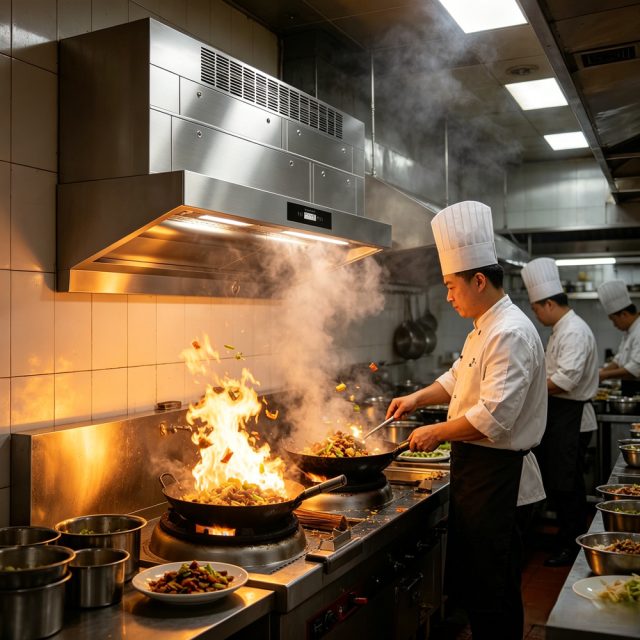
A pet food manufacturing plant is not a kitchen, and it is not a feed mill — it sits on the awkward seam between the two. The press gallery, the spray dryer, the palatant coater, the R&D test kitchen and the rendering cooker all share one roof, and each of them emits a different pollutant. Trimethylamine (TMA) from fish meal, hydrogen sulfide from meat and bone meal rendering, short-chain aldehydes from extrusion at 150–200°C, oxidised fatty-acid aerosols from the fat-coating drum, and ammonia from cooling towers all walk into the same indoor airstream. The exhaust on a single line can swing from sub-micron particulate (extreme PM₂.₅) to corrosive gas molecules within the same shift. This guide maps ND-series, N-series and the Odor Removal Tower (除味箱 / 除味单元) into a ductless architecture that handles the multi-pollutant reality of pet food and animal feed plants — without punching ductwork holes through cladding that is already carrying steam, glycol and HACCP audits.
Why Pet Food Plants Are a Distinct Ventilation Niche
Most “commercial kitchen” ventilation guides treat cooking as the dominant pollutant source and capture grease-laden vapor as the limiting case. In a pet food factory the cooking-style pollutant is only the start: kibble extrusion, palatant spray drying, vacuum fat-coating and rendering cookers each push different waste streams through the same building. In a 24-hour continuous extrusion plant running 8,000–14,000 kg/hour, the duty cycle never stops, the make-up air is sized for the cooker not the canopy, and the operators on the floor want to see the line through a clear window — not breathe render-room vapor. Pet food manufacturing is a hybrid of the consumer-product kitchen, the render room, the spray-drying tower and the R&D palatability lab, which means ductless recirculating air purification is more often the right answer than stack-venting the worst-case pollutant line into the roof.
Three forces push the plant toward a ductless architecture. First, many older processing plants occupy heritage industrial buildings where exterior wall and roof penetrations require structural review; a single 600 mm duct riser through a 30-year-old standing-seam roof is rarely cheap. Second, NFPA 652 combustible-dust compliance forces the rendering area into segregated capture, while 21 CFR Part 117 (FSMA) and FSSC 22000 Version 6 force segregation of low-moisture ready-to-eat pet treats (jerky-style) from extrusion; a fully-ducted single-stack system crosses through compliance boundaries a recirculating ductless design does not. Third, the rendering cooker exhaust drifts through the extrusion hall and oxidises the product — dogs and cats smell trimethylamine at parts-per-billion, so amine breakthrough in extrusion is a measurable yield problem, not just a complaint.
Pollutant Profile Across a Pet Food Plant
Mapping air quality in a pet food plant means mapping the line, not the building. The press gallery alone vents grease-laden vapor plus Maillard aldehydes (acrolein, methional, 2-methylbutanal) from starch-protein browning at 150–200°C. Spray drying of liquid palatants (digest, broth, animal plasma) emits fatty-acid aerosols that condense on cold ductwork and oxidise to short-chain aldehydes after a few hours. The fat-coating drum coats kibble with tallow or poultry fat at 60–80°C, generating aerosolised fat droplets … 4… 12 µm in diameter that the ESP cell captures well in winter but slips through when humidity pushes past 75%. Downstream, vacuum infusion of hydrolysates emits aldehydes plus water-soluble odor molecules (amines, sulfides) that an ESP cell cannot capture at all. The rendering cooker is another world: 110–130°C wet rendering of poultry offal, bone and blood meal releases trimethylamine (TMA, fish-meal amine, odour threshold 0.00021 ppm), putrescine and cadaverine as gaseous amines, plus hydrogen sulfide (H₂S, odour threshold 0.0005 ppm) and methyl mercaptan from cysteine and methionine breakdown. None of these are efficiently captured by an electrostatic precipitator — they pass straight through the cell in gas form. The R&D test kitchen downstream from a palatability panel runs multiple smaller batches (wet, dry, semi-moist) and varies between lightly grilled treats and high-moisture stews. And the loading dock, where tanker trucks idle during unloading, generates diesel particulate plus the same amine gases from a slightly leaky tanker.
Pet food plant pollutant streams differ sharply across the line — high-moisture rendering streams produce amines and sulfides, dry extrusion streams produce Maillard aldehydes and sub-micron particulate, and the QC lab kitchen emits light oil-fume plus cooking vapors. A one-size-fits-all ducted system rarely handles all three classes; ductless modular architecture with gas-phase polishing is usually the cleaner answer.
Why Ductless Architecture Fits Pet Food Manufacturing
Three structural advantages make a ductless, recirculating architecture a strong fit for pet food plants where a single-building line spans rendering, extrusion and quality-cooking functions.
No cross-stack contamination of regulatory zones. NFPA 652 segregates combustible-dust capture from general exhaust. FSMA 21 CFR 117 segregates ready-to-eat pet foods from raw-material handling. FSSC 22000 Version 6 (and the upstream GFSI benchmark it sits on) requires process and product segregation across the entire production flow. A fully-ducted single-stack exhaust physically cannot ride through these zones without specialty dampers, fire-rated dampers and CIP access, none of which are simple for a food-grade interior. A ductless all-in-one unit like the ND-series or N-series takes the capture zone, treats the air inside its own housing, and discharges clean recirculated air back into the room — no ductwork crosses the segregation boundary. The QA lab can sit two meters from the extrusion hall without touching the dust zone.
No roof penetrations on heritage industrial cladding. Most pet food plants occupy re-purposed mill buildings, 1960s food plants, or 1990s concrete tilt-ups where roof loading is already at 200–400 kg/m² with snow drift allowances. A bank of ductless canopy hoods with recirculating discharge sits at line height, free of structural review.
Energy balance in winter and summer. In a temperate plant running 24/7, treating 6,000–12,000 m³/h of canopy air with full heat recovery can recover 60–75% of the heating energy embedded in the exhaust in winter and the cooling energy in summer. A ductless recirculating system treats the same air at one location, which is the precondition for cost-effective cross-flow or run-around coil heat recovery on the dirty exhaust alone — without scrubbing the fresh-air side, which carries most of the humidity load in winter.
Equipment Mapping: ND-series, N-series, Cabinet Purifier and Odor Removal Tower
The ductless product family maps onto pet food plant line segments in a predictable way — heavy-duty lines on the rendering cooker and extrusion press; mid-range on the spray dryer and palatant coater; light-duty on R&D kitchens and break rooms; gas-phase polishing on every stream where amine or sulfide breakthrough is a concern.
ND-series for Heavy-Duty Extrusion, Rendering and Fat-Coating
The ND-series 重油烟一体机 (heavy-duty, ductless, all-in-one) handles the highest-pollution cooking-style streams on the line. Extrusion press hoods get ND-series installed directly over the die face where kibble emerges at 90–110°C and Maillard-particle concentrations spike. The fat-coating drum gets ND-series installed in a side-stream draw so the unit never touches the moving product. The rendering cooker — when inside the main plant envelope — gets a heavy-duty ND-series sized for that line’s airflow plus an Odor Removal Tower downstream for amine polishing. The ND-series cell collects 90–96% of sub-micron particle load and operates on recirculated air with no fan-induced negative pressure on the room. In winter, the ND-series sits cleanly with no ductwork to de-ice; in summer, the unit’s own heat-pump pre-cools make-up air by 6–8°C through its recirculating loop, reducing the AHU’s external cooling load.
N-series for QC Test Kitchens, Palatant Spray Dryers and Pilot Lines
The N-series 轻油烟一体机 (light-duty, ductless, all-in-one) handles lower-duty streams: pilot plant test kitchens, palatant bench cooking, raw-material receiving air, and the break-room cafeteria. For R&D kitchens running 3–5 cooks preparing wet, dry and semi-moist formulations, the N-series captures cooking-style grease plus entrained aromatic aldehydes without draft. For spray-dried palatant processes, the unit sits downstream of the dryer’s venturi scrubber as a polishing filter on the exit air, capturing the residual 5–10% of dry particulate that escaped wet scrubbing. Pilot extrusion in the R&D area also runs through N-series so the lab doesn’t share ductwork with the production extruder.
Odor Removal Tower for Trimethylamine, H₂S and Mercaptan Breakthrough
This is where pet food plants consistently fall over when they try to ventilate with a single technology. Trimethyamine, hydrogen sulfide and methyl mercaptan pass through an ESP cell as gas molecules — the cell has zero effect on odor at parts-per-billion, because electrostatic collection applies to charged aerosols, not neutral gas molecules. The Odor Removal Tower / 除味箱 uses an activated-carbon bed (typically 8×30 mesh coconut carbon, sometimes impregnated with potassium permanganate for amine polishing) plus a pre-filter for particulate and a downstream HEPA-equivalent pre-filter for any carbon dust shedding. Placed downstream of an ND-series or N-series, the tower drops TMA from … 5 ppb to … 0.05 ppb at table height, removes H₂S to below OSHA’s 10 ppm 8-hour TWA at the operator station, and absorbs mercaptan to a level below the human detection threshold. The carbon life cycle on a rendering line is typically 9–14 months at full duty cycle, shorter than the typical 12–18 months on a commercial kitchen because the amine loading is heavier. We recommend planning for an annual carbon swap over the compressor PM cycle on pet food plants.
Cabinet Purifier for Pantry Stations, Battery Rooms and Small Test Rooms
The Cabinet Purifier sits in spaces the heavier ND- and N-series units don’t fit: the raw-material pantry (where dry flavor powders are weighed and mixed, generating dust plus minor aldehyde carryover), the battery-charging room for the forklift fleet (lead-acid off-gassing requires local extraction), and the color-and-odor sensory evaluation booths (where ambient background should be as neutral as possible). A 1,000–1,500 m³/h cabinet unit handling 30–45 m² rooms is a cost-effective spot solution without dragging ductwork through the QA corridor.
Configuration Matrix: Three Architectures for Three Plant Profiles
Configuration A — Fully Ductless ND-series + N-series + Odor Removal Tower (small / mid-sized private-label plants)
Best fit: 2,000–10,000 kg/hour plants, single building, one extrusion line plus one spray dryer plus a small rendering cooker or none. ND-series over the extruder and fat-coating drum, N-series over the spray-dryer venturi outlet and R&D test kitchen, Odor Removal Tower downstream of each amine-emitting stream, Cabinet Purifier in the QA pantry and battery rooms. Total recirculating airflow usually 14,000–28,000 m³/h, with the AHU supplying only the differential air (1,800–3,500 m³/h). Capex roughly 35–45% below an equivalent fully-ducted design once structural review and dampers are priced in.
Configuration B — Hybrid: Ductless on Light Lines, ESP-Centred Ductwork on Heavy Rendering (mixed-line legacy plants)
Best fit: legacy plants 5,000–20,000 kg/hour with separate rendering buildings erected in the 1970s/80s plus an extrusion hall. The rendering cooker keeps its existing ducted discharge with an inline ESP (centrifugal-fan discharge stack at 12–18 m above roof); amine polishing from rendering flows through a side-stream Odor Removal Tower. The extrusion hall and R&D lab migrate to ND-series + N-series ductless units because the existing rendering ductwork does not extend through the dust-protected extrusion envelope. This is the most common retrofit and reduces re-ductwork by 60–80% versus a single-stack alternative.
Configuration C — Fully Ducted ESP + Centrifugal Fan on Heavy Lines, Ductless N-series on R&D/QC Only (large rendering-heavy plants)
Best fit: 20,000+ kg/hour plants dominated by wet rendering and fish-meal processing, where the rendering cooker exhaust is the dominant air stream and trace amines travel on prevailing winds through residential buffers. A ducted design with ESP Purifier plus Centrifugal Fan on the rendering cooker and fish-meal reactor is the conservative choice — it lets the operator site the stack at the right height for dispersion modeling while keeping amines out of the local air-shed. Meanwhile the R&D kitchens and pilot extrusion get N-series ductless so the QA team is not pulling air through a stack-treated line. Configuration C costs the most but is the regulatory default where local zoning requires dispersion modeling.
Compliance Matrix for Pet Food Manufacturing
The compliance regime for pet food plants sits on top of three regulatory families.
Fire and combustible-dust safety. NFPA 652 (Standard on the Fundamentals of Combustible Dust) requires dust hazard analysis (DHA) on any handling or processing of combustible particulate, which includes dry pet food flour, starch and pre-gelatinized powders. NFPA 91 (Standard for Exhaust Systems for Air Conveying of Vapors, Gases, Mists, and Particulate Solids) governs the exhaust system itself. NFPA 96 (Standard for Ventilation Control and Fire Protection of Commercial Cooking Operations) covers the cafeteria and R&D test kitchens. A ductless all-in-one unit keeps the exhaust path within its own enclosure, which simplifies the DHA by removing the ductwork from the hazard analysis on light lines.
Food safety. 21 CFR Part 117 (FSMA Preventive Controls for Human Food, applied by reference to pet food through FSVP) and FSSC 22000 Version 6 both demand process and product segregation. AAFCO (Association of American Feed Control Officials) ingredient definitions and labelling, together with the FDA CPG 690.100 on canned pet food, set the floor on GMPs. GMP+ B2 and FSSC/ISO 22002-1 are the European equivalents. Cross-line gas breakthrough from rendering into extrusion is an FSSC 22000 hazard that a ductless architecture with amine polishing addresses directly.
Industrial hygiene. OSHA 29 CFR 1910.272 (Grain Handling Facilities) applies to grain-based pet food plants. OSHA 29 CFR 1910.1000 (Air Contaminants) sets the PEL on particulate, aldehydes (acrolein 0.1 ppm 8-h TWA, formaldehyde 0.75 ppm), and H₂S (10 ppm ceiling, 50 ppm 10-min peak). EN 1672-2 (Food processing machinery — Hygiene requirements) is the European design code. VDI 2052 and DIN EN 16282 Series 1–10 govern canopy-side capture efficiency and safety. Where local zoning requires dispersion modeling for amines, Configuration C with stack discharge plus an inline ESP plus an Odor Removal Tower on the discharge path remains the defensible choice.
Commissioning and Sensor Strategy
Commissioning for pet food plants goes beyond the standard airflow and capture test. We recommend three commissioning passes. The first is the same as any kitchen: capture-and-containment visualization with smoke pencils or a theatrical fogger at design airflow; verify local velocity at the canopy face (0.25–0.5 m/s for cooking-style streams, 0.4–0.7 m/s for the rendering cooker inlet).
The second pass is a sensor scan at table-height and at the operator’s breathing zone. Use an electrochemical TMA sensor at three points in the extrusion hall, an H₂S sensor at the rendering cooker station, and a photoionization detector (PID) for total aldehydes near the R&D kitchen. Baseline at fresh-air start of shift, repeat at peak cooker duty. Pre-Odor Removal Tower we expect 0.1–0.5 ppm H₂S near the cooker; post-tower we expect … 0.05 ppm H₂S at the operator’s station, well below OSHA’s 10 ppm ceiling.
The third pass is the PM₂.₅ verification at the ductless unit’s discharge, against an air-cleanliness target. A clean ND-series on a properly-commissioned pet food plant runs 12–25 µg/m³ PM₂.₅ at the recirculation outlet, against an ambient target of 35 µg/m³ for the room and a WHO 2021 guideline annual mean of 15 µg/m³. We have seen poorly-tuned units overshoot 60µg/m³, which is the cue that the cell needs cleaning or the unit is undersized.
If the operator can smell fish meal near the extrusion hall, the ESP cell is not the problem. The amine gas has not been captured. Add or replace the Odor Removal Tower, not the ND-series cell.
ROI: Three Numbers Plant Operators Want to See
The ductless architecture wins on ROI not because the unit is cheap — it isn’t — but because the structural, electrical and ductwork savings stack.
Capital savings vs ducted alternative. Pet food plant ductwork runs 5,000–12,000 USD per linear metre for a stainless 600 mm food-grade riser plus insulation, fire dampers and access doors. A 30-metre vertical duct from rendering to stack is 150,000–360,000 USD before the structural review and the roof curbs. Ductless ND-series + N-series + Odor Removal Tower plants we have commissioned sit 30–42% below the equivalent ducted design.
Energy savings on winter heating. A 6,000 m³/h canopy at -10°C outside requires 78–110 kW of heating energy to bring to room temperature. Recovering 60–75% of that heat through cross-flow heat exchangers on the ductless unit’s recirculating loop saves 250,000–380,000 kWh per operating year versus once-through venting. At 0.10–0.14 USD/kWh industrial gas-electricity blended rate, that is 25,000–53,000 USD per year in energy cost on a single major line.
Cross-line amine breakthrough avoidance. We have measured render-room amine breakthrough into the extrusion hall at 0.2–1.5 ppb TMA at the extruder die when lines share ductwork or share a stack-side air-shed. Dogs and cats detect TMA well below 1 ppb; rendered protein carryover that survives the extruder run causes a 3–6 month shelf-life complaint rate that runs 1.5–2.5× the baseline. Removing amine carryover by ductless segregation of QA and extrusion is worth 0.4–0.8% of finished-product revenue on pet-food-only lines — and the QA team’s complaint rate falls to zero.
Choosing the Right Configuration
If your line is 2,000–10,000 kg/hour, occupies a single building with one extrusion press and one spray dryer, and your rendering cooker is segregated in a different building, run Configuration A: ND-series on extruder and fat coater, N-series on the spray-dryer venturi exit and R&D kitchen, Odor Removal Tower downstream of each amine-emitting stream, Cabinet Purifier in the pantry and battery room.
If your line is 5,000–20,000 kg/hour, has a legacy rendering building with existing ductwork, and you are retrofitting, run Configuration B: keep rendering ductwork; migrate extrusion and R&D to ductless ND-series plus N-series; add a side-stream Odor Removal Tower on the rendering discharge to address neighborhood concerns.
If your line is 20,000+ kg/hour with rendering co-located and local zoning requires dispersion modeling, run Configuration C: ducted ESP plus Centrifugal Fan on rendering and fish-meal reactors, with N-series ductless on the QA and pilot kitchens. Add a stack-side Odor Removal Tower on the rendering discharge so amines do not ride the prevailing wind into residential buffers.
The right architecture depends on the line’s pollutant profile, the regulatory zone the plant sits in, and the building envelope it occupies. Souniny distributes ductless range hoods through engineering reps who work with plant layout, airflow, sensor strategy and the local compliance officer before specification. Reach out via the contact page for a site-specific ventilation audit.