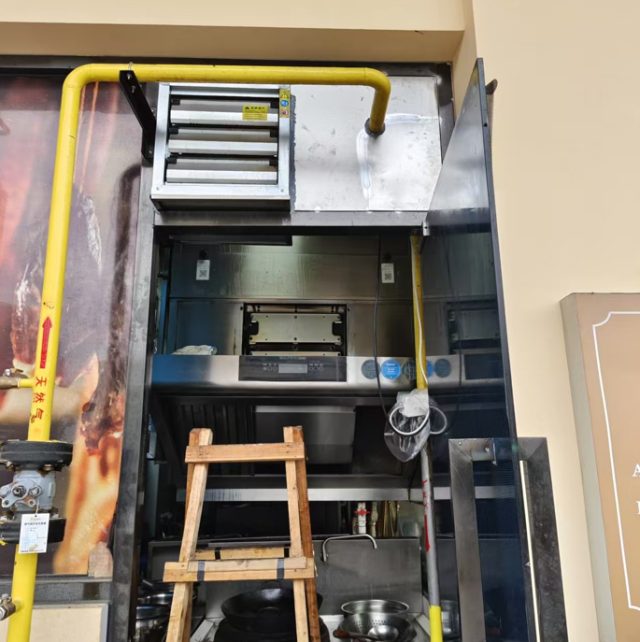
Two quotations arrive for the same kitchen, and both carry the word compliant. One lists duct diameters, exhaust rates and clearances lifted straight from the code tables. The other promises that the hood will capture under full load, that the noise limit at the boundary will hold, and that the system will measure within tolerance at commissioning. These are not two prices for the same product. They are two different contracts about who carries the design risk, and the difference stays invisible until the month the system stops capturing at the lunch rush. This piece is a buyer’s guide to that fork: what each approach actually transfers, the quantities that make an outcome enforceable, and the clauses that decide whose problem a failure is.
Two ways to buy the same airflow
A prescriptive specification is a table of rules that somebody else wrote. Exhaust rates per appliance class come from standard tables such as VDI 2052 in Germany or AS 1668.2 in Australia; construction rules come from codes such as NFPA 96, which sets the 457 mm clearance to combustibles, the 2.5 m/s (500 feet per minute) minimum velocity in grease ducts, and the access openings at each change of direction; IMC Section 507 sets the hood and duct requirements for Type I installations in the United States. Under a prescriptive approach, compliance means the delivered components match the table. The designer of the system is whoever assembled the table: the consultant, the contractor, or the code itself if nobody engaged either.
A performance specification is an outcome with a measurement attached to it. Capture holds at the hood edge with a face velocity in the working band under full cooking load. Design airflow is delivered within plus or minus ten percent, measured by pitot traverse at commissioning. The duct can be maintained to the cleanliness class it was bought for. Sound power at the duty point, and noise at the boundary, sit inside the stated limits. Under a performance approach, compliance means the measured numbers land inside the stated bands, whoever has to engineer them there.
Real projects are hybrids, because the codes themselves are hybrids. UL 710B is a performance listing: a hood passes by demonstrating capture and containment on a test rig. UL 1978 is a construction listing: a grease duct passes by being built a certain way. EN 16282 declares hood performance through a calculation method, while NFPA 96 prescribes duct construction. So the useful buyer question is never which camp a quotation belongs to. It is this: for each quantity that matters in this project, does the supplier own the gap between the rule and the result, or does the buyer?
What each approach transfers, and what each one hides
A prescriptive specification transfers design risk to the buyer and the consultant. The supplier warrants that the box matches its datasheet, and nothing beyond that. The hidden failure mode is integration: every element can be individually compliant while the assembly still fails. A hood sized from the appliance table, a duct run longer than the table assumed, and a fan selected against the clean-state resistance will together produce a hood that stops capturing in its second month of loaded operation, and no party has broken a single rule. That is the most common shape of kitchen extract dispute, and it is the one a prescriptive specification makes hardest to resolve, because the breach everyone is looking for does not exist.
A performance specification transfers design risk to the supplier, but only to the extent that the outcome is measurable and the test is written down. A promise of odour-free operation is unenforceable anywhere, because nobody can test it. The same promise expressed as measurable proxies is enforceable: an electrostatic section with a stated efficiency at rated flow, an activated carbon bed with a residence time in the 0.2 to 0.6 second band at design airflow, and a boundary noise limit measured to a named method. The difference is not the ambition. It is whether the promise can fail a test.
On price: a performance quotation carries a risk margin inside the supply price, and a prescriptive package carries a design fee somewhere else in the project budget. The totals are often closer than they look. What actually differs is the address where the dispute lands when something falls short.
The quantities that make a performance specification enforceable
A performance clause is only as strong as the number it names. These are the quantities worth naming, with the working figures the industry has converged on.
Capture and containment. Face velocity across the hood aperture: 0.25 to 0.5 m/s for light-duty equipment, 0.4 to 0.6 m/s for heavy frying and chargrill. Measured on a grid of vane-anemometer points, typically nine points at half-metre spacing, with a smoke-pencil spillage check along the front edge at full load. This is the quantity that catches undersized fans and blinded filters before the cook does.
Transport velocity. At least 2.5 m/s in grease-carrying ducts, with design practice holding 5 to 10 m/s so that deposit settling and regenerated noise both stay inside the band. A 560 mm duct at 8,000 m³/h runs 9.0 m/s, comfortably inside it; the same flow in a 710 mm duct drops to 5.6 m/s, and the temptation to upsize ducts for pressure savings should be checked against this floor.
Airflow and pressure at commissioning. Design flow within plus or minus ten percent, static pressure within plus or minus five percent, measured by pitot traverse to ISO 3966 or the commissioning method in EN 12599, reported at both clean-filter and loaded-filter reference conditions, because the two readings differ by 10 to 20 percent on a system with a carbon stage.
Cleanliness. EN 15780 classifies systems by use, and its current edition sets the working thresholds buyers can copy into a maintenance clause: surface deposit up to about 200 micrometres is acceptable, above that the section is due for cleaning, and above 500 micrometres it is a stop-and-clean item. The same numbers belong in the acceptance conversation for a new installation, since a duct delivered outside them is a defect, not a maintenance backlog.
Acoustics. Sound power level at the duty point in dB(A) and octave bands, plus the boundary limit in dB(A) by day and night that the design must meet, measured to ISO 1996-2 at the nearest residential facade. Where the authority applies a tonal penalty, it can add up to five decibels, which is exactly the margin between a passing and a failing plant on many sites.
Fire construction. Clearance to combustibles of 457 mm, duct enclosure or rating per the local code, and access openings at each change of direction and roughly every 3.6 m of duct run. These are prescriptive quantities by nature, and they belong in the performance specification anyway, because a performance promise that cannot be built safely is not a promise.
Writing the acceptance test so it survives a dispute
The test is where performance specifications are won or lost, and most of the losses are written in before the contract is signed. A test that survives holds four things fixed. Conditions: kitchen at full simulated load, all appliances running, make-up air balanced and running, doors in their normal operating position, measurements taken after the kitchen reaches thermal steady state, which takes roughly fifteen to twenty minutes. Method and instruments: named, so a vane anemometer grid and a pitot traverse cannot be silently swapped for a single handheld reading at the hood collar. Witness: who attends, and what the report must contain, which is raw grid readings rather than a single averaged number, because averages hide exactly the localised spillage the test exists to find.
The fourth is the retest regime, and it is the clause buyers most often leave out. Reasonable terms: the first retest is free; if the failure lies in the supplied scope, the supplier bears remediation and the cost of the retest; the number of retests is capped; and at the cap the remedy is stated in advance, typically rectification re-engineered at the supplier’s cost or refund of the performance portion of the price. Alongside the retest regime sit the exclusions, which must be listed rather than implied: acceptance excludes operation with grease filters removed, with make-up air deliberately disabled, or with appliances well beyond the duty the hood was sold for. Without that list, every failed test becomes an argument about whether somebody propped a door open.
Seven clauses that decide who owns the risk
- Definition of compliant. A named standard, with its edition and year: EN 16282-1 for the hood calculation, the NFPA 96 edition in force at contract, EN 15780:2025 for cleanliness. Codes update on cycles, and the test method moves with them.
- Design responsibility statement. Who sized the hood, the duct and the fan; whether the contractor carries a design portion; and whether professional indemnity insurance is in force for that design work. A supplier who designed nothing cannot warrant anything beyond the datasheet.
- Acceptance method, tolerance and reference conditions. The quantities above, with the test fixed in writing before pricing.
- Retest rights and cost allocation. First retest free, supplier-paid remediation where the failure is theirs, a cap, and a stated end remedy.
- The interface list. Make-up air, fire suppression, gas interlock, controls and BMS points: each junction named with its owner. Kitchen extract failures concentrate at interfaces, and a specification that does not list them has silently assigned every one of them to the buyer.
- Performance guarantee versus warranty. A defects liability period covers defects; a performance guarantee covers measured shortfall, with the remedy being re-engineering rather than repair. The two are different promises and are frequently blurred into one paragraph.
- Site-condition discovery. What happens if the building cannot deliver the promised outcome: a beam across the duct route, no plant space for the second fan, a boundary noise limit physically out of reach. The change procedure is written in advance, or the risk is absorbed silently by whichever party notices last.
The failure patterns each approach produces
Prescriptive projects produce the compliant-but-inadequate pattern, and it is the most expensive category of dispute in this trade. Nobody breached anything. The hood met the table, the fan met the schedule, the duct met the clearance rules, and the kitchen still cannot cook a full line because the assembled system falls short of capture. The remedy is usually an addendum nobody priced: a larger fan, a shorter duct route, or a supplementary carbon stage, each of which costs more retrofitted than it would have cost specified.
Performance projects produce test avoidance. The strong promise on page one quietly becomes a datasheet figure at rated laboratory conditions by page four, and at the acceptance meeting the two documents are ten pages apart. The defence is procedural: the test method, the reference conditions and the raw readings all named in the contract, so that a promise has only one interpretation at the moment of acceptance.
Then there are the two traps that sit between the parties. The per-drawings trap: the supplier builds exactly to a drawing prepared by a consultant who never visited the roof, and the duct meets a beam at the second floor. The reverse trap: a performance promise offered on a building that cannot deliver it, because there is no space for the make-up air the capture depends on, or because the noise limit at the boundary is unreachable with any fan arrangement. Both traps are closed the same way, by writing the site constraints and the change procedure into the specification before prices are requested.
When to write the rules yourself
Prescriptive specification is not the weaker choice in every situation; it is the cheaper one in several. A chain rolling out the same unit twenty times buys repeatability with a prescriptive component specification: one design, replicated, with performance acceptance at the first site and spot checks after. A small fit-out with standard equipment under a familiar code is well served by the code tables, which cost nothing to apply, with one exception worth converting to performance: noise at the boundary is the one quantity no table ever guarantees, because it depends on the building, the neighbours and the plant position as much as on the fan.
Complex sites run the other way. A basement kitchen with no natural discharge route, a heritage facade that constrains the penetration, a mixed-use building with residences over the plant: on these sites the boundary quantities, noise and odour proxies and discharge position, should be bought as performance, while the components stay prescriptive so the build remains controllable. That is the hybrid recipe in one line: prescriptive components, performance outcomes at the boundary, measured commissioning in the middle, and each risk held by the party best able to price it.
How the architecture choice moves the liability
The fork described above is also a fork in architecture, because the two system shapes distribute design risk differently. A ducted system chains canopy, ductwork, fan and discharge together across several parties: hood by one supplier, duct by the installer, fan by a third, discharge conditions set by the building. Where the building can carry a full duct run and the volume is genuinely high, that chain is the price of the capacity, and it is what the ducted ESP purifier range is built into: a cell stage for the particulate, a carbon or tower stage for odour, a centrifugal fan selected on the loaded system curve, and each junction named with an owner in the specification.
A ductless system collapses most of that chain into a single tested assembly at the hood. Capture, filtration and discharge are the same manufacturer’s problem, which is why a self-contained unit can carry a declared performance in a way that a field-assembled chain cannot. The integration risk reduces to two things the buyer still owns: matching the unit class to the fume load, and keeping the carbon stage on its replacement interval. For the heavy-fume end that pairing is the ND-series with the Odor Removal Tower as a separate odour stage; lighter menus run on the N-series doing the same job at lower volume. Souniny builds both as declared-performance assemblies, which shifts the specification conversation from component tables to measured outcomes.
And for operations with no fixed cookline at all, mobile catering carts carry the same logic to its conclusion: hood, cell and carbon arrive as one chassis, and the only specification question left is which menu fits which cart class.
The engineering conclusion is short. Decide, quantity by quantity, whether the supplier or the buyer owns the gap between the rule and the result. Name the standard edition, the test method, the tolerance and the reference conditions for every quantity that matters. Name who retests and who pays. Everything else on the quotation is price, and price is the only part of the comparison that can safely be settled last.