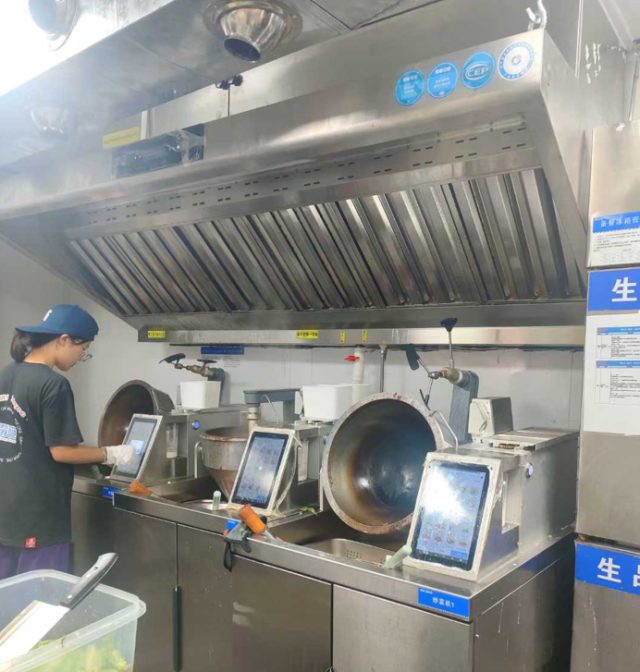
A railway station food court is the most schedule-driven foodservice environment in commercial catering. Service intensity follows the timetable, not the clock: a surge of passengers hits the stalls in the twelve minutes before each departure, the hall empties, and another wave arrives with the next arrival. Behind that rhythm sits a ventilation problem that no single-stall operator can solve alone, because the building belongs to the railway authority, the exhaust risers were sized decades ago, and every wisp of smoke that escapes a stall canopy drifts into a concourse where thousands of travelers form an instant, public judgment of the whole facility. This is the environment where the ductless Range Hood approach — an all-in-one canopy with an integrated electrostatic stage — has moved from convenience to default specification, and this article sets out how a station food court operator should deploy it stall by stall.
What Makes a Station Food Court Different
Three structural facts separate a railway station food court from a shopping-mall food court, even though the stall layout looks similar. First, the tenure split is severe: the railway authority or its concessionaire owns the building and the primary exhaust infrastructure, while each F&B stall is a separate tenant on a three-to-five-year lease. The tenant cannot penetrate the roof, cannot add a riser, and often cannot even access the plant deck. Any Exhaust Hood strategy that assumes the tenant controls a duct run to atmosphere is dead on arrival.
Second, the operating envelope is extreme. Stations run from the first train to the last — in major hubs that is effectively twenty hours a day, every day of the year — and the cooking load is not smooth. A noodle stall may idle for forty minutes and then serve sixty bowls in fifteen. Fryers and grills cycle from standby to full load dozens of times a day. Ventilation sized for a steady-state restaurant either over-runs wastefully at idle or under-captures exactly at the surge, and the surge is when the concourse is most crowded and most observant.
Third, the receptor is unavoidable. In a shopping mall, kitchen exhaust migrates toward service corridors that shoppers rarely enter. In a station, the concourse, the platforms, and the passenger tunnels form a single connected air volume. Smoke that leaves a stall canopy enters the breathing zone of every passenger on the concourse within minutes, and it also deposits: condensing grease-laden vapor settles on wayfinding signage, on platform flooring, and on rolling-stock liveries that the railway authority repaints on its own budget. Odor complaints at a station are therefore not just an F&B problem — they are a network-image problem, which is why railway landlords write emission clauses into F&B leases with a severity that mall landlords rarely match.
The Stall Mix and Its Pollutant Profile
A typical station food court runs eight to twenty stalls with a tenant mix that mirrors fast-casual demand: noodle and dumpling steamers, teppanyaki and stir-fry counters, fried chicken and fries, grilled kebab and burger flats, coffee roasting and espresso, and increasingly bubble tea and dessert counters with minimal cooking. The pollutant profile splits cleanly into three bands. Steamer and boiling stalls generate mostly water vapor with a light aerosol of starch and oil droplets — a light-duty capture problem. Stir-fry, griddle, and fryer stalls generate grease-laden vapor carrying sub-micron particulate, polycyclic aromatic hydrocarbons (PAHs), and volatile organic compounds (VOCs) — the heavy-duty band. Coffee roasting is a special case: low grease but intense odor and visible blue smoke that passengers notice from across the hall.
The mistake operators make is sizing one ventilation answer for all three bands. An oversized extraction canopy on a steamer stall wastes energy and dries out the product; an undersized canopy on a fryer stall leaks smoke into the concourse on the first surge of the day. The ductless all-in-one architecture solves the mismatch because capture, filtration, and clean-air discharge all happen at the stall itself, so each tenant matches the hood class to the menu rather than to a shared riser’s fixed capacity.
Stall-by-Stall Mapping with the Ductless Line
For the heavy-duty band — fryers, griddles, charcoal-adjacent grills — the ND-series heavy-duty all-in-one hood is the workhorse. It integrates a stainless-steel electrostatic precipitator cell behind a baffle pre-filter inside the canopy body, so grease aerosol is charged and collected before the air leaves the hood envelope, and the cleaned air is discharged back into the stall’s own space. No riser, no plant deck, no landlord negotiation. For stations where several heavy stalls sit side by side, pairing the ND-series hoods with a shared Odor Removal Tower takes out the VOC fraction that passengers smell even when they cannot see smoke — the difference between a stall that passes a visual check and a food court that passes a nose test.
For the light-duty band — noodle steamers, boiling counters, light griddle service — the N-series light-duty all-in-one hood provides capture at lower intensity and lower energy draw, and its integrated carbon-polishing stage keeps starch-and-oil film from migrating onto adjacent stall signage. Specifying an ND-series hood over a steamer stall is the common over-purchase; specifying an N-series over a fryer stall is the dangerous one, and the menu-to-hood mapping should be a lease-schedule document, not a verbal agreement.
Two product types cover the edges of the mix. The Cabinet Purifier — a self-contained ESP-plus-carbon unit on lockable casters — is the answer for kiosks and coffee corners that have no canopy at all: it sits beside a roaster or an induction counter, treats the plume at source, and can be repositioned when the tenant refreshes the kiosk layout. And where the railway landlord permits a short horizontal duct into a service void, the ducted ESP line — an ESP Purifier matched to a Centrifugal Fan — handles the rare stall whose menu demand exceeds what a ductless canopy can treat in-room. In practice that is a small minority: the overwhelming majority of station stalls are ductless-suitable, which is precisely why the ductless line leads the specification.
The Landlord-Tenant Compliance Framework
Modern station F&B leases increasingly specify emission performance at the stall boundary rather than prescribing equipment. The clause typically sets a visible-smoke prohibition, an odor-intensity limit at the food court’s public edge, and sometimes a grease-deposit requirement on surfaces above and around the stall. Ductless all-in-one hoods make these clauses enforceable and auditable in a way shared risers never were, because the treatment train is entirely inside the tenant’s demise: the landlord can inspect the canopy, check the ESP cell condition, and verify the carbon stage without access negotiations.
For the operator drafting or negotiating such a lease, three numbers matter. Capture efficiency at the cookline — the fraction of the plume that actually enters the hood — should be demonstrated against a recognized method such as the ASTM F2519 aerosol challenge or the EN 16282 capture provisions. Removal efficiency through the ESP stage should be quoted for the same aerosol, with sub-micron performance stated explicitly, because the sub-micron fraction is what stays airborne long enough to reach the concourse. And the odor stage should be characterized as a reduction across the cooking-odor spectrum, since a single-point odor number is meaningless against the mixed menu of a food court.
One drafting trap: leases that specify “extraction rate” per stall force tenants toward high-velocity hoods that, in an open concourse with strong cross-drafts from train-induced piston effects, actually degrade capture by blowing plume off the cookline. The correct specification language is capture-and-removal performance at the stall boundary — what leaves the stall, not how fast the fan spins.
Train-Induced Air Movement and Capture Design
A factor unique to stations is the air movement caused by the trains themselves. A train entering or leaving an underground platform acts as a piston, pushing a pressure wave through connected volumes, and stations ventilate their platforms with powerful supply and extract systems that cycle with service. The food court sits inside this moving-air environment, and a canopy that relies on a fragile rising thermal plume will lose capture during the pressure swings. The engineering counter is the same one that works in poolside pavilions: low-velocity, high-efficiency capture with a perimeter-slot canopy profile that draws air inward from all sides rather than fighting the cross-current, combined with an ESP stage that removes what is captured so that recirculation is safe.
Recirculation is the point that railway authorities probe hardest in plan review: if the hood discharges cleaned air into the food court, what proves the air is clean enough to breathe? The answer is the treatment train itself — baffle pre-filter, ESP cell, carbon or catalytic odor stage — with each stage independently serviceable and inspectable. A hood whose ionization stage interlocks with panel access, whose cells are field-replaceable, and whose filter condition is visible to the inspector is far easier to approve than a black-box unit, and station landlords have learned to demand exactly that serviceability.
Fire Safety in a Connected Air Volume
Fire strategy in a station treats the concourse and platforms as evacuation routes, and every duct penetrating a fire compartment line is a reviewed pathway. A traditional ducted canopy in a station food court therefore triggers compartment assessments, fire dampers, and often an impossibility finding when the riser crosses platform tunnels. The ductless architecture removes the duct from the problem: there is no riser to penetrate a compartment line, no grease accumulation along a horizontal run, and the fire-suppression scope collapses to the cooking appliance itself under a wet-chemical system. NFPA 96 recognizes listed ductless cooking equipment within its provisions, and European operators will map the same logic onto EN 16282 for the ventilation system and its grease-tightness requirements. The approval narrative is materially simpler, and station fire officers — who have seen every kind of improvisation — respond to simpler narratives.
Operations Around the Timetable
Maintenance at a station follows gaps in service, not calendar convenience. The practical discipline is timetable-anchored: pre-filter wash and visual cell check in the mid-morning lull between the commuter peak and the midday surge; a full ESP cell wash on a rotation set by stall class — heavy-duty stalls on a short rotation through the summer months, light-duty stalls on a longer one; and carbon-stage replacement on condition, tracked by differential pressure across the tower rather than by calendar. Operators that align cleaning windows with the natural service gaps achieve two things: the equipment runs at design efficiency during every surge, and the visible cleanliness of the canopy — which passengers read as a hygiene signal — stays presentable throughout the day.
Staff practice matters as much as the rota. Surge cooking tempts operators to over-fire, and over-firing is the single largest generator of visible smoke; a hood can only treat what enters it. Station stall training should include firing discipline at surge, the meaning of the hood’s indicator states, and a rule that any visible smoke escaping the canopy is reported as an equipment event, not accepted as a busy-day normal.
A Specification Template for a Twelve-Stall Hall
For a representative twelve-stall station food court, the specification reads as follows. Four heavy-duty stalls (fried chicken, burgers, kebab, wok) each take an ND-series all-in-one hood, sized to the cookline with perimeter overlap, with wet-chemical suppression over the appliances. Five light-duty stalls (noodles, dumplings, teppanyaki-lite, sandwiches, breakfast) each take an N-series hood. Two kiosks — coffee and dessert — take Cabinet Purifier units positioned at the plume source. One shared Odor Removal Tower is positioned to serve the cluster of heavy-duty stalls through short, landlord-approved connections, or each heavy stall carries its own compact odor stage where the ceiling void will not permit sharing. The remaining stall count flexes with tenant churn, and because every unit is ductless and self-contained, a re-tenanting that swaps a noodle stall for a grill stall is an equipment swap, not a building project.
That last property is the quiet strategic advantage of the ductless approach in stations: lease churn is constant, menus migrate, and every ducted decision is permanent. A food court built on ductless all-in-one hoods can re-tenant any stall in days, with the hood class adjusted to the new menu, without touching a riser, a plant deck, or a fire compartment line.
Why Ductless Wins the Station
The station food court concentrates every constraint that makes conventional kitchen exhaust hard — landlord control of the building, extreme load cycling, an unforgiving public receptor, and fire strategy built around evacuation routes — into a single hall. The ductless Range Hood line answers each constraint at the stall itself: capture at low velocity against train-induced air movement, electrostatic removal of sub-micron grease and particulate, odor polishing for the concourse nose test, and clean-air discharge that keeps every duct, damper, and riser out of the approval path. For operators bidding for station concessions and for railway landlords writing the emission clauses those concessions must meet, the ductless all-in-one specification is the template that survives contact with the timetable.