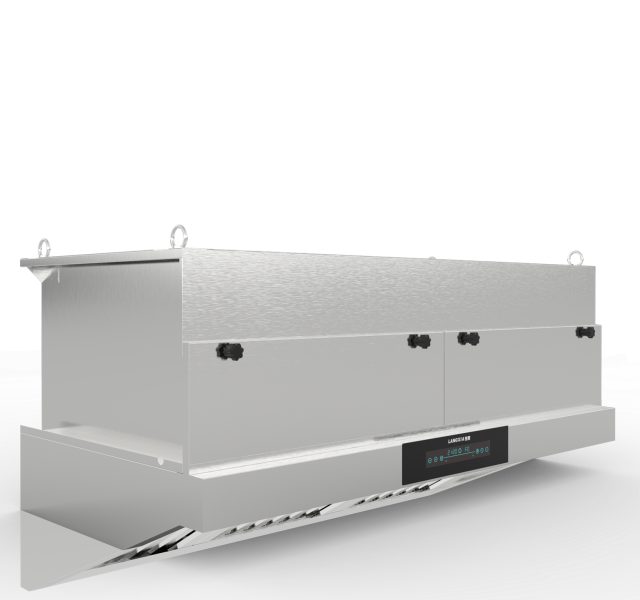
Ramen counters, sushi bars, and izakaya kitchens share a challenge that sets them apart from most Western-style restaurants: they generate a constant, layered stream of steam, aromatic vapor, and aerosolized oil that must be captured within centimeters of where diners sit. Broth pots boil for twelve hours or more, blowtorches sear the surface of aburi sushi at the pass, and the izakaya line fries karaage while charcoal skewers smoke behind it. Souniny’s ductless N-series and ND-series all-in-one range hoods, paired with the Odor Removal Tower, deliver professional-grade air purification without ductwork — which is precisely what counter-seating Japanese concepts need in leased, low-ceiling, and heritage building spaces.
The Three Emission Profiles of Japanese-Style Kitchens
Unlike a single-format kitchen, ramen, sushi, and izakaya operations stack three very different emission profiles under one roof. Understanding them is the first step to selecting the right purification architecture.
1. The Steam-Heavy Broth Station (Ramen)
Tonkotsu broth is boiled at rolling temperatures for 10 to 14 hours, releasing a continuous plume of steam laden with fine fat aerosols and intense, savory aromatics. The visible cloud is mostly condensed water vapor, but it carries sub-micron lipid droplets and volatile organic compounds (VOCs) that settle on ceilings, walls, and dining surfaces as a sticky film. Without capture, this film degrades the interior of a premium ramen house within months and becomes a hygiene liability during health inspections.
Steam is invisible to conventional baffle-filter thinking: it is not grease-heavy, but it is volume-heavy. The N-series handles this profile with high airflow capacity and a filtration train that separates condensate while capturing the fine oil fraction.
2. The Torch and Teppan Line (Sushi)
Aburi (flame-seared) sushi, torched salmon, and binchotan-grilled eel produce short, intense bursts of smoke and grease-laden vapor directly at the counter. A propane or butane blowtorch releases combustion products alongside the oil aerosol from seared fish skin. In many modern sushi bars, this happens within one meter of guests. The same applies to teppan cooking, where butter and oil flash at high temperature, throwing an aerosol plume that is both a sensory asset and an air-quality burden.
3. The Fried and Grilled Line (Izakaya)
Izakaya menus center on karaage (deep-fried chicken), tempura, yakitori skewers, and grilled fish. Deep frying produces dense, heavy grease-laden vapor that standard lightweight hoods cannot retain. Charcoal and gas grilling add sub-micron carbon particulate and smoke. This is the heaviest load of the three profiles and calls for the larger collector capacity of the ND-series.
Why Ductless Purification Fits the Japanese Counter Format
Counter-seating concepts — the defining format of ramen-ya, sushi bars, and neighborhood izakaya — place cooking directly in the dining room. A traditional ducted canopy mounted above a pass-through line requires vertical risers, roof penetrations, fire-rated shaft enclosures, and make-up air. In compact urban premises, these requirements are frequently impossible: landlords refuse roof access, heritage rules prohibit facade alterations, and basement locations have no path to the outside at all.
The ductless approach removes the entire exhaust infrastructure. The N-series and ND-series mount over the cooking line, draw the contaminated air through a multi-stage filter train, and return cleaned air to the room. For counter seating, this also preserves the chef-guest connection: no glass walls, no air curtains, no curtain of grease film on the sushi case.
How the Multi-Stage Filtration Train Handles Steam, Oil, and Odor
Both series share the same four-stage logic, tuned by model size:
Stage one — stainless-steel mesh pre-filter. Captures large droplets, batter fragments from the fryer, and coarse food debris. Removable and dishwasher-safe, it protects the downstream electrostatic cells from overload.
Stage two — electrostatic precipitation. The ESP cell charges and collects sub-micron oil mist and smoke particles that pass the mesh. This is the stage that actually removes the aerosolized fat that steam carries, and it is the reason the N-series and ND-series outperform simple carbon-filter hoods on Japanese menus.
Stage three — activated-carbon deodorization. Neutralizes the aromatic compounds of simmering broth, seared fish, and fried chicken that would otherwise linger in the dining room and migrate into neighboring retail units.
Stage four — Odor Removal Tower. Where odor sensitivity is extreme — a ramen shop beneath residential apartments, an izakaya in a mixed-use building, a sushi bar in a hotel lobby — the standalone Odor Removal Tower extends deodorization with additional chemical-media trays targeting sulfur and long-chain aldehyde compounds released by slow-simmered broths and torch searing.
Selecting Between N-series and ND-series for a Japanese Kitchen
The choice between the N-series (light-duty all-in-one) and the ND-series (heavy-duty all-in-one) follows the cooking load, not the cuisine label:
N-series — ideal for ramen counters and sushi bars where the dominant emissions are steam, light torch smoke, and gentle teriyaki searing. Its airflow and cell sizing match the moderate grease load of these lines while delivering the condensate handling that broth stations need.
ND-series — the right choice for izakaya kitchens with dedicated fryer batteries, charcoal yakitori grills, and robata lines. The reinforced collector plates and larger ionization zone handle the dense grease-laden vapor and carbon particulate that deep frying and live-fire grilling produce.
Mixed concepts — many venues run both profiles: a ramen counter by day and an izakaya grill menu by night. The practical answer is a combination, with an N-series over the broth station and an ND-series over the fryer and grill line, sharing a common Odor Removal Tower on the recirculation side.
The Counter Experience: Protecting Guests Without Barriers
Japanese counter dining sells atmosphere: the hiss of the fryer, the flash of the torch, the aroma of the grill. None of that atmosphere should include the sting of oil aerosol or the film of grease that settles on glasses and lacquerware. Recirculating ductless purification preserves the theater while removing the byproducts. Guests seated at the counter experience the visual and olfactory theater of the cooking, minus the respiratory irritation and the sticky surfaces that accompany an unmanaged kitchen plume.
For operators, the benefit is equally practical. Ceilings stay clean, the sushi display case stays free of film, ventilation grilles do not accumulate a grease crust, and the dining room does not need its own air-quality complaints logged in review platforms. Restaurants that manage kitchen air quality measurably improve review scores and repeat-visit rates.
Regulatory Compliance: EN 16282, NFPA 96, UL 710B, and Local Odor Rules
European operators of ramen and izakaya concepts must satisfy EN 16282, the European standard for commercial kitchen ventilation, covering airflow design, hygiene, and fire safety of kitchen ventilation components. In the United Kingdom, the Environmental Protection Act 1990 requires food businesses to prevent statutory nuisance from cooking odors — a clause that has closed more than one basement ramen shop in London. German TA Luft guidance sets measurable limits on odor units and organic carbon emissions.
In North America, NFPA 96 governs grease-removal and fire-safety practice in commercial cooking exhaust. While NFPA 96 traditionally assumes ducted systems, its fire-safety intent — preventing grease accumulation as a fuel source — is met by ductless systems that continuously remove grease aerosol before it deposits. The stainless-steel construction of the N-series and ND-series supports the hygiene expectations of UL 710B-style testing, and Souniny’s CE certification covers the electrical safety of the high-voltage power supply and ESP cells.
For operators in Japan, Southeast Asia, and Australia, AS 1668.2 and local municipal food-service codes increasingly recognize recirculating filtration for cooking equipment as an acceptable alternative where ducted exhaust is not feasible — provided the filtration equipment is maintained to the manufacturer’s schedule.
Energy Economics of Recirculation in Steam-Heavy Kitchens
Steam-heavy kitchens are energy-hungry in two ways: the fuel that boils the broth and the HVAC energy that removes or treats the resulting humidity. A conventional ducted exhaust in a ramen shop extracts the warm, humid air and draws in unconditioned replacement air that must be heated or cooled. In cold climates, that means reheating cold outdoor air in winter; in tropical climates, it means dehumidifying humid outdoor air in summer. Both are expensive.
Ductless recirculation avoids this cycle. The N-series and ND-series return air to the room after purification, so the broth station’s heat and humidity are partially retained in winter, and the HVAC system is not fighting a constant negative-pressure leak. Operators in Northern European cities have reported meaningful seasonal energy reductions after converting ramen and izakaya lines from ducted to ductless operation.
Installation, Maintenance, and Ownership Cost
Installation of a ductless all-in-one hood is a one-day job for a qualified technician: wall or ceiling mounting, a power connection, and commissioning of the high-voltage power supply. No duct fabrication, no roof work, no fire-rated shaft, and no coordination with building management beyond standard electrical approval.
Maintenance follows a simple rhythm. The pre-filter is cleaned daily or every two days depending on frying volume. ESP cells are immersion-washed weekly in warm degreasing solution — a 20-minute task per cell. Carbon media in the hood is replaced every six to twelve months, and the Odor Removal Tower media trays follow the same cycle. Souniny supports this with a 12-month whole-unit warranty, with ESP cells, aluminum collector plates, sealing strips, and ceramic insulators classified as consumable wear items.
Over a five-year ownership horizon, the ductless route typically wins on total cost: no duct-cleaning contracts, no access-panel inspections, no grease-buildup fire-risk mitigation, and no HVAC make-up air penalty. For leased premises — the norm for ramen and izakaya concepts — this is decisive, because capital invested in permanent duct infrastructure is not recoverable at the end of the lease.
Conclusion
Ramen counters, sushi bars, and izakaya kitchens ask more of their ventilation than most foodservice formats: steam volume from long-boiled broths, intermittent torch smoke at the pass, and dense grease from frying and charcoal grilling — all within a meter of the guest. Souniny’s ductless N-series and ND-series all-in-one range hoods, reinforced by the Odor Removal Tower, remove the grease, smoke, and odor at source and return clean air to the room. For the counter-format Japanese kitchen, ductless purification is not a compromise. It is the format that fits.