Comparing kitchen purification equipment from a datasheet is difficult in a way that comparing, say, delivery vans is not, because the most important numbers are either missing, quoted without context, or inflated by an unconventional measurement. Two units can both print 99 percent and 6,000 cubic metres per hour on the front page and differ by a factor of three in what they actually do. This article walks through a datasheet line by line – airflow, efficiency, the filtration train, power supply, materials, maintenance arithmetic, compliance and warranty – and marks what to check, what to compute, and what the absence of a figure usually means.
Airflow: which number is it?
Most datasheets lead with an airflow figure, and it is worth asking a simple question of that number: is it the maximum free-blowing output of the fan, or the rated flow at which the filtration stages were actually tested?
Every filtration stage in the train – mesh pre-filter, electrostatic cell, media filter, carbon bed – adds resistance, and airflow falls as resistance rises. A unit that moves 7,000 cubic metres per hour with the filters removed may deliver 5,000 or less with a loaded pre-filter in place. Datasheets that print only the maximum are not lying, but they are answering a question nobody asked. The figure that matters for sizing is the rated flow with the filtration train installed and part-loaded, because that is the condition the equipment lives in.
The second question is what happens to efficiency at that flow. An electrostatic cell collects sub-micron particles very well at low velocity and progressively worse as face velocity rises, so a purification efficiency figure measured at half the rated airflow tells you almost nothing about performance at the airflow you intend to run. The honest document is an efficiency-against-airflow curve; where a supplier offers one without being asked, that is itself informative.
Two companion figures belong on the same page. Static pressure tells you whether the unit can push air through ductwork where one exists, not merely through its own cabinet. And sound pressure level is only meaningful with its measurement condition attached – distance and background – because 60 dB(A) at one metre and 60 dB(A) at three metres are different products entirely.
A practical cross-check: divide the claimed airflow by the cross-sectional area of the treatment section. If the implied face velocity through the electrostatic cell exceeds roughly one metre per second, the collection efficiency claim is not physically plausible at that flow. The arithmetic takes thirty seconds and catches the most common inflation in the category.
Efficiency claims: ninety-nine percent of what?
Percentage efficiency without three qualifiers – particle size, test method and loading state – is marketing, not data. Each qualifier changes the number by an order of magnitude.
Particle size first. Capturing visible oil mist, most of which sits in the ten-micron and larger range, is close to trivial; almost any mesh will do it. The difficult fraction is sub-micron – the fume and the aerosol that stays airborne, passes through mesh, darkens ceilings and carries odour. A claim of 99 percent against visible smoke and a claim of 90 percent against 0.3 micron particles describe entirely different machines, and the second is the harder, more valuable number.
Test method second. Was the efficiency measured against a standard aerosol challenge under a recognised procedure, or measured in-house with a smoke machine and a phone camera? Both produce percentage signs; only one produces evidence. Where a third-party report exists, the method and the loading state are stated on its face.
Loading state third. Efficiency on a clean cell is the easy number. Every electrostatic cell loses collection performance as grease accumulates on its collector plates, and the relevant question for a buyer is not the clean figure but the shape of the decline – how quickly, and what the manufacturer specifies as the cleaning interval that restores it. A supplier who quotes a clean-cell figure and also states a credible service interval is describing a real machine; one who quotes only the clean figure is describing a photograph.
There is also a number that often goes unasked: ozone. High-voltage ionisation produces ozone as a by-product, and most jurisdictions cap it against recognised indoor air guidance. A responsible datasheet states the by-product level; an evasive one does not mention the word.
The filtration train, stage by stage
The train behind the front page is where two similar-looking units separate. Ask what is physically inside, in order, and how each stage is replaced.
The pre-filter matters more than its position suggests. A washable mesh and a proper baffle or cyclone stage are different products with different service lives; the pre-filter determines how much of the heavy grease reaches the electrostatic cell, and the cell’s cleaning interval is largely decided upstream of itself.
The electrostatic cell deserves its own questions: how many cells, what collector material – aluminium is standard and lighter, stainless steel survives corrosive and high-temperature streams better – and what the cell dimensions are, because cell area is the physical basis of every efficiency claim. A datasheet that hides cell dimensions is hiding the one number from which everything else could be checked.
Behind the cell, look for what actually addresses the volatile fraction. A media filter noted as F8 or H13 grade is a particulate stage, not an odour stage; only activated carbon addresses cooking volatiles, and the meaningful figure is the quantity of carbon in kilograms, not the existence of “a carbon filter”. A thin carbon pad saturates in weeks in a commercial kitchen; a deep bed measured in kilograms is a consumable with a real service life.
Replaceability is the last test of the description. Can one person remove a cell for washing in a few minutes without tools, or is the train a sealed assembly that goes back to the factory? The answer decides whether maintenance is a scheduled task or a service call, and the cost difference over five years is larger than the price difference between competing units.
Power supply, electrical and environment
The high-voltage section is the part of the machine most likely to fail, and the datasheet says more about it than buyers usually notice.
Look for the type of high-voltage supply – a conventional transformer-based unit and a switched-mode supply with automatic load tracking behave differently under arcing and dirty-cell conditions. Load-sensing supplies reduce power as the cell loads up rather than shutting down, which keeps a kitchen running between cleanings instead of stopping it. Where a supplier specifies an automatic shut-down on fault, ask what the restart procedure is and who performs it.
The electrical envelope questions are mundane and decisive: supply voltage and frequency compatibility for the destination market, total power consumption across the fan and the high-voltage section at rated flow, ingress protection if the unit sits near a wash-down area or under a leaky roof, and whether the control interface offers anything beyond an on-off switch – a fault indicator, a filter-loading indication, or a connection that can report into a building system.
Materials, weight and build honesty
Weight is the most under-used honesty check in the category. Metal thickness, cell mass, motor size and cabinet bracing all add up, and a unit claimed to handle heavy-duty flow at a suspiciously low weight is telling you something its brochure does not. Compare the stated weight against comparable units at the same airflow; large divergences in either direction deserve a question.
Stainless grade matters where the stream is corrosive – salt-laden coastal air, heavy charcoal work, cleaning chemicals – and SUS 304 costs more than SUS 201 for a reason that shows up in year four rather than year one. Cabinet construction details worth checking are the gasketing around access doors, the drainage arrangement for water-wash or condensate, the finish of welds at grease-contact points, and whether fasteners at the wet sections are corrosion-compatible with the panels around them.
Maintenance arithmetic you can do yourself
Most datasheets state a service interval as a virtue rather than a calculation. Treat it as a hypothesis and check it against your own loading.
The inputs are simple: the area of the electrostatic collector surface, the grease load your menu generates, and the hours of operation. A heavy charbroiler line loading a given cell area will need attention several times more often than a steamer line on the same hardware. When a manufacturer states forty to sixty days between cell cleanings, ask what cooking load that assumes – the honest answer is a specific duty class, and the vague answer is a brochure.
Then check the consumables picture: which parts are consumable – pre-filters, cells, carbon, seals, high-voltage insulators usually are – how they are priced and supplied, and how many years of spares availability the manufacturer commits to. A five-year-old cell that cannot be replaced turns the whole unit into scrap, so parts availability is a durability claim, not an after-sales courtesy.
Finally, weight the cleaning access against the cleaning method. Cells that slide out and wash in a sink keep maintenance in-house; assemblies that need a technician with chemicals on site do not. Automatic water-wash options exist and change the arithmetic again, at a price that should be compared against the labour it replaces over the same period.
Compliance, test evidence and warranty
Compliance markings split into two very different kinds. A CE declaration is a self-declaration of conformity with the applicable directives; a third-party test report from a recognised laboratory against a named standard is evidence. Both may be legitimate, but they are not the same weight, and a datasheet that presents the first in the typography of the second is relying on nobody reading carefully.
For recirculating installations – where cleaned air returns to the room rather than leaving through a duct – the listing question is sharper still: the assembly should be covered by a listing route that evaluates the treatment stages, such as the UL 710B route in North America, and accepted by the authority having jurisdiction. European projects lean on the EN 16282 series and national guidance; Australian projects on AS 1668.2. Ask which documents apply to the configuration being sold, not to the product family in general.
Warranty terms deserve a line-by-line read because the exclusions are standard and structural. Twelve months on the whole unit is common; electrostatic cells, collector plates, sealing strips and ceramic insulators are normally classed as consumable wear items and excluded, which is reasonable – they are the parts that do the work and take the load. What matters more is what the warranty says about the high-voltage power supply, the component with the highest repair cost, and whether the manufacturer names a parts availability horizon beyond the warranty year.
A short list of red flags
Enough reading of datasheets produces a compact list of tells. None is individually disqualifying; three together usually are.
– Airflow quoted only as a maximum, with no rated flow through the filtration train.
– Efficiency quoted only as a clean-cell percentage, with no particle size, method or loading context.
– No electrostatic cell dimensions or count – the number from which efficiency could be independently estimated.
– No ozone statement anywhere in the document.
– A weight inconsistent with the claimed construction and airflow.
– Carbon described without a quantity.
– Compliance typography implying third-party testing where only a self-declaration exists.
– No parts availability commitment beyond the warranty period.
The mirror image is also true. A datasheet that states rated and maximum airflow separately, publishes an efficiency curve, names cell materials and dimensions, quantifies the carbon, states an ozone figure, and attaches a dated third-party report is from a manufacturer who expects to be checked – and that expectation predicts the next five years of the relationship better than any brochure.
Applying the checklist to the two architectures
The same reading discipline applies whichever architecture a project lands on, and it is worth being explicit about what a well-documented unit looks like in each.
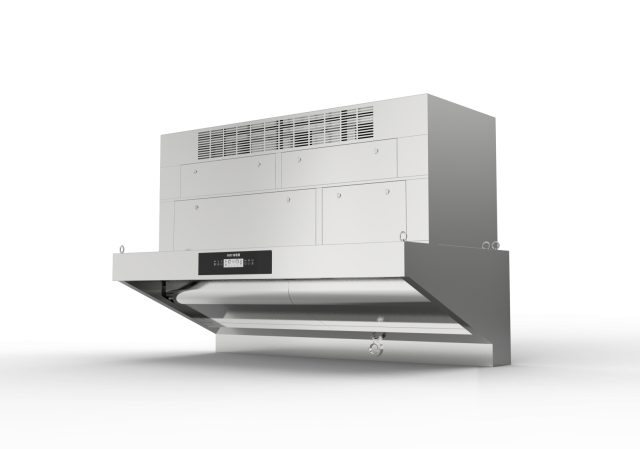
In the recirculating above-cookline format, the datasheet has to describe a complete train in one cabinet: the pre-separation stage, the electrostatic section with its cell count and material, the media grade behind it, and the carbon quantity behind that. A well-documented medium-duty unit in this format, such as the N-series, will state a rated flow with the full train installed, an 850-millimetre body width, and the electrical consumption across fan and high-voltage sections at that flow. Where the duty is heavier – rendering fat, open flame, solid fuel – the ND-series documents a water-cycle section ahead of the cells with its tank capacity and a low-water lockout, medium and high-grade media behind, and a stated cell-cleaning interval in days that assumes a specific duty class rather than a generic kitchen. In both cases the odour stage is documented separately, because the dedicated Odor Removal Tower line addresses the volatile fraction with quantities and a removal figure of its own, and it belongs in the comparison with its own numbers rather than folded into the particulate claims.
For the ducted route, where treatment sits in the extract run and larger total volumes are handled, the additional datasheet questions are static pressure, fan matching and weather protection at the discharge – and where the project genuinely supports that route, the ducted ESP purifier range is documented around inline airflow and pressure rather than cabinet dimensions, which is exactly the difference the checklist above is designed to catch. For shops that do not support a duct run at all, the recirculating ductless range hood family is documented as a single integrated assembly, and every stage in it should be individually specified. And the discipline extends to mobile equipment without change: for market and event operators comparing mobile food carts, the same five questions – rated flow, efficiency context, cell detail, carbon quantity, service interval – separate a working pitch from a complaint generator just as reliably as they do a fixed kitchen.
Bringing it to a decision
Reduce the whole exercise to five questions and ask them of every candidate in the same order: what is the rated flow with the train installed; what does the efficiency curve look like at that flow, against what particle size and method; what is inside the train, stage by stage, with dimensions and quantities; what is the maintenance arithmetic in my duty class and my hours; and which test documents, not markings, support each claim.
Suppliers who answer those five questions on paper are usually the ones who answer them after the sale as well. The datasheet, read carefully, is not a brochure – it is the most honest preview of the ownership experience a buyer will ever get for free.