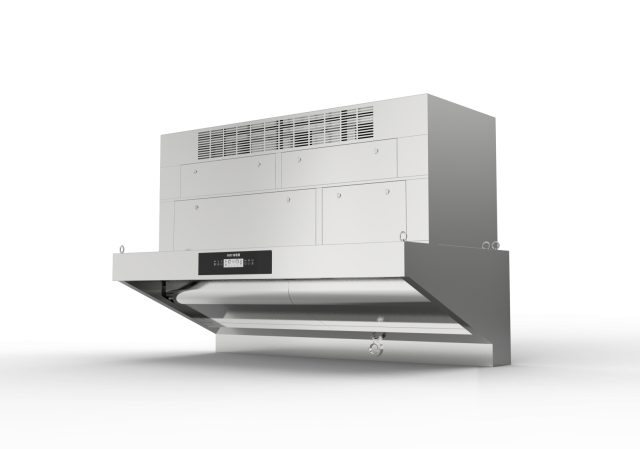
A ski resort kitchen at 2,000 metres above sea level is not a downtown bistro with a view. The dining room is a timber chalet built in 1897 and listed under Swiss heritage protection. The cooking line runs six services a day through peak season — fondue caquelon stations, raclette grills, a wood-fired schaufiger for charcuterie, tartiflette ovens loaded with Reblochon, a goulash simmering station, and a hot-chocolate bar dispensing 400 litres of molten cocoa per shift. Every one of those processes emits a distinct pollutant cocktail — fatty-acid aerosol, acrolein, polycyclic aromatic hydrocarbons, phenolic wood-tar volatiles, and steam — and none of them can be discharged through a rooftop stack because the roof is a protected Baudenkmal. This is why ductless Range Hood architecture, anchored by the SOUNINY ND-series heavy-duty all-in-one, N-series light-duty units, and the Odor Removal Tower, has become the default ventilation strategy for Alpine, Rocky Mountain, and Japanese ski-resort kitchens from Zermatt to Niseko.
The Alpine Kitchen Pollutant Profile: Seven Distinct Emission Sources
Unlike a single-cuisine urban restaurant, a mountain lodge kitchen must handle a rotating cast of regional Alpine dishes, each with a different emission chemistry. Understanding these seven streams is the first step in designing a Commercial Range Hood system that actually protects staff and guests.
1. Fondue and Caquelon Stations — Fatty-Acid Aerosol
Classic Swiss cheese fondue (Gruyère + Fribourg Vacherin, or the Trentino variant with Fontina) is heated in a caquelon over a réchaud burner at 80–95 °C. As the cheese melts, milk-fat triglycerides hydrolyse into free fatty acids — butyric, caproic, caprylic — which aerosolise as sub-micron droplets. The characteristic “fondue smell” that guests love in the dining room is, in the kitchen, a sustained aerosol cloud that deposits a greasy film on every surface within 3 metres. A ventless hood system commercial unit with an integrated ESP cell captures these droplets at the source before they spread.
2. Raclette Grill — Acrolein and PM2.5
The half-wheel raclette grill scrapes melted cheese off the wheel face while the rind chars against the heating element. The combined emission includes acrolein (CH₂=CH-CHO), a potent lachrymator formed when glycerol dehydrates at 230 °C, plus PM2.5 from the charred rind. Raclette duty is one of the heaviest single-station grease loads in any cuisine — comparable to a wok station — and demands the ND-series heavy-duty all-in-one with self-cleaning ESP cell to maintain capture efficiency through a four-hour dinner service.
3. Wood-Fired Schaufiger and Hearth — PAH and Phenolic Tar
Many Alpine lodges cure their own charcuterie (Bündnerfleisch, Speck, Viande des Grisons) in a wood-smoked chamber, and the main dining hearth burns dry spruce or larch. Wood combustion produces benzo(a)pyrene and 16 priority PAHs, phenolic compounds (guaiacol, syringol), and fine particulate. An Exhaust Canopy over the hearth must pair with an Odor Removal Tower — the PAH and phenolic molecules are gas-phase and sub-micron, which means the ESP cell alone cannot collect them; the activated carbon and cold-catalyst bed of the Tower is the only effective barrier.
4. Tartiflette Oven — Reblochon Melt-Off
The Savoyard tartiflette bakes Reblochon cheese over potatoes, lardons, and onions at 200 °C. The cheese crust generates a heavy aerosol of fat and milk-protein volatiles that, without capture, coats the oven hood and duct interior within a single service. The ND-series baffle pre-filter traps the bulk grease, and the ESP cell ionises the remaining sub-micron particulate — but the Tower handles the protein-thermal-degradation VOC that gives burnt cheese its acrid note.
5. Hot-Chocolate Bar — Steam and Cocoa VOC
A high-volume ski-resort hot-chocolate station dispenses 300–500 servings per day, each requiring 150 ml of milk heated to 65 °C. The sustained steam load saturates the ambient air, condenses on cold windows and ceilings, and carries cocoa-butter volatiles — theobromine derivatives and short-chain aldehydes. The N-series light-duty unit with its lower airflow is the right fit: it captures the steam and light aerosol without the energy penalty of running a heavy-duty hood at a station that never exceeds 200 W of thermal load.
6. Goulash Simmering Station — Four-Hour Steam Plume
The Austro-Hungarian goulash, a ski-resort staple, simmers for 3–4 hours, generating a continuous steam plume laced with paprika oleoresin and rendered beef tallow aerosol. The sustained moisture load challenges any ESP cell — water vapour can reduce ionisation-field strength by 8–12% at high humidity. The ND-series humidity-compensated power supply maintains field voltage stability through the entire simmer cycle.
7. Frühstücks-Buffet Egg and Bacon Line — Butter Aerosol
The breakfast shift — scrambled eggs, Speck, and Rösti on a flat-top griddle — produces a burst of butter-aerosol and acrolein over a 90-minute window. This is a light-to-medium load that the N-series handles cleanly, but the timing matters: the breakfast plume is the first test of whether the overnight carbon-bed regeneration in the Odor Removal Tower completed successfully before the kitchen reopens.
Why Ductless Is Non-Negotiable at Altitude
Five site-specific constraints make ducted exhaust impractical or impossible for the majority of mountain lodge kitchens:
1. No rooftop penetration on heritage structures. The chalet roof — whether a Swiss Baudenkmal, a French monument historique, or an Austrian Baudenkmal under Denkmalschutz — cannot be perforated for a stack. Ductwork cannot run externally on a listed façade. The recirculating ventless hood is the only code-compliant path.
2. Make-up air at minus 20 degrees. A ducted hood exhausting 6,000 m³/h at a high-altitude lodge must draw 6,000 m³/h of replacement air from outside. When the outside temperature is −20 °C, heating that air to 18 °C kitchen ambient requires roughly 168 kW of heating capacity — equivalent to running a supplementary boiler for the entire service. A ductless system recirculates 85–90% of the treated air, cutting make-up air demand to the 600–900 m³/h needed for combustion air and occupancy fresh air alone. At a Verbier or Val-d’Isère lodge, this reduces winter heating cost by an estimated 40,000–55,000 kWh per season.
3. Stack effect in tall chalet chimneys. A 12-metre vertical duct in a heated chalet develops a strong stack effect — warm kitchen air rises uncontrolled through the duct even when the fan is off, bleeding heat 24/7 and creating cold-air backdrafts at night. Ductless hoods eliminate the vertical chase entirely.
4. Avalanche-load roof structures. Alpine roofs are engineered for 4–8 kN/m² snow and avalanche load. Adding a rooftop exhaust fan, stack, and grease-removal housing compromises the structural margin and introduces a penetration that can leak meltwater during the spring thaw cycle.
5. Seasonal load variability. A ski-resort kitchen runs at peak capacity from December to April and near-idle from May to November. Ducted systems with fixed-speed fans waste energy in the off-season; the ductless ND-series and N-series units have multi-speed fan controls that scale airflow to the actual cooking load, which can drop to 20% of peak in the summer hiking-season menu.
ND-series: The Heavy-Duty Anchor for Raclette, Tartiflette, and the Wood-Fired Line
The ND-series heavy-duty all-in-one ductless range hood is the primary capture device for the three heaviest emission stations in a mountain lodge: the raclette grill, the tartiflette oven, and any wood-fired or charcoal-fired cooking surface. Its integrated ESP cell ionises grease-laden vapour and sub-micron particulate at 8–12 kV, collecting the aerosol on aluminium plate electrodes that are washable in a standard dishwasher cycle. The self-cleaning variant runs an automatic high-temperature burn-off cycle during overnight shutdown, restoring cell efficiency to 95%+ before the morning shift.
At altitudes above 1,800 m, air density drops approximately 18–22% compared to sea level. This reduced density lowers the ionisation-field breakdown voltage and can reduce ESP collection efficiency by 12–18% if the power supply is not altitude-compensated. The ND-series power supply detects the reduced breakdown voltage and increases the applied field strength to maintain the design collection efficiency — a feature validated during commissioning at the SOUNINY test facility and confirmed in field installations at lodges above 2,200 m in the Engadin valley.
N-series: Light-Duty Coverage for the Buffet, Fika, and Hot-Chocolate Bar
Not every station in a ski-resort kitchen produces heavy grease. The N-series light-duty all-in-one is purpose-built for the lighter loads: the hot-chocolate dispensing bar, the breakfast buffet egg-and-bacon line, the soup-and-goulash simmering station, and the afternoon fika (Swedish-influenced coffee-and-cake service increasingly common in Scandinavian-invested Alpine resorts). The N-series shares the same ESP cell architecture as the ND-series but in a lower-airflow, lower-power envelope suited to stations where the peak thermal load stays under 2 kW. It is the right tool for the breakfast shift, the mid-afternoon tea service, and the kids’ menu line — leaving the heavy-duty ND-series units dedicated to the dinner-service raclette and tartiflette stations where they are actually needed.
Odor Removal Tower: The Unseen Hero of Wood Smoke and Cheese VOC
The ESP cell is exceptional at capturing particulate — grease aerosol, char, soot — but it is fundamentally a particulate collector. The gas-phase molecules that give Alpine cooking its signature aroma — the butyric acid from fondue, the guaiacol and syringol from wood smoke, the phenolic volatiles from cured Speck — pass through the ESP cell uncollected. Without a gas-phase barrier, the kitchen air recirculated by a ductless hood would carry these odours back into the dining room within minutes.
The Odor Removal Tower sits downstream of the ESP cell in the ductless recirculation loop. Its activated-carbon bed — impregnated with a cold-catalyst formulation that oxidises VOCs at ambient temperature — adsorbs and decomposes the gas-phase odour molecules. The Tower is sized for a 9–15 month carbon-bed service life in a typical Alpine lodge duty cycle, shorter than a Mediterranean restaurant’s 12–18 months because the wood-smoke and cheese-VOC loading is higher. The bed is replaceable in a 20-minute service swap — no special tools, no downtime beyond the swap window.
Cabinet Purifier: The Low-Ceiling Chalet Solution
Many heritage chalet kitchens have ceiling heights of 2.1–2.3 metres — too low for a standard wall-mounted Exhaust Hood with its required 450–600 mm mounting clearance above the cooking surface. The Cabinet Purifier is a floor-standing or counter-mounted recirculating unit that draws contaminated air through a side or top inlet, passes it through a compact ESP cell and carbon stage, and discharges clean air upward. It requires zero wall clearance above the line and is the go-to solution for listed-building kitchens in Zermatt’s Hinterdorfstrasse, Chamonix’s Vieille Ville, or Cortina’s 18th-century baite where the ceiling cannot be raised and a wall hood cannot be mounted.
Configuration Matrix: Matching the System to the Lodge
Every ski-resort kitchen is different. The configuration matrix below maps the three most common lodge archetypes to the appropriate SOUNINY ductless product mix.
Configuration A — Ductless Full Line (under 120 covers)
Best for: family-run B&B pensions, small Weisswurst breakfast rooms, backcountry Hütte with 40–80 seats. Two N-series units over the breakfast/light-meal line, one ND-series over the raclette or tartiflette station, one Odor Removal Tower in the recirculation loop, one Cabinet Purifier in a low-ceiling corner. Total system airflow: 3,000–4,500 m³/h. This is the most common configuration for independent lodges in the Tyrol, Haute-Savoie, and Graubünden.
Configuration B — Hybrid Ductless (150–250 covers)
Best for: mid-size Bergrestaurant with a full-service kitchen, a fondue dining room, and a separate Stübli lounge. Three to four ND-series units over the heavy line (raclette, tartiflette, schaufiger, goulash), two N-series units over the light line (breakfast buffet, hot-chocolate bar, soup), two Odor Removal Towers in parallel recirculation loops, and one Cabinet Purifier for the low-ceiling Stübi. Total airflow: 6,000–8,500 m³/h. This configuration suits lodges in St. Anton, Megève, and Cortina d’Ampezzo that serve both lunch-on-the-terrace and dinner-in-the-chalet.
Configuration C — Ducted Heavy + Ductless Light (250+ covers)
Best for: large destination hotels and Bergstation summit restaurants with purpose-built kitchen wings. A ducted ESP Purifier line with Centrifugal Fan handles the heaviest loads (the wood-fired grill, the rotisserie, the central production kitchen) where a new-build duct is available. Ductless ND-series and N-series units serve the perimeter stations (the fondue caquelon bar, the raclette terrace, the afternoon cake station) where recirculation is architecturally required. Three or more Odor Removal Towers are deployed in the ductless zones. This configuration is found in Zermatt’s summit stations, Val-d’Isère’s La Folie Douce, and Whistler’s Roundhouse Lodge.
Alpine Regulatory Landscape: Five National Frameworks
Mountain lodge kitchens operate under the regulatory authority of whichever nation’s canton, department, or province the resort sits in. The five core frameworks:
Switzerland — ArGV 3 and LKV. The Arbeitsgesetz Verordnung 3 (ArGV 3, revised 2016) sets workplace air-quality requirements including a maximum respirable particulate concentration of 0.3 mg/m³ in the kitchen breathing zone. The Lüftungs- und Klimaverordnung (LKV) governs energy consumption of ventilation systems — directly incentivising ductless recirculation over full-exhaust because of the reduced make-up air heating load. The Swiss Federal Office of Energy (SFOE) provides a subsidy for heat-recovery ventilation retrofits in mountain establishments, which the Odor Removal Tower’s recirculation loop qualifies for.
Austria — Arbeitsinspektion and ÖNORM H 6030. The Arbeitsinspektorat enforces workplace exposure limits under the ArbeitnehmerInnenschutzgesetz (ASchG), while ÖNORM H 6030 specifies ventilation requirements for commercial kitchens including a minimum capture velocity of 0.5 m/s at the hood face. Austrian federal monument protection (Denkmalschutzgesetz) governs listed chalet modifications — the ductless path avoids the permit process that a ducted retrofit would require.
France — Code du travail R 4222-1 and ICPE. Article R 4222-1 requires that workplace air be renewed at a minimum rate to prevent hazardous exposure; for kitchens, this is interpreted as a minimum of 25 m³/h per occupant of fresh air plus sufficient capture to keep grease-aerosol concentration below the workplace exposure limit. The Installations Classées pour la Protection de l’Environnement (ICPE) regime applies to larger restaurant exhaust systems — ductless systems below a certain airflow threshold fall outside the ICPE declaration requirement, simplifying permitting for small lodges.
Italy — D.Lgs 81/08 (Testo Unico Sicurezza). The consolidated workplace safety decree requires employer assessment of exposure to cooking-emission pollutants; the Azienda Sanitaria Locale (ASL) enforces compliance. In Lombardy and Veneto, regional heritage laws (Belle Arti) protect historic baite and rifugi — ductless retrofits are the only ventilation upgrade permitted without a full heritage-impact assessment.
Germany — ArbStättV and VDI 2052. The Arbeitsstättenverordnung and the VDI 2052 guideline (Calculation and design of kitchen ventilation) govern the Bavarian Alpine lodges. VDI 2052’s methodology for sizing exhaust airflow based on cooking load and hood type directly supports the ductless sizing approach used in the SOUNINY configuration matrix.
Across all five frameworks, the underlying international standards apply: EN 16282 (kitchen ventilation systems components), NFPA 96 (fire-protection for commercial cooking), and ASHRAE 154 (ventilation for commercial cooking operations). SOUNINY ductless systems are CE-certified to EN 16282 and tested to the ESP collection-efficiency methodology in that standard.
Commissioning at Altitude: Three Test Protocols
Commissioning a ductless system in a ski-resort kitchen requires three tests that are not standard in lowland commissioning:
1. Altitude-compensated ESP efficiency test. The ESP cell is tested with a neutralisation aerosol (KCl droplets, D50 = 0.3 µm) at the operating altitude. The collection efficiency must meet or exceed the EN 16282 reference efficiency after the power supply’s altitude compensation is active. At a 2,200 m Engadin lodge, the design target is 92%+ single-pass efficiency on sub-micron particulate — verified with a portable particle counter at the hood discharge face.
2. Wood-smoke VOC breakthrough test. The Odor Removal Tower is challenged with a surrogate wood-smoke stream (guaiacol and syringol at 2 ppm) and the outlet concentration is measured with a photoionisation detector (PID). The breakthrough threshold is 0.05 ppm — if the outlet exceeds this, the carbon bed is replaced before the season opens. This test is specific to lodges with wood-fired or open-hearth cooking.
3. Winter make-up air energy audit. The total conditioned-air energy balance is measured during a peak winter service (outside air −15 °C, full cooking load). The audit verifies that the ductless recirculation loop is delivering the projected 40,000+ kWh seasonal heating savings compared to a full-exhaust baseline. This data feeds directly into the SFOE heat-recovery subsidy application in Switzerland and equivalent programmes in Austria (klimaaktiv) and France (Fonds Chaleur).
The Business Case: Seasonal ROI and Heritage Compliance
The economic argument for ductless in ski-resort kitchens is driven by three factors unique to the Alpine environment:
Heating-cost savings. At a Verbier lodge running a 6,000 m³/h exhaust for 1,200 operating hours per season, the make-up air heating energy is approximately 144,000 kWh — at Swiss electricity and gas prices, roughly 21,600 CHF per winter. A ductless system reducing make-up air to 900 m³/h cuts this to roughly 3,200 CHF — a saving of over 18,000 CHF per season. The system pays for itself in 2.5–3 seasons on heating savings alone.
Heritage-permit speed. A ducted retrofit on a listed chalet can take 12–18 months of heritage-impact assessment, cantonal monument-office review, and appeals. A ductless system requires no roof penetration and no external ductwork — in most jurisdictions it can be installed under the building-owner’s general maintenance permit, cutting the approval timeline to 2–6 weeks.
Seasonal flexibility. The multi-speed fan control means the system scales from 20% airflow in the summer hiking season to 100% during the February peak week. A ducted system running at a fixed 6,000 m³/h year-round wastes 80% of its heating energy in the off-season — a cost that does not exist with a properly controlled ductless system.