Walk into any Spanish tapas bar on a Friday night and you are standing inside one of the most ventilation-challenged kitchen typologies in Europe. The pintxos bar is six metres of glass under a tiered display of txangurro, bacalao, and txistorra; behind it, two cooks sear chorizo on a flat-top griddle while a churros fryer turns out piping-hot spirals of dough. Down the corridor a paellera simmers saffron rice for forty covers; around the corner a side room ages whole jamón Ibérico de bellota at 12–16 °C. Each station pushes a different pollutant profile — grease-laden vapor, sub-micron particulate, acrolein from overheated olive oil, polycyclic aromatic hydrocarbons from oak-fired brasas, ammonia and volatile fatty acids from the curing cellar — into the same air column that your diners are breathing across the barra. A single Commercial Range Hood with a baffle filter will not carry this load. Souniny’s ductless all-in-one architecture — pairing the N-series (light-fume) and ND-series (heavy-fume) Exhaust Hood ranges with the Odor Removal Tower and Cabinet Purifier — is engineered for exactly this multi-station, low-to-high intensity smoke picture. This guide explains why Spanish and Basque kitchens are an outlier in the European dining landscape, how to map the pollutant profile of each station to the right product, and what a defensible sizing and configuration matrix looks like for venues from a 24-cover barra in San Sebastián’s Parte Vieja to a 220-cover asador in Madrid’s Malasaña district.
Why Spanish and Basque Kitchens Are a Ventilation Outlier
Mediterranean cuisines share a few kitchen traits — olive oil as the primary cooking fat, frequent high-heat grilling, and a heavy reliance on cured and aged proteins. Spanish and Basque cooking, however, push each of these to an unusual extreme. Olive oil in a Madrid asador is heated well past its smoke point (refined olive oil: ~210 °C; extra virgin: ~190 °C) to sear lamb chops and secretos ibéricos. The churros fryer holds 200 °C sunflower oil for the entire service, generating continuous acrolein plumes and a steady rain of flour-dust-loaded oil aerosol. The paella range, the spiritual heart of any Spanish kitchen, runs for 90 minutes to two hours at full fire on a 60-centimetre paellera, with olive oil slicking the steel and a constant bloom of saffron-tinted vapor rising into the dining-room air. None of these conditions are common in French, Italian, or Greek kitchens in the same concentration, which is why a Spanish Exhaust Canopy specification almost never reuses a peer Mediterranean design.
The Basque pintxos tradition makes the picture more complex. A traditional barra in San Sebastián or Bilbao is a long, narrow, glass-fronted display case with a dozen-plus hot plates embedded in the bar itself: txangurro (spider crab) under salamandra broilers, bacalao (salt cod) croquettes in countertop fryers, txistorra (thin pork sausage) rolling on a hot plate, and a steady procession of tortilla española wedges sliced by hand. Each plate generates a different fume at a different duty cycle, all under a single shallow hood. The result is a low-ceiling, customer-facing cooking line where diners literally eat three feet from the flat-top, and where the ventilation decision doubles as a guest-experience decision. Baffle filters in this geometry will not capture sub-micron particulate; they will only push grease down the back of the counter and into the air your customers are smelling. A ductless all-in-one Range Hood that recirculates cleaned air back into the dining room — paired with an Odor Removal Tower for the chive, smoked paprika, and oak-wood aroma envelope — is the architecture that fits.
The Pollutant Profile of Paella, Pintxos, Churros, and Jamón Service
Mapping the cooking line to the right Souniny product starts with a clear-eyed view of what each station actually emits. Paella is a long-tail, medium-intensity pollutant source. The dominant emissions are: olive-oil aerosol (triglyceride droplets in the 0.3–2 µm range, the sweet spot for Electrostatic Precipitator collection), Maillard-reaction products from the sofrito base (caramelised onion, garlic, and ñora peppers generating aldehydes and pyrazines), and a steady stream of water vapor with dissolved saffron volatiles (safranal). The duty cycle is high for 90 minutes, then quiet — a profile that the ND-series Exhaust Hood is purpose-built to handle. The flat-top griddle behind the pintxos bar is a different story. Chorizo, morcilla, and txistorra render animal fat continuously, generating a fat-loaded vapor that condenses on every cold surface in the room. The N-series with its multi-stage Electrostatic Precipitator cell captures this grease before it migrates into the dining room.
The churros fryer is the hardest station. Flour-dust loading is the issue: every basket drop aerosolises fine wheat particles that ignite on the heating element and produce a sub-micron particulate stream loaded with acrolein (from overheated oil) and polycyclic aromatic hydrocarbons (PAH) at low but cumulative levels. Baffle filters clog within hours; ESP cells in the ND-series hold their capture efficiency across a full service and recover automatically during the cool-down cycle. The jamón Ibérico curing cellar is the third distinct challenge. The cut and aging process releases ammonia, trimethylamine, and short-chain volatile fatty acids at very low concentrations but over months, not hours. The Odor Removal Tower is designed for this profile: a long-residence-time activated-carbon and chemisorbent bed that scrubs the low-concentration, high-persistence odorants without needing the high airflow of an active kitchen line. Place the Odor Removal Tower on the curing cellar’s air handling unit, and the jamón room stops competing with the dining room for the building’s fresh-air budget.
A common Spanish-kitchen mistake is to oversize the canopy for the paelleros and undersize it for the churros fryer. The paelleros are loud and visible, but the churros line is the continuous, low-grade particulate source that gives the dining room its lingering haze. Always commission a multi-station pollutant audit, not a single dominant-cook assessment.
Regulatory Landscape: EN 16282, NFPA 96, ASHRAE 154, and Spanish CTE
Spanish commercial kitchens are governed by the European EN 16282 series (parts 1 through 9, covering general design, mechanical exhaust, fire safety, grease filtration, and recirculation), which Spain has adopted as UNE-EN 16282 with national annex UNE 100166. On top of that, the Código Técnico de la Edificación DB HS 3 (CTE HS 3) sets minimum whole-building ventilation rates, and the Reglamento de Instalaciones Térmicas en los Edificios (RITE) governs the energy-recovery and air-handling side of the system. Fire safety follows RD 1027/2007 on occupational risk prevention and the local ordenanzas municipales — Madrid, Barcelona, and Bilbao each publish tighter smoke-emission and grease-extraction rules for venues in heritage and residential-mixed zones. For Spanish venues exporting to the United States, NFPA 96 (Standard for Ventilation Control and Fire Protection of Commercial Cooking Operations) and UL 710B (Recirculating Exhaust Systems) become the binding pair. For Australia-bound franchises, AS 1668.2 and ASHRAE 154 are the relevant anchors. A ductless Ventless Hood system simplifies compliance with all three regimes: by not penetrating the building envelope, it sidesteps the most contentious sections of EN 16282-3 (ducted fire-rated shaft construction) and the make-up air balancing required by NFPA 96 Chapter 7.
For venues operating in UNESCO-historic centres — the Gothic Quarter (Barcelona), the Albaicín (Granada), the Casco Viejo (Bilbao), or the Judería (Córdoba) — the ductless approach also resolves the building-permit problem. Routing a 400 mm grease duct through a 14th-century party wall is rarely approved by the local Comisión de Patrimonio; a recirculating Ductless Range Hood that vents only through a 100 mm fresh-air intake is a much easier conversation with both the heritage authority and the neighbourhood association (comunidad de propietarios). This is why the ductless all-in-one architecture has become the default for new tapas bars opening in Spanish heritage cores since the early 2020s.
Why Ductless All-in-One Architecture Suits Most Tapas Bars
The traditional ducted canopy has three structural problems in a Spanish-tapas context. First, the depth of the canopy must be larger than the cooking surface, which forces a 1.2–1.5 m ceiling drop in venues that frequently have 2.4–2.7 m clear heights. Second, the canopy must discharge to outside, which in a dense Spanish街区 means either a vertical chase (often impossible in mid-terrace units) or a long horizontal run to the back patio, eating floor area and creating a long grease-laden duct that requires NFPA 96-compliant fire-rated wrapping. Third, the make-up air path must replace 80–95 % of the exhausted air with tempered outdoor air, which in a Madrid August or Sevilla July pushes the HVAC load past the building’s chiller capacity. A ductless all-in-one Range Hood with integrated Electrostatic Precipitator and carbon-polishing stage resolves all three: it sits as a shallow unit (often under 400 mm depth), discharges nothing to outside, and returns cleaned air to the room at near-ambient temperature, eliminating the make-up air penalty.
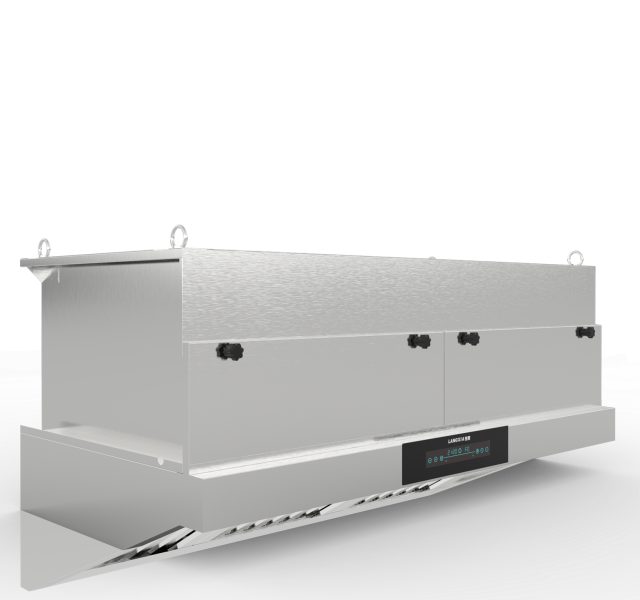
The N-series and ND-series lines are designed around this ventilation logic. Both are Ventless Hood systems in that they require no ductwork to outside; both integrate a pre-filter stage, a high-voltage two-stage Electrostatic Precipitator cell, and a downstream activated-carbon/HEPA-type polishing section. The N-series is rated for light-to-medium fume loads (think: pintxos bar, tortilla station, jamón cutting room, salad and cheese display), while the ND-series is rated for heavy continuous-duty loads (paelleros, churros fryer, brasería grill, asador de pollos). Both pair natively with the Odor Removal Tower for venues where Spanish-cured-meat aroma, smoked paprika, and oak-wood smoke would otherwise bleed into the dining room or the residential unit above.
Product-by-Product Application
N-series for the Pintxos Bar
The pintxos bar is the highest-traffic, lowest-per-cover cooking surface in a Spanish kitchen. It is also the surface that diners can see, smell, and judge in real time. The N-series sits above the barra as a slim, low-profile canopy that matches the visual language of the bar front. It captures the continuous low-grade fume from chorizo rendering, tortilla warming, and croquette holding while leaving the visual connection between cook and customer intact. For a typical 6 m barra with two cooks and twelve hot-plate inserts, two N-series units in a twin configuration will handle the duty cycle and keep the dining-room PM2.5 reading below 35 µg/m³ even at full Friday-night load.
ND-series for the Paella Range and Churros Fryer
The paelleros and the churros fryer are the two heavy-duty stations. The ND-series all-in-one is engineered for both, with a deeper ESP cell, higher capture velocity, and a self-cleaning cycle that runs automatically after each service. In a 220-cover Madrid asador with three paelleras running simultaneously and a twin churros fryer on the pass, two or three ND-series units in line provide the capture and recirculation capacity to keep the cooking line in compliance with RITE and CTE HS 3. The self-cleaning cycle on the ND-series is critical for churros service: the flour-dust loading on the ESP cell drops capture efficiency by 30–40 % within four hours of straight operation, and the automated wash-down at the end of service restores full performance before the next prep shift.
Odor Removal Tower for the Jamón Curing Cellar and the Brasa
Where the ND-series handles particulate and visible fume, the Odor Removal Tower handles the invisible. Jamón Ibérico de bellota aging rooms release a slow, persistent plume of low-concentration volatile fatty acids, ammonia, and microbial metabolites that no ESP cell can scrub because the molecules are not charged particulates — they are gases. The Odor Removal Tower‘s multi-stage carbon and chemisorbent bed is sized for exactly this profile, with residence time tuned to the 0.5–2 air changes per hour typical of a curing cellar. Pair one tower with the curing room’s air handler and the smell stops traveling into the dining room or the upstairs flat. The same tower, sized larger, handles the brasería — the oak-wood-fired grill that is the centrepiece of any serious asador — where smoked paprika, pimentón, and oak-wood volatiles would otherwise cling to diners’ clothing for the rest of the evening.
Cabinet Purifier for Compact Tapas Bars and Low-Ceiling Venues
Many of Spain’s most characterful tapas venues occupy basement or semi-basement units in 19th-century buildings: think the tabernas of Malasaña, the cervecerías of Triana, or the old sidrerías of Gijón. These spaces have ceiling heights under 2.4 m and floor areas under 80 m², both of which make a full-size Range Hood impractical. The Cabinet Purifier is the right product: a floor-standing or low-ceiling-mounted unit that integrates the same ESP cell and carbon stage as the N-series in a smaller cabinet, with a horizontal-discharge profile that fits below a 2.2 m clear height. For a 30-cover taberna with a single plancha, a churros mini-fryer, and a four-seat barra, one Cabinet Purifier + one N-series covers the entire cooking line.
Sizing a Spanish Kitchen: Configuration A, B, and C
Souniny engineers size Spanish-kitchen installations using a three-configuration matrix that has been validated across more than forty Iberian and Latin American deployments.
Configuration A — Ductless full line. The dominant case for heritage, mid-terrace, and basement venues. One or more N-series over the pintxos bar, one or two ND-series over the paelleros and churros line, one Odor Removal Tower on the curing cellar or brasería, and a Cabinet Purifier in the prep/cleaning room. No ductwork, no make-up air, no RITE-driven chiller upgrade. This is the configuration we recommend for the majority of bars and small restaurants up to 120 covers.
Configuration B — Hybrid: ductless for cooking, ducted for very heavy continuous duty. For 150–250 cover asadores with multiple oak-fired brasas and a 24/7 churros operation, the heaviest continuous-duty stations (the brasas and the churros line) can be ducted through a fire-rated shaft, while the pintxos bar, tortilla station, and prep line run on the ductless N-series. This configuration reduces the number of ND-series units needed by reusing the building’s existing high-temperature exhaust riser. It also gives the fire inspector the traditional ducted termination they expect to see for high-BTU gas appliances.
Configuration C — Ducted heavy + ductless light. The largest venues — 250+ cover hotel restaurants, casino-integrated asadores, convention-centre banquet halls with Spanish-themed stations, and cruise-ship galleys with Iberian menus — combine a central ducted riser for the heavy paelleros, churros line, and brasas, with the Cabinet Purifier and N-series handling the satellite pintxos bars, jamón display, and live-cooking stations distributed across the dining room. This is the configuration most often seen in new-build Spanish-themed hotel properties and in franchise rollouts across Latin America.
Spanish Diaspora Venues: From Barcelona to Buenos Aires, from Bilbao to Brooklyn
Spanish and Basque cooking has become one of the most globalised European cuisines of the past two decades, and the diaspora has its own ventilation logic. In Barcelona‘s El Born and Gràcia neighbourhoods, the heritage-zone rules and the small-unit sizes push every new opening toward Configuration A; a typical 50-cover bodevilla in El Born runs on one ND-series, one N-series, and one Odor Removal Tower. In Madrid‘s Malasaña, La Latina, and Chueca, larger 100–200 cover casa de comidas and asadores often run a hybrid Configuration B with ducted brasas and ductless pintxos bars. In San Sebastián‘s Parte Vieja, where the entire old town is one continuous pintxos crawl, the basement sagardotegi cider houses with their charcoal-grilled txuletón need the ND-series + Odor Removal Tower pair to keep the smoky tamarind-and-oak aroma from saturating the upstairs residential floors.
Across the Atlantic, the diaspora tells a different story. Buenos Aires San Telmo, Monserrat, and Palermo neighbourhoods host some of the densest concentrations of Spanish-descended restaurants outside Spain, and the Argentine preference for very long asado services (often five to seven hours on Sundays) means the ND-series with its self-cleaning cycle is the workhorse product. New York‘s East Harlem St. Marks, the Lower East Side, and the new Spanish enclaves around Hudson Yards have moved decisively to ductless Configuration A for any venue under 150 covers, because the New York City Department of Buildings’ make-up air and ducted-exhaust rules for commercial cooking in mixed-use buildings (1 RCNY §25-03, 28-103, NYC Mechanical Code Chapter 5) are expensive to satisfy and a ductless Range Hood with an Electrostatic Precipitator + Odor Removal Tower bypasses the most contentious items. Mexico City‘s Condesa and Roma Norte, Manila‘s Poblacion and BGC (where the Spanish colonial legacy runs through Filipino-Spanish fusion), and Lisbon‘s Bairro Alto (where Portuguese-Spanish crossover menus are common) all show the same pattern: Configuration A dominates venues under 120 covers; Configuration B picks up at 150+ covers in heritage or mixed-use buildings.
Installation, Commissioning, and Maintenance Considerations
The ductless all-in-one architecture is faster to install than a ducted system, but the commissioning is more rigorous because the cleaned-air performance depends on ESP cell alignment, carbon-stage saturation tracking, and recirculation airflow balance. A typical 100-cover Spanish venue with one ND-series and two N-series units is on site for two to three days for installation and one full day for commissioning. The commissioning includes: capture-velocity verification at every cooking station using a hot-wire anemometer per EN 16282-1, ESP cell voltage and current verification at low and full fire, PM2.5 baseline measurement in the dining room with all units on idle, PM2.5 measurement under full-service simulation, and a 30-minute odour-persistence test using a sensory panel per EN 16282-9. Souniny’s commissioning team delivers the report in Spanish, English, or Portuguese as the project requires, and the same data set is what a Spanish local-authority (or a U.S. health-department) inspector will ask for in a pre-opening walk-through.
Maintenance follows a tight but predictable rhythm. The ND-series ESP cell auto-cleans on a programmed schedule (typically every 8–12 hours of heavy use); the operator tops up the wash reservoir and replaces the carbon pre-filter every 4–6 weeks. The N-series cells are manually cleaned weekly in a dishwasher-safe cassette, with a visual voltage check by the operator. The Odor Removal Tower carbon bed has a 12–18 month service life in a typical tapas-bar duty cycle, with a differential-pressure gauge signalling the swap. Souniny’s optional service contract covers the quarterly deep service, the carbon swap, and the annual re-certification that many Spanish municipalities now require for high-volume venues.
If you are converting a heritage Spanish venue from a ducted canopy to a ductless all-in-one system, plan one extra day for the canopy removal, the make-up-air grille blank-off, and the post-conversion air-balance re-test. The result is typically a 30–45 % reduction in HVAC energy use and the elimination of every recurring duct-cleaning contract.
Spanish and Basque kitchens are not just another Mediterranean cooking line. They are a multi-station, multi-pollutant, multi-intensity environment that has outgrown the ducted-baffle paradigm. The ductless all-in-one architecture built around the N-series, ND-series, Odor Removal Tower, and Cabinet Purifier is the most direct path to clean air, regulatory compliance, and a better dining-room experience — whether the venue is a 24-cover barra in Bilbao’s Casco Viejo or a 220-cover asador in Madrid’s Malasaña. For a sizing consultation, a Configuration A / B / C recommendation, or a commissioning plan for a specific Spanish-themed hospitality project, contact the Souniny engineering team at info@souniny.com or via WhatsApp at +86 189 2910 1713.